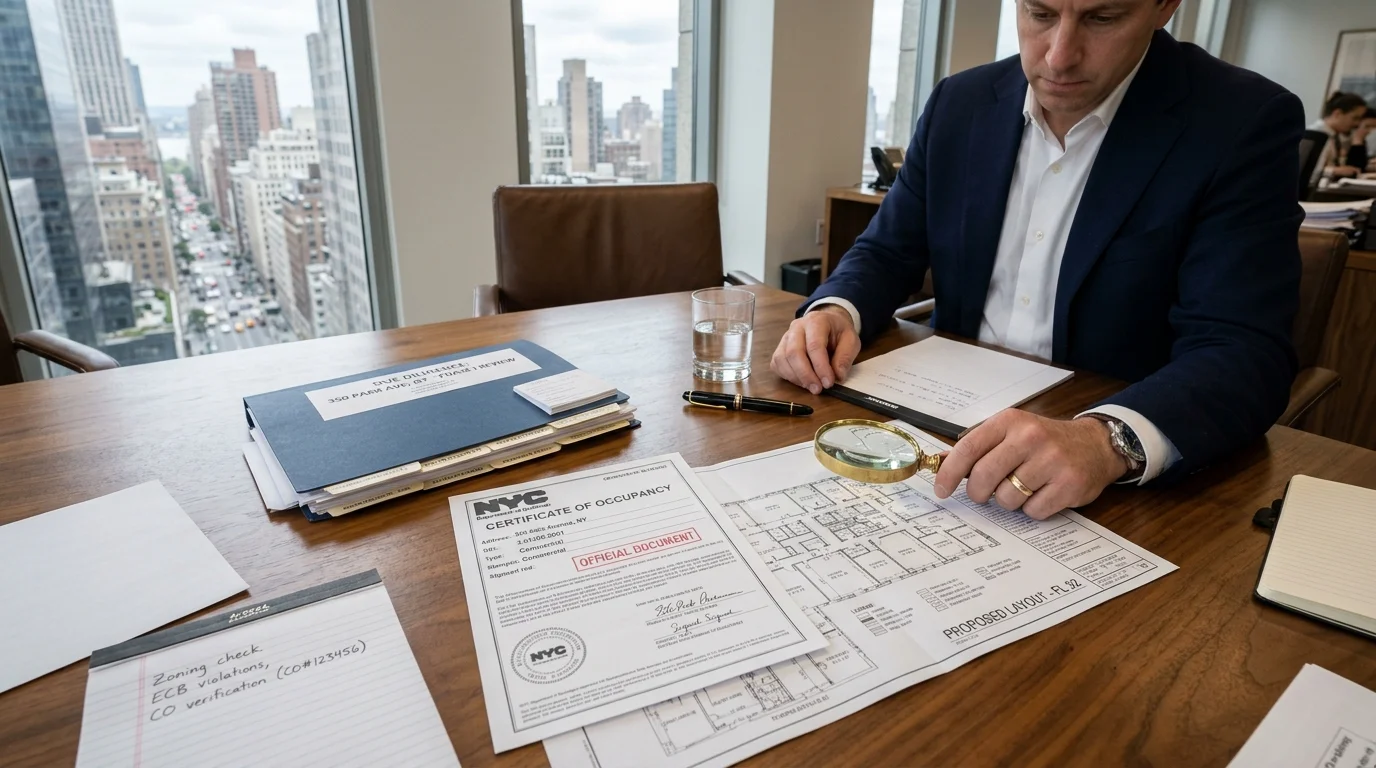
Understand what a Temporary Certificate of Occupancy (TCO) means, when a building can receive one, how long it remains valid, and what property owners must do to renew it or obtain a final Certificate of Occupancy.
Introduction: Understanding a Temporary Certificate of Occupancy
Completing a construction or renovation project does not always mean a building is immediately ready to receive its final Certificate of Occupancy (CO).
Sometimes, a property is substantially complete and considered safe for occupants, but certain inspections, documentation, or construction items are still outstanding.
In these situations, the local building department may issue a Temporary Certificate of Occupancy (TCO).
A TCO allows a building or a specific portion of it to be occupied temporarily while the owner completes the remaining requirements for final approval.
However, a temporary certificate comes with conditions and an expiration date. Property owners must understand how long it remains valid, whether it can be renewed, and what happens when it expires.
One common question is whether a Temporary Certificate of Occupancy always lasts 90 days.
The answer is no. The validity period depends on the jurisdiction issuing it. For example, New York City generally issues TCOs for 90 days, while Miami-Dade County also specifies a 90-day period. Carlsbad, California, allows a period of up to 180 days under its local building code.
In this guide, we explain what a temporary Certificate of Occupancy is, how the process works, what requirements owners must satisfy, and how to transition from a temporary certificate to a final approval.
1. What Is a Temporary Certificate of Occupancy (TCO)?
A Temporary Certificate of Occupancy is an official document issued by a local building department or authorized building official allowing a building or a designated portion of it to be occupied before all permitted construction work and final approval requirements have been completed.
It is generally issued when the building is considered safe for its intended temporary occupancy, but certain outstanding items prevent the issuance of a permanent Certificate of Occupancy.
These outstanding items may include:
- Final construction inspections.
- Remaining plumbing approvals.
- Electrical inspection sign-offs.
- Elevator approvals, where applicable.
- Final surveys and documentation.
- Completion of approved construction work.
- Other agency approvals.
A TCO establishes that the permitted space can be occupied under the specific conditions and limitations identified by the issuing authority.
1.1 Why Is a Temporary Certificate of Occupancy Issued?
Construction projects can involve several inspection stages and approvals from different authorities.
Waiting for every administrative and noncritical construction item to be completed may delay occupancy even when the designated area is safe to use.
A TCO provides a temporary solution where the building official determines that the applicable safety requirements have been met.
For example, consider a newly constructed commercial office building where:
- The main construction work is substantially completed.
- Fire and life-safety requirements have been approved.
- Electrical and plumbing systems have received the necessary sign-offs.
- Certain exterior finishing work remains incomplete.
- Final documentation is still being processed.
Depending on the applicable code and the building official's determination, the completed office floors may be eligible for temporary occupancy while the remaining work is finished.
1.2 Does a TCO Mean the Entire Building Is Approved?
Not necessarily.
A temporary Certificate of Occupancy may apply to:
- An entire building.
- Specific floors.
- Individual commercial units.
- A designated residential area.
- A particular permitted use or occupancy.
The certificate identifies what areas and uses are authorized.
Owners and tenants should review the actual certificate rather than assuming that approval for one portion automatically covers the entire property.
2. How Long Does a Temporary Certificate of Occupancy Last?
There is no universal expiration period for Temporary Certificates of Occupancy across the United States.
Under the International Building Code's (IBC) temporary occupancy provision, the building official is authorized to issue a TCO when the applicable portion of the building can be occupied safely. The official establishes the period for which the certificate remains valid.
The actual period depends on local building codes, municipal regulations, the scope of remaining work, and approval conditions.
2.1 Typical TCO Validity Periods
The following examples illustrate how requirements differ between jurisdictions:
| Jurisdiction | TCO Validity Period | Renewal or Extension Policy |
|---|---|---|
| New York City (NYC DOB) | Typically 90 days | Renewal may be requested through DOB NOW: Build; subject to review of unresolved items. |
| Miami-Dade County, Florida | 90 days | Extensions may be requested subject to trade and Fire Department approvals. |
| Carlsbad, California | Maximum 180 days | Additional certificates may be issued when approved by the building official. |
| Other IBC-Based Jurisdictions | Set by local building official | Determined case-by-case based on adopted municipal building codes. |
These examples should not be interpreted as a nationwide standard.
2.2 New York City TCO Validity
In New York City, the Department of Buildings (DOB) generally issues Temporary Certificates of Occupancy that expire 90 days after issuance.
If outstanding issues required for the final Certificate of Occupancy remain unresolved, the property owner may request renewal.
However, renewal is not automatic. The owner must continue working toward resolving the outstanding requirements and follow the DOB's renewal process.
The NYC Department of Buildings recommends consulting a New York State licensed Professional Engineer (PE) or Registered Architect (RA) to identify what remains necessary for obtaining a final CO.
2.3 Miami-Dade County TCO Validity
Miami-Dade County specifies a 90-day validity period for Temporary Certificates of Occupancy and Temporary Certificates of Completion.
Extensions may be requested.
The county requires the necessary trade and Fire Department approvals for TCO extensions.
2.4 Carlsbad, California TCO Validity
Carlsbad has a different local approach.
Under its amended building code, a Temporary Certificate of Occupancy cannot exceed 180 days.
Additional temporary certificates may be issued when the building official approves the application.
This example demonstrates why owners should never assume that a 90-day validity period applies to every property in the country.
3. What Is the Difference Between a Temporary Certificate of Occupancy and a Final Certificate of Occupancy?
Understanding the difference between these two documents is essential for property owners, construction professionals, and tenants.
A Temporary Certificate of Occupancy provides limited, time-bound authorization to occupy an approved space.
A final Certificate of Occupancy confirms that the completed building or approved work satisfies the applicable requirements for its designated use and occupancy.
| Comparison Feature | Temporary Certificate of Occupancy (TCO) | Final Certificate of Occupancy (CO) |
|---|---|---|
| Main Purpose | Allows temporary occupancy while work finishes | Confirms final approved occupancy and building compliance |
| Validity Term | Limited period (typically 90 to 180 days) | Generally permanent (no expiration date under normal use) |
| Construction Status | Certain permitted noncritical work may remain incomplete | All permitted construction work and scope completed |
| Inspection Status | Core life-safety and required conditions satisfied | All required final inspections and sign-offs completed |
| Outstanding Items | Administrative, trade, or finishing items may remain | All objections and open requirements resolved |
| Renewal Obligation | Periodic renewal required until final CO is issued | Normally no renewal required unless occupancy changes |
| Occupancy Scope | Strictly limited to areas and conditions on certificate | Based on permanent approved use, egress, and occupancy |
| Long-Term Authorization | No (interim authorization only) | Yes (statutory permanent authority) |
In New York City, a final CO has no expiration date. However, changes to building use, egress, or occupancy may require a new or amended certificate.
3.1 Can a Property Be Occupied Without a Final CO?
In jurisdictions requiring a Certificate of Occupancy, occupancy generally requires the final CO or an authorized temporary alternative.
In New York City, the Department of Buildings states that a building cannot legally be occupied until a Certificate of Occupancy or Temporary Certificate of Occupancy has been issued.
A property owner should never assume that completing construction or passing an individual inspection automatically grants permission to occupy the building.
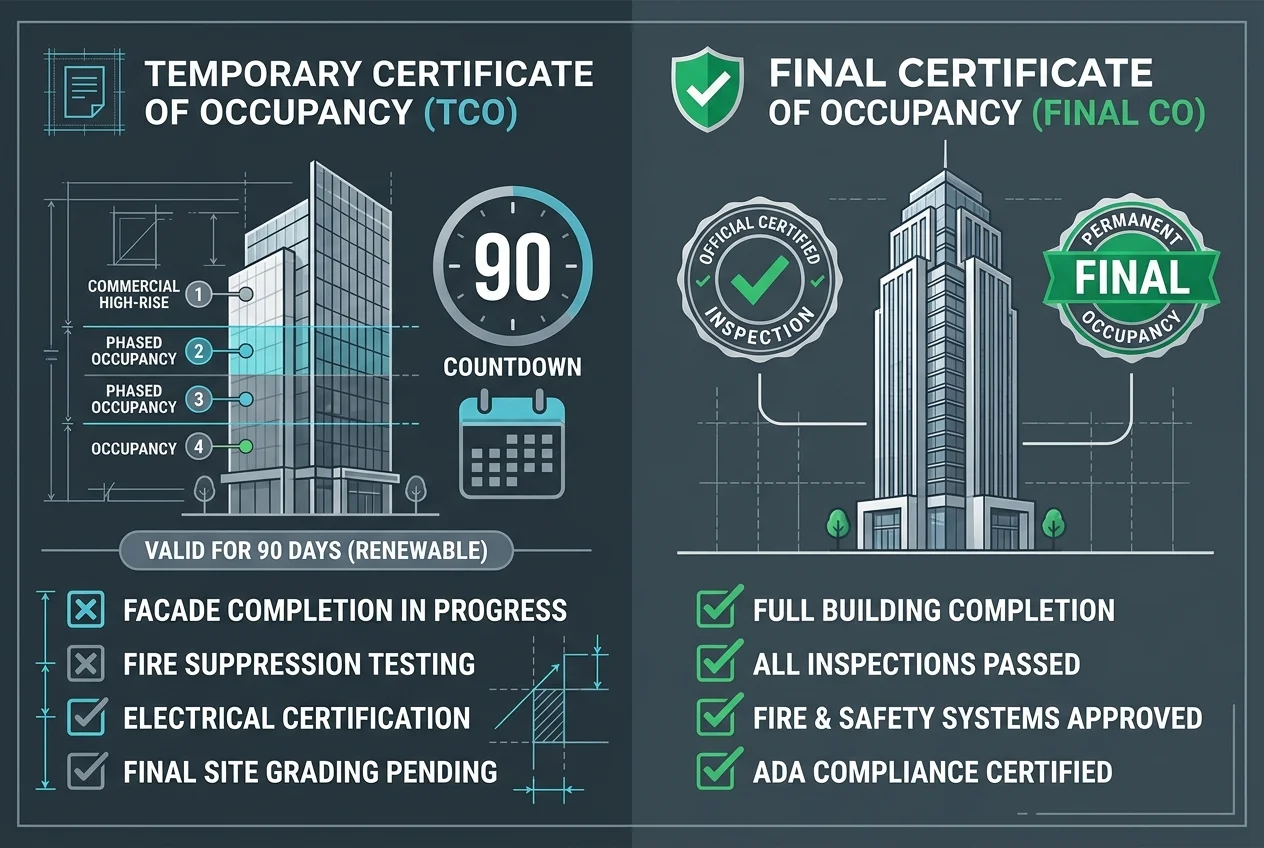 Technical comparison matrix illustrating the legal differences, expiration timelines, and inspection criteria between a Temporary CO and a Final Certificate of Occupancy.
4. What Are the Requirements for Obtaining a Temporary Certificate of Occupancy?
The requirements differ by jurisdiction, but the common principle is that the building or designated area must be safe for its intended occupancy.
The issuing building department evaluates the completed work, remaining construction activities, outstanding approvals, and any restrictions needed to protect occupants.
4.1 Construction Inspection Approval
The building official may require construction inspections to confirm that the completed work is consistent with approved plans and applicable building codes. Depending on the project, this may include:
- Structural integrity and load-bearing framing.
- Fire-rated walls, assemblies, and barriers.
- Stairways, railings, and egress routes.
- Corridors and primary access pathways.
- Accessibility compliance under ADA and local building codes.
- Emergency lighting and exit signage systems.
4.2 Plumbing and Electrical Approvals
Plumbing and electrical inspections may be required before temporary occupancy is granted. The building department may review:
- Potable water supply and active drainage systems.
- Electrical distribution switchgear and breaker panels.
- Wiring integrity and equipment grounding.
- Emergency electrical systems and backup power circuits.
- Operational plumbing fixtures in occupied zones.
- Required licensed trade inspection sign-offs.
4.3 Fire and Life-Safety Approvals
Fire and life-safety requirements are critical when determining whether a building can be occupied. Relevant approvals include:
- Operational fire alarm panels and certified signaling devices.
- Automatic fire sprinkler systems and standpipes.
- Unobstructed emergency exits and panic hardware.
- Self-closing fire doors and rated damper assemblies.
- Illuminated exit signs and directional egress markers.
- Clear emergency vehicle access routes.
- Fire department operational approvals, where required.
Temporary occupancy should never be used as a way to bypass required life-safety measures.
4.4 Elevator and Accessibility Approvals
For multistory commercial properties, temporary elevator operating permits must be secured before opening upper floors to occupants. The building department also verifies barrier-free entrances, ADA-compliant restrooms, and accessible paths of travel within the permitted areas.
4.5 Approved Schedule of Occupancy
In New York City, an approved Schedule of Occupancy in DOB NOW: Build is among the mandatory TCO requirements. It identifies the permitted occupancy classifications, maximum allowable live loads, and floor-by-floor space arrangements. Owners must ensure that the requested occupancy matches approved construction filings exactly.
5. How to Apply for a Temporary Certificate of Occupancy
Applying for a TCO generally involves preparing documentation, passing necessary safety inspections, and submitting formal applications through municipal portals. The standard workflow follows six key steps:
Step 1: Review Approved Construction Plans
Review the permitted drawings and compare them against completed on-site construction. Identify remaining punch-list items, incomplete tenant work, or exterior scope that prevents immediate final CO sign-off.
Step 2: Complete Required Safety Inspections
Arrange mandatory trade inspections across construction, plumbing, electrical, fire protection, and elevators. Building inspectors must verify that the designated zones can be occupied without danger to life or health.
Step 3: Prepare Supporting Documentation
Compile all project records required by the authority having jurisdiction (AHJ), including:
- Approved architectural and engineering drawings.
- Active building, plumbing, and electrical permits.
- Special inspection sign-off logs and lab reports (TR-1 in NYC).
- Fire alarm and sprinkler acceptance test certificates.
- Temporary elevator inspection certificates.
- Approved Schedule of Occupancy.
- Punch list of remaining noncritical construction items.
- Application forms and required municipal filing fees.
Step 4: Submit the TCO Application
Submit the formal Certificate of Occupancy Request. In New York City, filings are submitted electronically through DOB NOW: Build for modern job filings, or through the borough office for legacy BIS applications.
Step 5: Address Department Plan Examiner Reviews
Building department examiners review submitted inspection reports and documentation. They may issue plan objections, request clarifying affidavits from the registered architect or professional engineer, or require supplemental field verifications.
Step 6: Receive TCO and Enforce Specific Conditions
Once approved, carefully review the issued certificate for:
- Specifically approved floors, suites, or square footage.
- Permitted occupancy classification (e.g., Business B, Mercantile M).
- Maximum permissible occupant load.
- Effective start date and exact 90-day expiration date.
- List of outstanding construction obligations.
- Special operational or safety restrictions.
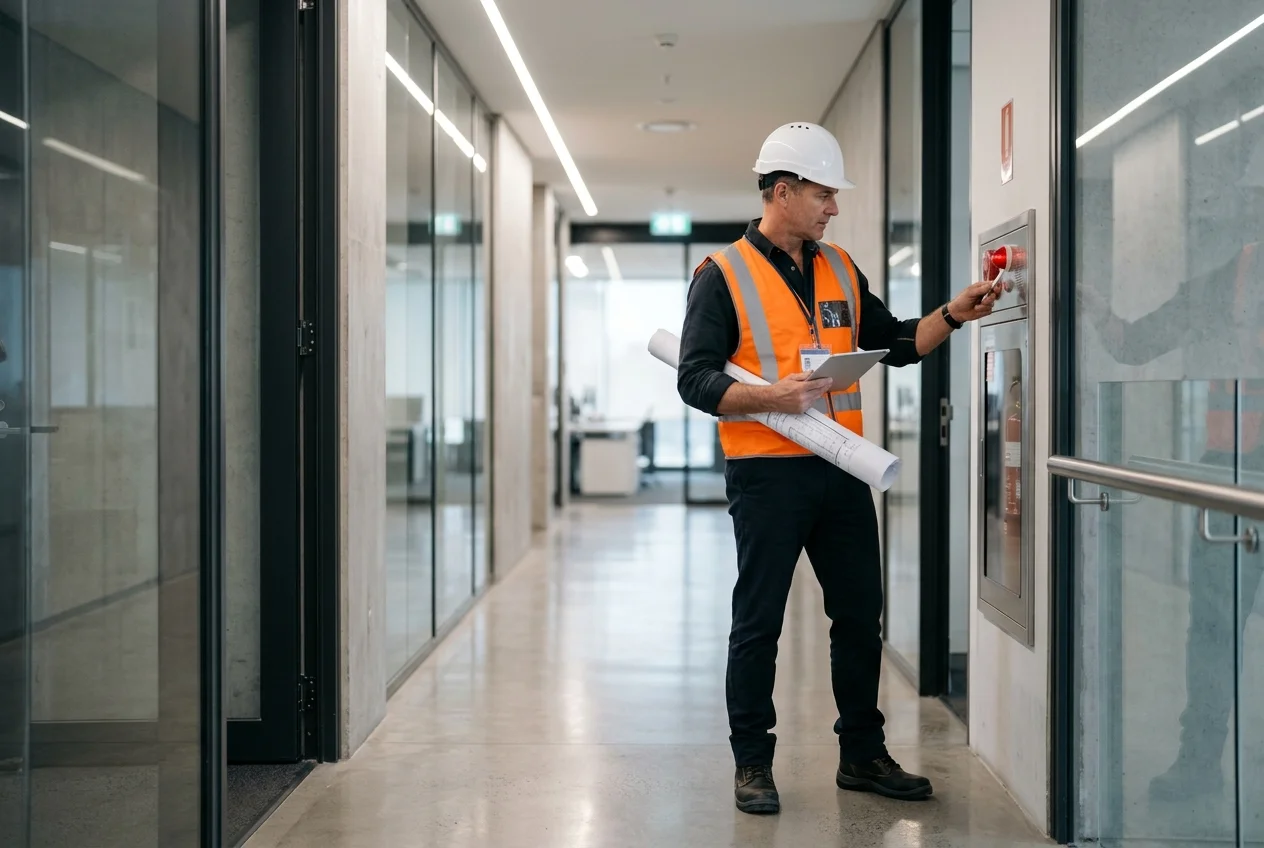 Building department inspectors conduct detailed life-safety, egress, and electrical verifications before approving temporary occupancy authorization.
6. Can a Temporary Certificate of Occupancy Be Renewed?
Yes. Many jurisdictions allow TCO renewal or extension, provided the owner demonstrates continuous progress toward final building approval.
However, an extension should never be assumed to be automatic.
The issuing authority reviews whether construction progress is being maintained, life-safety systems remain certified, and outstanding objections are being systematically resolved.
6.1 NYC Temporary Certificate of Occupancy Renewal
In New York City, a TCO typically expires after 90 days. The DOB permits renewal applications when remaining requirements prevent final CO sign-off. The recommended procedure includes:
- Review the current TCO and itemize all open requirements.
- Consult the project's licensed Professional Engineer (PE) or Registered Architect (RA).
- Complete ongoing trade inspections and document completed work.
- Prepare updated special inspection reports and trade sign-offs.
- Submit the renewal request through DOB NOW: Build at least 30 days before expiration.
- Pay required municipal renewal fees and resolve any examiner objections.
6.2 What Can Delay TCO Renewal?
Common obstacles that stall TCO extensions include:
- Unresolved DOB or Environmental Control Board (ECB) violations.
- Expired general contractor insurance or active job permits.
- Missing elevator annual inspection or load test sign-offs.
- Changes between approved plans and field conditions without an amended filing.
- Lapsed fire alarm central office monitoring contracts.
- Unpaid municipal civil penalties or outstanding filing fees.
7. What Happens When a Temporary Certificate of Occupancy Expires?
An expired TCO creates an immediate legal and regulatory compliance exposure. Once the certificate reaches its expiration date, original occupancy authorization terminates automatically under the law.
7.1 Potential Consequences of an Expired TCO
Allowing a TCO to lapse without securing an extension or a final CO can lead to significant operational disruptions:
- Occupancy Violations: Continued physical occupancy becomes unauthorized, exposing owners to Class 1 or Class 2 DOB violations and daily civil penalties.
- Vacate Orders: If life-safety questions arise, the building commissioner may issue a partial or full Vacate Order, forcing businesses to halt operations.
- Lease Breaches & Rent Withholding: Commercial and residential tenants may have contractual rights to withhold rent or terminate leases if the landlord fails to maintain legal occupancy.
- Insurance Voidance: Property and casualty insurers may question coverage for casualty, water damage, or slip-and-fall claims occurring in uncertified premises.
- Lender Defaults: Commercial mortgages and construction loans routinely contain covenants requiring active, unexpired occupancy permits, triggering potential technical loan default.
7.2 Does an Expired TCO Automatically Make a Building Unsafe?
No. An expired certificate does not, by itself, establish that the building has become physically hazardous.
In testimony before the New York City Council, the NYC Department of Buildings clarified that an expired TCO is primarily an administrative compliance failure rather than proof of structural or fire danger.
However, this administrative distinction provides no defense against municipal enforcement. Building owners must proactively file renewal paperwork well before the expiration deadline arrives.
8. How to Convert a Temporary Certificate of Occupancy Into a Final CO
A TCO is designed to serve as a transitional bridge, not a permanent status. Achieving a final Certificate of Occupancy requires systematic completion of five core milestones:
8.1 Complete Outstanding Construction Work
Finish all exterior facade detailing, site landscaping, permanent signage, accessibility ramps, and noncritical interior spaces that were excluded from the temporary occupancy scope.
8.2 Obtain Final Inspection Sign-Offs
Secure official sign-offs across all permitted disciplines:
- Final Construction sign-off (Directive 14 or DOB inspection).
- Final Plumbing sign-off and gas piping authorization (Local Law 152 compliance).
- Electrical final certificate from the Bureau of Electrical Control (BEC).
- Elevator Division permanent operating certificates.
- Fire Department (FDNY) range hood, sprinkler, and alarm sign-offs.
- Final architectural survey and property boundary certification.
8.3 Resolve Outstanding Violations and Objections
Audit DOB and ECB records to confirm that all historical notices of violation, stop-work orders, and audit objections are formally dismissed with Certificates of Correction on file.
8.4 Submit the Final CO Request
Submit the permanent Certificate of Occupancy request through DOB NOW: Build. The Borough Commissioner's office reviews the complete project history, ensuring every required affidavit and permit has closed out cleanly.
8.5 Verify the Final Certificate
Once issued, download the permanent Certificate of Occupancy. Confirm that building address, tax lot numbers, allowable occupant loads, building zoning classifications, and floor-by-floor uses match building operations exactly.
9. Temporary Certificate of Occupancy vs. Partial and Interim Certificates
Building owners frequently encounter different categories of occupancy documents during complex construction phasing. Understanding their legal definitions prevents costly project misunderstandings:
| Document Type | Primary Statutory Purpose | Typical Duration |
|---|---|---|
| Temporary Certificate of Occupancy (TCO) | Authorizes occupancy of space while noncritical work finishes | 90 to 180 days (renewable) |
| Final Certificate of Occupancy (CO) | Certifies permanent legal compliance for entire approved building | Permanent (no expiration) |
| Partial Certificate of Occupancy | Authorizes distinct, segregated portions while other phases continue | Varies by jurisdiction and scope |
| Interim Certificate of Occupancy (NYC) | Statutory authorization for completed floors in qualifying high-rises | Defined under NYC Admin Code § 28-118.15.1 |
| Certificate of Completion (CC) | Documents completed work for non-occupiable alterations | Permanent record of permitted scope |
9.1 What Is a Partial Certificate of Occupancy?
A Partial Certificate of Occupancy authorizes a specific portion of a building to open while major construction continues in adjacent areas. For example, a developer may open street-level retail stores while upper residential towers undergo interior rough-ins. The authority requires independent egress, fire separation, and life-safety systems for the occupied zones.
9.2 What Is an Interim Certificate of Occupancy in NYC?
New York City established a distinct statutory framework for Interim Certificates of Occupancy under NYC Administrative Code § 28-118.15.1. This mechanism allows qualifying multi-story buildings of noncombustible construction with full sprinkler protection to permanently certify specific completed floors before the entire skyscraper finishes construction.
10. What Should Property Owners, Buyers, and Tenants Check Before Occupancy?
Before closing on a commercial purchase, signing a long-term lease, or taking occupancy under a TCO, parties should perform rigorous due diligence:
- Verify Current Expiration Dates: Confirm that the certificate is currently active and not within days of expiring. Check whether a timely renewal filing is already submitted.
- Confirm Approved Use Classification: Ensure the permitted use on the TCO aligns with intended business operations. A certificate authorizing retail storage does not authorize assembly or public dining.
- Audit Remaining Construction Scope: Request written disclosure of open punch-list items, remaining trade inspections, and developer timelines for securing the final CO.
- Check Official Municipal Databases: In NYC, verify records through DOB NOW: Build and the Buildings Information System (BIS) to verify that open violations, stop-work orders, or tax liens will not block future renewals.
A Temporary Certificate of Occupancy is an invaluable mechanism that generates tenant revenue and operational cash flow during final construction close-out. However, managing a TCO requires disciplined compliance tracking. Treating a TCO as an interim milestone rather than a permanent solution protects property owners against costly renewals, tenant disputes, and severe municipal fines.
Need Help Obtaining or Renewing a Temporary Certificate of Occupancy?
Navigating building department approvals, DOB NOW filings, inspections, and outstanding construction requirements can make the occupancy approval process complicated. Whether you are completing a commercial construction project, renovating an existing property, or preparing to transition from a temporary certificate to a final Certificate of Occupancy, understanding the applicable requirements is essential.