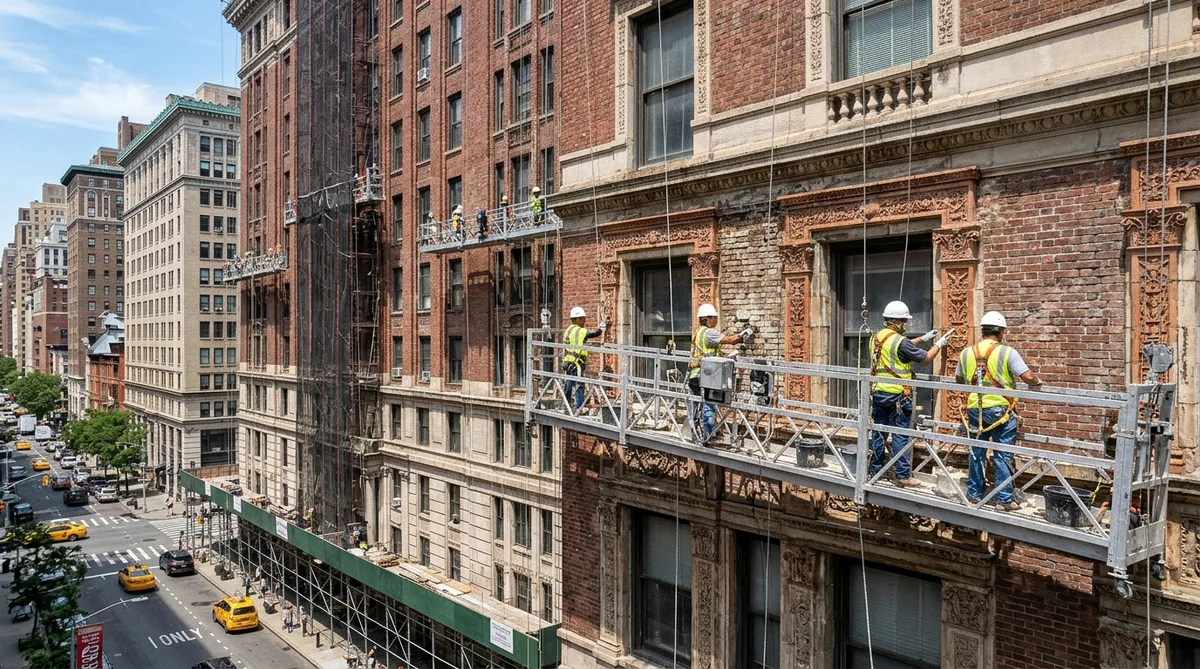
Introduction: What Should a NYC Building Budget for Local Law 11 Repairs?
A deteriorating building facade can become an expensive problem, particularly when a NYC Department of Buildings (DOB) inspection identifies conditions requiring repair under the Facade Inspection & Safety Program (FISP / Local Law 11 of 1998). In New York City, all buildings taller than six stories are legally mandated to undergo a comprehensive facade inspection by a registered Qualified Exterior Wall Inspector (QEWI) once every five years.
Facade repairs across Manhattan, Brooklyn, and the outer boroughs can range from modest maintenance expenditures of $50,000 to $120,000 for localized brick repointing up to complex historic restorations exceeding $1,500,000 to $4,000,000. When co-op boards, condo managers, and commercial real estate asset owners receive an engineering report categorizing their building exterior as SWARMP or Unsafe, the immediate question is: what will this actually cost to fix?
The single greatest determinant of cost is not merely building height or square footage—it is the envelope material composition. The architectural heritage of New York City relies heavily on three primary facade materials:
- Brick Masonry: The workhorse of NYC residential architecture, requiring mortar joint raking, repointing, lintel stabilization, and occasional cavity wall rebuilding.
- Architectural Terra Cotta: Ornate, hollow-core glazed ceramic units popular in pre-war construction that suffer from internal freeze-thaw cycles, anchor corrosion, and spalling.
- Natural Stone: Limestone, brownstone, sandstone, and granite detailing subject to surface exfoliation, delamination, and severe anchorage failure.
Each material demands specialized artisan tradecraft, distinct restoration methodologies, custom fabrication lead times, and rigorous DOB permitting. Understanding typical unit pricing and ancillary access costs allows property owners to prepare realistic capital expenditure budgets and avoid financially devastating surprise assessments.
FISP Cycle 9 & Cycle 10 Rule Tightening:
Under DOB 1 RCNY §103-04 updates, Qualified Exterior Wall Inspectors must perform close-up hands-on inspections every 60 feet along street facades using suspended scaffolding or industrial rope access, complete with structural cavity wall probe openings. Conditions previously classified as SWARMP that were not repaired within the mandated timeframe must automatically be reclassified as Unsafe, immediately triggering sidewalk bridge mandates and severe monthly penalties.
1. Understanding Local Law 11 (FISP) Repair Classifications
Before analyzing material repair costs, building executives must understand how the Department of Buildings classifies exterior conditions. The QEWI must file one of three official classifications in the DOB NOW: Safety portal:
| DOB Classification | Definition & Structural Risk | Required Actions & Timelines | Budgetary Urgency |
|---|---|---|---|
| Safe | Facade has no defective conditions that threaten pedestrian life-safety; requires only normal preventative maintenance. | File compliance report; maintain building envelope until next 5-year cycle. | Low: Routine preventative maintenance ($10k–$30k every few years). |
| SWARMP (Safe With a Repair & Maintenance Program) |
Conditions currently safe but exhibiting early deterioration (e.g., hairline mortar cracks, minor stone spalling) that will become unsafe before next cycle if unaddressed. | QEWI specifies an exact repair deadline (often 12–36 months). Must be corrected before next filing cycle or automatically converts to Unsafe. | Moderate to High: Capital planning required; competitive contractor bidding encouraged. |
| Unsafe | Active hazard to public safety (loose ornamental stone, displaced brick bulging, loose terra cotta cornices, failing balcony railings). | Immediate: Install sidewalk shedding within 24 hours. File FISP1 Unsafe report. Complete repairs and file amended report within 90 days (extensions permitted with active permits). | Critical: Immediate emergency mobilization, sidewalk shed monthly rental, accelerated repair contracts. |
When an Unsafe classification is filed, the City mandates sidewalk bridge installation. If structural repairs stall due to board indecision or contractor delays, sidewalk shed rental fees alone can easily drain $10,000 to $25,000 per month, costing more over two years than the actual physical masonry repair itself!
2. Typical Price Ranges for Brick Masonry Repairs
Brick is the most common exterior material across New York's multifamily and commercial building stock. While brick is structurally durable, the mortar joints between bricks and the structural steel shelf angles supporting them deteriorate constantly under freeze-thaw cycles and driving Atlantic rain.
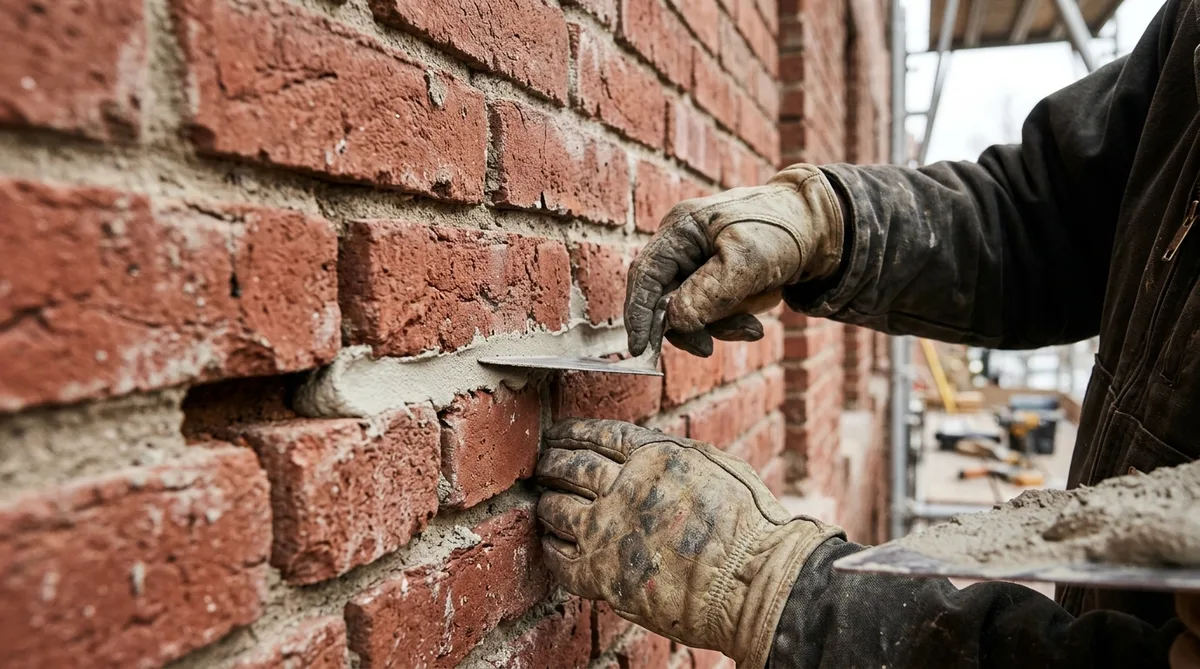 Masonry repointing requires mechanical raking of decayed mortar joints to a minimum depth of 3/4-inch, followed by thorough dust removal and multi-pass tooling with compatible lime mortar.
Key Brick Facade Repair Categories:
- Brick Repointing (Tuckpointing): Raking out deteriorated mortar joints to a depth of 1/2" to 3/4" and tooling fresh mortar. In NYC, standard repointing ranges from $18 to $35 per square foot. Historic properties requiring hand-chiseled joint preparation or custom hydraulic lime blends command $35 to $60 per square foot.
- Brick Replacement & Bulging Masonry Rebuilding: Water infiltration behind the outer wythe causes rusted wall ties and freeze-thaw expansion, pushing brick outward in visible bulges. Removing damaged brick, stabilizing the backup masonry, installing stainless-steel helical anchors, and rebuilding outer wythe brick costs $85 to $150 per square foot (or $25 to $45 per individual replacement brick for spot repairs).
- Steel Lintel & Shelf Angle Restoration: Structural steel lintels spanning window and door heads expand up to ten times their original volume when oxidized ("rust jacking"), cracking adjacent masonry. Scraping, wire-brushing, priming, flashing, and sealing existing steel costs $120 to $220 per linear foot. Complete steel lintel removal and structural replacement with galvanized or stainless steel ranges from $350 to $650 per linear foot.
- Helical Wall Tie Stabilization: Anchoring detached veneer wythes back to concrete or terra cotta back-up walls without dismantling the facade costs $45 to $85 per installed tie.
- Parapet Rebuilding: Roof parapet walls absorb weather from both sides. Fully demolishing and rebuilding an unreinforced or structurally compromised brick parapet wall costs $400 to $850 per linear foot including structural tiebacks, through-wall flashing, and stone coping stones.
| Brick Masonry Scope of Work | Standard Cost Range (NYC) | High-End / Historic Landmark Cost | Key Cost Drivers |
|---|---|---|---|
| Mortar Repointing (General) | $18 – $35 / sq ft | $35 – $60 / sq ft | Joint depth, lime vs Portland mix, dust collection regulations. |
| Spot Brick Replacement (10–50 bricks) | $25 – $45 / brick | $50 – $95 / brick | Salvaged antique brick sourcing, custom color matching. |
| Veneer Brick Rebuilding (Bulged wythe) | $85 – $140 / sq ft | $140 – $220 / sq ft | Temporary shoring, backup wall condition, tieback density. |
| Window Steel Lintel Scrape & Paint | $120 – $220 / linear ft | $250 – $380 / linear ft | Lead abatement protocols, flashing membrane installation. |
| Structural Lintel Full Replacement | $350 – $650 / linear ft | $700 – $1,200 / linear ft | Interior apartment disruption, structural needle beaming. |
| Roof Parapet Complete Reconstruction | $400 – $750 / linear ft | $750 – $1,200 / linear ft | Counterflashing, stone coping replacement, roof tie-in. |
3. Architectural Terra Cotta Restoration Costs
Architectural terra cotta was widely celebrated between 1890 and 1935 for its ability to mimic carved stone at lower initial production costs while displaying spectacular glazed polychrome finishes. However, on today's NYC repair market, terra cotta is often the single most expensive facade material to restore.
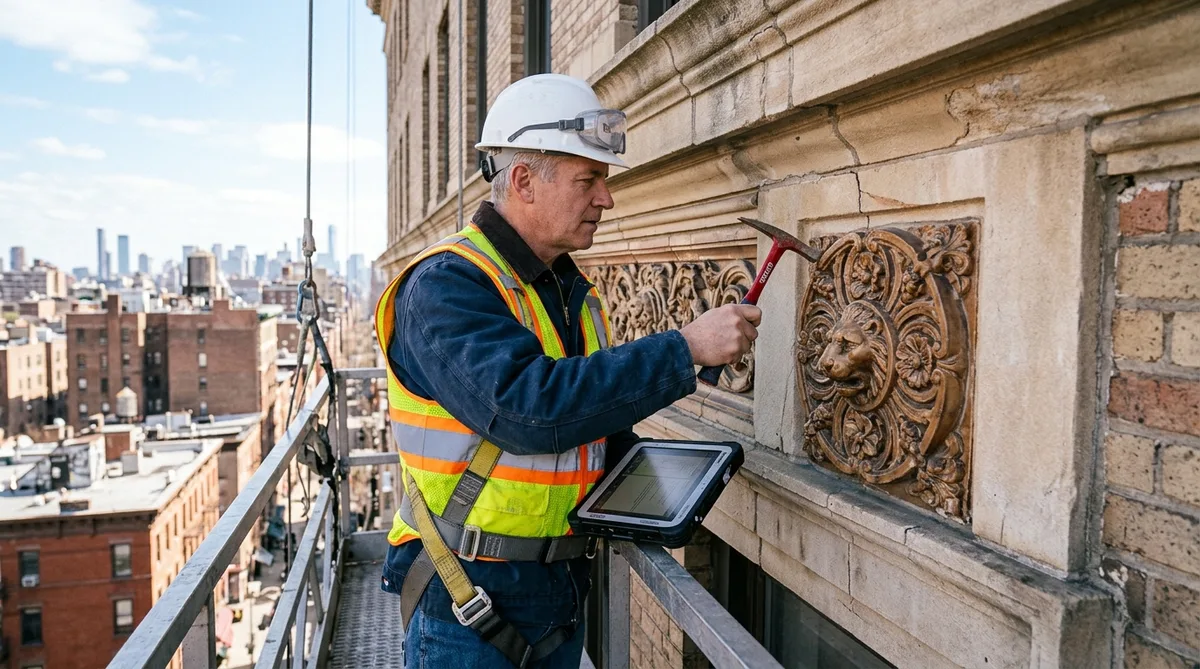 Architectural terra cotta units are hollow ceramic blocks anchored by internal mild-steel pins. When water penetrates glazed crazing cracks, corroded steel expands and shatters the brittle ceramic shell.
Why Terra Cotta Repairs Carry Such a High Price Tag:
- Hollow Ceramic Construction: Terra cotta blocks consist of an outer glazed ceramic shell backed by internal ceramic webs. They cannot simply be patched with standard mortar; moisture trapped inside hollow cavities will freeze and blow the patch off.
- Internal Steel Anchor Corrosion: Historic installations anchored blocks with non-galvanized mild steel hooks and pins. Over 90+ years, atmospheric moisture rusts these anchors, exerting thousands of pounds of pressure per square inch from within.
- Custom Kiln Fabrication: No supplier stocks off-the-shelf replacements. Every replacement piece requires laser scanning, hand-sculpted clay modeling, shrinkage compensation calculations (clay shrinks 8–10% during firing), custom glaze color formulation, and 6 to 12 months in kiln production.
| Terra Cotta Repair Method | Typical Cost Range | Turnaround Time | When Used / Suitability |
|---|---|---|---|
| Surface Crack Injection & Glaze Sealing | $60 – $120 / linear ft | Immediate (on scaffold) | Hairline thermal cracks (<1/16") with intact internal anchors. |
| Mineral-Based Spall Patching (Breathable mortar) | $250 – $650 / patch | 1 – 2 weeks | Surface spalls < 2" deep where original anchor is sound. |
| Structural Pinning (Stainless steel threaded rod) | $180 – $350 / pin | Immediate | Securing loose or cracked ornamental brackets to backup brick. |
| Terra Cotta Dutchman Repair | $800 – $2,200 / unit | 4 – 8 weeks | Carving out a broken section and mortaring a custom ceramic insert. |
| Full Custom Terra Cotta Replacement Block | $2,200 – $5,500 / block | 6 – 12 months | Severely fractured structural medallions, cornices, or water tables. |
| Glass-Fiber Reinforced Concrete (GFRC) Alternative | $1,200 – $2,800 / block | 2 – 4 months | Approved alternative for non-landmark buildings or high cornice profiles. |
If your property is not in an LPC Historic District, ask your structural engineer whether the DOB will approve lightweight Glass-Fiber Reinforced Concrete (GFRC) or cast stone replicas for upper-floor decorative cornices. GFRC replicates terra cotta profiles at 40% lower material cost, weighs significantly less, and cuts manufacturing lead times from 10 months down to 8 weeks.
4. Natural Stone Facade Repair Costs (Limestone, Sandstone, Brownstone, Granite)
Natural stone delivers magnificent architectural prestige, but decades of acidic rain, soot deposition, and seasonal freezing create localized flaking, cleavage-plane spalling, and detachment of monumental belt courses.
Stone Deterioration Mechanisms & Price Ranges:
- Stone Spall Patching (Composite Mortar): Using breathable, polymer-modified silicate mortars (such as Cathedral Stone Jahn M70 or Conproco) colored and textured to mirror the host stone matrix. Costs range from $150 to $350 per square foot of patch area.
- Stone Dutchman Repair: When damage is too structural for composite patching, masons sawcut the deteriorated stone back to sound material, drill stainless steel dowels, and epoxy a precision-sawn block of matching natural stone ("Dutchman"). Pricing ranges from $900 to $2,800 per Dutchman depending on stone carving complexity.
- Brownstone Exfoliation & Re-Facing: Brownstone is a layered sedimentary sandstone that peels along its natural bedding planes when water freezes inside. Chipping away exfoliated layers down to sound stone, drilling galvanized wire mesh, and applying a scratch, brown, and finish coat of authentic brownstone mortar costs $120 to $240 per square foot.
- Stone Balcony & Balustrade Anchoring: Projecting decorative stone balconies require structural stabilization using 316 stainless-steel threaded tension rods anchored deep into the floor slabs. Expect $4,500 to $12,000 per balcony assembly.
- Full Natural Stone Replacement (Quarry Sourced): Sourcing dimensional limestone from Indiana quarries or historic brownstone from Portland, Connecticut, carving profiles, and rigging multi-ton stones onto high-rise facades costs $3,500 to $10,000+ per block.
| Natural Stone Type | Typical Spall Patching | Dutchman Repair | Full Block Sourced Replacement |
|---|---|---|---|
| Indiana Limestone | $160 – $320 / sq ft | $950 – $2,200 / unit | $2,800 – $6,500 / block |
| Historic Brownstone | $140 – $280 / sq ft | $1,100 – $2,600 / unit | $3,200 – $7,500 / block |
| Granite (Polished / Thermal) | $220 – $450 / sq ft | $1,400 – $3,200 / unit | $4,000 – $9,000 / block |
| Ohio Sandstone | $150 – $300 / sq ft | $900 – $2,100 / unit | $2,600 – $5,800 / block |
5. The "Hidden" Budget Killers: Access, Scaffolding, and Soft Costs
When co-op boards and property managers review contractor bids, they are frequently shocked to discover that 35% to 55% of the total project budget has nothing to do with buying bricks or mortar. In dense NYC urban environments, site logistics, safety staging, insurance, and municipal filings represent immense overhead costs.
| Access / Soft Cost Item | Typical NYC Pricing (2026) | Billing Mechanism | Cost Containment Strategy |
|---|---|---|---|
| Sidewalk Shed (Bridge) | $90 – $140 / linear ft install & tear down $22 – $45 / linear ft monthly rental |
One-time install + monthly recurring | Expedite contractor milestone deadlines to pull down shed promptly. |
| Suspended Swing Stage Rigging | $3,500 – $7,500 / drop setup $1,200 – $2,500 / month rig rental |
Per motorized stage drop | Coordinate vertical facade strips so masons complete drops systematically. |
| Pipe Scaffolding (Full Facade) | $18 – $35 / square foot of elevation | Mobilization + rental | Only use pipe scaffolding when 70%+ of facade requires intensive masonry rebuilding. |
| QEWI Construction Administration | $12,000 – $35,000 / project | Milestone or hourly engineering rate | Mandate regular site visits to approve completed work for progress billing. |
| DOB & LPC Filing Fees | $3,500 – $12,000 | Direct City municipal fees | File through an experienced expediter to avoid DOB plan examination objections. |
| Site Safety Coordinator / Manager | $800 – $1,800 / day (if required by height) | Daily rate during active work | Schedule high-hazard exterior removals in concentrated project blocks. |
6. Comparison Matrix: Three Real-World Budget Scenarios
To demonstrate how these variables coalesce into a final capital expenditure, consider three common NYC multifamily building typologies facing Local Law 11 compliance:
| Cost Component | Scenario A: 12-Story Post-War Brick (Routine SWARMP) | Scenario B: 16-Story Pre-War Brick & Limestone | Scenario C: 22-Story Historic Terra Cotta Landmark (Unsafe Filing) |
|---|---|---|---|
| Building Scope | 15% repointing, 20 lintels scraped/primed, roof parapet cap resealing. | 30% repointing, 8 bulging brick rebuilds, 15 limestone Dutchman repairs, 40 lintels. | Full facade overhaul, 180 custom terra cotta blocks, structural cornice tiebacks, 45% repointing. |
| Sidewalk Shed & Access | $45,000 (3 months shed + 2 swing stages) | $115,000 (6 months shed + 4 swing stages) | $320,000 (14 months heavy-duty shed + 6 stages) |
| Brick Masonry Work | $62,000 | $185,000 | $420,000 |
| Stone / Terra Cotta Work | $0 | $68,000 (Limestone Dutchmen & patching) | $850,000 (Custom terra cotta replacement & kiln molds) |
| Lintels & Parapets | $18,000 | $74,000 | $210,000 |
| QEWI Fees & DOB Filings | $22,000 | $38,000 | $75,000 |
| Contingency Reserve (15-20%) | $25,000 | $75,000 | $350,000 |
| TOTAL PROJECT BUDGET | $172,000 | $555,000 | $2,225,000 |
| Per-Unit Cost (Avg 80 units) | $2,150 / shareholder | $6,938 / shareholder | $27,812 / shareholder |
7. Contractor Selection, Bidding Best Practices & Value Engineering
Managing facade restoration costs requires disciplined contract structuring. In New York City's competitive restoration market, a poorly drafted bid specification can lead to disputes and cost overruns.
Essential Rules for Bidding Facade Restorations:
- Never Bid Without a QEWI Specification: Do not ask contractors to inspect the facade and bid their own scopes. Retain an independent engineering firm to prepare detailed architectural drawings and standardized bid sheets with fixed unit quantities. All contractors must bid on the exact same unit-rate basis.
- Require Unit Prices for Unknowns: Include contractual unit prices for:
- Cost per square foot of additional brick rebuilding beyond base contract.
- Cost per linear foot of steel lintel replacement if hidden corrosion is uncovered.
- Cost per additional stainless-steel helical tie or epoxy anchor pin.
- Tie Payments to QEWI Field Sign-Offs: Never release contractor progress payments based on contractor self-certification. Require your QEWI to inspect the completed scaffolding drop, perform hammer-sounding, verify mortar depth, and sign the AIA G702 payment application prior to check disbursement.
- Bundle Facade Work with Energy Efficiency: Take advantage of installed scaffolding. While swing stages are in place, inspect window perimeter caulking, insulate parapet return walls, and address thermal envelope penetrations to assist with your building's NYC Local Law 97 carbon emissions compliance goals.
8. Step-by-Step Budget Planning Checklist for Boards and Owners
- Cycle Scheduling: Identify your building's FISP sub-cycle filing deadline based on the last digit of your DOB building identification number (BIN).
- Retain a QEWI 12 Months Early: Avoid last-minute engineering fee markups by engaging a Qualified Exterior Wall Inspector one full year before your sub-cycle window closes.
- Mandate Close-Up Inspection Drops: Authorize necessary physical scaffold drops and probe openings early to uncover hidden conditions before formulating the final capital budget.
- Establish a Dedicated Capital Reserve: If your building features historic terra cotta or decorative limestone, maintain an ongoing facade capital reserve rather than relying solely on sudden emergency assessments.
- Track Sidewalk Shed Rental Clauses: Include liquidated damages or aggressive completion incentives in contractor contracts to prevent scaffolding from remaining on your sidewalk for months after active work concludes.
- File FISP2 Amended Reports Promptly: Once contractors complete work, have the QEWI file an immediate amended report to clear Unsafe or SWARMP designations in DOB NOW, avoiding recurring municipal penalty notices.