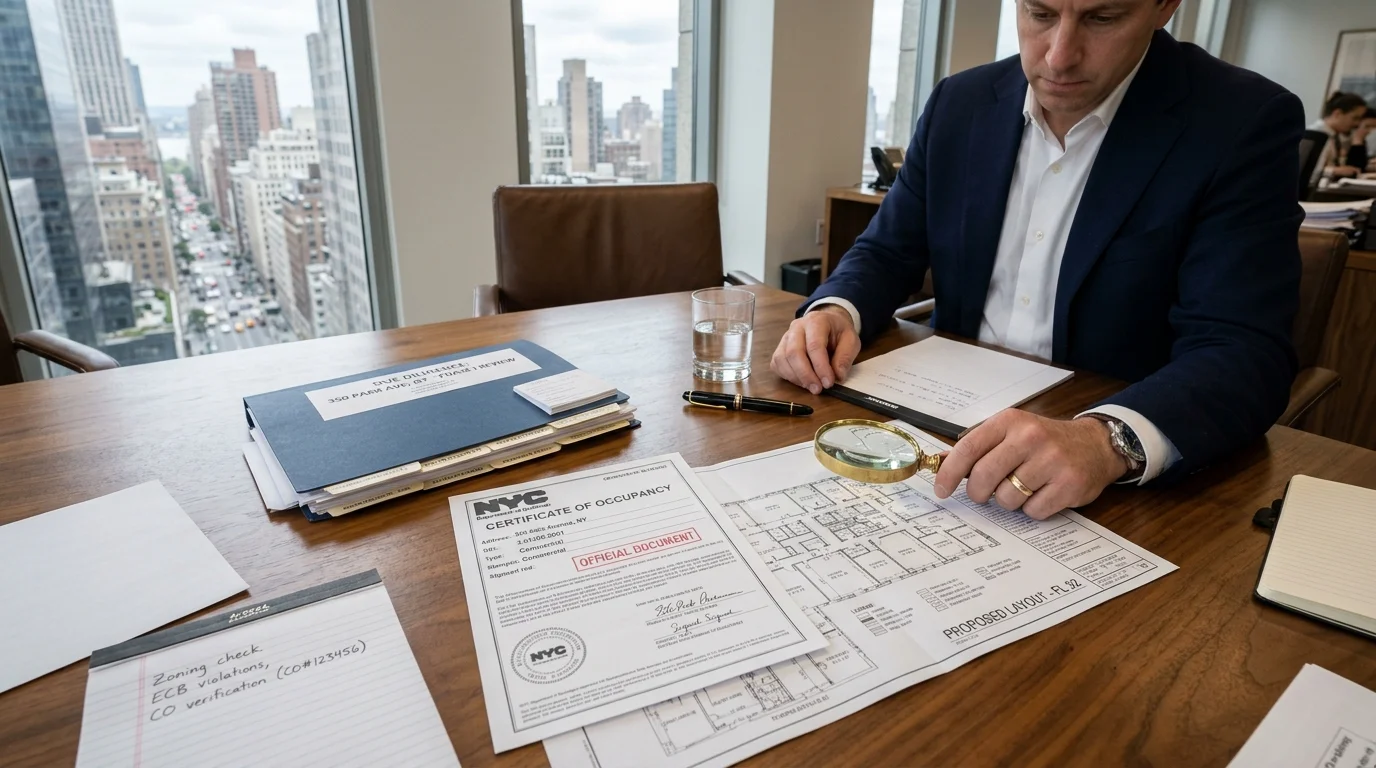
The Document That Can Complicate a Property Sale
A building owner spends months preparing a property for sale. The broker has photographs ready, buyers have toured the space, and the attorney has started reviewing the paperwork. Then a question appears during due diligence: Does the Certificate of Occupancy match the way this building is actually being used?
That question can uncover problems that have gone unnoticed for years.
A commercial space may be operating as a restaurant even though its records describe a different use. An apartment layout may not match the approved occupancy information. A recently renovated building may still have a temporary Certificate of Occupancy, with outstanding items preventing final approval.
These issues are not always obvious during routine property management. They often surface when a buyer, lender, attorney, or design professional examines the building's official records.
A Certificate of Occupancy (CO) establishes the legal use and permitted occupancy of a building under the New York City Department of Buildings (DOB). It is not simply another document to keep in a filing cabinet. It helps establish whether the property's documented use aligns with what the owner intends to sell, lease, or operate.
NYC DOB notes that a Certificate of Occupancy is often required when selling a home or refinancing a mortgage. Although the exact transaction requirements vary, finding a mismatch late in the process can create additional due diligence, professional fees, and delays. Source: NYC DOB — Permits by Type.
What Is a Certificate of Occupancy in NYC?
A Certificate of Occupancy is an official DOB document that identifies a building's legally permitted use and type of occupancy. Depending on the property, it may describe residential units, commercial spaces, community facilities, parking areas, occupancy limits, and other relevant details.
New buildings generally require a CO before they can legally be occupied. Existing buildings may require a new or amended CO when construction changes the use, means of egress, or type of occupancy.
For example, converting a commercial space into a residential apartment is not simply an interior renovation. It may change the legal occupancy classification and trigger requirements for approvals, building systems, exits, and other code provisions.
The final CO is issued after the applicable project requirements have been satisfied. Depending on the work, this can include inspection sign-offs, required paperwork, payment of fees, resolution of relevant violations, and approvals from other city agencies.
For owners, the practical test is whether the official record supports the property's current and intended use.
Why the Certificate of Occupancy Becomes Important at Sale Time
A property can operate for years without anyone questioning its occupancy records. That does not necessarily mean the documentation is accurate or that a discrepancy will be accepted during a sale.
Here are four common reasons a CO becomes important during a transaction.
| Issue discovered | Why it matters to the transaction |
|---|---|
| No Certificate of Occupancy can be located | The buyer may need evidence of the property's legal use or confirmation that a CO was not required |
| The recorded use differs from the actual use | The buyer's attorney or design professional may need to investigate whether the current use is authorized |
| The property has an expired Temporary CO | Outstanding approvals may complicate occupancy, insurance, financing, or the sale |
| Open DOB violations or unfinished applications remain | These may need to be resolved before DOB can issue a new or amended CO or close out related work |
The consequences depend on the property and the transaction. A missing document does not automatically mean a property is illegal, and every discrepancy does not automatically prevent a sale. However, owners who investigate early have more time to establish the property's status and address any required corrective work.
DOB specifically warns that an expired, unrenewed Temporary Certificate of Occupancy can make it difficult or impossible to sell or refinance a property. Source: NYC DOB — Owner Tips.

Five Certificate of Occupancy Problems Owners Discover Too Late
1. The Building's Actual Use Does Not Match the CO
This is one of the most important discrepancies to investigate.
Imagine a building whose records describe a permitted retail use, but the space now operates as a restaurant. Depending on the approved use, occupancy classification, layout, and alterations, the current operation may require additional approvals or an amended CO.
Other examples include converting storage space to an office, changing a commercial space to residential use, or altering an approved occupancy arrangement.
The owner should compare the CO with the property's actual use and approved plans. A broker's listing description, property-tax classification, or tenant's lease does not independently establish that a use is authorized under DOB requirements.
2. Renovations Were Completed but Never Properly Closed Out
Finishing construction does not necessarily mean the project is administratively complete.
A contractor may have completed the physical work, while final inspections, required sign-offs, or paperwork remain outstanding. Where the project requires a new or amended CO, those unfinished requirements can prevent the final document from being issued.
Before marketing a recently renovated property, check the DOB job records and confirm that relevant applications and permits have reached the required completion status.
For minor alterations that do not require a new or amended CO, a Letter of Completion may be the relevant closeout document instead. Source: NYC DOB — Letter of No Objection or Completion.
3. The Property Has Only a Temporary Certificate of Occupancy
A Temporary Certificate of Occupancy (TCO) allows a building or specified portion of it to be occupied temporarily, subject to the certificate's scope and conditions, while outstanding requirements for final approval remain.
NYC TCOs typically expire 90 days after issuance, although they may be renewed when the applicable requirements are met. Owners should check the current certificate and its exact expiration date rather than assume that an old TCO remains valid.
The real issue is what remains unfinished. The owner may need final inspections, a completed survey, outstanding documents, or other approvals before a permanent CO can be issued.
A purchaser considering a property with a TCO should have a qualified professional review the remaining requirements and consult legal counsel about the proposed closing arrangements.
4. The Owner Assumes an Older Building Never Needed a CO
Some older NYC buildings do not have a Certificate of Occupancy because one was not required when they were built.
DOB generally states that buildings constructed before 1938 are not required to have a CO unless later alterations changed the use, egress, or occupancy in a way that requires one.
For an eligible building without a required CO, the owner may be able to request a Letter of No Objection (LNO) to establish evidence of its legal use. Issuance depends on the property's records and applicable conditions; it is not an automatic replacement for a missing CO.
This distinction matters for older townhouses, multifamily properties, and commercial buildings whose records may predate modern certificate requirements. Source: NYC DOB — Certificate of Occupancy.
5. Open Violations or Applications Remain on the Property Record
A Certificate of Occupancy issue may be connected to a broader DOB compliance problem.
Open violations, incomplete filings, or unresolved project requirements can prevent a new or amended CO from being issued. DOB also states that open violations can appear in a property title search and may prevent an owner from selling or refinancing.
Before a sale, review the property records rather than checking the CO alone. If a problem appears, determine whether it relates to an outstanding permit, work performed without authorization, missing inspections, or another issue that requires its own resolution process. Source: NYC DOB — Resolve a Summons or Violation.
CO vs TCO vs Letter of No Objection vs Letter of Completion
These documents are not interchangeable. Understanding the difference helps owners determine what they actually need.
| Document | What it establishes | When it may apply |
|---|---|---|
| Certificate of Occupancy (CO) | The building's legal use and permitted occupancy | New buildings and existing buildings where a current or amended CO is required |
| Temporary Certificate of Occupancy (TCO) | Temporary authorization for the specified building or portion to be occupied, subject to applicable conditions | When the building is considered safe for temporary occupancy but final requirements remain outstanding |
| Letter of No Objection (LNO) | Evidence supporting a property's legal use in qualifying circumstances | Certain older buildings or cases where a CO is unavailable and the legal-use criteria are satisfied |
| Letter of Completion (LOC) | Closeout of qualifying work that does not require a new or amended CO | Certain minor alterations after the required closeout requirements are met |
A CO does not have a routine expiration date. However, that does not mean it remains suitable for every future use: subsequent changes to the building may require an amended or new CO.
The appropriate document depends on the property's history, approved work, and current legal status. DOB's records and the advice of a qualified professional should guide the decision.
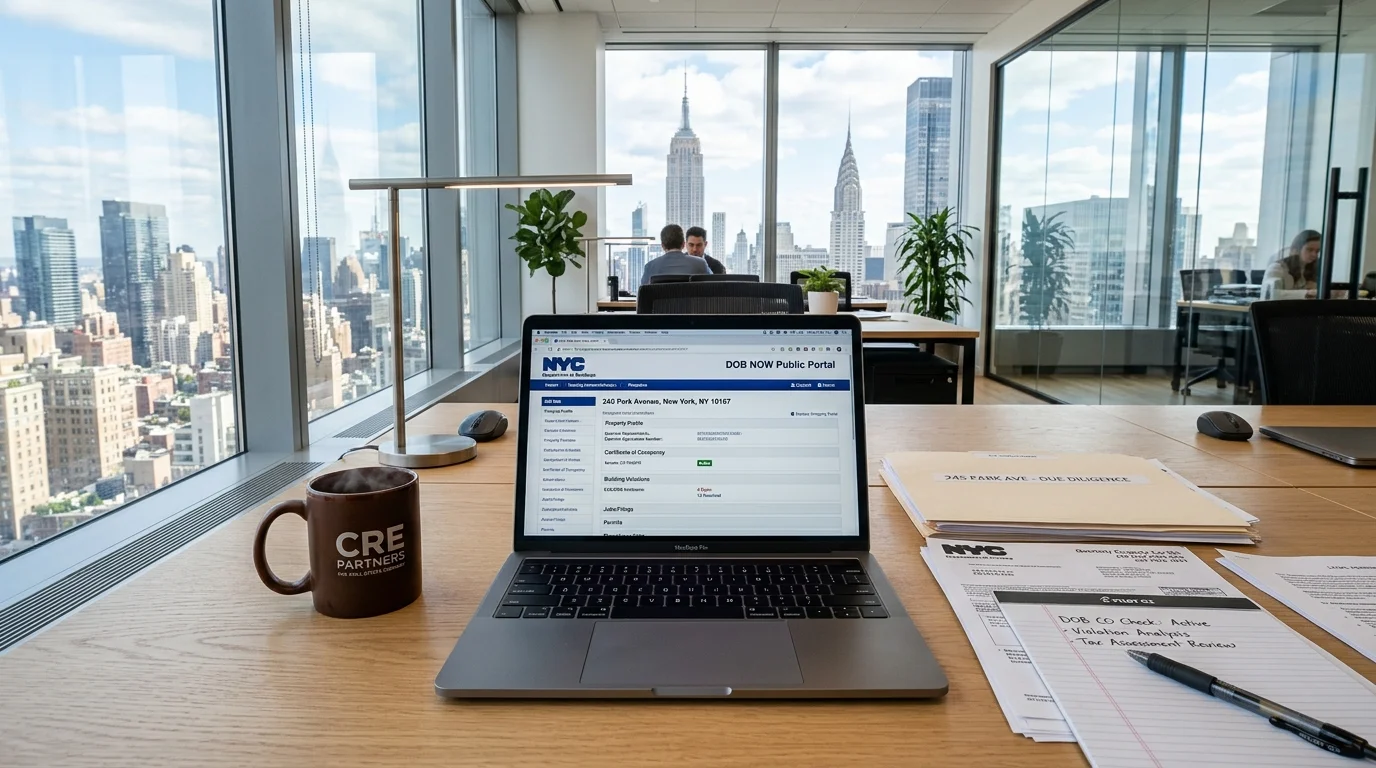
How to Check Your NYC Certificate of Occupancy Before Listing a Property
You do not need to wait until a buyer requests the document. Owners can make an initial review of the public records before listing or refinancing.
Step 1: Search the property in DOB's online records.
Use the DOB NOW Public Portal to search by address. For CO requests made on or after March 1, 2021, DOB directs users to the property's profile in DOB NOW and the Certificate of Occupancy section.
For older CO requests, search the Buildings Information System (BIS) and select the option to view Certificates of Occupancy.
Step 2: Compare the recorded details with the actual property.
Review the permitted uses and floor-use information against the building's current layout, occupancy, and intended use. Note any spaces whose function or configuration appears inconsistent with the record.
Step 3: Check for related job filings and violations.
Review relevant permits, alterations, sign-offs, and open violations. If a renovation was completed, verify that its required approvals and closeout documents are recorded.
Step 4: Ask a qualified professional to evaluate discrepancies.
A New York State-licensed Professional Engineer (PE) or Registered Architect (RA) may be needed to assess the property history, interpret the records, determine whether an amended CO is required, and identify the steps toward approval. The owner's attorney should also be involved where the issue may affect transaction terms.
Step 5: Resolve the issue before closing negotiations become urgent.
If the property needs corrective work or further DOB approval, identifying it early gives the owner time to assess cost, scheduling, and documentation requirements.
A Realistic Sale-Time Example
Consider a hypothetical NYC commercial property advertised as a two-story office building. During due diligence, the buyer discovers that a portion of the ground floor is being used as a restaurant, but the available CO does not clearly support that use.
The seller initially assumes the discrepancy is minor because the restaurant has operated for years.
The buyer's team requests additional records. A design professional reviews the CO, prior permits, approved plans, and the property's actual configuration. The review determines whether the current use is authorized and whether further approvals or alterations are necessary.
If additional work is required, the parties may need to discuss the scope, cost, timing, and responsibilities before closing. The transaction outcome will depend on the findings and the agreed contractual terms.
The lesson is not that every use discrepancy prevents a sale. It is that longstanding operation is not a substitute for verifying legal use, and late discovery can turn a straightforward closing into a more complicated project.
A Pre-Sale Certificate of Occupancy Checklist
Before listing, refinancing, or negotiating a commercial property transaction, review these items:
This checklist is a practical due-diligence tool, not a guarantee that a property is ready for sale. Each building may have additional requirements depending on its use, construction history, and transaction.
How Much Does It Cost to Fix a Missing or Outdated CO?
There is no single cost for resolving a Certificate of Occupancy problem. The expense depends on why the document is missing or outdated.
If the required approvals and sign-offs are already complete, locating the existing record or obtaining the relevant documentation may be relatively straightforward. If the building requires an amended CO, the work may involve a design professional, new filings, additional inspections, code-compliant alterations, or the resolution of outstanding violations.
Older properties may require historical research to establish their legal use. A change of occupancy can involve a more extensive review of exits, accessibility, fire protection, plumbing, and other requirements, depending on the proposed use and the building.
For this reason, owners should avoid assuming that every missing CO can be resolved with a simple administrative request. Start with a records search and professional review to establish the actual problem before budgeting for corrective work.
Final Takeaway: Verify the CO Before You Need It
A Certificate of Occupancy is easy to overlook when a property operates without obvious problems. But when the owner needs to sell, refinance, lease a space for a different purpose, or close out major alterations, the building's legal-use records become much more important.
The smartest approach is to verify the CO early, compare it with the property's actual use, and address discrepancies before a transaction is underway. For eligible older properties, an LNO may be appropriate; for certain minor alterations, an LOC may be sufficient; and where a TCO is in place, outstanding requirements should be understood well before its expiration.
For NYC building owners, pre-sale CO review is a practical way to reduce uncertainty, prepare for buyer due diligence, and identify compliance work while there is still time to plan it properly.
Related Due Diligence & DOB Compliance Guides
Explore our comprehensive guides on resolving Department of Buildings challenges: read about Common Reasons a DOB Violation Gets Dismissed in NYC and stay ahead of required utility system verifications with our LL152 Gas Piping Inspections Timeline Guide.