Learn how green lease clauses influence tenant energy habits, utility costs, HVAC schedules, equipment choices, data sharing, and building efficiency.
Introduction: How Lease Agreements Influence Building Energy Consumption
When discussing commercial building energy efficiency, most property owners focus on HVAC equipment, insulation, lighting systems, and renewable energy installations.
However, another important factor often receives less attention: tenant behavior.
In multi-tenant commercial buildings, occupants influence how and when energy is consumed. Office employees leave lights running after business hours, retailers operate equipment throughout the day, restaurants depend on refrigeration and ventilation, and tenants may use additional heating or cooling equipment inside their leased spaces.
These everyday activities can significantly influence a building's overall energy consumption.
According to the U.S. Department of Energy's Better Buildings resources, occupants can control up to 80% of energy use in some commercial building types. The actual proportion varies depending on the property and how its systems are operated.
This creates an important opportunity for commercial landlords and tenants to work together.
One way to achieve this is through green lease clauses.
Green leases, also called energy-aligned or high-performance leases, incorporate specific responsibilities and operational guidelines into standard commercial lease agreements.
These clauses can influence:
- HVAC operating schedules.
- Electricity and water consumption.
- Lighting and equipment usage.
- Tenant improvement projects.
- Energy monitoring and reporting.
- Maintenance responsibilities.
- After-hours building operations.
- Shared investment in energy-efficiency improvements.
Rather than treating energy efficiency as the landlord's responsibility alone, green lease language establishes a framework for both parties to participate in building performance improvements.
In this article, we explore how lease language changes tenant energy habits, which clauses make the biggest difference, and how property owners can incorporate practical sustainability requirements into commercial lease agreements.
1. Why Do Tenant Energy Habits Matter in Commercial Buildings?
A commercial building's energy consumption is influenced by its physical infrastructure and the people operating within it.
Even an efficient building can experience unnecessary energy consumption when occupants use equipment inefficiently or operate their spaces outside normal building schedules.
For example, consider an office building with centralized heating and cooling.
The landlord may invest in an efficient HVAC system, but tenants might request cooling throughout the night, operate portable air conditioners, or leave equipment running when the office is empty.
These decisions can increase building energy consumption and operating expenses.
1.1 Common Tenant Activities That Increase Energy Consumption
Several everyday activities contribute to unnecessary energy use:
- Lighting left on after business hours: Offices, conference rooms, storage areas, and corridors may remain illuminated even when they are unoccupied.
- Excessive heating and cooling: Tenants may request temperatures outside the building's normal operating range.
- Unnecessary equipment operation: Computers, printers, kitchen appliances, vending machines, and other equipment can continue consuming electricity when not required.
- Poor thermostat management: Incorrect thermostat settings and frequent manual adjustments can affect HVAC performance.
- Inefficient tenant fit-outs: Poor lighting layouts, inefficient appliances, and unsuitable equipment can increase long-term electricity consumption.
- Extended operating schedules: Businesses operating beyond normal building hours may require additional HVAC, lighting, and ventilation.
1.2 How Much Control Do Tenants Have Over Building Energy Use?
The level of tenant control varies depending on the building's design and lease structure.
In some properties, tenants control most of their interior lighting, plug loads, and operating schedules.
In other buildings, centralized HVAC and lighting systems are controlled almost entirely by the landlord.
This distinction matters because energy management responsibilities should match the actual control that each party has over the equipment.
A tenant should not be held responsible for the performance of a central HVAC system that only the landlord can operate or maintain.
Similarly, landlords need access to tenant-controlled utility information when evaluating whole-building energy performance under municipal mandates such as NYC Local Law 97 and Local Law 84 benchmarking.
2. What Are Green Lease Clauses?
Green lease clauses are contractual provisions included in commercial lease agreements to encourage energy efficiency, resource conservation, and better building operations.
They establish practical expectations between landlords and tenants regarding how the property should be used and maintained.
A traditional commercial lease generally focuses on rent, maintenance, occupancy, insurance, operating expenses, and other property-related responsibilities. A green lease adds specific environmental and operational considerations covering:
- Energy consumption limits.
- Equipment efficiency standards.
- Utility data sharing.
- Submetering.
- HVAC operation.
- Lighting requirements.
- Water conservation.
- Sustainable construction materials.
- Waste management.
- Building performance reporting.
2.1 Traditional Lease vs. Green Lease
The main distinction is how sustainability responsibilities are incorporated into the agreement:
| Lease Feature | Traditional Commercial Lease | Green / Energy-Aligned Lease |
|---|---|---|
| Energy Consumption | Primarily managed through existing utility arrangements | Energy performance and management responsibilities are explicitly specified |
| Utility Data | Remains separate between landlord and tenant | Mandatory shared energy and water reporting for compliance and benchmarking |
| HVAC Schedules | Based on historical building hours | Includes agreed operating bands, setback schedules, and transparent after-hours rates |
| Equipment Standards | General tenant equipment allowances | Mandates ENERGY STAR-certified or equivalent high-efficiency equipment |
| Tenant Improvements | Subject to standard architectural sign-offs | Requires energy modeling review, LED lighting controls, and low-flow plumbing fixtures |
| Maintenance | General upkeep provisions | Specifies routine filter replacement, sensor calibration, and equipment maintenance |
| Energy Upgrades | Cost allocation frequently disputed or unclear | Structured capital cost recovery and shared savings mechanisms |
| Building Performance | Not tracked or reviewed jointly | Collaborative quarterly reviews and whole-building emissions targets |
A green lease does not have to be an entirely separate document. In most commercial transactions, it can be incorporated into the existing lease through specific riders, exhibits, or tenant improvement work-letters.
3. The Split-Incentive Problem: Why Landlords and Tenants Often Disagree About Energy Efficiency
One of the biggest challenges in commercial building energy management is known as the split-incentive problem.
It occurs when the party responsible for paying for an energy-efficiency improvement is not the same party receiving the financial benefits.
For example, a landlord owns a commercial office building and is responsible for installing new central HVAC equipment. However, tenants pay their own electricity bills.
When the landlord invests in a more efficient HVAC system, tenants receive lower utility bills, while the landlord bears the entire initial installation cost. The landlord therefore has limited financial motivation to invest unless the lease provides a way to recover the costs or share the benefits.
The opposite can also happen: a tenant may pay high utility bills but have no authority to upgrade the building's central heating or cooling plant.
Green leases resolve these conflicting incentives by defining responsibilities and financial cost-recovery mechanisms clearly.
3.1 How Green Leases Address Split Incentives
Several lease mechanisms help align landlord and tenant financial interests:
- Capital Cost Recovery: Landlords may amortize and recover qualifying energy-efficiency improvements through operating expenses, provided the annual cost does not exceed projected utility savings.
- Shared Energy Savings: Landlords and tenants contractually divide documented financial savings resulting from major efficiency retrofits.
- Energy Consumption Reporting: Both parties share utility and interval submeter data to evaluate actual performance.
- Joint Improvement Planning: Tenants and landlords coordinate equipment upgrades during lease renewals and major tenant fit-outs.
- Performance Incentives: Tenants receive base-rent credits or operating-expense discounts for achieving verified energy reduction targets.
Under conventional triple-net leases, landlords pay for energy upgrades while tenants reap utility savings. Green lease amortization clauses allow owners to recover capital investments over the equipment's useful life, provided annual pass-throughs do not exceed tenant utility savings.
4. Eight Lease Clauses That Can Change Tenant Energy Habits
Energy-aligned leases influence daily building operations through targeted, enforceable contractual provisions. The following eight clauses deliver the greatest practical impact on tenant behavior:
4.1 Utility Data Sharing and Energy Reporting
In many commercial properties, tenants purchase electricity or natural gas directly from utility companies. A data-sharing clause obligates tenants to provide monthly consumption data, interval meter records, and account authorization letters. Landlords require this data for annual LL84 benchmarking and compliance with Building Performance Standards.
Behavioral Impact: Regular tracking provides tenants with direct visibility into monthly consumption, making waste immediately apparent.
4.2 HVAC Operating Hours and After-Hours Usage
Defines standard building operating hours (e.g., 8:00 AM to 6:00 PM Monday through Friday) and establishes a formal procedure for after-hours HVAC requests billed at disclosed, transparent rates per zone.
Behavioral Impact: Attaching a clear cost to after-hours HVAC eliminates the habit of leaving entire building zones conditioned for single late-working employees.
4.3 Temperature Settings and Thermostat Controls
Establishes agreed occupied temperature ranges (e.g., 68°F–70°F heating, 74°F–76°F cooling) alongside automated night and weekend setbacks (e.g., 60°F heating, 82°F cooling).
Behavioral Impact: Prevents occupants from overcooling offices in summer or overheating in winter, eliminating manual thermostat fighting.
4.4 Restrictions on Energy-Intensive Equipment
Prohibits unauthorized personal space heaters, portable air conditioners, and unapproved refrigeration units while requiring ENERGY STAR ratings for all tenant-procured appliances.
Behavioral Impact: Eliminates plug-load spikes and dangerous localized electrical circuits while encouraging occupants to report comfort issues to building management.
4.5 Energy-Efficient Tenant Improvement Requirements
Establishes mandatory baseline specifications for tenant fit-outs, including 100% LED fixtures, daylight-harvesting controls, low-flow plumbing fixtures, and ASHRAE 90.1 compliance.
Behavioral Impact: Integrates high-performance engineering into space planning before construction begins, preventing long-term operational inefficiency.
4.6 Lighting and Plug Load Management
Requires automated occupancy sensors in private offices, conference rooms, and copy areas, alongside smart power strips for workstations.
Behavioral Impact: Cultivates automated equipment shutdown protocols when employees leave their spaces at the end of the day.
4.7 Maintenance and Responsibility for Tenant-Controlled Equipment
Clarifies maintenance obligations for tenant-dedicated equipment, such as packaged rooftop units (RTUs), kitchen exhaust hoods, and server room supplemental cooling units.
Behavioral Impact: Mandates quarterly filter replacements and coil cleaning, ensuring tenant systems do not operate under degraded, energy-wasting conditions.
4.8 Energy Performance Goals and Incentives
Establishes quantitative Energy Use Intensity (EUI) benchmarks for tenant premises and offers financial incentives or public recognition for meeting reduction milestones.
Behavioral Impact: Transforms corporate sustainability pledges into everyday operational accountability across departmental teams.
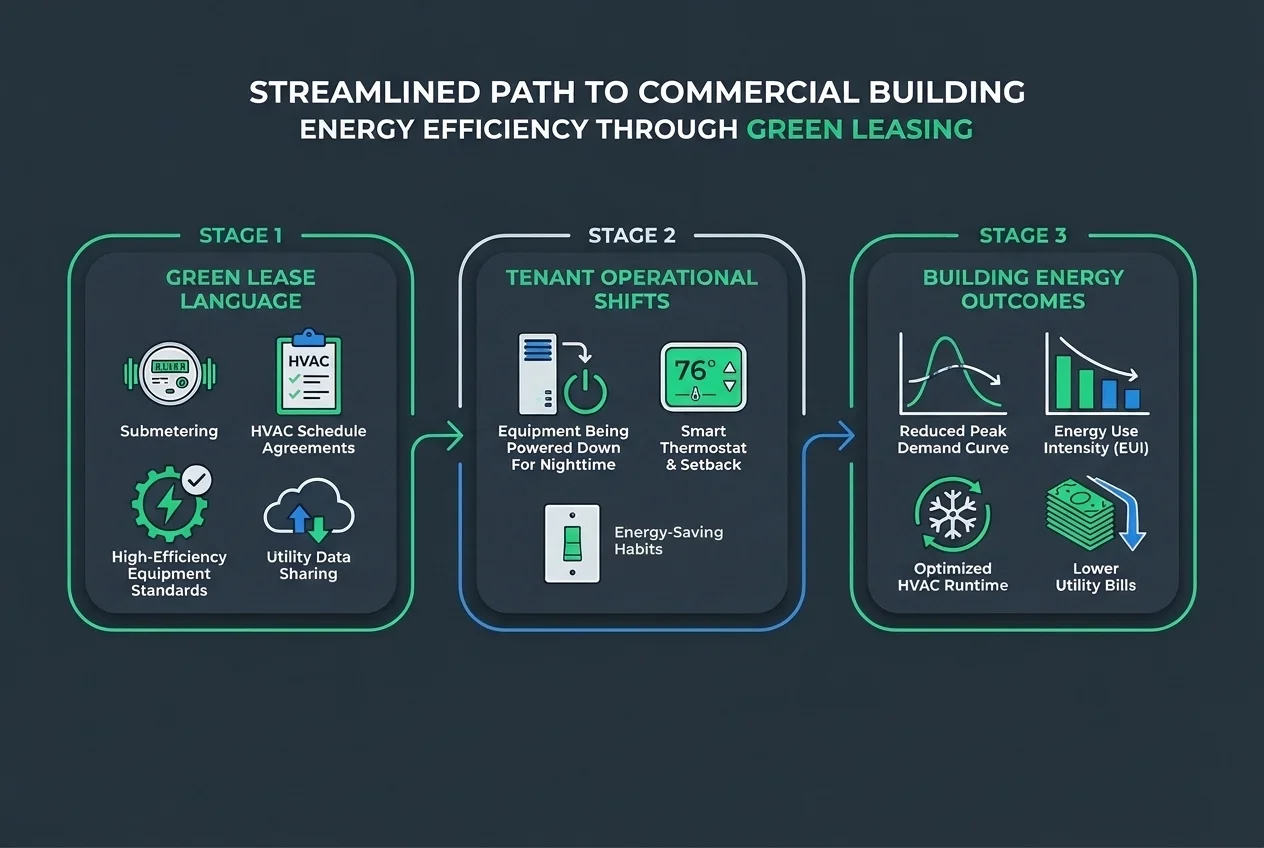 Three-stage operational framework showing how contractual green lease clauses translate directly into tenant behavioral modifications and whole-building energy efficiency outcomes.
5. Comparison: Which Lease Clauses Have the Biggest Influence on Energy Usage?
Different lease provisions target distinct operational systems across commercial properties. The following matrix illustrates the relationship between specific clauses, occupant actions, and measurement methods:
| Lease Clause | Tenant Behavior Influenced | Expected Building Impact | Measurement Method |
|---|---|---|---|
| Utility Data Sharing | Regular energy tracking & reporting | Complete whole-building consumption visibility | Monthly utility reports & EDI feeds |
| HVAC Operating Hours | Reduced unnecessary after-hours requests | Lower central plant runtime & peak demand | BMS runtime logs & zone overrides |
| Temperature Controls | Adhering to agreed comfort setpoints | Optimized heating & cooling energy cycles | Smart thermostat data & BMS trends |
| Equipment Restrictions | Elimination of personal space heaters | Lower base plug loads & reduced fire hazard | Plug-load submetering & facility audits |
| Efficient Fit-Out Standards | Procuring high-efficiency fixtures & controls | Permanently lowered lighting & HVAC base demand | Tenant improvement plan reviews |
| Lighting Controls | Switching off unused conference & office lights | Reduced lighting electricity consumption | Lighting circuit interval submeters |
| Maintenance Clauses | Timely filter replacement & coil cleaning | Preventing equipment degradation & premature failure | Quarterly maintenance logs & work orders |
| Performance Incentives | Active employee participation in conservation | Measurable progress toward net-zero targets | Annual EUI tracking & carbon accounting |
Moving tenants from square-footage proration to direct submetered billing reliably reduces space energy consumption by 15% to 25% within the first year, as occupants become directly accountable for waste.
6. Sample Green Lease Language: Practical Examples for Commercial Properties
The following model clauses illustrate how landlords and tenants can integrate energy-aligned commitments into commercial lease negotiations:
6.1 Utility Data Sharing Clause
"Tenant shall provide Landlord with monthly electricity, natural gas, and water consumption data for the leased premises within thirty (30) days of utility invoice receipt. If requested by Landlord, Tenant shall execute an authorization letter permitting Landlord to obtain automated utility data directly via Electronic Data Interchange (EDI) for the sole purposes of statutory energy benchmarking, emissions accounting, and energy audit compliance."
6.2 HVAC Operating Hours Clause
"Landlord shall provide HVAC services during Building Operating Hours (8:00 AM to 6:00 PM, Monday through Friday, excluding legal holidays). Any tenant request for HVAC service outside these hours must be submitted via the building management portal at least twenty-four (24) hours in advance and shall be billed at the published hourly after-hours rate reflecting actual utility and maintenance costs."
6.3 Energy-Efficient Equipment Clause
"All tenant-installed appliances, IT hardware, copiers, and commercial refrigeration units must be ENERGY STAR-certified or meet equivalent industry efficiency standards. Personal space heaters, portable air conditioners, and supplemental resistance heaters are strictly prohibited without prior written consent from building engineering."
6.4 Tenant Improvement Clause
"All Tenant Alterations must incorporate 100% solid-state LED lighting with an installed lighting power density (LPD) at least 15% below ASHRAE 90.1 standards, vacancy sensors in all enclosed private spaces, daylight dimming within fifteen (15) feet of exterior glazing, and WaterSense-labeled plumbing fixtures."
6.5 Shared Savings and Cost Recovery Clause
"If Landlord executes capital energy-efficiency improvements that reduce building operating expenses, Landlord may amortize the verified capital cost (net of any utility rebates, grants, or tax incentives) over the equipment's useful life. The annual amortized amount included in Tenant's operating expenses shall not exceed Tenant's proportionate share of documented annual utility cost savings."
7. How Different Commercial Lease Structures Affect Tenant Energy Habits
The financial structure of a commercial lease fundamentally dictates how incentives and utility costs are distributed:
| Lease Type | Utility Payment Arrangement | Incentive Alignment Challenge |
|---|---|---|
| Gross / Full-Service Lease | Landlord pays utilities from base rent | Tenants have zero financial consequence for leaving lights or equipment running. |
| Triple Net (NNN) Lease | Tenant pays all utilities and operating expenses directly | Landlord has little financial motivation to invest capital in high-efficiency central plants. |
| Modified Gross Lease | Utilities split or billed above an initial base-year expense stop | Requires precise baseline adjustments to avoid unfair cost allocations as energy prices fluctuate. |
7.1 Why Submetering Matters
Electrical submetering bridges the gap between gross and net lease structures. By measuring actual kilowatt-hour consumption at the tenant suite level, building managers can bill occupants for exact usage rather than allocating costs by rented square footage. Submetering creates immediate accountability, typically yielding a 15% to 20% reduction in tenant plug loads within months of implementation.
8. How Green Leases Apply to Different Commercial Building Types
Operating realities vary significantly across asset classes:
- Commercial Office Properties: Focus primarily on occupancy-sensor controls, IT equipment sleep modes, after-hours HVAC zone management, and quarterly energy scorecards.
- Retail Stores & Shopping Centers: Emphasize display lighting efficiency, scheduled exterior facade lighting, dedicated rooftop unit (RTU) maintenance, and door-closure requirements during heating and cooling seasons.
- Restaurants & Commercial Kitchens: Center on demand-controlled kitchen ventilation (DCKV), high-efficiency refrigeration, automatic walk-in door closers, and hot water heat pump retrofits.
- Multifamily Residential: Address smart thermostats, WaterSense plumbing fixtures, common area lighting schedules, and transparent tenant submetering.
9. How Landlords Can Encourage Better Tenant Energy Habits
Contractual clauses provide the legal framework, but ongoing engagement drives real behavioral change:
- Distribute Monthly Tenant Energy Scorecards: Benchmark tenant energy usage against floor averages and previous months to highlight efficiency opportunities.
- Designate a Dedicated Building Sustainability Liaison: Give tenants a direct point of contact for thermostat calibrations, after-hours scheduling questions, and submetering data.
- Host Quarterly Tenant Sustainability Roundtables: Review whole-building performance, discuss comfort issues, and share energy conservation best practices.
- Issue Tenant Onboarding Green Guides: Provide new tenants with clear, visual operational guidelines on day one of occupancy.
- Introduce Performance Recognition & Awards: Recognize high-performing tenants through building lobby digital signage and sustainability certificates.
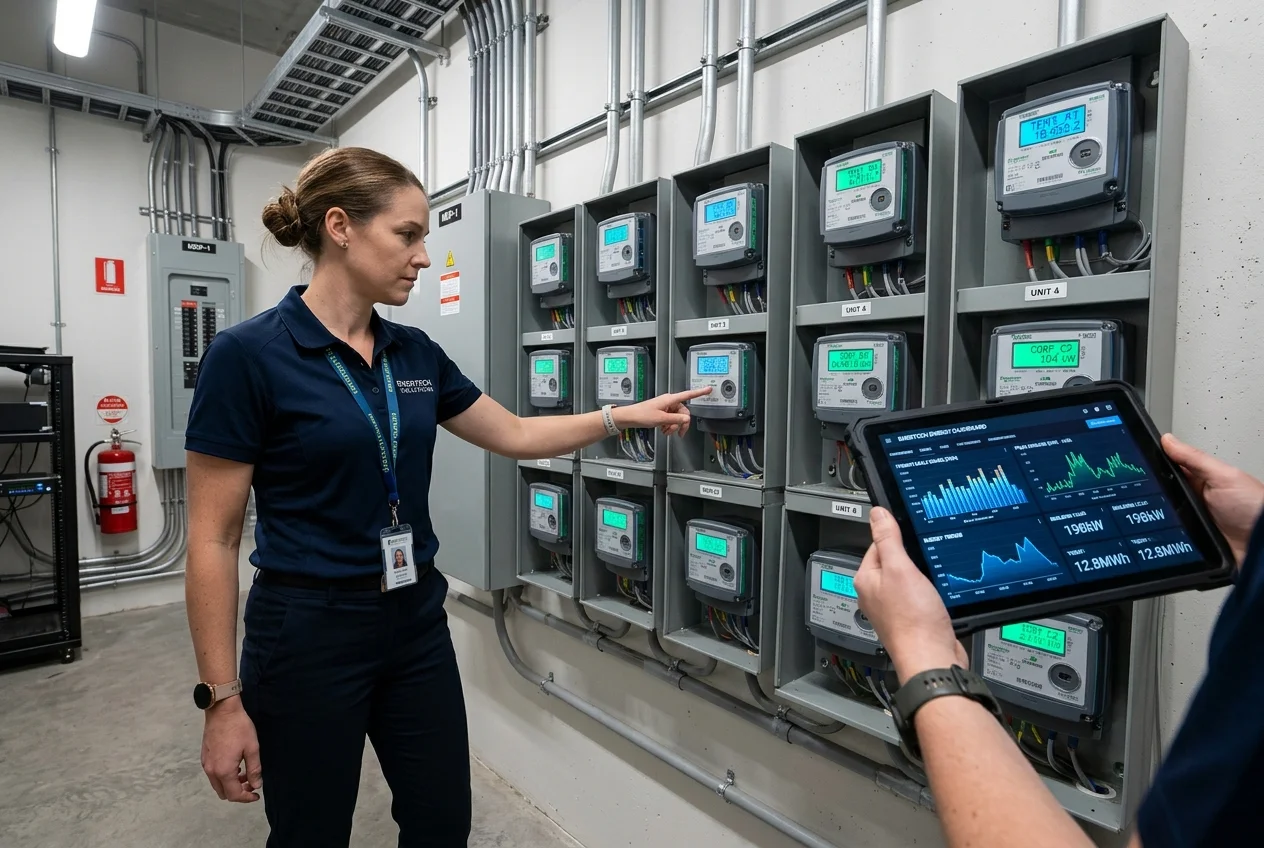 Real-time electrical submetering and digital facility dashboards empower commercial property managers to monitor tenant-level energy consumption and verify green lease compliance.
Pair green lease clauses with tenant engagement: establish building sustainability committees, provide monthly energy scorecards, and celebrate tenant carbon-reduction milestones to foster genuine long-term buy-in.
10. How to Measure Whether Lease Language Is Actually Changing Energy Usage
A green lease must deliver quantifiable performance gains. Property teams should track eight core key performance indicators (KPIs):
| Key Performance Indicator (KPI) | Operational Metric | Target Outcome |
|---|---|---|
| Weather-Normalized EUI | kBtu per gross square foot per year | Continuous downward trajectory toward municipal targets |
| Tenant Monthly kWh Consumption | Total electricity consumption per suite | Reduction in baseline plug load and lighting demand |
| After-Hours HVAC Runtime Hours | Overtime system runtime outside building hours | Measurable drop in evening and weekend system runtime |
| Peak Electrical Demand (kW) | Highest 15-minute electrical demand interval | Flattened demand profile and lower utility demand charges |
| Base Plug Load Density | Watts per square foot during unoccupied hours | Minimization of phantom power and idling equipment |
| Domestic Water Consumption | Gallons per occupant per day | Verification of low-flow fixture performance |
| Indoor Temperature Compliance | Percentage of operating hours within agreed comfort bands | Elimination of tenant heating/cooling complaints |
| ENERGY STAR Score | 1–100 national building performance percentile | Qualification for ENERGY STAR certification and green certifications |
11. Common Mistakes When Drafting Green Lease Agreements
Poorly drafted green leases frequently lead to friction, tenant distrust, or legal disputes. Property managers should avoid these six common pitfalls:
- Vague, Unenforceable Aspirations: Avoid statements like "Tenant shall make good-faith efforts to conserve energy." Use measurable criteria, specific equipment standards, and concrete reporting schedules.
- Uncapped Capital Cost Pass-Throughs: Never attempt to shift major structural capital expenditures onto tenants under the guise of sustainability without clear savings-based cost recovery caps.
- Compromising Indoor Comfort & Health: Energy setback schedules must never compromise indoor air quality (IAQ), minimum ventilation rates (ASHRAE 62.1), or tenant thermal comfort.
- Data Collection Without Confidentiality Guarantees: Clearly specify that tenant utility data is strictly confidential and used solely for municipal compliance and benchmarking.
- Misaligned Equipment Jurisdictions: Never hold a tenant responsible for maintaining systems they have no physical access to or operational control over.
- Omitting an Annual Audit & Reconciliation Mechanism: Always establish an annual review procedure where actual utility savings are reconciled against amortized capital investments.
12. The Future of Green Leasing: Performance-Based Real Estate Contracts
The commercial real estate sector is moving rapidly from voluntary sustainability certifications toward mandatory municipal performance standards. Frameworks such as the Green Lease Leaders program—developed by the Institute for Market Transformation (IMT) and the U.S. Department of Energy—have proven that energy-aligned leases deliver an average 17% reduction in commercial utility expenses.
Looking ahead, commercial leases are evolving into performance-based contracts where rent structures and operating expenses are directly indexed to carbon emissions reductions and Energy Use Intensity milestones. As statewide standards in Washington, Colorado, Maryland, and New York expand enforcement, energy-aligned leases will become standard operating procedure for preserving asset value and avoiding massive regulatory penalties.
Energy efficiency in commercial real estate is no longer an isolated engineering challenge—it is an operational partnership. By aligning lease language with real-world tenant behaviors, commercial property owners can eliminate energy waste, lower operating expenses, protect tenant comfort, and ensure long-term compliance with stringent urban decarbonization laws.
Want to Improve Your Building's Energy Performance?
Commercial building efficiency depends on more than HVAC systems and lighting upgrades. The way tenants operate their leased spaces can significantly influence overall energy consumption. Whether you manage an office building, retail property, shopping center, or multifamily portfolio, introducing energy-aligned lease provisions can help establish clearer responsibilities and improve operational efficiency.