Introduction: The Energy Load That Keeps Working Even When Nobody Is Watching
A building's heating and cooling equipment usually receives most of the attention during an energy-efficiency review. Property managers closely monitor boilers, chillers, building automation systems, and rooftop ventilation units because their winter and peak summer operating expenses are obvious and substantial.
Domestic hot water (DHW) receives far less attention.
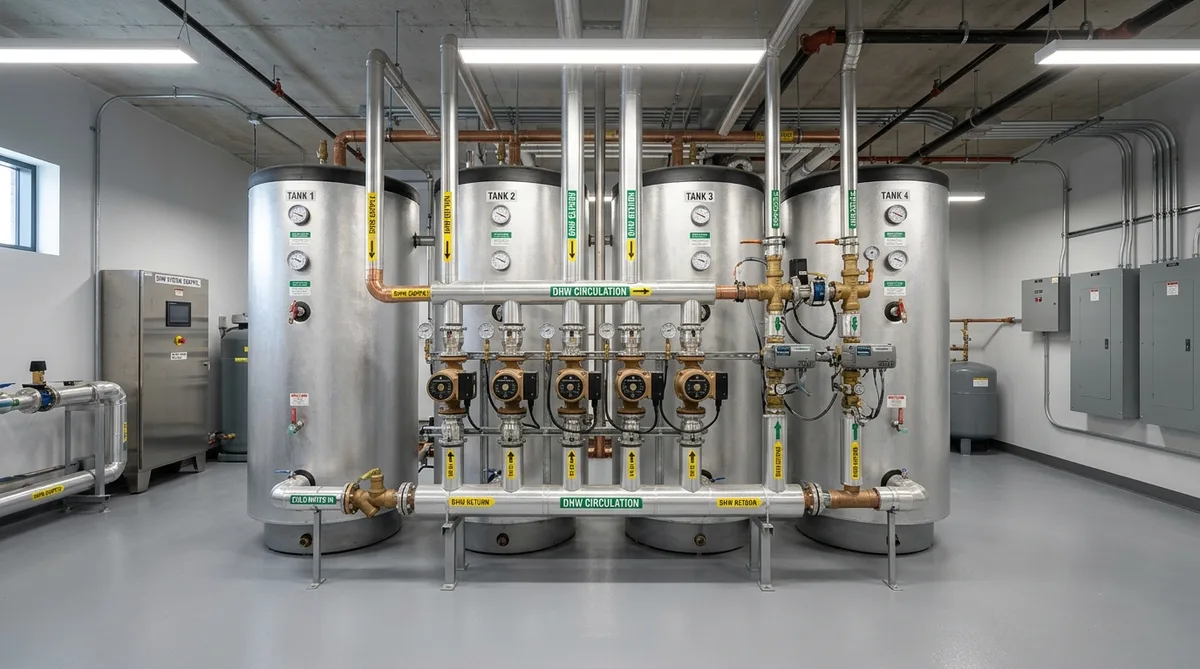
Yet a multifamily residential building must provide domestic hot water throughout the entire year, including during mild spring days and the hottest summer months when the central space-heating plant is completely switched off. Every morning shower, kitchen sink rinse, common laundry cycle, and janitorial tap creates instantaneous demand. The system must continuously heat cold incoming municipal water, store it at safe temperatures, circulate it through hundreds of feet of distribution risers, and maintain delivery readiness 24 hours a day, 7 days a week.
That relentless responsibility makes domestic hot water one of the largest single energy consumers in urban multifamily properties.
The 20% figure highlighted in this article serves as a proven industry planning benchmark. In comprehensive NYC building-energy audit datasets compiled by the Urban Green Council, domestic hot water accounted for 15% of total source energy in audited multifamily properties and 12% across all audited commercial and residential large buildings. In older pre-war buildings using linked boiler systems, water heating frequently exceeds 20% to 25% of annual fuel usage.
For building owners, co-op and condo boards, and facility managers, the critical takeaway is clear: is your DHW system consuming far more energy than necessary simply to deliver reliable hot water?
The Baseline Energy Fact:
Urban Green Council's analysis revealed that NYC multifamily residential buildings consume nearly three times as much DHW energy per square foot as commercial office buildings. Combined, domestic hot water and space cooling accounted for 21% of total source energy in the audited portfolio. Because hot water represents an unvarying 365-day baseload, efficiency gains here directly lower operating costs every single month of the year.
1. What Is a Domestic Hot Water System?
A domestic hot water system heats, stores, and circulates potable water used for everyday domestic and sanitary functions. In a multifamily or commercial residential property, this network supplies:
- Apartment showers, bathtubs, and bathroom lavatories.
- Kitchen sinks and residential dishwashers.
- Common-area and resident laundry facilities.
- Janitorial maintenance closets and utility service sinks.
- Commercial ground-floor retail or restaurant hot-water fixtures.
A typical centralized multifamily DHW plant consists of four core engineering components:
| Component | Primary Mechanical Function | Primary Energy Consideration |
|---|---|---|
| Heat Source | Boiler, dedicated water heater, or heat pump generates thermal energy. | Direct fossil fuel (gas/oil) combustion efficiency or electrical consumption. |
| Storage Equipment | Insulated tanks hold heated water to buffer morning and evening peak demand. | Standby skin heat loss radiating into mechanical rooms 24/7. |
| Distribution Piping | Vertical risers and horizontal mains deliver pressurized hot water to fixtures. | Convective and conductive heat loss along building shafts and pipework. |
| Recirculation System | Pumps continuously circulate water through supply and return loops. | Parasitic pump electrical draw plus continuous distribution loop thermal decay. |
A building can install a brand-new 95% thermal-efficiency water heater and still squander substantial energy if the distribution mains are uninsulated, the recirculation pump runs unrestricted 24/7, or storage tanks suffer from excessive standby radiation. Evaluating equipment nameplate efficiency alone never tells the complete story.
2. Why Does Domestic Hot Water Account for ~20% of Building Energy?
The primary reason DHW consumes such a large fraction of the annual energy budget is its non-weather-dependent, year-round operation. While space-heating systems ramp down drastically when outdoor temperatures rise above 55°F, residential hot water demand remains virtually flat across all four seasons.
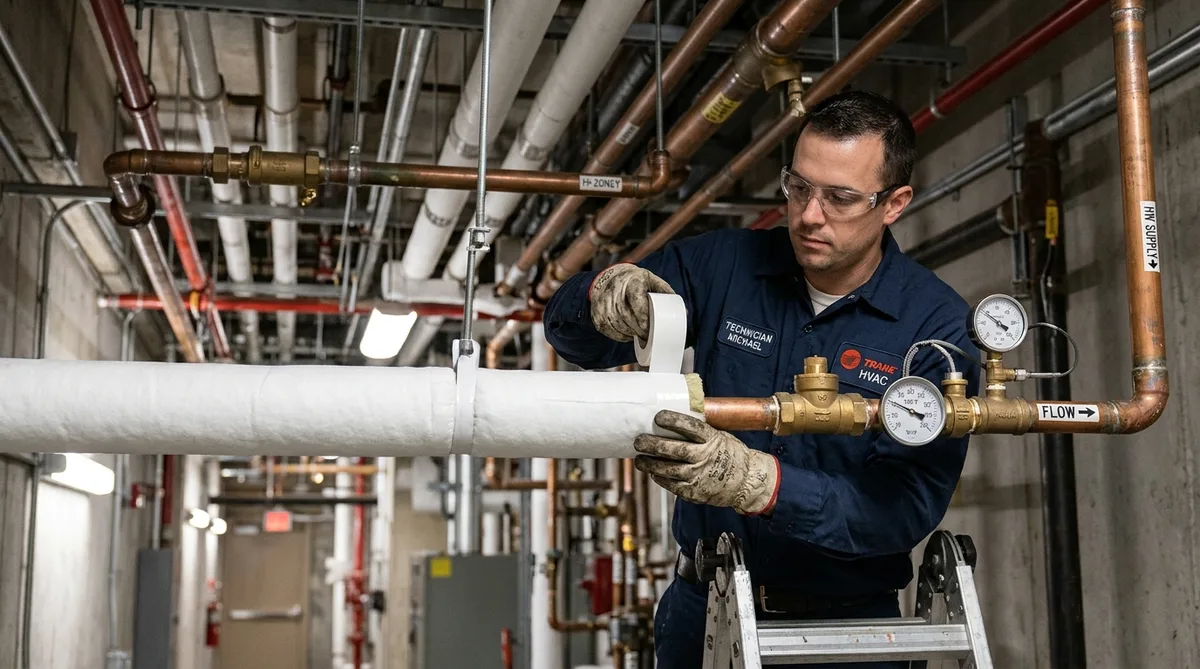 Uninsulated hot water distribution piping acts like an unintended baseboard radiator, dissipating expensive boiler energy into basements and pipe chases year-round.
Key Factors Driving High DHW Consumption in Multifamily Housing:
- Simultaneous Peak Demand: A 150-unit residential property experiences severe morning peaks (6:30 AM to 9:00 AM) and evening peaks (6:00 PM to 9:30 PM). To prevent cold-water complaints, systems are engineered with massive heating and storage buffers.
- Municipal Cold Water Rise: In New York City, incoming water from upstate reservoirs drops to 40°F–45°F during winter months. Heating that water to the code-mandated 120°F requires a dramatic 75°F to 80°F temperature rise (ΔT), requiring immense BTUs.
- Energy Consumption vs. Energy Cost: Fuel selection plays a pivotal role in the bottom-line utility budget. A building utilizing legacy electric resistance immersion heaters will incur exorbitant utility bills compared to one utilizing a high-efficiency condensing gas plant or modern heat pump, even when delivering identical hot water volume.
3. The Hidden Culprit: Distribution and Recirculation Heat Losses
One of the most overlooked components of a central DHW system is the extensive pipe network hidden within building chases and ceiling plenums. Once water is heated in the central plant, it travels through hundreds or thousands of linear feet of copper or steel pipework.
According to ASHRAE service-water-heating research, distribution piping heat loss combined with potable water wasted while tenants wait for hot water commonly accounts for 10% to 20% or more of total DHW system energy use. In poorly insulated buildings with long horizontal branch lines, distribution losses can exceed 30% of total boiler output.
Continuous hot-water recirculation loops are designed to ensure immediate hot water at upper-floor taps. However, keeping extensive piping networks continuously heated at 125°F–130°F causes severe heat dissipation into unconditioned shafts and basements. ASHRAE guidelines warn that uncontrolled, continuous recirculation loops can more than double total water-heating energy consumption compared to the actual hot water consumed at the faucet!
Where Does the Wasted Thermal Energy Go?
- Uninsulated Supply Mains: Bare pipes in unconditioned basements bleed heat continuously, turning basement mechanical rooms into 85°F ovens.
- Uninsulated Return Lines: Recirculation return lines carry cooled water back to the heater, losing thermal energy throughout the entire return loop.
- Unbalanced Recirculation Risers: Over-pumping through short loops starves distant risers while overheating closer ones, requiring higher overall plant temperatures.
- Storage Vessel Standby Losses: Unjacketed or aging storage tanks radiate standby heat 24 hours a day, requiring cyclic burner firing even during dead-of-night periods.
4. Linked vs. Separate DHW Systems: The Older NYC Building Penalty
In thousands of older pre-war and post-war NYC apartment buildings, domestic hot water is generated by the same central boiler that provides space heating. These are known as linked DHW systems, operating via internal tankless coils or external shell-and-tube indirect heat exchangers.
During the winter, when the boiler is actively firing to heat the building, linked systems function acceptably. However, during the summer months, the massive space-heating boiler must continue firing exclusively to satisfy domestic hot water demand.
Imagine using a 150-horsepower steam or hydronic boiler—sized to heat an entire 14-story building during a 10°F January blizzard—just to heat water for an afternoon shower in July. The boiler short-cycles, operates at less than 25% part-load efficiency, and loses vast amounts of standby heat through the chimney stack and boiler skin.
| DHW System Configuration | Median Weather-Normalized Fuel EUI | Fuel Penalty vs. Separate Direct-Fired | Seasonal Operational Profile |
|---|---|---|---|
| Direct-Fired Storage Tank (Separate) | 50.7 kBtu/sq. ft. | Baseline (0%) | Space heating boiler shuts down entirely from May to October. |
| Separate Hot-Water Boiler | 57.0 kBtu/sq. ft. | +12.4% fuel use | Dedicated high-efficiency DHW boiler operates year-round at proper sizing. |
| Indirect Heat Exchanger (Linked) | 62.3 kBtu/sq. ft. | +22.9% fuel use | Main heating boiler maintains temperature year-round to feed exchanger. |
| Tankless Coil in Heating Boiler (Linked) | 67.5 kBtu/sq. ft. | +33.1% fuel use | Severest seasonal penalty; massive boiler fires intermittently all summer. |
Urban Green Council's study documented that a typical NYC multifamily building with a linked DHW system consumed approximately 10 kBtu/sq. ft. more fuel annually than an equivalent building with separate DHW equipment—representing a 16% to 20%+ fuel penalty across pre-war building stock.
5. Common DHW Deficiencies Uncovered During Energy Audits
Under NYC Local Law 87, buildings over 50,000 square feet must undergo an ASHRAE Level II energy audit and retro-commissioning study every 10 years. In multifamily properties, DHW deficiencies represent some of the most lucrative, rapid-payback Energy Conservation Measures (ECMs) identified by energy auditors.
Top 6 Deficiencies Discovered in Mechanical Audits:
- Missing or Compromised Pipe Insulation: Bare copper lines, missing valve jackets, and damaged fiberglass wraps along basement mains. Adding 1.5-inch fiberglass insulation delivers payback in under 18 months.
- Constant Uncontrolled Recirculation Pumping: Recirculation pumps running at constant speed 24/7 without temperature aquastats or electronic timer controls.
- Boiler Short-Cycling During Summer: Burners firing for 90-second bursts to satisfy tankless coil demand, creating incomplete combustion, sooting, and massive fuel waste.
- Excessive Aquastat Temperature Settings: Heaters set to 140°F–145°F to overcome distribution balancing flaws, accelerating pipe scaling, increasing standby loss, and creating severe scalding risks.
- Deteriorated Tank Storage Insulation: Bare steel storage vessels radiating thousands of BTUs per hour directly into boiler room ambient air.
- Unrestricted Point-of-Use Fixture Flows: Legacy 2.5 to 3.5 gpm showerheads and missing aerators allowing hundreds of thousands of gallons of heated water to wash down drains unnecessarily.
6. How Much Energy Do Insulation and Water-Saving Upgrades Save?
Achieving meaningful DHW energy savings does not necessarily require spending $250,000 on an immediate plant overhaul. Targeted low-cost and medium-cost retrofits yield substantial annual utility savings:
| Energy Conservation Measure (ECM) | Typical Capital Cost | Expected DHW Energy Reduction | Typical Payback Period |
|---|---|---|---|
| Pipe & Fitting Insulation (1.5" Fiberglass) | $15 – $35 / linear foot | 8% – 15% reduction in distribution losses | 0.8 – 2.0 years |
| Storage Tank Thermal Jacket Insulation | $500 – $2,000 / tank | 3% – 6% reduction in standby loss | 1.0 – 2.5 years |
| Smart Recirculation Temperature Aquastats | $1,500 – $4,500 installed | 15% – 30% reduction in loop heat loss | 1.2 – 3.0 years |
| High-Efficiency WaterSense Fixtures (1.5 gpm) | $25 – $45 / dwelling unit | 10% – 20% reduction in hot water volume | 0.5 – 1.5 years |
| Separating Summer DHW from Main Boiler | $35,000 – $85,000 installed | 15% – 25% overall building fuel reduction | 3.0 – 5.5 years |
7. Heat Pump Water Heaters: The Electrification Solution for NYC Buildings
As NYC building owners formulate decarbonization capital plans to avoid steep emissions fines under Local Law 97, domestic hot water electrification is taking center stage. Commercial Heat Pump Water Heaters (HPWHs) extract thermal energy from surrounding air (or water loops) and transfer it into domestic water via high-pressure refrigerant compression.
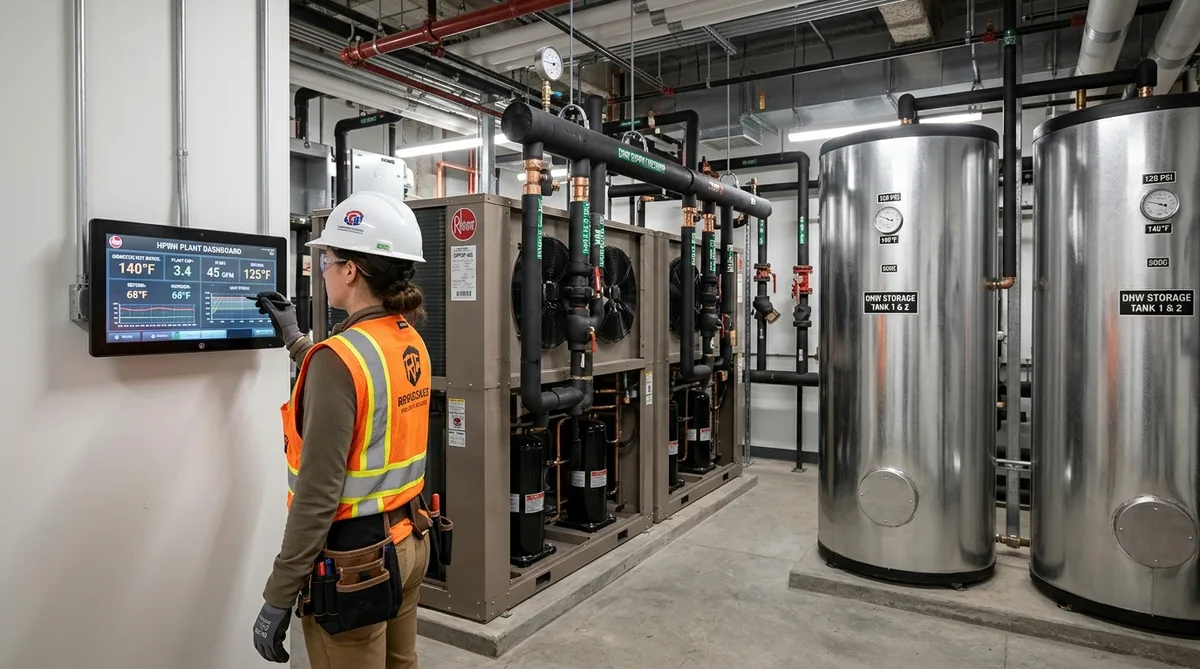 Commercial heat pump water heaters deliver Coefficients of Performance (COP) of 2.5 to 3.8, moving 3 to 4 units of thermal heat into domestic water for every unit of electricity consumed.
Why HPWHs Outperform Traditional Water Heaters:
- 300%+ Efficiency (COP > 3.0): Traditional electric resistance water heaters convert 1 kW of electricity into 1 kW of heat (100% efficiency). Heat pumps move heat rather than creating it, delivering 2.5 to 3.8 kW of heat per kW of electrical input.
- Zero On-Site Carbon Emissions: Eliminates gas and fuel oil combustion, helping properties beat LL97 carbon penalty thresholds.
- Thermal Battery Storage Potential: By pairing heat pumps with large insulated storage tanks, buildings can pre-heat water during off-peak overnight hours when Con Edison electric rates are lowest.
8. Con Edison Incentives for DHW Electrification in 2026
To accelerate building decarbonization, Con Edison provides aggressive utility incentives for qualifying heat pump water heating projects across market-rate and affordable multifamily properties:
| Program Category | Eligible Electrification Measure | Published 2026 Con Edison Incentive | Incentive Caps & Restrictions |
|---|---|---|---|
| Market-Rate Multifamily | Prescriptive Air-Source DHW Electrification | $1,000 / dwelling unit | Capped at $1,000,000 or 50% of total project costs. |
| Market-Rate Multifamily | Custom Commercial DHW Electrification | $200 / MMBtu saved | Requires pre-engineering energy model; 50% cap. |
| Affordable Housing (AMEEP-E) | Water Heating Electrification (Non-Comprehensive) | $2,400 / dwelling unit | 5+ unit affordable buildings; capped at 85% of cost. |
| Affordable Housing (AMEEP-E) | Water Heating Electrification (Comprehensive) | $4,400 / dwelling unit | Bundled with envelope/controls; capped at 85% of cost. |
| Affordable Housing (AMEEP-E) | Combined Space & Water Heating Electrification | $14,400 – $18,400 / dwelling unit | Whole-building full decarbonization incentive. |
9. NYC Code Mandates: Health, Safety, and Minimum Temperatures
When executing energy efficiency retrofits on domestic hot water systems, building owners must never sacrifice tenant safety or regulatory compliance. In New York City, strict municipal codes govern water temperatures:
NYC HPD 120°F Constant Delivery Rule:
Under the NYC Housing Maintenance Code enforced by Housing Preservation and Development (HPD), residential property owners are legally required to provide domestic hot water 24 hours a day, 365 days a year, at a constant minimum temperature of 120°F at every tap and fixture. Violations result in emergency HPD violations and tenant rent abatements.
Balancing Legionella Prevention with Anti-Scald Protection:
- Storage Temperature: To prevent the proliferation of Legionella pneumophila bacteria, storage tanks should generally maintain water at 140°F.
- Delivery Temperature: Water at 140°F causes second-degree burns in less than three seconds. Therefore, code-compliant systems must install certified ASSE 1017 master thermostatic mixing valves (digital or mechanical) to temper water down to precisely 120°F–125°F before entering distribution risers.
- 2025 NYC Energy Conservation Code: Enforced as of March 30, 2026, the updated NYCECC mandates strict distribution pipe insulation thicknesses (R-value minimums) and automatic shutoff controls on recirculation loops during prolonged unoccupied periods for commercial and multifamily systems.
10. How to Measure Your Building's True DHW Energy Baseline
Before committing capital to equipment replacement, facility managers and boards must establish a defensible domestic hot water baseline. Do not guess DHW consumption from annual utility bills when heating and hot water share the same gas meter.
Key Metrics to Track on Your Energy Dashboard:
- DHW Energy Use Intensity (EUI): Total kBtu of water heating fuel per gross square foot.
- Gallons Per Dwelling Unit Per Day: Benchmarking daily potable water consumption per apartment (typically 40–60 gallons/unit/day in efficient buildings).
- Recirculation Loop ΔT: Temperature difference between supply water entering risers and return water arriving back at the mixing valve. A ΔT greater than 15°F indicates poor balancing or uninsulated loops.
- Summer Boiler Runtime Hours: Logging burner cycles when outdoor temperatures exceed 65°F to expose severe short-cycling.
11. Practical Staged DHW Upgrade Roadmap for Property Managers
Upgrading domestic hot water should follow a disciplined, phased approach that harvests rapid-payback low-hanging fruit before investing in major capital plant conversions:
| Implementation Phase | Targeted Mechanical Upgrades | Primary Engineering Objective |
|---|---|---|
| Phase 1: Distribution & Storage Insulation | Insulate all unjacketed basement supply lines, return piping, valves, and storage tanks. | Eliminate 10%–20% parasitic thermal decay immediately with minimal capital. |
| Phase 2: Point-of-Use Flow Control | Audit fixtures and distribute 1.5 gpm WaterSense showerheads and 0.5 gpm faucet aerators. | Reduce total hot water demand across residential units by 15% to 25%. |
| Phase 3: Recirculation Balancing & Aquastats | Install balancing valves on risers and add temperature-controlled aquastats to pump starters. | Prevent overheating of return loops and eliminate excessive continuous pumping. |
| Phase 4: Summer Plant Decoupling | Install a dedicated high-efficiency condensing gas or heat pump water heater for summer baseload. | Allow the central space-heating boiler to be shut down completely for 5–6 months annually. |
| Phase 5: Full Electrification with HPWH | Transition entire domestic hot water infrastructure to commercial heat pump water heaters. | Eliminate fossil-fuel water heating, leverage Con Edison incentives, and comply with LL97. |