BY NYC Energy Code Team
ON
1 November 2026
Cool Roof vs White Roof vs Green Roof: Which Cuts More Cooling Cost?
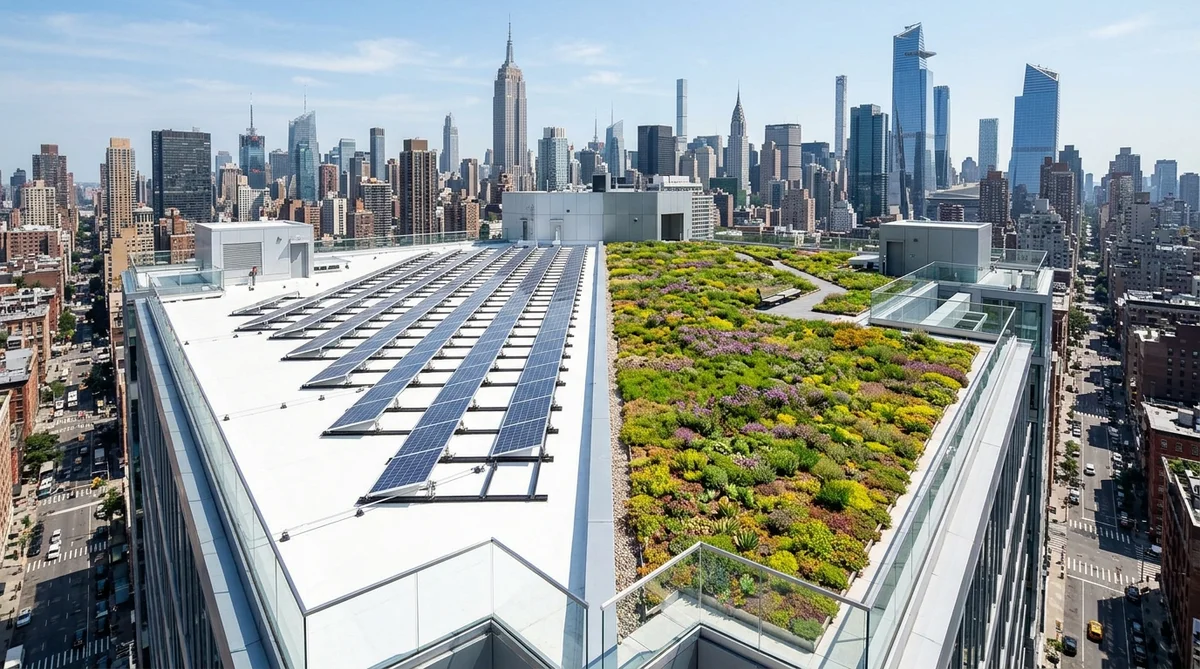
Which Roof Reduces Cooling Costs the Most?
A commercial building owner planning a roof replacement has three common options: install a reflective white roof, choose another high-performance cool roofing material, or invest in a green roof with vegetation.
All three can help reduce heat entering a building, but they work differently and do not offer the same financial benefits.
A reflective roof sends more incoming sunlight away from the building. A green roof uses vegetation, growing medium, shading, and evapotranspiration to reduce roof temperatures and influence heat transfer.
For a building focused primarily on reducing summer air-conditioning costs, a high-performance reflective cool roof is often the more direct and economical solution. A green roof may offer additional year-round and environmental benefits, but it usually requires a larger initial investment, structural assessment, and ongoing maintenance.
There is also an important terminology issue: a white roof is commonly one type of cool roof. The real technical comparison is between a reflective roof assembly and a vegetated roof assembly.
The best choice depends on the building's insulation, cooling demand, winter heating requirements, roof condition, available budget, and intended use of the rooftop.
The Direct Cooling vs. Holistic Value Equation
When summer air-conditioning reduction per dollar spent is the sole metric, high-reflectance cool roofs win on simplicity and immediate ROI. However, green roofs provide stormwater mitigation, urban heat island attenuation, extended membrane lifespan, and compliance with NYC sustainable roofing mandates.
1. What Is a Cool Roof?
A cool roof is designed to absorb less solar heat and release the heat it does absorb more effectively than conventional roofing materials.
Two properties determine much of its performance:
- Solar reflectance: The percentage of incoming sunlight reflected away from the roof rather than absorbed.
- Thermal emittance: How effectively the roof releases absorbed heat through thermal radiation.
A cool roof generally performs better when it has both high solar reflectance and high thermal emittance.
Common cool roofing materials include reflective membranes, specialty coatings, metal roofing, reflective tiles, and other products designed to meet relevant performance criteria.
Unlike older roofing systems that rely primarily on dark surfaces, cool roofs reduce the amount of solar energy absorbed by the building envelope.
ENERGY STAR identifies lower air-conditioning demand, improved indoor comfort, reduced urban heat-island effects, and potentially longer roof-material life as benefits of cool roofing. It also notes that performance depends on climate and building characteristics. Reference: ENERGY STAR — Cool Roofs.
How Much Cooling Energy Can a Cool Roof Save?
The greatest opportunity generally occurs in buildings with dark, poorly insulated roofs and significant summer cooling demand. When a roof absorbs less solar radiation, less heat is transferred toward the occupied interior. This can reduce the amount of cooling that HVAC equipment needs to provide.
However, a cool roof does not eliminate the building's other cooling loads. Solar exposure through windows, internal equipment, occupancy, ventilation, and heat entering through walls also affect electricity consumption.
For a well-insulated building, the difference in cooling costs may be less significant because the existing insulation already limits heat transfer through the roof.
2. What Is a White Roof?
A white roof typically uses a light-colored membrane, coating, or roofing surface that reflects a large portion of incoming sunlight.
It is one of the most common ways to achieve cool-roof performance on flat and low-slope commercial buildings.
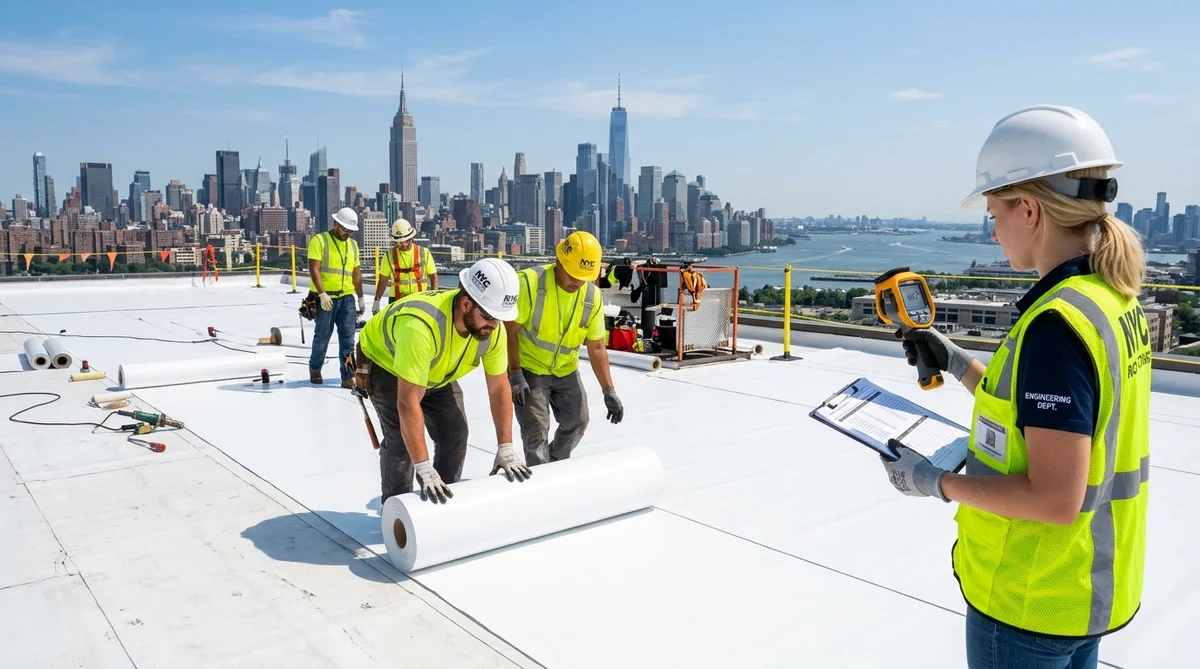
For example, an owner may apply a compatible white reflective coating over an existing roof assembly after addressing surface damage and other preparation requirements. Another option is to install a reflective white single-ply roofing membrane during a full roof replacement.
White surfaces are generally effective at reflecting solar radiation, but color alone does not prove that a product meets the required performance standard. A white coating with inadequate solar reflectance or thermal emittance may not qualify as a cool roofing product under the applicable code. Product specifications and independent performance ratings should be checked before selection.
Reflective Technology
Why White Roofs Are Popular with Commercial Property Owners
The main advantage is relatively straightforward installation compared with a fully vegetated roof system. Where the existing membrane is suitable, a reflective coating may provide an opportunity to improve surface performance without reconstructing the entire roofing assembly. A new reflective membrane may also be integrated into a planned roof replacement.
White roofs generally do not require the planting systems, growing medium, irrigation arrangements, and vegetation maintenance associated with green roofs. However, reflective surfaces can become dirty and lose performance over time. Periodic inspection and maintenance are important to preserve their reflectivity.
3. What Is a Green Roof?
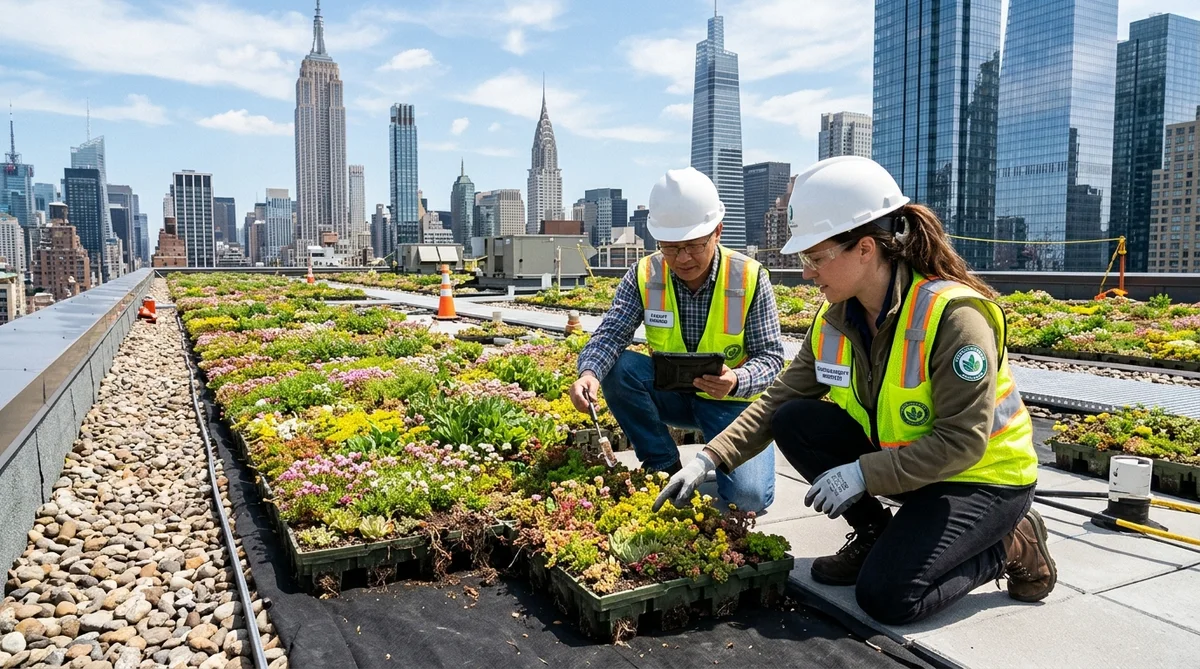
A green roof is a rooftop assembly that supports vegetation over a waterproofing and drainage system.
Unlike a reflective membrane, a green roof changes the way the rooftop interacts with sunlight, water, and surrounding air. Plants provide shade, while growing medium and retained moisture influence heat transfer. Evapotranspiration—the process through which plants release water vapor—can also cool the surrounding roof environment.
Green roofs are generally divided into two categories:
| Green Roof Type | Construction | Typical Characteristics |
|---|---|---|
| Extensive green roof | Relatively shallow growing medium and low-growing vegetation | Lighter than intensive systems, with comparatively lower maintenance requirements |
| Intensive green roof | Deeper growing medium with a wider range of plants, shrubs, and sometimes trees | Greater landscaping potential but higher structural and maintenance demands |
An extensive green roof is often considered for commercial buildings where the objective is environmental performance rather than creating a public rooftop garden.
An intensive roof may be suitable for properties seeking usable landscaped space, recreational amenities, or greater vegetation diversity.
The U.S. General Services Administration describes planted roofs as systems that can reduce stormwater runoff, support biodiversity, improve rooftop environments, and provide energy-related benefits. It also highlights the additional structural and maintenance considerations associated with deeper planted systems. Reference: GSA — Planted Roofs.
4. Cool Roof vs White Roof vs Green Roof: Side-by-Side Comparison
Before comparing costs, remember that cool roof and white roof overlap: a white roof can be a cool roof when it meets the relevant performance criteria.
| Feature | Cool Roof | White Roof | Green Roof |
|---|---|---|---|
| Main principle | High solar reflectance and thermal emittance | Reflects sunlight through a light-colored surface | Vegetation, shading, moisture, and growing-medium insulation |
| Typical material | Reflective membranes, coatings, metal, or tiles | White coating or membrane | Plants, growing medium, drainage and protection layers |
| Summer cooling benefit | Reduces solar heat absorption | Reduces solar heat absorption when appropriately rated | Reduces roof heating through shading and evapotranspiration |
| Winter performance | Can increase heating demand in some climates | Similar to other reflective cool roofs | Growing medium can provide additional insulation |
| Initial installation cost | Depends on product and roof work | Often relatively low for compatible coatings | Generally higher due to additional roof layers and engineering |
| Structural demand | Usually limited compared with a planted system | Usually limited compared with a planted system | Requires evaluation of saturated weight and other roof loads |
| Maintenance | Surface inspection and product-specific maintenance | Cleaning and coating or membrane upkeep | Vegetation, drains, growing medium, and waterproofing maintenance |
| Stormwater benefits | Generally limited compared with a green roof | Generally limited compared with a green roof | Helps retain and slow stormwater runoff |
| Additional benefits | Reduced heat-island effect and potential roof durability benefits | Reflective rooftop surface | Biodiversity, habitat, vegetation, and possible rooftop amenity space |
The distinction is not that one system is universally better. Each addresses a different combination of building performance objectives.
5. Which Roof Cuts More Cooling Electricity Costs?
When the question is specifically about summer cooling energy, reflective cool roofs often have an advantage over conventional dark roofs. Green roofs can also reduce cooling demand, but their performance depends on vegetation, growing-medium depth, available moisture, local climate, and building design.
A 2024 study published in npj Urban Sustainability compared cool and green roofs using building-energy simulations across six cities: Cairo, Hong Kong, Seoul, London, Los Angeles, and São Paulo. The research found that cool roofs produced slightly greater cooling-energy reductions than green roofs in most of the modeled regions. It also found that green roofs could provide more favorable heating-energy performance in colder climates because of their additional insulating layer. Reference: Jia et al., 2024 — Building Energy Savings by Green Roofs and Cool Roofs.
For a NYC building, the comparison needs to account for four key factors:
- Summer solar exposure: A large, unobstructed roof with significant afternoon sun may benefit substantially from a reflective surface.
- Existing insulation: If the roof assembly already has strong insulation, changing the surface may produce a smaller reduction in indoor cooling demand.
- Winter heating: A reflective roof reduces solar heat gain during winter too. That can increase heating demand under some conditions, offsetting part of the summer benefit.
- Building height and roof area: A low-rise building with a large roof relative to its occupied floor area may benefit more than a high-rise building where the roof represents a small share of the total building envelope.
For this reason, owners should compare annual heating and cooling costs rather than judging a project only by rooftop temperature measurements.
6. Installation Costs: Which Option Is Easier on the Budget?
Installation cost depends heavily on whether the owner is applying a new surface over a suitable roof or replacing an entire roof assembly.
A reflective coating may be a relatively limited intervention when the existing roofing system is in suitable condition and compatible with the coating. A complete white membrane replacement involves more work, including removal or preparation of existing materials, insulation, waterproofing, and flashing details.
A green roof generally involves more components and coordination. In addition to waterproofing, the installation may require root protection, drainage layers, filter fabric, growing medium, vegetation, edging, access provisions, and structural verification.
| Cost Consideration | Reflective White/Cool Roof | Green Roof |
|---|---|---|
| Surface preparation | Usually relatively straightforward, depending on existing roof condition | Existing roof must be assessed for the complete new assembly |
| Waterproofing | New membrane or compatible coating system | Waterproofing plus appropriate root protection |
| Additional layers | Product-specific reflective roofing layers | Drainage, filter, growing medium, and vegetation |
| Structural assessment | Needed where the scope and conditions require it | Particularly important because of saturated system weight |
| Installation complexity | Generally lower | Generally higher |
| Ongoing expenses | Cleaning, inspection, and product maintenance | Drainage, vegetation care, irrigation where needed, and membrane inspection |
There is no reliable universal price per square foot for all three options. Commercial roof costs vary with roof size, access, existing conditions, insulation, membrane type, labor, and the amount of repair required.
A green roof should also be evaluated over its lifecycle. The GSA's green-roof research identifies reduced stormwater management costs, potential energy savings, and longer roof service life among its economic benefits. However, those benefits need to be assessed against installation and maintenance costs for the specific property. Reference: GSA — Planted Roof Cost and Benefits.
7. A Commercial Building Example: Calculating the Potential Cooling Savings
Consider a hypothetical NYC office building with a 50,000-square-foot roof. Its existing roof is dark, and the property manager wants to compare a reflective roofing upgrade with a green roof.
Assume the building spends $80,000 annually on electricity attributable to cooling. The design team models three scenarios:
| Scenario | Assumed Reduction in Cooling Electricity Cost | Estimated Annual Savings |
|---|---|---|
| Reflective roof option | 5% | $4,000 |
| Higher-performance cool roof option | 8% | $6,400 |
| Green roof option | 6% | $4,800 |
Illustrative assumptions only. These percentages are not industry averages, published savings guarantees, or measured NYC performance results.
For example, the reflective roof calculation is:
$80,000 × 0.05 = $4,000
If the reflective roof project costs $40,000, its simple cooling-cost payback would be:
$40,000 / $4,000 = 10 years
This calculation is useful for understanding the financial relationship between installation cost and estimated savings. However, it does not capture every economic benefit or expense. A complete comparison should include additional winter heating costs where applicable, maintenance, roof replacement timing, stormwater benefits, utility rates, and any available incentives.
8. What NYC Building Owners Must Know About Cool Roofs and Green Roofs
New York City has requirements covering both reflective roof performance and sustainable roofing installations.
Building Code §1504.9
Cool Roof Requirements Under NYC Building Code §1504.9
Under the NYC Building Code, roof coverings on roofs or setbacks with a slope equal to or less than 2:12 (17%) generally must satisfy one of these performance paths:
- Minimum initial solar reflectance of 0.70 and minimum thermal emittance of 0.75; or
- Minimum Solar Reflectance Index (SRI) of 82.
For roof slopes greater than 17%, the corresponding requirements are generally a minimum initial solar reflectance of 0.25 and thermal emittance of 0.75, or an SRI of 39.
The code provides exceptions, including qualifying areas covered by green roof systems and certain rooftop spaces or other specified conditions. These are code performance requirements, not a rule that every roof must simply be painted white. A product must meet the applicable measured performance criteria. Reference: NYC Building Code §1504.9 — Reflectance.
Local Laws 92 & 94
Local Laws 92 and 94: Sustainable Roofing Zones
Local Laws 92 and 94 require sustainable roofing zones on certain projects, including:
- New buildings.
- New roofs resulting from building enlargements.
- Existing buildings replacing an entire existing roof deck or roof assembly.
The applicable sustainable roofing zone must generally be covered by green roof systems, solar photovoltaic systems, or a combination of both, subject to defined exceptions and permitted exclusions.
A reflective white roof alone does not satisfy the sustainable-roofing-zone requirement under LL92/94. It may satisfy the separate roof-reflectance requirements, but the sustainable zone must use the qualifying green roof and/or solar PV systems. NYC requires applicable green roof and solar filings through DOB NOW, and a registered design professional must be involved. Reference: NYC DOB — Local Laws 92 and 94.
9. Can a Building Combine a Cool Roof and a Green Roof?
Yes. A rooftop does not necessarily need to use only one system across its entire surface.
A coordinated design may place a green roof over one portion of the roof and reflective roofing material over another. The design can also accommodate solar panels where appropriate.
This approach may be useful when:
- Structural capacity limits the area that can support a planted assembly.
- Mechanical equipment occupies substantial roof space.
- The building needs both sustainable-roofing compliance and reflective roofing on unplanted areas.
- Different areas have different maintenance and access requirements.
The architect and structural engineer should coordinate the complete roof plan. Drainage, access pathways, equipment clearances, waterproofing details, and load distribution must remain functional. The goal is not to maximize one roof technology at the expense of the others. It is to assign each roof area a function that works for the building.
10. How to Choose the Right Roof for Your Building
A property owner should begin with the building's primary objective rather than selecting a roofing product based on appearance or marketing claims.
If the priority is reducing summer cooling demand with limited additional structural work, a reflective cool roof deserves close evaluation.
If the building also needs stormwater management, rooftop vegetation, or environmental amenities, a green roof may provide broader value even when its direct cooling-cost savings are not the highest.
If the building has an aging roof, start with the existing assembly. Installing a reflective coating over a roof with moisture damage or significant deterioration may only postpone necessary replacement.
Before making a final decision, compare these factors:
- Existing roof condition and remaining service life.
- Insulation level and current cooling and heating consumption.
- Structural capacity and proposed additional loads.
- Applicable NYC reflectance and sustainable-roofing requirements.
- Installation cost and expected maintenance.
- Stormwater objectives, rooftop use, and potential incentives.
A roof consultant, architect, and energy professional can help translate these factors into a lifecycle-cost comparison rather than relying on a generic savings percentage.
Conclusion: Which Roof Actually Saves More Money?
For a commercial building focused mainly on summer air-conditioning costs, a high-performance reflective cool roof is often the more direct and economical option. A white roof can deliver that performance when its reflectance and thermal-emittance characteristics meet the required criteria.
A green roof offers a different value proposition. It can reduce summer roof heat, contribute insulation, retain stormwater, support vegetation, and provide additional environmental benefits. Its higher installation and maintenance requirements should be considered alongside those benefits.
For NYC building owners, the decision also needs to account for winter heating performance and the separate obligations under Building Code §1504.9 and Local Laws 92 and 94.
There is no universal winner across all properties. The most financially suitable option is the one that reduces the building's annual energy costs while satisfying structural, waterproofing, maintenance, and regulatory requirements.
Before committing to a roof replacement, compare the expected annual cooling and heating impacts, complete installation costs, and long-term maintenance requirements. That analysis will provide a more dependable investment decision than choosing a roof based on color or technology alone.
Frequently Asked Questions
A reflective cool roof often provides stronger direct summer cooling-energy reductions, particularly on dark, poorly insulated roofs. Green roofs can also reduce cooling demand, but their performance depends on vegetation, moisture, substrate depth, climate, and building design.
Not exactly. A white roof is a common type of cool roof, but a cool roof is defined by its measured solar reflectance and thermal emittance. A white surface does not automatically meet the required cool-roof performance standards.
Savings vary according to roof condition, insulation, climate, solar exposure, HVAC efficiency, and operating patterns. Buildings with dark roofs and significant cooling demand generally have greater opportunities. An energy model provides a more reliable property-specific estimate.
It can increase heating demand in some climates because the roof reflects sunlight that might otherwise provide passive solar heat. The effect depends on insulation, climate, building orientation, and heating system operation. NYC building owners should evaluate annual heating and cooling costs together.
Generally, yes. Green roofs require additional layers, growing medium, vegetation, drainage components, structural review, and maintenance. A reflective white coating or membrane typically involves a simpler installation, although the actual cost depends on the existing roof and project scope.
A green roof adds growing medium and other layers that can influence thermal performance. However, its insulating performance depends on substrate depth, moisture content, and the complete roof assembly. It should not be treated as a replacement for properly specified insulation.
No. A white reflective roof may satisfy the separate cool-roof reflectance requirements, but it does not independently satisfy the sustainable roofing-zone requirement. Applicable zones must use qualifying green roof systems, solar PV systems, or a combination of both.
NYC Building Code §1504.9 establishes solar-reflectance and thermal-emittance requirements for applicable roof coverings, particularly low-slope roofs, subject to listed exceptions. The actual requirement depends on roof slope, assembly, and applicable code provisions.
Potentially, but the existing roof membrane, waterproofing, drainage, structural capacity, and saturated system weight must be evaluated. A registered design professional should assess the proposed installation and its DOB filing requirements.
Yes, where the roof layout and engineering support the combination. Solar panels and green roofs can occupy the sustainable roofing zone, while reflective roofing materials can be used on suitable remaining areas. The complete design must address structural loads, drainage, solar access, maintenance, and NYC code requirements.
You may also like