Introduction: What Is the Section 179D Tax Deduction?
Improving the energy efficiency of commercial buildings requires significant investment. Property owners may need to replace HVAC equipment, upgrade lighting systems, improve insulation, modernize building envelopes, or install more efficient hot water systems.
These improvements can reduce operating expenses and support building decarbonization, but their initial costs can be substantial. The US federal government introduced Section 179D of the Internal Revenue Code to encourage investment in energy-efficient commercial buildings through a federal tax deduction.
Commonly known as the Energy Efficient Commercial Buildings Deduction, Section 179D allows eligible building owners to claim a deduction for qualifying energy-efficient property installed in commercial buildings.
The program also includes a special provision allowing certain tax-exempt building owners, such as government entities and nonprofit organizations, to allocate the deduction to eligible building designers. This creates opportunities for architects, engineers, and other qualifying design professionals involved in energy-efficient building projects.
Important 2026 Legislative Update
June 30, 2026 Construction Cutoff: The One Big Beautiful Bill Act of 2025 terminated the Section 179D deduction for property whose construction begins after June 30, 2026. Building owners, developers, architects, and engineering teams must substantiate physical work or the 5% Safe Harbor on or before June 30, 2026 to remain eligible.
In this guide, we explain how Section 179D works, who qualifies, how deduction amounts are calculated, and what building owners and designers need to know about the latest federal tax rules.
1. What Is Section 179D?
Section 179D is a federal income tax deduction designed to encourage energy-efficient improvements in commercial buildings. It was originally established under the Energy Policy Act of 2005 and later expanded through subsequent legislation, including the Inflation Reduction Act of 2022.
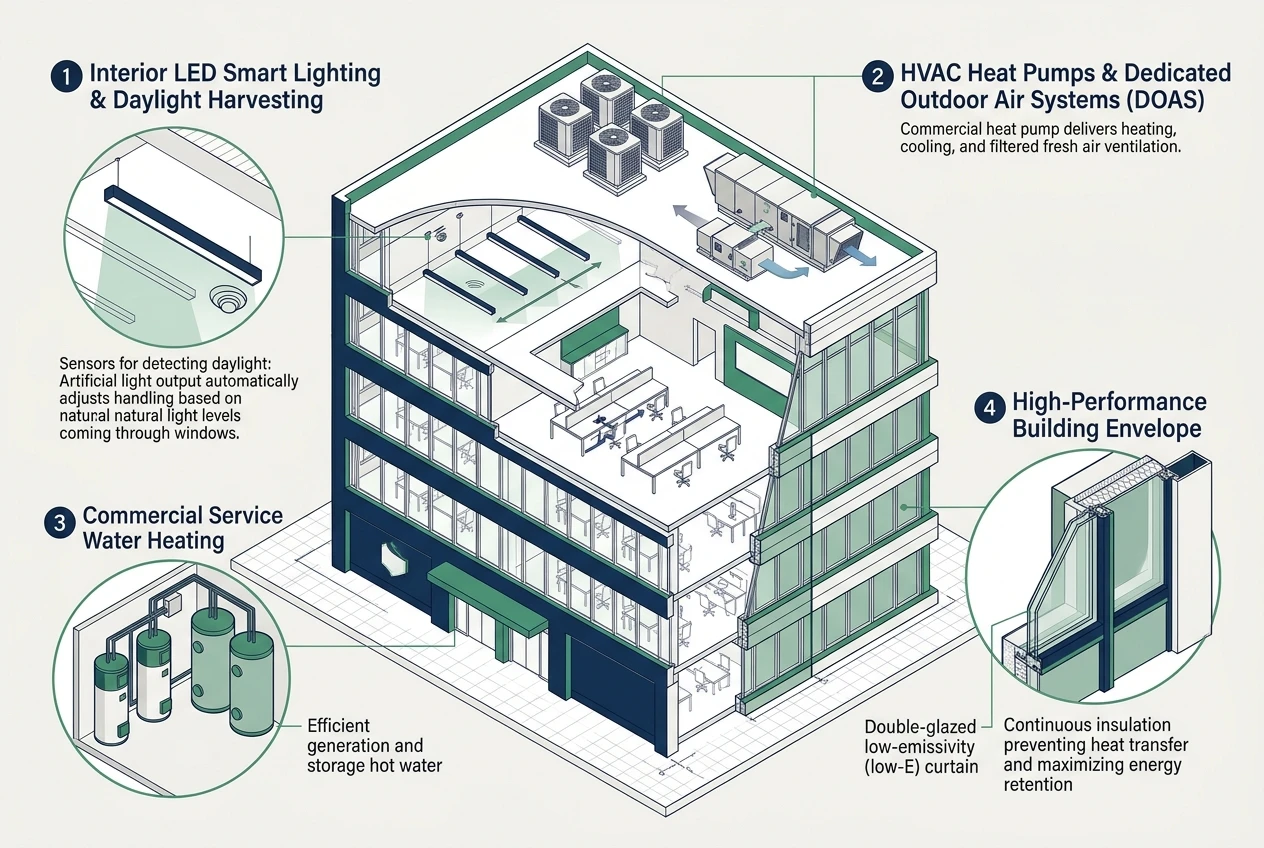
The deduction applies to qualifying energy-efficient commercial building property installed as part of eligible building systems:
- Interior Lighting: High-efficiency fixtures, controls, and integrated daylighting circuits.
- Heating and Cooling Systems: Variable refrigerant flow (VRF), chillers, boilers, and heat pumps.
- Ventilation Systems: Energy recovery ventilators (ERVs), demand-controlled ventilation, and high-efficiency fan arrays.
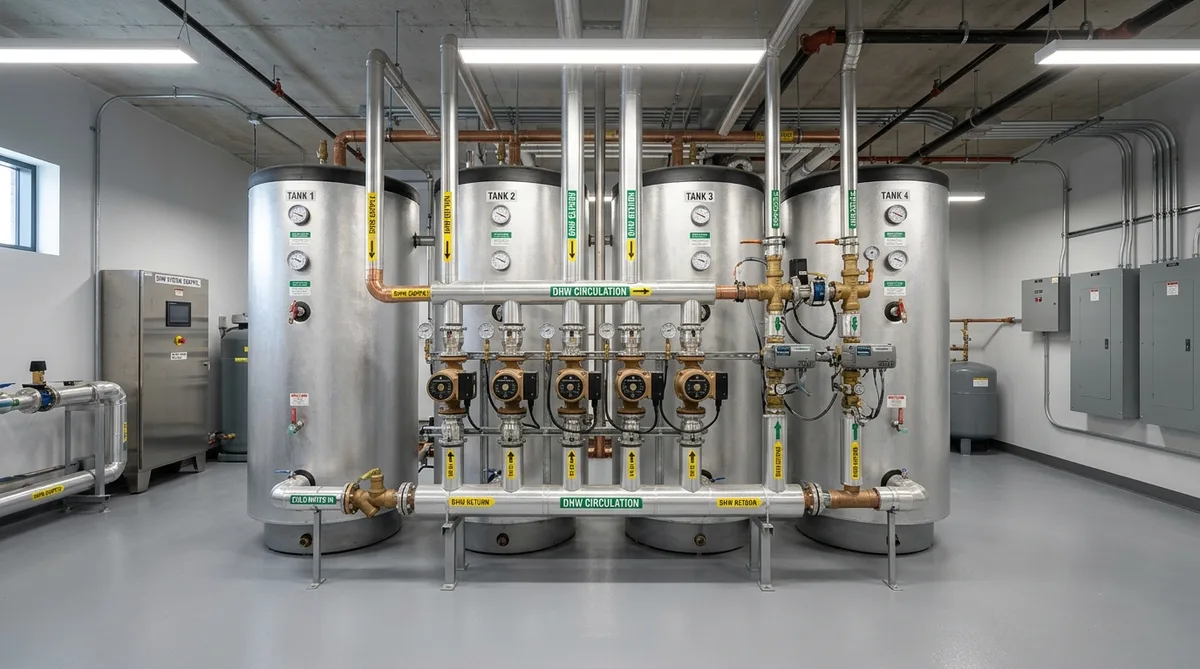
- Service Hot Water Systems: Commercial heat pump water heaters, condensing systems, and distribution loops.
- Building Envelope Components: Fenestration, wall insulation, cool roof assemblies, and high-performance air barriers.
The amount of the deduction generally depends on the building's eligible square footage, certified energy savings, applicable deduction rates, and cost limitations.
1.1 Is Section 179D a Tax Credit or a Tax Deduction?
Section 179D is a tax deduction, not a tax credit. This distinction is critical when evaluating pro forma financial models.
A tax credit directly reduces the amount of tax owed on a dollar-for-dollar basis, while a tax deduction reduces overall taxable income. For example, suppose an eligible business receives a $100,000 Section 179D deduction. That does not mean the business receives $100,000 in cash or reduces its tax bill by $100,000. Instead, the business reduces its taxable income by $100,000, and the actual cash tax savings depend on the taxpayer's marginal corporate or individual tax bracket.
1.2 Why Was Section 179D Introduced?
The purpose of Section 179D is to encourage building owners and designers to invest in energy-efficient systems. Commercial buildings consume substantial electricity and thermal fuel through lighting, heating, cooling, ventilation, and water heating.
Improving these systems reduces operating expenses and grid demand while cutting carbon emissions. The deduction helps offset upfront capital expenditures while advancing national clean energy goals.
1.3 What Changed Under the Inflation Reduction Act?
The Inflation Reduction Act of 2022 significantly modified Section 179D for qualifying property placed in service after December 31, 2022:
- Higher Potential Deduction Amounts: Maximum deduction jumped from $1.88/sq. ft. up to $5.00+/sq. ft. (inflation-adjusted to $5.94/sq. ft. in 2026).
- Prevailing Wage and Apprenticeship Multiplier: A ~5x multiplier for projects meeting federal wage and registered apprenticeship standards.
- Expansion of Designer Allocations: Broadened from only government-owned buildings to all tax-exempt entities, including 501(c)(3) nonprofits, private universities, hospitals, and tribal governments.
- Alternative Measured Retrofit Pathway: Introduction of the Energy Efficient Building Retrofit Property (EEBRP) pathway based on measured EUI reduction rather than whole-building computer simulation.
- Resetting Building Cap: Shifted the deduction cap reset cycle to every 3 to 4 tax years, allowing repeating retrofits on the same property over time.
2. Important 2026 Update: Section 179D Deduction Termination
One of the most consequential developments for commercial property owners is the termination of Section 179D for qualifying property whose construction begins after June 30, 2026. The change was enacted through Section 70507 of Public Law 119-21.
The IRS confirms that existing Section 179D rules continue to apply to property whose construction begins on or before June 30, 2026, provided all statutory energy-efficiency and certification requirements are satisfied.
2.1 What Does the June 30, 2026 Deadline Mean?
The termination rule is strictly based on when construction begins, not simply when the project is finished or when the tax return is filed. This is vital for complex commercial projects that take 18 to 36 months to complete.
Under IRS Notice 2022-61, taxpayers may establish the beginning of construction using one of two established tests:
- Physical Work Test: Requires physical work of a significant nature on-site or off-site under a binding written contract. Preliminary activities such as planning, architectural modeling, engineering design, permitting, financing, and site clearing do not satisfy this test.
- Five Percent Safe Harbor: Requires the taxpayer to pay or incur at least 5% of the total qualifying property cost on or before June 30, 2026, and maintain continuous construction or continuous diligent efforts until completion.
Key Takeaway: Beginning of Construction Documentation
Taxpayers seeking to claim 179D for projects completing in 2026, 2027, or beyond must create an incontrovertible audit trail demonstrating qualifying physical work or incurred capital expenditure meeting the 5% Safe Harbor on or before June 30, 2026.
2.2 Which Projects May Still Qualify?
| Project Scenario | Potential Section 179D Eligibility |
|---|---|
| Construction began before June 30, 2026 | May qualify if energy performance and certification rules are satisfied. |
| Installation began on June 30, 2026 | May qualify, subject to verifiable commencement documentation. |
| Construction begins after June 30, 2026 | Not eligible under the terminated statutory provision. |
| Project completed in 2027 (construction started Q1 2026) | May qualify under continuous construction / safe harbor guidelines. |
| Only engineering/permitting completed before cutoff | Not sufficient by itself without physical work or 5% safe harbor. |
| Completed before cutoff but fails 25% energy threshold | Not eligible; statutory energy savings are mandatory. |
2.3 What Should Building Owners Do About the 2026 Change?
Owners and developers with planned capital improvements should immediately compile and preserve:
- Executed binding construction and equipment procurement contracts.
- Vendor invoices, proof of milestone payments, and escrow records.
- Detailed contractor daily logs and photo documentation verifying physical installation.
- Comprehensive energy modeling files and baseline specifications.
- Prevailing wage payroll submissions and certified apprentice program verifications.
3. Who Can Claim the Section 179D Tax Deduction?
Section 179D provides two principal categories of eligible claimants: commercial building owners and qualified designers of energy-efficient systems installed in buildings owned by specified tax-exempt entities.
3.1 Commercial Building Owners
Owners of commercial buildings who pay federal income taxes can claim the deduction directly against their taxable income. Qualifying property types include:
- Commercial office complexes and high-rises.
- Retail properties, shopping centers, and urban malls.
- Hotels, motels, and hospitality properties.
- Industrial warehouses, distribution hubs, and flex buildings.
- Multifamily residential buildings that are four stories or greater above grade.
3.2 Architects, Engineers, and Design Professionals
Because government entities, public school districts, and nonprofit organizations do not pay federal income taxes, they cannot utilize a tax deduction. To incentivize efficiency in public infrastructure, Congress created the designer allocation provision.
Eligible design professionals include mechanical engineers, electrical engineers, structural and envelope designers, energy consultants, and architects who are primarily responsible for creating the technical specifications of the qualifying systems.
3.3 Government and Nonprofit Building Projects
Specified tax-exempt owners authorized to execute Section 179D allocation letters include:
- Federal, state, county, and municipal government departments.
- Public school districts, community colleges, and state universities.
- 501(c)(3) nonprofit entities, including non-profit hospitals, religious institutions, and foundations.
- Indian tribal governments and Alaska Native Corporations.
- Public transit authorities, airport authorities, and port agencies.
Can Private Building Architects Claim 179D Directly?
No. On a privately owned commercial building, the deduction belongs exclusively to the building owner. The designer allocation mechanism applies strictly to qualifying property installed in buildings owned by specified tax-exempt entities.
4. Which Commercial Building Improvements Qualify for Section 179D?
Section 179D applies to three core technical domains under the traditional building simulation method, plus building envelope performance.
4.1 Interior Lighting Systems
Qualifying lighting improvements must be hardwired interior systems. Eligible measures include:
- Complete transitions from fluorescent or high-intensity discharge (HID) to high-efficacy LED fixtures.
- Bilevel switching, daylight harvesting sensors, and automated occupancy controls.
- Digital lighting networks and building management system (BMS) lighting schedules.
4.2 HVAC and Mechanical Systems
Heating, ventilation, and air-conditioning retrofits generally deliver the largest share of overall building energy savings:
- High-efficiency magnetic bearing centrifugal or modular water-cooled chillers.
- Variable Refrigerant Flow (VRF) and centralized heat pump heating and cooling plants.
- Dedicated Outdoor Air Systems (DOAS) with sensible and latent energy recovery wheels.
- Variable Frequency Drives (VFDs) on pump motors, fans, and cooling tower drives.
4.3 Service Hot Water Systems
High-demand domestic hot water systems in hotels, multifamily buildings, and healthcare facilities can qualify through commercial heat pump water heaters, condensing boiler loops, and hot water distribution optimization.
4.4 Building Envelope Improvements
Upgrades to the thermal boundary reduce heating and cooling loads, enabling mechanical equipment downsizing:
- Low-emissivity double or triple-glazed thermally broken window systems.
- Continuous exterior wall insulation and thermal bridge mitigation.
- Rooftop insulation retrofits achieving high R-values (R-30 to R-40+).
- Continuous airtight building envelope sealing and air barrier membranes.
4.5 What Does Not Automatically Qualify?
Section 179D is strictly an efficiency deduction. The following items do not qualify under Section 179D:
- On-site solar photovoltaic panels and battery energy storage systems (these claim the Section 48 Investment Tax Credit instead).
- Industrial manufacturing or commercial kitchen process equipment.
- Elevators, escalators, and moving walkways.
- Exterior, parking lot, or architectural facade lighting.
5. What Are the Energy Efficiency Requirements Under Section 179D?
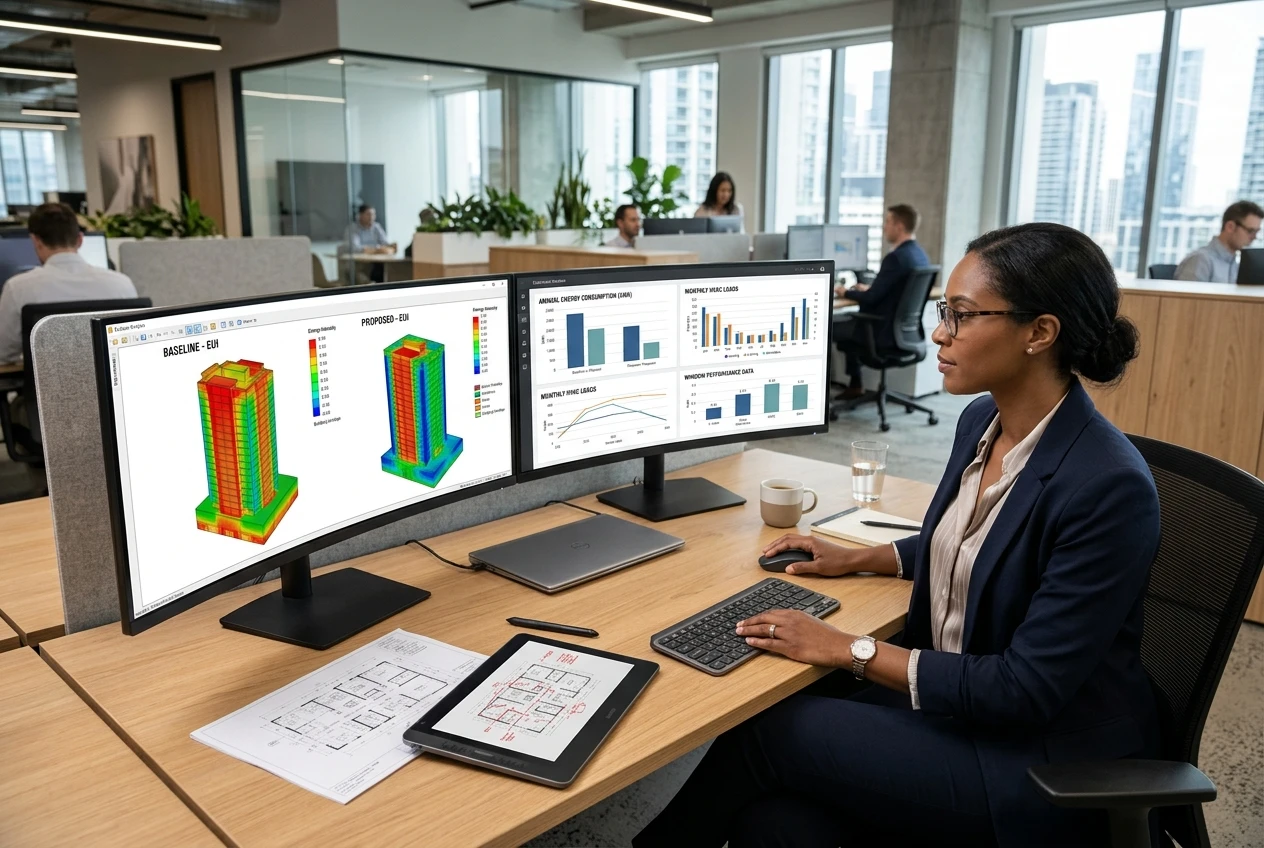
To qualify under the traditional modeling pathway, the installed energy-efficient property must be certified as reducing total annual energy and power costs for interior lighting, HVAC, and service hot water by at least 25% compared to an applicable reference building.
5.1 What Is ASHRAE Standard 90.1?
ASHRAE Standard 90.1 is the national benchmark for commercial building energy codes. Under Section 179D, the baseline reference standard is determined by federal regulations based on the date construction begins. The energy model must compare the proposed building design against an identically shaped and oriented reference building built strictly to the reference standard.
5.2 How Energy Savings Are Calculated
The engineering analysis uses IRS-approved building energy simulation software (such as EnergyPlus, eQUEST, or Trane TRACE). The model calculates total annual energy costs for regulated building loads (heating, cooling, ventilation, interior lighting, and service water heating). Plug loads and unregulated process equipment are excluded from the comparison.
5.3 Professional Certification Rules
Federal law requires Section 179D certifications to be conducted by an independent, licensed professional engineer or registered architect licensed in the jurisdiction where the building is located. The certifier must conduct an on-site field inspection to verify that the energy-efficient systems are installed as specified.
6. How Much Is the Section 179D Tax Deduction?
The deduction amount depends on the certified energy reduction percentage, whether prevailing wage and apprenticeship standards are met, and the project's actual cost.
For tax years beginning in 2026, the IRS published the following inflation-indexed statutory deduction rates:
| 2026 Deduction Category | At 25% Energy Savings | At Maximum Savings (55%+) |
|---|---|---|
| Base Deduction Rate | $0.59 / sq. ft. | $1.19 / sq. ft. |
| With Prevailing Wage & Apprenticeship | $2.97 / sq. ft. | $5.94 / sq. ft. |
| Sliding Scale Increment | +$0.02/sq. ft. (Base) or +$0.10/sq. ft. (Enhanced) per 1% savings above 25% | |
6.1 Illustrative Example: 100,000 Sq. Ft. Commercial Office
Consider a 100,000-square-foot commercial building achieving maximum efficiency (55% savings over ASHRAE 90.1):
- Without Prevailing Wage Compliance: 100,000 sq. ft. × $1.19/sq. ft. = $119,000 deduction.
- With Prevailing Wage & Apprenticeship: 100,000 sq. ft. × $5.94/sq. ft. = $594,000 deduction.
Note: The deduction cannot exceed the total actual capital cost of the qualifying installed property, and it reduces the depreciable tax basis of the asset by the deduction amount.
7. Prevailing Wage and Apprenticeship Requirements
To unlock the ~5x enhanced deduction rate ($2.97 to $5.94/sq. ft.), taxpayers must ensure that all laborers and mechanics employed by contractors and subcontractors are paid prevailing wages and that registered apprentices perform an applicable percentage of total labor hours.
7.1 Prevailing Wage Compliance
Prevailing wage rates are determined by the US Department of Labor under the Davis-Bacon Act for the specific geographic locality and construction trade classification. Wage determinations must be monitored and maintained throughout the active installation period.
7.2 Registered Apprenticeship Standards
For construction beginning in 2024, 2025, and 2026, at least 15% of total construction labor hours must be performed by qualified apprentices enrolled in registered apprenticeship programs certified by the US Department of Labor or a recognized state apprenticeship agency.
8. Section 179D for Building Owners vs Designers
| Key Feature | Commercial Building Owner | Allocated Designer / Engineer |
|---|---|---|
| Eligible Property Ownership | Privately owned commercial properties | Government, municipal, or 501(c)(3) tax-exempt buildings |
| Mechanism | Claimed directly on corporate/business tax return | Transferred via written allocation letter signed by building owner |
| Basis Adjustment | Must reduce depreciable tax basis by deduction | No basis reduction; accounted for in ordinary business income |
| Lookback Period | 3 tax years | 4 tax years |
9. Alternative Section 179D Pathway: Energy-Efficient Building Retrofit Property
For existing buildings where whole-building energy modeling against ASHRAE 90.1 is impractical or cost-prohibitive, the Inflation Reduction Act introduced the Energy Efficient Building Retrofit Property (EEBRP) pathway.
Key rules of the alternative retrofit pathway include:
- Building Age: The building must have been placed in service at least 5 years before the Qualified Retrofit Plan is established.
- Qualified Retrofit Plan: A comprehensive plan prepared and certified by a licensed professional detailing expected energy reductions.
- Measured EUI Reduction: Requires at least a 25% reduction in weather-normalized site Energy Use Intensity (EUI) compared to the building's historical baseline consumption measured over the 12 months immediately preceding retrofit commencement.
- Post-Retrofit Measurement: Final verification occurs 12 months after the retrofit property is placed in service to substantiate actual utility bill savings.
10. How to Claim the Section 179D Deduction: Step-by-Step
- Audit Existing Building Infrastructure: Identify qualifying lighting, HVAC, and envelope scopes during schematic design.
- Substantiate Commencement Date: Ensure physical construction contracts or 5% Safe Harbor expenditures are documented on or before June 30, 2026.
- Verify Labor Compliance: Enforce prevailing wage determinations and registered apprenticeship ratios in all trade subcontracts.
- Execute Energy Simulation or Retrofit Plan: Model baseline vs. proposed building systems using IRS-approved software.
- Perform On-Site Field Certification: Retain an independent licensed engineer or architect to inspect equipment and issue the formal certification report.
- Execute Allocation Agreement (Designers Only): Secure a signed Section 179D allocation letter from the authorized tax-exempt official.
- File IRS Form 7205: Complete IRS Form 7205 (Energy Efficient Commercial Buildings Deduction) and attach it to the taxpayer's federal tax return.
11. Common Mistakes When Claiming Section 179D
- Treating the Deduction as a Tax Credit: Misunderstanding that deductions reduce taxable income rather than reducing tax liability dollar-for-dollar.
- Missing the June 30, 2026 Construction Deadline: Assuming that designing or financing a project is sufficient to establish beginning of construction without physical work or safe harbor expenditures.
- Claiming Enhanced Rates Without Certified Payrolls: Failing to retain certified weekly payroll records and apprenticeship program registrations.
- Attempting Designer Allocation on Private Buildings: Trying to allocate deductions from taxable commercial real estate owners rather than qualifying tax-exempt entities.
- Failing to Adjust Depreciable Basis: Neglecting to reduce the building's asset basis by the claimed 179D deduction amount, triggering IRS audit adjustments.
Conclusion: Maximizing Federal Incentives Before the 2026 Cutoff
Section 179D remains one of the most powerful tax incentives available for commercial building modernization and decarbonization. With enhanced deduction rates reaching up to $5.94 per square foot in 2026, large commercial properties and institutional campuses can unlock millions of dollars in tax deductions.
However, the hard statutory termination deadline of June 30, 2026 under Public Law 119-21 means that the window of opportunity is closing rapidly. Commercial building owners, developers, architects, and engineering consultants must act decisively to structure contracts, commence physical work, and document compliance before the cutoff.
Ready to Evaluate Section 179D for Your Building Project?
Proper technical modeling, Davis-Bacon wage documentation, and IRS Form 7205 compliance require close coordination between licensed engineering consultants and tax professionals. Start your energy feasibility analysis early to capture maximum federal tax benefits.