Understand how commercial building owners can request compliance adjustments, deadline extensions, and hardship exemptions under US Building Performance Standards. Explore eligibility, acceptable reasons, documentation requirements, and application processes across Washington, Colorado, Maryland, New York City, Denver, Boston, and Seattle.
Key Takeaways for Property Owners
- Target Adjustments vs. Deadline Extensions vs. Exemptions: A target adjustment modifies the required performance metric; an extension grants additional time to complete upgrades; an exemption removes specific regulatory obligations.
- Valid Grounds Across Jurisdictions: Equipment delivery delays, utility distribution transformer shortages, financial insolvency/hardship, major capital renovations, and historic constraints are recognized reasons in Washington, Colorado, Denver, NYC, Boston, and Seattle.
- Strict Timelines Apply: Flexibility is never automatic. Washington allows up to 2-year extensions; Denver offers 24-month holds; NYC LL97 provides external (up to 3 years) and financial (1 year) adjustments, but filing deadlines and criteria are rigorous.
- Technical Evidence is Mandatory: Applications require ASHRAE Level 2 energy audits, purchase orders, utility service interconnection correspondence, and certified financial statements.
Introduction: What Happens When a Building Cannot Meet Its Compliance Deadline?
Commercial building owners across the United States are facing increasingly demanding energy-efficiency and emissions-reduction requirements. State and city governments are introducing Building Performance Standards (BPS) that require covered properties to reduce energy consumption, improve building operations, and meet greenhouse gas emissions targets within specific timeframes.
However, not every building can complete the required improvements on schedule. Some properties have limited financial resources. Others face construction delays, outdated electrical infrastructure, historic preservation restrictions, equipment shortages, or complicated ownership arrangements.
These challenges can make it difficult to achieve compliance by the original regulatory deadline. To address such situations, several jurisdictions provide mechanisms that allow eligible building owners to request compliance adjustments, deadline extensions, or temporary exemptions.
But these options are not automatic, and they do not apply equally across every jurisdiction. For example, Washington's Clean Buildings Performance Standard provides a two-year extension pathway for qualifying circumstances. Colorado allows owners to request adjusted performance targets and timelines. Boston offers hardship compliance plans that may modify emissions targets or reduction schedules.
Understanding these options is essential for property owners who want to avoid unnecessary penalties while developing a realistic building improvement strategy. This guide explains who can apply, why applications may qualify, what documentation is needed, and how different US jurisdictions handle adjustment and extension requests.
1. What Are Building Compliance Adjustments and Deadline Extensions?
Building compliance adjustments and deadline extensions are regulatory mechanisms that provide flexibility to property owners facing specific difficulties in meeting mandatory building performance requirements. Although these terms are sometimes used interchangeably, they represent different types of regulatory relief.
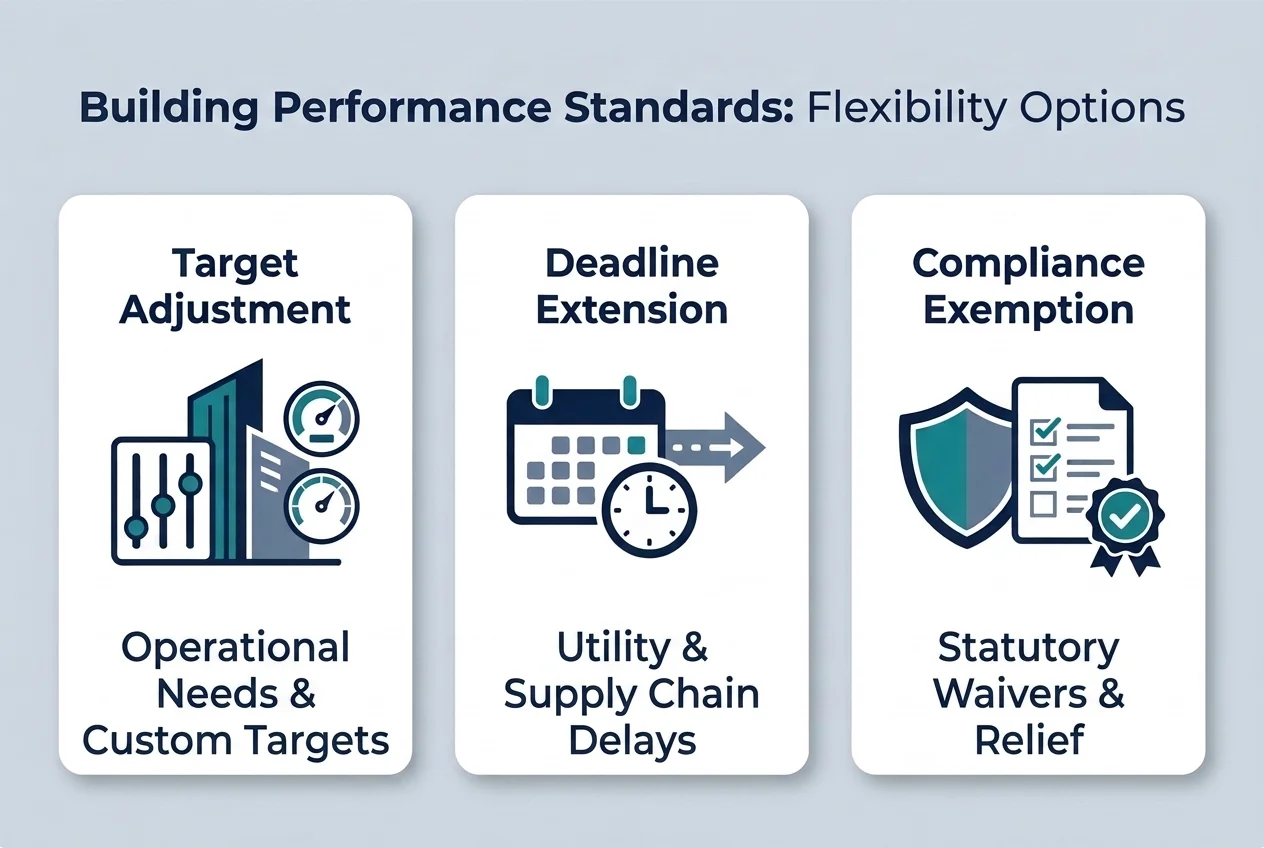 Infographic comparing building performance target adjustments, compliance deadline extensions, and regulatory exemptions.
1.1 What Is a Compliance Adjustment?
A compliance adjustment changes how a building's performance requirement is calculated or applied. For example, a commercial building may receive an energy-use target based on its property classification. However, the original target might not accurately account for its operating hours, building use, energy-intensive equipment, or unusual physical characteristics.
An adjustment may allow the regulatory authority to establish a more appropriate target using supporting technical evidence. Common reasons include:
- Building Classification Corrections: Reclassifying mixed-use, healthcare, or high-density spaces where default occupancy codes underestimate true energy baselines.
- Gross Floor Area (GFA) Recalculations: Correcting inaccurate assessor square footages or excluding unconditioned parking garages and storage basements.
- Continuous Operational Schedules: Accommodating 24/7 operating hours, multi-shift production, or high-ventilation laboratory schedules.
- Specialized Process Loads: Normalizing plug loads for commercial kitchens, broadcast studios, data rooms, or medical imaging equipment.
- Historic Preservation Constraints: Adjusting targets where municipal landmark preservation laws strictly prohibit exterior insulation, solar panels, or window replacements.
- Physical Site Limitations: Properties lacking physical clearance, roof capacity, or utility access to install standard high-efficiency mechanical plant systems.
1.2 What Is a Deadline Extension?
A deadline extension gives an eligible building owner additional time to complete required compliance activities. For example, a property owner may be unable to replace an aging HVAC system before the required performance deadline because the utility needs additional time to upgrade electrical distribution infrastructure.
An approved extension may allow the owner to complete the work under a revised compliance schedule. Common reasons include:
- Equipment Supply-Chain Delays: Extended manufacturer procurement lead times (often 40-70 weeks) for commercial heat pumps, large switchgear, and chillers.
- Utility Interconnection & Grid Bottlenecks: Waiting on electric utilities to engineer and install pad-mounted transformers, network vaults, or line extensions.
- Specialized Workforce Shortages: Lack of available certified heat pump installers, electrical contractors, or commissioning engineers.
- Major Renovation Alignment: Synchronizing energy-efficiency retrofits with scheduled capital façade restorations, roof replacements, or gut renovations.
- Recent Property Ownership Transfers: Providing necessary time for new buyers to audit existing energy profiles, establish capital budgets, and engineer compliance roadmaps.
- Severe Financial Distress: Documented commercial insolvency or debt-service distress qualifying under statutory hardship standards.
1.3 What Is a Compliance Exemption?
An exemption removes a building or a particular requirement from regulatory obligations when specific conditions are satisfied. Depending on the program, exemptions may be permanent, temporary, or limited to a particular reporting year or compliance cycle. Examples include:
- Demolished or Scheduled for Demolition: Properties with approved demolition permits or active raze orders issued by municipal building departments.
- Full-Building Prolonged Vacancy: Commercial structures completely unoccupied for an entire 12-month reporting cycle with zero tenant utility accounts.
- Exempt Industrial & Agricultural Structures: Heavy manufacturing facilities, unconditioned storage barns, or non-commercial municipal utilities.
- Extreme Hardship Exemptions: Buildings in judicial receivership, bankruptcy proceedings, or designated as public safety hazards.
An exemption should not be confused with an extension. An extension provides more time, while an exemption removes an applicable obligation under defined conditions.
2. Who Can Apply for Building Compliance Adjustments or Extensions?
Eligibility varies by jurisdiction, but most programs allow the building owner or an authorized representative to submit applications. In certain programs, additional requirements may apply regarding professional certification, financial documentation, or engineering assessments.
2.1 Commercial Building Owners
Commercial property owners are generally responsible for regulatory compliance. They may submit applications when their properties experience financial hardship, major renovation requirements, electrical infrastructure limitations, unexpected building conditions, equipment replacement delays, or difficulties meeting prescribed energy targets. Owners should provide documentation demonstrating that the requested flexibility is justified.
2.2 Affordable Housing Providers
Affordable housing providers may receive additional consideration because building improvement costs can create financial pressure on properties serving lower-income residents. Certain programs provide alternative targets, adjusted compliance schedules, reduced fees, or additional compliance options. For example, Colorado recognizes affordable housing and under-resourced properties as potential applicants for certain adjusted timeline and performance target provisions.
2.3 Nonprofit Organizations and Public Institutions
Nonprofit organizations, hospitals, healthcare facilities, and certain public institutions may have specialized requirements. Some buildings operate continuously or have specialized equipment that creates unusually high energy demand. New York City's Local Law 97, for example, provides specific historical adjustment provisions for qualifying not-for-profit hospitals and healthcare facilities.
2.4 Property Managers and Authorized Representatives
Property managers, facility managers, and sustainability consultants may prepare and submit applications on behalf of owners when authorized. Their responsibilities may include collecting energy consumption data, coordinating professional audits, preparing compliance documentation, communicating with regulatory authorities, tracking application status, and managing updated compliance schedules.
3. Common Reasons for Requesting a Deadline Extension
Regulatory authorities generally require applicants to demonstrate a specific reason why they cannot meet the original compliance schedule. Simply stating that a project is expensive or difficult is not necessarily sufficient. The applicant should explain the circumstances, provide supporting evidence, and demonstrate a realistic plan for achieving compliance.
3.1 Financial Hardship
Financial hardship is one of the most common reasons for requesting regulatory flexibility. Commercial buildings may require substantial investments in HVAC replacement, electrical service upgrades, heating electrification, building envelope improvements, energy management systems, or renewable energy installations. Owners with limited access to capital may struggle to finance these improvements within the original compliance period.
Depending on the jurisdiction, acceptable financial evidence may include financial statements, building operating income, debt-service coverage information, cash-flow projections, capital expenditure estimates, financing rejection documentation, and outstanding property-related financial obligations.
3.2 Equipment Supply-Chain Delays
Certain building improvement projects depend on specialized mechanical and electrical equipment, such as commercial heat pumps, large electrical transformers, switchgear, boilers, chillers, and building automation equipment. When equipment delivery delays prevent a building owner from completing a required upgrade, the owner may be eligible for additional time under certain programs.
3.3 Utility Infrastructure Limitations
Electrification projects often require electrical distribution improvements beyond the building owner's direct control. For example, a commercial building may need a utility transformer replacement before installing several large heat pumps. The building owner may have completed the engineering assessment and submitted the service request, but the utility may not be able to provide the required capacity before the regulatory deadline.
3.4 Major Renovation or Redevelopment
Some properties are already scheduled for extensive renovations. Completing energy improvements separately from a planned renovation may create unnecessary costs and construction disruption. A building owner may instead request a modified timeline that allows energy-efficiency measures to be coordinated with the larger renovation.
3.5 Historic Building Restrictions
Historic properties may face limitations on external modifications, window replacement, insulation installation, and mechanical equipment placement. These restrictions can make certain energy-efficiency projects difficult or expensive to implement. Some programs recognize historic building characteristics as a reason for an adjusted compliance approach.
3.6 Change of Property Ownership
A recent change of ownership can create complications for building compliance. New owners may need time to review energy records, understand outstanding obligations, evaluate previous improvements, and develop a capital expenditure plan.
3.7 High Vacancy Rates and Lease Terminations
Buildings experiencing substantial vacancy may have financial and operational difficulties. For example, the loss of a major commercial tenant can reduce rental income while leaving the building owner responsible for maintaining the property's infrastructure. Seattle and Denver have specific provisions addressing certain vacancy-related circumstances.
Regulatory authorities will reject informal claims of project difficulty. Always secure stamped engineering assessments, utility interconnection applications, and binding manufacturer lead-time notices before formally submitting an extension request.
4. Washington State: Clean Buildings Performance Standard Extensions
Washington's Clean Buildings Performance Standard (CBPS) provides a formal extension process for eligible Tier 1 and Tier 2 building owners, administered by the Washington State Department of Commerce.
4.1 Who Can Apply?
Eligible building owners may request an extension when qualifying circumstances prevent them from meeting the scheduled compliance requirements, including:
- Circumstances Beyond Owner Control: Documented supplier force majeure, extreme permitting backlogs, or utility interconnection delays.
- Recent Ownership Acquisition: Transfer of property deed within 24 months of compliance deadlines requiring initial energy management setup.
- Financial Hardship & Capital Constraints: Documented inability to secure conventional financing or capital reserve shortfalls.
- Major Construction & Tenant Fit-Outs: Active comprehensive architectural renovations or phased core-and-shell modernizations.
- Phased Energy Management Plan Execution: Additional runway required to complete ASHRAE Level 2 audit action items and tune building automation controls.
4.2 How Long Is the Extension?
Washington's Tier-specific program guidance describes an extension of up to two years. Applications are generally accepted from six months before the scheduled compliance deadline through six months after that deadline.
| Milestone | Date |
|---|---|
| Compliance deadline | June 1, 2026 |
| Beginning of application window | December 1, 2025 |
| End of application window | December 1, 2026 |
| Potential extension | Up to 2 years |
5. Colorado: Building Performance Colorado Adjustment Requests
Colorado's Building Performance Standards provide several mechanisms for modifying compliance timelines and performance targets, administered by the Colorado Energy Office (CEO) under Air Quality Control Commission regulations.
5.1 Who Can Request an Adjusted Timeline?
Potential applicants include owners of affordable housing properties, under-resourced buildings, properties undergoing major renovation, buildings experiencing significant supply-chain or workforce delays, properties with unique physical limitations, buildings requiring electrical distribution upgrades, properties experiencing qualifying financial hardship, and recently purchased covered buildings.
| Target Year | Timeline Adjustment Deadline |
|---|---|
| 2026 performance target | December 31, 2025 |
| 2030 performance target | December 31, 2029 |
6. Maryland: Building Energy Performance Standards Exemptions and Alternative Compliance
Maryland's Building Energy Performance Standards (BEPS) take a somewhat different approach. The regulations establish specific exemptions and alternative compliance mechanisms rather than providing the same general building-performance deadline extension pathway used in Washington or Colorado.
Recognized exemption circumstances include financial distress, an unoccupied building for the entire reporting year, or demolition. Maryland also allows building owners to use an alternative compliance pathway by paying a fee for greenhouse gas emissions exceeding the applicable net direct emissions standard.
7. City-Level Adjustment and Extension Programs
Statewide regulations are only one part of the US building compliance landscape. Several major cities have established independent programs with their own adjustment procedures and application requirements.
7.1 Denver: Energize Denver
Denver provides two important forms of timeline flexibility:
- Interim Compliance Hold: A temporary 24-month pause on evaluating building performance requirements during short-term challenges such as financial distress, high vacancy, ownership changes, or redevelopment. Annual benchmarking must continue.
- Timeline Extension: Designed for longer-term capital improvement projects, equipment end-of-life scheduling, and electrical service capacity constraints. Performance deadlines can be extended as far as 2039 with an agreed compliance roadmap.
7.2 Boston: BERDO Hardship Compliance Plans
Boston's Building Emissions Reduction and Disclosure Ordinance (BERDO) provides flexibility measures including Building Portfolios, Individual Compliance Schedules, and Hardship Compliance Plans. Short-term and long-term hardship applications allow owners experiencing eligible technical or financial hardship to request customized emissions reduction trajectories.
| Application Type | Relevant Deadline |
|---|---|
| Building Portfolios | May 1, 2027, for 2026 emissions compliance |
| Individual Compliance Schedules | May 1, 2027, for 2026 emissions compliance |
| Short-Term Hardship Plan | May 1, 2027, for 2026 emissions compliance |
| Streamlined Short-Term Hardship | May 1, 2027, for qualifying equity-priority buildings |
| Long-Term Hardship | July 1 of the year before the applicable reporting year |
7.3 New York City: Local Law 97 Adjustments
New York City's Local Law 97 (LL97) establishes strict greenhouse gas emissions limits for covered properties. The NYC Department of Buildings provides specific adjustment mechanisms for buildings experiencing external or financial constraints:
- External Constraints (NYC Admin Code §28-320.7): Granted when legal or physical conditions prevent the owner from completing necessary improvements (e.g. landmark restrictions, utility grid limitations, lack of site access, or uncooperative commercial tenants). An approved external-constraint adjustment may last up to three calendar years.
- Financial Constraints (NYC Admin Code §28-320.8): Granted when the cost of required retrofits creates qualifying financial hardship or prevents a reasonable financial return. Financial adjustments are effective for up to one calendar year and require CPA financial verification alongside registered design professional attestations.
7.4 Seattle: Building Emissions Performance Standard Extensions
Seattle's Building Emissions Performance Standard (BEPS) includes relief categories for new construction, financial distress (one compliance-interval extension), high rental vacancy (≥35%), change of ownership, and qualifying low-income housing.
While Washington and Colorado offer formalized multi-year extensions, NYC Local Law 97 separates external constraints (up to 3 years) from financial hardship (1 year) and requires specialized CPA financial attestations alongside Registered Design Professional sign-offs.
8. Comparison: Adjustment and Extension Options Across US Jurisdictions
| Jurisdiction | Available Flexibility | Who May Apply | Key Reasons |
|---|---|---|---|
| Washington State | Up to 2-year extension; exemptions | Covered building owners | Financial limits, ownership change, major renovation, uncontrollable delays |
| Colorado State | Adjusted timeline and performance target | Covered building owners & under-resourced properties | Financial hardship, major renovation, equipment or utility delays |
| Maryland | One-year exemptions & alternative compliance fee | Owners meeting defined conditions | Financial distress, full-year vacancy, demolition |
| Denver | 24-month hold, timeline extension, target adjustment | Covered building owners | Financial distress, renovation, capital planning, target-data errors |
| Boston | Hardship plans, individual schedules, building portfolios | BERDO building owners | Technical or financial hardship, prior emissions reductions |
| NYC (LL97) | External and financial adjustments; specified reporting extensions | Eligible LL97 building owners | Legal or physical restrictions, qualifying financial constraints |
| Seattle | Multiple extensions and exemptions | Owners of qualifying covered buildings | Financial distress, vacancy, new construction, change of ownership |
9. What Documents Are Required for an Adjustment or Extension Request?
One of the most important parts of the application process is providing evidence that supports the requested flexibility. Regulatory authorities generally expect applicants to explain the circumstances, show how they affect compliance, and demonstrate a realistic plan for moving toward the required performance target.
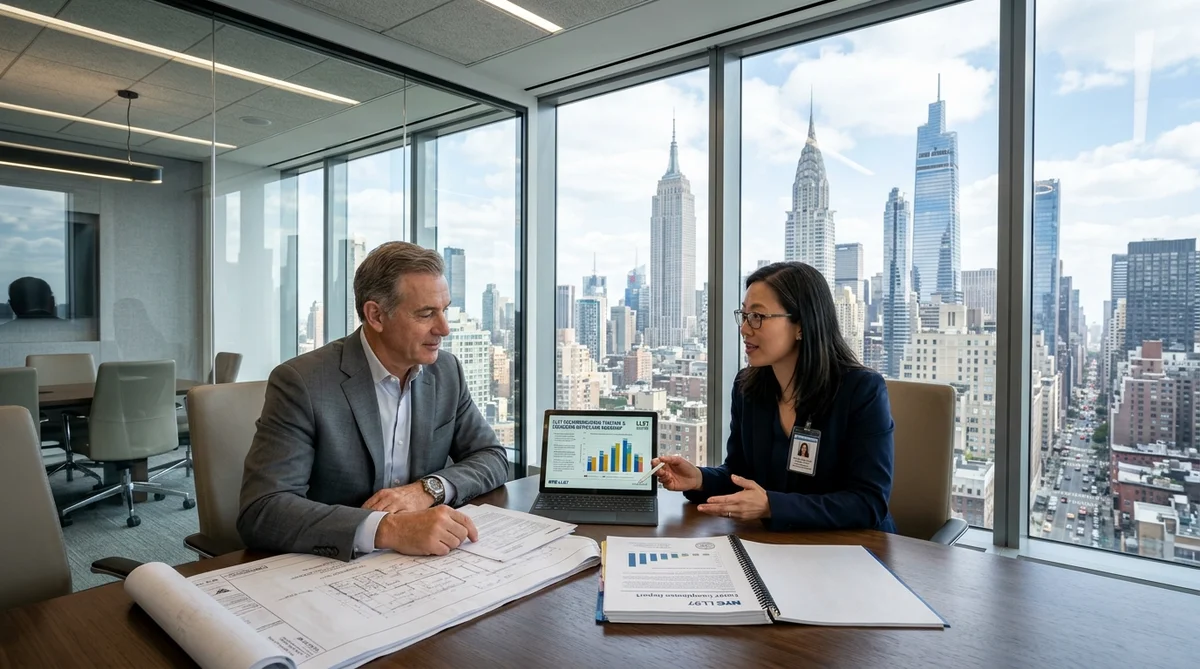
 Building energy consultant preparing supporting technical and financial documents for a compliance deadline extension application.
9.1 Building Identification and Ownership Information
Prepare property address, Borough-Block-Lot (BBL) or parcel identification, Gross Floor Area (GFA), building occupancy classification, deed/ownership records, and authorized representative filings.
9.2 Energy and Performance Information
Provide ENERGY STAR Portfolio Manager historical records, weather-normalized Energy Use Intensity (EUI) metrics, utility bills for electricity, gas, and steam, and third-party verification reports.
9.3 Financial Documentation
For hardship-related applications, gather audited balance sheets, net operating income (NOI) calculations, debt-service coverage ratios (DSCR), capital expenditure budgets, and written lender financing rejections.
9.4 Technical Documentation
Include ASHRAE Level 2 energy audits, mechanical equipment condition assessments, electrical service capacity evaluations, formal utility interconnection correspondence, contractor quotations, equipment purchase orders, and manufacturer lead-time notices.
10. Step-by-Step: How to Submit an Adjustment or Deadline Extension Application
- Confirm the Applicable Regulation: Identify overlapping state and municipal mandates.
- Identify the Correct Type of Request: Select between target adjustment, deadline extension, hardship hold, or exemption.
- Review Detailed Eligibility Criteria: Never assume another building's approval establishes eligibility for your property.
- Assemble Supporting Engineering & Financial Evidence: Work with licensed Professional Engineers (PE), Registered Design Professionals (RDP), or CPAs.
- Prepare a Concrete Compliance Roadmap: Detail milestones, financing schedules, and expected energy/carbon reductions.
- Submit Through the Official Agency Portal: Use DOB NOW Safety/BEAM (NYC), Clean Buildings Portal (WA), or Energize Denver portal.
- Respond to Regulatory Inquiries: Promptly answer formal requests for clarifications or audit verifications.
- Track Written Approvals and Comply With All Conditions: Maintain mandatory annual reporting even during approved extensions.
11. What Happens When an Extension Request Is Denied?
A rejected extension or adjustment request does not eliminate the building owner's underlying compliance obligation. Depending on the jurisdiction, owners may file for administrative review (e.g. Colorado's 90-day review or Denver's 30-day pre-compliance appeal), provide missing documentation, or pivot to alternative compliance pathways such as renewable energy credits or accelerated capital retrofits.
12. Common Mistakes to Avoid When Applying for Regulatory Flexibility
- Mistake 1: Waiting Until the Final Deadline: Engineering audits and utility verifications require months of lead time.
- Mistake 2: Submitting Generic Delay Claims: Regulators reject unverified statements without purchase orders or utility letters.
- Mistake 3: Confusing Target Adjustments with Extensions: A target adjustment modifies the baseline/metric; an extension merely defers enforcement.
- Mistake 4: Halting Annual Benchmarking: Benchmarking reporting obligations persist even during an active compliance hold.
- Mistake 5: Assuming New Ownership Automatically Resets Deadlines: Property transfers do not erase accumulated statutory liabilities.
Need Help Managing Building Performance Compliance?
Building performance regulations create complex reporting, financial, and engineering requirements. Whether your commercial property needs an adjusted emissions target under NYC Local Law 97, additional compliance time, a hardship application, or an electrical service feasibility study, our team of licensed engineers and compliance specialists can guide you through every regulatory step.