Introduction: Net Zero, Zero Energy, and Carbon Neutral Explained
Sustainability has become an essential pillar of modern commercial building design, corporate facility management, and urban real estate strategy. In New York City, regulations like NYC Local Law 97 and statewide decarbonization mandates have accelerated the transition toward high-performance properties. As property owners, institutional developers, and enterprise tenants seek to demonstrate environmental stewardship, terms like net zero, zero energy, and carbon neutral appear with increasing frequency.
Although these terms sound similar and are often used interchangeably in marketing brochures, they describe fundamentally different metrics, reporting boundaries, and accounting methodologies.
A high-performance property can generate as much renewable power as it consumes annually without eliminating all of its direct carbon emissions. Conversely, a corporation can establish a carbon-neutral claim through operational efficiency and verified carbon offset purchases without meeting the strict, science-aligned criteria of a comprehensive net-zero framework.
Understanding these distinctions is vital for commercial building owners, co-op and condo boards, architects, MEP engineers, and sustainability officers planning capital improvements or public disclosures.
The Three Core Definitions at a Glance:
- Net Zero: Achieving deep, systemic greenhouse gas (GHG) reductions across operations and value chains, with remaining residual emissions permanently neutralized using certified carbon removals under rigorous frameworks like the Science Based Targets initiative (SBTi).
- Zero Energy: An energy-accounting balance where an ultra-efficient building produces at least as much on-site or procured renewable energy as it consumes over a specified 12-month period.
- Carbon Neutral: Balancing a defined greenhouse gas footprint through quantifiable emissions reductions paired with compensation mechanisms, such as verified carbon credits or offsets (under standards like ISO 14068:2026).
1. What Is Net Zero?
At its core, net zero refers to achieving equilibrium between anthropogenic greenhouse gas emissions released into the atmosphere and permanent greenhouse gas removals sequestered from the atmosphere.
Crucially, achieving net zero is not an exercise in buying cheap carbon credits to cancel out ongoing fossil-fuel combustion. Credible net-zero frameworks establish that organizations must execute aggressive direct emissions cuts—typically 90% or more across Scope 1, Scope 2, and relevant Scope 3 emissions—before neutralizing the small fraction of residual emissions that cannot technically be eliminated.
The Science Based Targets initiative (SBTi) provides the international benchmark for corporate net-zero standards. Under SBTi guidelines, carbon offsets cannot be counted toward near-term or long-term emissions reduction targets. Only durable carbon dioxide removal (CDR) and permanent geological or biological storage can be utilized to neutralize residual emissions at the net-zero target horizon.
1.1 What Does Net Zero Mean for Buildings?
Within the built environment and commercial real estate sector, net-zero targets are evaluated across two critical boundaries:
Net Zero Operational Carbon
Operational carbon encompasses all greenhouse gas emissions produced while a facility is in active service. Primary sources include:
- Electricity consumption for interior lighting, plug loads, and vertical transportation.
- Onsite combustion of natural gas or fuel oil for space heating and domestic hot water.
- Chilled water, condenser water, and cooling tower operation.
- Mechanical ventilation and make-up air fans.
- Fugitive fluorinated refrigerant leakages from VRF or chiller circuits.
Buildings eliminate operational emissions through energy efficiency retrofits, full heating electrification (such as air-source or water-source heat pumps), clean power purchasing, and smart building management systems (BMS). Any unavoidable residual operational emissions must then be neutralized through eligible carbon removal mechanisms.
Net Zero Whole-Life Carbon
Whole-life carbon offers a holistic lifecycle assessment (LCA) that evaluates emissions across the entire existence of the asset, including:
- Raw material extraction, manufacturing, and processing (embodied carbon of concrete, structural steel, glass, and facade insulation).
- Transportation of components to the construction site.
- Onsite construction, heavy equipment operation, and staging.
- Day-to-day operations and recurring maintenance over 50+ years.
- Tenant fit-outs, interior refurbishments, and envelope retrofits.
- End-of-life deconstruction, demolition, recycling, and disposal.
A building might operate with 100% clean solar electricity, yet still possess thousands of metric tons of embodied carbon locked into its structural foundation. Whole-life carbon accounting ensures this upstream and downstream impact is measured and systematically addressed.
1.2 How Can a Building Achieve Net Zero?
Executing an authentic net-zero roadmap requires a structured, multi-step engineering methodology:
- Baseline Emissions Inventory: Conduct a comprehensive carbon audit covering Scope 1, Scope 2, and embodied Scope 3 emissions.
- Passive & Active Efficiency: Upgrade building envelope thermal performance (windows, wall insulation, air sealing) to drive down base heating and cooling loads.
- Electrification of Thermal Loads: Decommission aging steam boilers or gas furnaces in favor of high-efficiency commercial heat pump systems.
- Onsite Renewable Power: Maximize rooftop and canopy solar photovoltaic installations to generate clean power on site.
- Low-Carbon Materials: Specify low-carbon concrete mixes, mass timber, and recycled steel during structural renovations.
- Permanent Carbon Removals: Neutralize remaining, unavoidable residual emissions through certified carbon removal initiatives.
2. What Is a Zero Energy Building?
A zero energy building (frequently termed a Net Zero Energy Building or NZEB) is an energy-efficient property where the actual annual delivered energy is less than or equal to the on-site renewable energy exported to the utility grid.
The defining characteristic of zero energy is its explicit focus on energy units (BTUs, kWh) rather than direct emissions metrics. The goal is energetic self-sufficiency over an annualized accounting cycle.
The U.S. Department of Energy (DOE) established the formal federal definition of a Zero Energy Building (ZEB):
"An energy-efficient building where, on a source energy basis, the actual annual delivered energy is less than or equal to the on-site renewable exported energy."
Using source energy accounting accounts for the losses incurred during generation, transmission, and distribution of utility power, providing an equitable comparison across various fuel and grid profiles.
2.1 How Does a Zero Energy Building Work?
Achieving zero energy requires a "reduction first, generation second" hierarchy. Building designers must slash building energy use intensity (EUI) through advanced conservation before sizing renewable generation arrays:
- Advanced Envelope Design: Continuous exterior insulation, triple-pane low-E glazing, and air barrier integrity to minimize conductive and infiltrative losses.
- Variable Refrigerant Flow (VRF) & Heat Recovery: Moving thermal energy between cooling and heating zones with coefficient of performance (COP) exceeding 3.5.
- Daylighting & LED Controls: Occupancy sensors, photocells, and automated shading to reduce electrical lighting demands.
- Dedicated Outdoor Air Systems (DOAS): Utilizing energy recovery ventilators (ERVs) to capture heat and moisture from exhaust airstreams.
- Rooftop & Facade Solar PV: Deploying high-efficiency monocrystalline solar panels to meet remaining power loads.
2.2 Example of a Zero Energy Building
Consider a modern commercial mid-rise building that undergoes comprehensive efficiency upgrades, lowering its annual consumption to 100,000 kWh. The property installs a rooftop solar PV array sized to deliver 110,000 kWh annually:
| Energy Balance Metric | Annual Energy (kWh) | Status / Operational Impact |
|---|---|---|
| Annual Building Energy Consumption | 100,000 kWh | Measured annual delivered utility electricity |
| Annual Onsite Solar Generation | 110,000 kWh | Generated by rooftop photovoltaic array |
| Net Annual Surplus Energy | +10,000 kWh | Exported to the local electric grid |
Illustrative example only. Formal zero-energy qualification depends on the applicable accounting framework (site vs. source energy), boundary demarcation, eligible renewable attributes, and 12 consecutive months of verified utility meter data.
3. What Does Carbon Neutral Mean?
Carbon neutral describes a state where the net greenhouse gas emissions associated with a specific entity, facility, product, or activity equal zero over a designated reporting period, achieved through a combination of internal emissions reductions and external carbon compensation.
Unlike zero energy, which measures kWh, carbon neutrality measures metric tons of carbon dioxide equivalent (tCO₂e). And unlike net zero under SBTi, carbon neutrality allows for the immediate use of verified carbon offsets to compensate for emissions that remain after baseline efficiency gains.
Under international standards such as ISO 14068:2026 (which succeeds PAS 2060), carbon neutrality claims require strict quantification, documented carbon management plans, prioritized internal abatement, and the retirement of high-integrity, third-party verified carbon credits.
3.1 How Does Carbon Neutrality Work in Practice?
To demonstrate a credible carbon-neutral claim, a facility measures its greenhouse gas footprint across defined operational boundaries, implements feasible efficiency retrofits, and compensates for the remaining balance:
| Accounting Stage | Emissions Volume (tCO₂e) | Action Taken |
|---|---|---|
| Initial Measured Footprint | 1,000 tonnes CO₂e | Comprehensive Scope 1 and Scope 2 baseline audit |
| Internal Reductions | -600 tonnes CO₂e | LED lighting, HVAC retrofits, and electrification |
| Remaining Carbon Footprint | 400 tonnes CO₂e | Residual emissions requiring compensation |
| Verified Offsets Purchased & Retired | -400 tonnes CO₂e | High-integrity biological or industrial carbon credits |
| Declared Net Carbon Balance | 0 tonnes CO₂e | Verified carbon neutral status achieved |
3.2 What Is the Role of Carbon Offsets?
Carbon offsets allow organizations to compensate for emissions by funding external projects that avoid, reduce, or remove greenhouse gases elsewhere. Common project typologies include certified reforestation, agricultural soil sequestration, landfill methane capture, and direct air capture (DAC).
However, offsets carry varying degrees of quality and credibility. To ensure claims are defensible and avoid greenwashing scrutiny, building owners must evaluate credits against established integrity criteria:
- Additionality: The greenhouse gas reduction would not have occurred without carbon credit financing.
- Permanence & Reversal Risk: The carbon remains sequestered for decades or centuries without risk of premature release.
- Measurability & Verification: Reductions are quantified using accredited methodologies and audited by independent registries (e.g., Gold Standard, Verra VCS, American Carbon Registry).
- Single-Registry Retirement: Credits are permanently retired on an immutable registry to prevent double counting.
4. Net Zero vs Zero Energy vs Carbon Neutral: Key Differences
The primary difference among these three sustainability goals lies in what they measure, how renewables are utilized, and the degree of offset reliance allowed under recognized international standards.
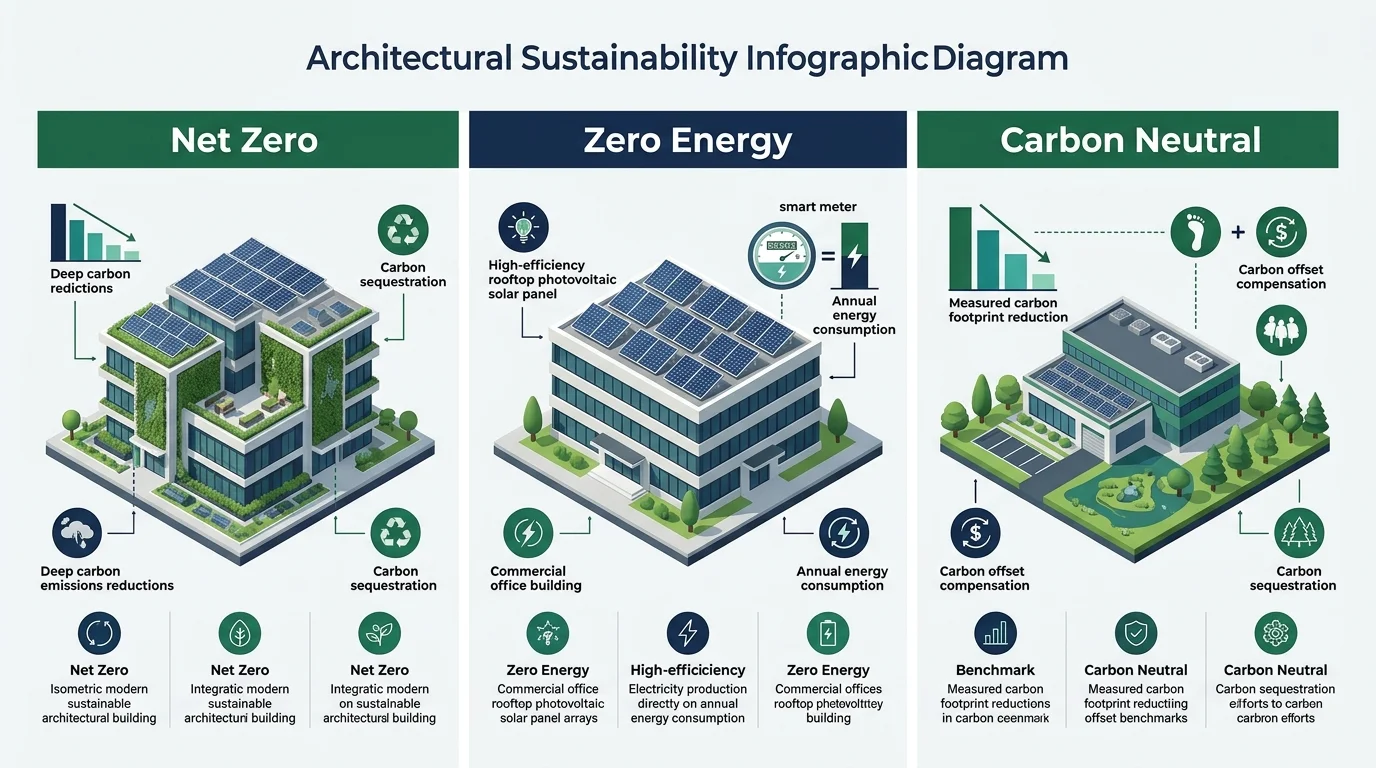 A structural comparison of core sustainability pathways: Net Zero demands deep emissions reduction followed by permanent carbon removal; Zero Energy balances annual site energy consumption with renewable generation; Carbon Neutral balances a defined carbon footprint using verified compensation credits.
| Comparison Criterion | Net Zero | Zero Energy | Carbon Neutral |
|---|---|---|---|
| Primary Metric | Greenhouse Gas Emissions (tCO₂e) | Energy Generation & Consumption (kWh/BTU) | Net Carbon Balance (tCO₂e) |
| Accounting Scope | Scope 1, Scope 2, and major Scope 3 | Onsite delivered and exported energy | Defined operational footprint (Scope 1 & 2) |
| Role of Renewables | Primary direct decarbonization measure | Mandatory foundation of energy balance | Eligible tool to lower baseline emissions |
| Use of Carbon Offsets | Offsets prohibited for reductions; only permanent removals allowed for residual ~5-10% | Not applicable (energy balance, not carbon offset) | Permitted to balance remaining carbon footprint after efficiency gains |
| Embodied Carbon | Mandatory under whole-life carbon assessments | Excluded (focus is operational energy) | Optional unless explicitly in declared boundary |
| Governing Frameworks | SBTi Corporate Net-Zero, UK Net Zero Carbon Buildings Standard | U.S. DOE ZEB Definition, ILFI Zero Energy Certification | ISO 14068:2026, PAS 2060, Climate Neutral Certified |
| Primary Objective | Eliminating systemic emissions to limit global warming to 1.5°C | Eliminating net operational energy demand from utility grids | Achieving a net-zero operational carbon accounting balance |
Important Standard Notice:
This comparison describes broad industry principles. Precise compliance and audit requirements depend on the specific standard, municipal code, or third-party certification framework being pursued.
5. Is Net Zero the Same as Zero Carbon?
No. Although frequently conflated in everyday conversation, zero carbon (or absolute zero) and net zero represent distinctly different thresholds.
Zero Carbon means that no greenhouse gas emissions are generated whatsoever within the defined boundary. There are zero emissions produced, and consequently, zero compensation or carbon removal is required. For example, a facility that heats with 100% geothermal, powers all systems via dedicated onsite solar with battery storage, and uses zero fossil fuels operates with zero direct operational emissions.
Net Zero explicitly acknowledges that achieving absolute zero across every single industrial activity—such as long-distance transport, emergency diesel generators, or high-temperature steam—may not be immediately feasible with current technologies. Net zero requires reducing gross emissions by 90% or more, while neutralizing the remaining small residual volume with permanent carbon removal.
6. How Do These Concepts Apply to Commercial Buildings?
For commercial building owners, co-op boards, and facility executives, adopting these definitions provides strategic clarity when planning capital improvements, complying with municipal emission caps, and budgeting multi-year retrofits.
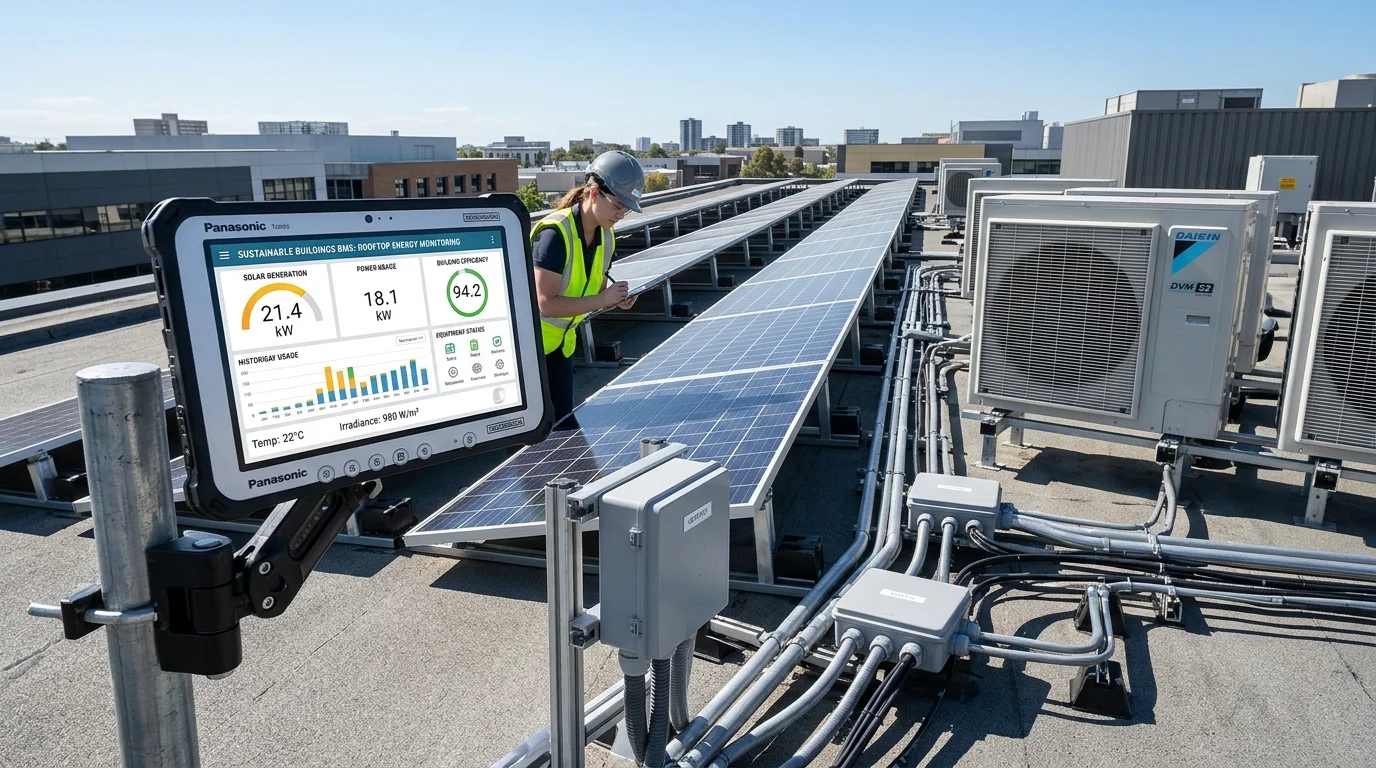 Commercial decarbonization integrates rooftop photovoltaic solar generation, high-efficiency heat pump HVAC systems, and real-time building management system (BMS) telemetry to optimize load and reduce operational emissions.
6.1 Improving Building Energy Performance
Regardless of whether the ultimate objective is Net Zero, Zero Energy, or Carbon Neutrality, the initial step is always aggressive load reduction. Improving energy efficiency lowers operating costs, reduces required solar array size, and shrinks penalties under LL84 benchmarking and LL97 carbon limits:
- Upgrading to commercial LED lighting with automated daylight harvesting.
- Installing variable frequency drives (VFDs) on pumps and ventilation fans.
- Replacing legacy steam traps, balancing hydronic risers, and insulating bare pipework.
- Installing advanced building automation systems (BAS) with predictive scheduling.
6.2 Integrating Renewable Energy
Onsite renewable electricity is fundamental to Zero Energy and a core pillar of Net Zero. Commercial properties can deploy rooftop solar arrays, solar canopies over parking decks, and battery energy storage systems (BESS) to capture peak generation, mitigate utility demand charges, and supply clean electricity directly to building loads.
6.3 Addressing Embodied Carbon in Renovations
As building operational efficiency improves, embodied carbon constitutes an increasingly large proportion of total lifecycle emissions. Architects and developers pursuing whole-life net-zero targets can:
- Specify Environmental Product Declarations (EPDs) for structural and envelope materials.
- Incorporate low-carbon concrete mixes using supplementary cementitious materials (fly ash, slag).
- Prioritize adaptive reuse and structural preservation over full teardown and reconstruction.
7. How Can Businesses Choose the Right Sustainability Goal?
Selecting the appropriate target depends on your organization's regulatory environment, asset holding horizon, capital availability, and stakeholder expectations.
7.1 When to Target Zero Energy
Zero Energy is ideal for building owners and developers focused on physical property asset value, energy independence, and operational utility cost minimization. It is especially suited for low- to mid-rise commercial buildings, schools, and suburban campuses with ample rooftop or land area for solar arrays.
7.2 When to Target Net Zero
Net Zero is the gold standard for institutional real estate investment trusts (REITs), corporate enterprises with ESG commitments, and buildings facing stringent regulatory emissions limits (like NYC LL97). It provides a science-backed, climate-aligned trajectory that withstands regulatory and investor scrutiny.
7.3 When to Target Carbon Neutrality
Carbon Neutrality can serve as an interim milestone for organizations seeking immediate accountability for their operational footprint while multi-year capital retrofit projects (such as complete heating electrification) are designed, permitted, and financed.
8. Common Misconceptions About Net Zero and Zero Energy
- Misconception 1: "Adding rooftop solar automatically makes a building net zero." Solar reduces purchased electricity emissions, but it does not address gas heating, refrigerant leaks, or embodied carbon.
- Misconception 2: "Zero energy means zero carbon emissions." If a zero-energy building draws grid power generated from fossil fuels during winter nights and exports solar in summer afternoons, it may still produce net operational carbon emissions depending on grid emissions intensity.
- Misconception 3: "Carbon neutrality is identical to net zero." Carbon neutrality allows immediate offset reliance; credible net zero requires deep 90%+ gross decarbonization before neutralizing residual emissions.
- Misconception 4: "Designing for zero energy guarantees zero energy in operation." True zero energy requires verified utility billing and generation data over a full 12-month operational cycle.
9. How to Verify Net Zero and Carbon Neutral Claims
To guard against greenwashing risks and ensure public disclosures are credible, property owners and sustainability managers must follow four verification best practices:
- Define Explicit Boundaries: Clearly state whether claims encompass Scope 1, Scope 2, tenant submetered power, or embodied lifecycle carbon.
- Rely on Third-Party Audits: Engage accredited energy engineers to conduct ASHRAE Level 2 audits and verify greenhouse gas accounting under ISO 14064.
- Align with Recognized Standards: Follow established protocols such as ISO 14068, SBTi Net-Zero, or the DOE Zero Energy Building framework.
- Maintain Transparent Public Registry Data: Document annual energy use intensity (EUI), renewable generation volumes, and carbon credit retirement serial numbers.
Sustainability is not just about achieving a label. It is about measuring environmental impact, systematically reducing emissions at the source, and demonstrating verified, measurable improvements over time.
Ready to Make Your Building More Sustainable?
Understanding your building's energy consumption and carbon footprint is the first step toward a more efficient, high-performing property. Whether you are considering rooftop solar installation, HVAC heat pump electrification, energy efficiency improvements, or a complete net-zero roadmap, choosing the right strategy begins with an accurate technical assessment.