
Introduction: The Cost of a Retrofit Is Only Half the Financial Problem
Replacing an outdated boiler, installing heat pumps, upgrading a building envelope, or modernizing an HVAC system can reduce energy consumption and improve building performance. The difficulty is often not identifying the improvements. It is finding the capital to pay for them.
A comprehensive retrofit can involve equipment purchases, engineering, electrical upgrades, construction, commissioning, and temporary building disruptions. For an owner managing a commercial or multifamily property, paying for everything upfront may compete with other capital requirements.
That is where green financing becomes relevant.
Property owners in New York City have several ways to fund energy improvements. These include Commercial Property Assessed Clean Energy (C-PACE) financing, specialist green loans, conventional lending, NYSERDA financing, and utility incentive programs.
They are not interchangeable.
PACE is repaid through a property assessment. A green loan is generally a debt product structured around an energy-related project. A utility rebate reduces the eligible project cost but does not necessarily provide the capital needed to begin construction.
Understanding these differences helps owners choose a funding structure that matches the size, useful life, cash flow, and regulatory objectives of the retrofit.
Strategic Funding Order:
For large-scale decarbonization projects in NYC, experienced owners follow a structured capital stack: first, lock in pre-approved utility rebates (Con Edison/National Grid) to shrink the net capital basis; second, deploy owner equity or incentive bridge financing; and third, fund the long-term balance via fixed-rate C-PACE or specialist green loans.
1. What Is Green Financing for Building Retrofits?
Green financing refers to loans, financing arrangements, and other funding mechanisms used to pay for improvements that reduce energy consumption, improve building efficiency, support electrification, or generate renewable energy.
For NYC property owners, eligible projects may include:
| Retrofit Project | Potential Financing Application |
|---|---|
| HVAC replacement | High-efficiency heating and cooling equipment |
| Heat pump installation | Electrification of heating and cooling |
| Building insulation | Roof, wall, and envelope improvements |
| LED lighting | Energy-efficient lighting and controls |
| Building management systems | Automated equipment monitoring and control |
| Solar PV installation | On-site renewable energy generation |
| Battery storage | Energy storage and load management |
| Boiler modernization | Improved heating efficiency and controls |
| Window upgrades | Reduced heating and cooling demand |
| Domestic hot water improvements | More efficient water heating |
The important distinction is that a project must satisfy the relevant lender or program's eligibility conditions. Calling an upgrade a sustainability project does not automatically make it eligible for every green financing product.
Financing, Rebates, and Incentives Are Different
These terms are often grouped together, but they affect a project's finances differently.
| Funding Type | How It Works | Does It Need Repayment? |
|---|---|---|
| PACE financing | Capital is provided for eligible improvements and repaid through a property assessment | Yes |
| Green loan | A lender provides capital for eligible energy or sustainability improvements | Yes |
| Utility rebate | A utility pays an approved incentive for eligible installed equipment or savings | Generally no |
| NYSERDA financing | State-supported financing through participating lenders or designated program providers | Yes |
| On-bill recovery loan | Eligible financing is repaid through a utility bill charge | Yes |
| Energy services agreement | A provider funds or delivers improvements under a contract tied to agreed services or savings | Depends on the contract |
| Owner equity | The property owner pays directly using available capital | No |
A rebate can reduce the amount an owner needs to borrow, but it should not be treated as a loan replacement. Similarly, a loan can fund installation costs but does not automatically make the project financially viable.
2. PACE Financing: A Long-Term Funding Option for Larger Retrofits
Commercial Property Assessed Clean Energy financing, commonly known as C-PACE, allows eligible property owners to fund energy efficiency and renewable energy improvements through financing secured by a special property assessment.
New York City operates its own PACE program, administered by the New York City Energy Efficiency Corporation (NYCEEC) as part of the NYC Accelerator PACE Financing program.
The financing is provided by qualified capital providers rather than being a standard grant from the City.
How NYC PACE Financing Works
The basic process is:
- The owner identifies an eligible energy efficiency or renewable energy project.
- The owner works with a qualified PACE lender and prepares the required technical and financial documentation.
- The proposed project is reviewed under the NYC PACE program requirements.
- The financing is approved and the project moves through closing and installation.
- Repayment is collected through a special assessment on the property's tax bill.
Unlike a conventional equipment loan, the repayment obligation is associated with the property assessment. The program is designed to support longer-term financing for building improvements.
NYC PACE can cover up to 100% of eligible energy upgrade costs, subject to project review, program requirements, and lender approval.
What Makes PACE Different?
| Feature | NYC PACE Financing |
|---|---|
| Financing structure | Property-assessed financing |
| Repayment | Special assessment collected through the property tax bill |
| Financing term | Long-term structure, subject to lender and project approval |
| Interest | Fixed-rate financing |
| Eligible projects | Qualifying energy efficiency and renewable energy improvements |
| Upfront capital | May cover up to 100% of eligible project costs |
| Building sale | Financing may transfer with the property, subject to program documents and applicable requirements |
| Administration | NYCEEC |
| Capital providers | Qualified PACE lenders |
Which Buildings Can Qualify?
NYC PACE may be available to:
- Commercial and office buildings.
- Industrial properties.
- Multifamily properties with three or more residential units.
- Buildings owned by qualifying nonprofit or tax-exempt organizations.
- Eligible new construction and major renovation projects.
The program also requires the property to satisfy relevant financial and administrative conditions. For example, NYC Accelerator identifies outstanding City taxes, civil penalties, or other debts as eligibility issues.
One important limitation: NYC PACE is not a general residential home-improvement loan for every property. One- and two-family residential homes are excluded from the program.
Can PACE Finance New Construction?
Yes. NYC expanded its PACE program guidance in 2024 to allow eligible new construction and major renovation projects to participate.
For qualifying major renovations that result in all-electric buildings, the updated guidance provides a specific route to financing. Full-electrification retrofit projects can also qualify for pre-qualified treatment under the program's Savings-to-Investment Ratio requirements.
This matters for owners undertaking substantial redevelopment rather than replacing only one piece of equipment.
An Important 2026 PACE Update
A NYC Department of Finance rule became effective on August 8, 2026. It removed the previous requirement that the full financing amount be treated as disbursed at loan closing.
The updated approach permits installments, with interest accruing only on the loan funds that have actually been disbursed.
For a construction project with several installation stages, this can reduce financing costs during periods when the owner does not yet need the full approved amount.
Owners should confirm the actual draw schedule and interest calculation with their qualified lender before closing.
What Should Owners Check Before Choosing PACE?
PACE has advantages, but it is not automatically the cheapest or simplest financing option.
First, an existing mortgage can complicate the transaction. NYC's program requires mortgage-holder consent where the property has an existing mortgage.
Second, repayment appears as a property assessment. Owners must understand how the payment interacts with operating budgets, tax bills, refinancing, and property sale documents.
Third, the project must satisfy PACE eligibility and technical requirements. The availability of a qualified lender does not mean every proposed measure will receive approval.
Owners undertaking substantial building-wide energy upgrades, electrification projects, or renewable energy improvements that justify a longer financing term.
3. Green Loans: Flexible Financing Through Banks and Specialist Lenders
A green loan is a financing product intended to fund improvements that support energy efficiency, renewable energy, electrification, or other sustainability objectives.
Unlike PACE, a conventional green loan does not depend on repayment through a property tax assessment.
Depending on the lender, it may be structured as a term loan, equipment loan, credit facility, construction loan, or another form of project financing.
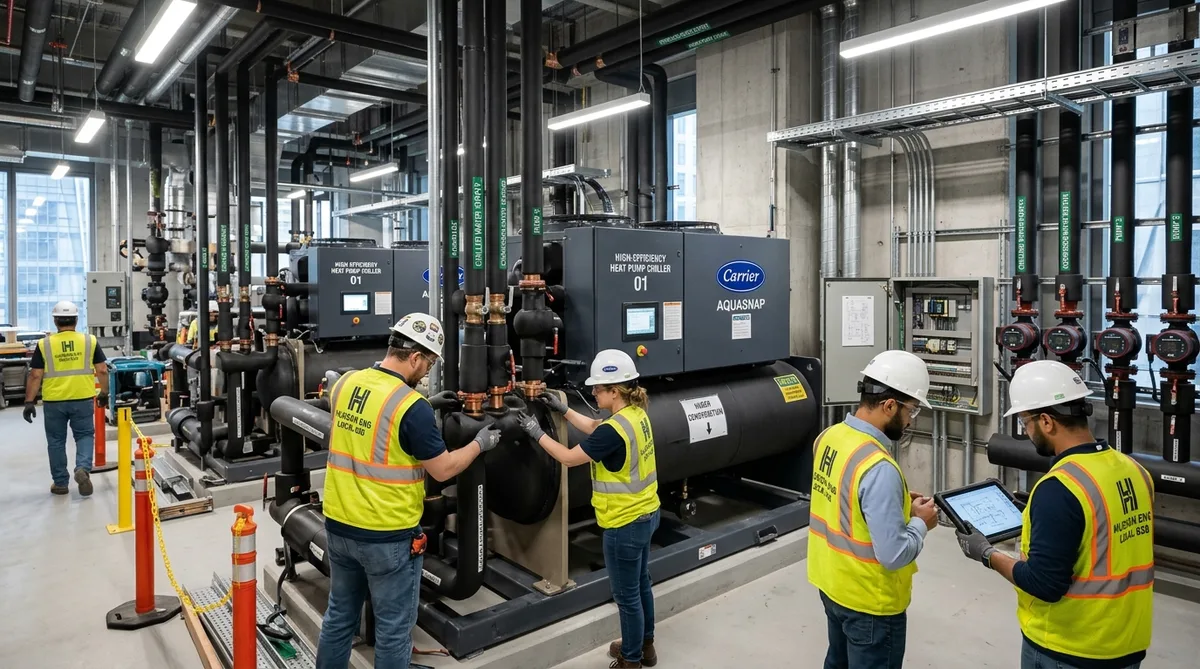 Major central plant retrofits—such as transitioning from fossil-fuel boilers to high-efficiency heat pumps—frequently utilize specialist green loans to fund mechanical installation and electrical service upgrades.
How Green Building Loans Work
A property owner submits a project scope, financial information, and supporting technical documentation to the lender.
The lender evaluates the borrower's ability to repay, the project's cost, the proposed improvements, and any available energy savings.
If approved, the lender provides capital according to the agreed loan structure. Repayment is generally made through scheduled installments.
Possible uses include:
- HVAC and boiler replacement.
- Heat pump installations.
- Building automation and controls.
- Roof and wall insulation.
- LED lighting upgrades.
- Solar and battery storage.
- Energy efficiency improvements across multiple buildings.
The financing terms depend on the lender, borrower, project, collateral, and repayment structure.
NYCEEC: A Specialist Clean Energy Financing Source
The New York City Energy Efficiency Corporation (NYCEEC) is an important financing institution for building owners and clean energy projects in NYC.
It offers financing products for multifamily, commercial, industrial, and institutional properties.
Its product range includes direct loans, PACE loans, incentive bridge loans, and other structures designed around energy and clean energy projects.
NYCEEC states that its financing can be structured to work alongside existing loans or mortgages, although the specific conditions depend on the transaction.
This can be useful when a property owner already has a mortgage and needs separate capital for an energy retrofit.
A specialist lender may also be able to work directly with a contractor or project developer, depending on the project arrangement.
NYSERDA Small Business Financing
The New York State Energy Research and Development Authority (NYSERDA) offers financing options for eligible small businesses, multifamily building owners, and nonprofit organizations.
Two relevant structures are the Participation Loan and the On-Bill Recovery Loan.
Participation Loan
Under the participation structure, NYSERDA finances 50% of the loan principal, up to $50,000, while the selected lender provides the remaining portion at its market rate.
The lender issues and services the loan. The overall financing available through participating lenders can reach $100,000 or more, depending on the transaction.
On-Bill Recovery Loan
The On-Bill Recovery structure allows eligible small businesses and nonprofit organizations to repay financing through a charge on their utility bill.
For the energy efficiency pathway, the maximum loan amount is $50,000 and the term cannot exceed 10 years.
The project must be supported by a qualified energy assessment. Expected annual energy cost savings must exceed the annual loan payments, and estimated savings must be sufficient to recover the project cost within the program's eligibility period.
A borrower must also meet program underwriting and utility-account requirements.
Note on NYSERDA Interest Rates:
One pricing detail requires particular attention: NYSERDA's current public materials display inconsistent interest-rate information for the On-Bill Recovery program. The borrower information page lists the Wall Street Journal Prime Rate plus 2%, fixed at closing, while its FAQ states 0%. Owners should obtain the applicable rate and fees in writing from the program provider rather than relying on either figure when modelling project cash flow.
Green Loans vs. PACE
| Comparison Feature | Green Loan | NYC PACE |
|---|---|---|
| Repayment method | Scheduled loan payments | Property assessment |
| Security structure | Depends on lender and loan | Special assessment associated with property |
| Mortgage-holder consent | Depends on loan and existing mortgage documents | Required where an existing mortgage is present |
| Project size | Varies by lender | Often suited to larger eligible projects |
| Loan term | Depends on lender | Long-term fixed-rate structure |
| Property sale | Depends on loan documents | May transfer with property under program rules |
| Interest rate | Lender-specific | Fixed-rate financing |
| Main consideration | Borrower credit and repayment capacity | Property eligibility, assessment, lender approval, and mortgage consent |
Owners who need flexible project financing, want to preserve available cash, or need a funding structure that can work with existing property debt.
4. Utility Programs: Rebates That Reduce Retrofit Costs
Utility incentive programs are another important source of funding for NYC building owners.
These programs are different from loans because they generally do not require the owner to repay an approved rebate.
Instead, a utility provides a financial incentive for installing eligible energy-efficient equipment or achieving qualifying energy savings.
The incentive may be calculated using equipment capacity, energy savings, project scope, or a published rebate schedule.
Con Edison Commercial and Industrial Incentives
Con Edison offers energy efficiency incentives for eligible commercial and industrial gas and electric customers.
Its Commercial and Industrial Energy Efficiency program includes equipment rebates, custom incentives, and support for qualifying energy studies.
Potentially eligible improvements include:
- Lighting and lighting controls.
- Heating, ventilation, and air conditioning equipment.
- Boilers and other qualifying gas equipment.
- Variable frequency drives.
- Chiller and refrigeration upgrades.
- Motors and industrial process improvements.
Custom incentives may also be available for cost-effective improvements that do not fit a standard equipment rebate category.
An important requirement is preapproval. Owners should obtain the necessary program approval before purchasing or installing equipment. A project that is already completed may not qualify simply because the installed equipment appears on a rebate list.
The approved incentive is generally paid after the project is completed and the required documentation is accepted.
Con Edison Multifamily Energy Efficiency Programs
Multifamily properties have additional opportunities through Con Edison's Multifamily Energy Efficiency Program and affordable multifamily pathways.
The 2026 program guide covers buildings with five or more residential units and separates market-rate and affordable housing pathways.
Depending on eligibility and project design, measures can include:
| Retrofit Measure | Potential Incentive Category |
|---|---|
| Roof and attic insulation | Weatherization |
| Wall insulation | Building envelope |
| Window upgrades | Building envelope |
| Air sealing | Weatherization |
| Building automation systems | Controls |
| Boiler controls | Heating efficiency |
| Pipe insulation | Heating-system efficiency |
| Heat pumps | Building electrification |
| Domestic hot water electrification | Building electrification |
| Ventilation upgrades | Building-system efficiency |
For affordable housing, the 2026 Comprehensive Pathway advertises incentives of up to $2,600 per dwelling unit for qualifying multi-system retrofits. Actual incentives depend on the program's point thresholds, eligible measures, project conditions, and caps.
The 2026 guide also identifies general incentive caps of 70% of project costs for the market-rate multifamily pathway and 85% for the affordable multifamily pathway. Specific electrification incentives can have their own limits.
These figures are program-specific, not a blanket promise that every building will receive the same percentage.
National Grid Incentives
National Grid also provides commercial, industrial, and multifamily energy efficiency incentives in its eligible service territories.
For NYC property owners, the relevant program depends on the building's utility account and service area. Owners should verify whether National Grid or Con Edison is the applicable utility for the measure being installed.
Potential areas of support can include qualifying heating equipment, building controls, insulation, and other energy efficiency improvements.
Owners should confirm current program manuals, equipment requirements, incentive amounts, and application deadlines before including a utility rebate in the project budget.
Owners replacing eligible equipment, undertaking smaller efficiency projects, or reducing the net capital requirement of a larger retrofit.
5. How NYC Owners Can Combine Financing and Incentives
A retrofit does not necessarily need to rely on a single source of capital.
A project may use utility incentives to lower the eligible project cost, owner equity to cover part of the remaining requirement, and a financing product to fund the balance.
The challenge is confirming that the funding sources can be used together and that their rules allow the same costs to be included.
Example: Financing a Multifamily Building Retrofit
Assume a NYC multifamily owner plans a $600,000 project involving HVAC upgrades, building controls, and insulation.
The illustrative funding structure is:
| Project Cost Component | Amount |
|---|---|
| Total retrofit cost | $600,000 |
| Approved utility incentives | $90,000 |
| Owner's contribution | $60,000 |
| Remaining financing requirement | $450,000 |
The owner could investigate a suitable green loan or eligible PACE financing to cover the remaining $450,000.
This example is illustrative. It does not represent an approved Con Edison rebate, a PACE offer, or confirmation that the same project costs can qualify for both programs. The actual funding structure depends on the project's eligibility, incentive rules, lender underwriting, and timing of payments.
A Practical Funding Sequence
For a larger retrofit, owners should evaluate funding in this order:
- First: Identify incentives. Determine which installed measures qualify for utility or state incentives. Confirm preapproval and documentation requirements.
- Second: Calculate the net project cost. Subtract only confirmed or properly modelled incentives from the total eligible project expenditure.
- Third: Compare financing options. Evaluate PACE, green loans, mortgage refinancing, equipment financing, and other available structures.
- Fourth: Determine the required owner contribution. Decide how much capital the property can contribute without compromising other building obligations.
- Finally: Test the repayment plan. Compare energy savings, avoided operating costs, maintenance savings, and any applicable reduction in projected emissions-related exposure against the annual financing obligations.
This sequence reduces the risk of borrowing against incentives that may not be approved or paid when expected.
6. How to Decide Which Financing Option Fits Your Building
The best financing option depends on the project and property, not simply the advertised interest rate.
| Owner's Situation | Option Worth Evaluating | Why |
|---|---|---|
| Large building-wide retrofit | NYC PACE | Can provide long-term financing for eligible improvements |
| Existing mortgage on property | Green loan | May provide a separate financing structure, subject to lender requirements |
| Small commercial energy upgrade | NYSERDA small business financing | Provides program-supported loan options for eligible borrowers |
| Eligible equipment replacement | Utility rebate | Reduces the net cost of approved equipment |
| Affordable multifamily retrofit | Con Edison AMEEP and affordable programs | May provide enhanced incentives for qualifying projects |
| Multi-stage construction project | PACE or construction green financing | Draw schedules may align better with installation milestones |
| Solar or renewable energy installation | Green loan, PACE, or eligible incentives | Can support capital costs while incentives reduce the net project expense |
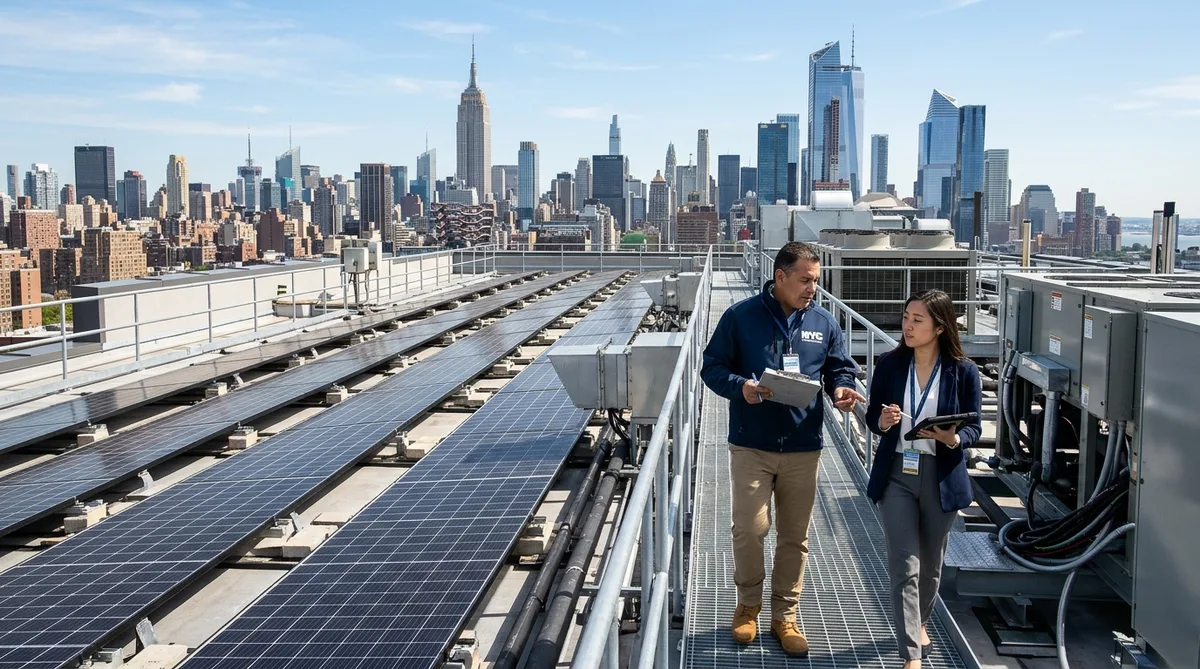 Coupling on-site rooftop solar photovoltaic generation with mechanical electrification maximizes utility incentive capture while lowering long-term debt repayment burdens.
Consider the Useful Life of the Equipment
The financing term should be assessed against the expected useful life of the installed equipment.
For example, financing a long-life building envelope improvement over a longer period may make more sense than using the same repayment term for equipment that will need replacement much sooner.
A longer term can lower annual payments, but it can increase total interest paid. The owner should compare the term, interest rate, fees, and expected equipment life rather than focusing only on monthly repayment.
Consider Who Benefits From the Energy Savings
Multifamily buildings often have a split-incentive problem. The owner may pay for the HVAC upgrade, while tenants pay some or all of the electricity costs. In that situation, the owner may carry the financing obligation without receiving the full utility savings.
Before approving a retrofit, owners should understand:
- Who pays each utility bill.
- Whether common-area and tenant loads are separately metered.
- How operating-cost savings are allocated.
- Whether lease provisions affect cost recovery (such as green leases).
- Whether the improvement supports property value, tenant comfort, or regulatory objectives beyond direct bill savings.
A project can have operational and compliance value even when the owner does not capture every dollar of the energy savings.
7. How Green Financing Supports Local Law 97 Planning
Local Law 97 makes emissions performance a financial planning issue for many NYC building owners.
For covered buildings, emissions limits apply according to the relevant building classification and compliance period. A retrofit may reduce emissions by improving equipment efficiency, electrifying heating, adding renewable energy, or reducing overall energy demand.
Financing can help owners implement these improvements without funding the entire project from available cash.
However, three separate issues must be evaluated:
- Project eligibility: Does the improvement qualify for the financing program?
- Emissions impact: Will the proposed measure actually reduce the building's emissions under the applicable LL97 calculation methodology?
- Financial impact: Do the expected energy savings and other benefits justify the loan or assessment payments?
A project financed through PACE or a green loan does not automatically establish LL97 compliance. Owners still need to calculate their regulated emissions, use applicable emissions factors, and complete required reporting.
NYC Accelerator provides free technical assistance and helps property owners understand financing, incentives, and energy upgrade options. It can be a useful starting point before preparing a full financing application.
8. Common Mistakes When Financing Building Retrofits
- Starting Work Before Incentive Approval: Some utility programs require written approval before equipment is purchased or installed. Starting work too early can make a project ineligible for a rebate.
- Comparing Interest Rates Without Comparing Total Cost: A loan with a lower advertised rate may have fees, shorter repayment terms, or additional security requirements. Compare total repayment, not only the stated interest rate.
- Assuming PACE Automatically Transfers Without Conditions: PACE financing may transfer with a property, but the owner should review the applicable program documents, assignment requirements, sale process, and mortgage arrangements.
- Borrowing Before Confirming Project Eligibility: A contractor's claim that equipment is energy-efficient is not evidence that it qualifies for a particular financing or rebate program. Obtain technical documentation and written eligibility confirmation.
- Treating Projected Energy Savings as Guaranteed Cash Flow: Actual savings can be lower than predicted because of occupancy changes, energy prices, weather, operating schedules, and equipment performance. Include realistic downside scenarios in financial models.
- Ignoring Incentive Payment Timing: A rebate may arrive after construction and verification. The owner may need to arrange interim capital to pay contractors before receiving the incentive.
- Failing to Coordinate With the Existing Mortgage Lender: PACE in particular requires mortgage-holder consent. A financing decision made without early lender coordination can delay or prevent closing.
9. A Practical Checklist Before Applying for Green Financing
Before selecting a financing option, owners should assemble the core documents needed to evaluate both the retrofit and the funding structure:
| Document or Information | Why It Is Needed |
|---|---|
| Utility bills and consumption history | Establishes the building's energy baseline |
| Energy audit or engineering assessment | Identifies suitable improvements and expected savings |
| Project scope and contractor proposals | Defines eligible measures and installation costs |
| Equipment specifications | Supports technical eligibility for lenders and utilities |
| Building ownership documents | Confirms authority to enter the financing agreement |
| Existing mortgage information | Helps identify lender-consent and security requirements |
| LL97 emissions information | Connects the project to compliance planning |
| Projected energy savings | Supports financial evaluation and debt-service coverage |
| Utility incentive preapproval | Confirms eligibility before work begins |
| Cash-flow projection | Tests whether repayments are affordable |
| Construction schedule | Helps coordinate financing draws and contractor payments |
Conclusion: The Right Funding Structure Makes a Retrofit Financially Manageable
Green financing gives NYC property owners more than one way to fund building improvements.
PACE can support large eligible projects with long-term property-assessed financing. Green loans offer different repayment structures through specialist and conventional lenders. Utility incentives can reduce the cost of approved equipment and energy efficiency improvements.
The strongest approach is usually to evaluate the available incentives first, calculate the remaining project cost, and then compare financing structures against the building's cash flow and long-term operating objectives.
For a smaller upgrade, a utility rebate or state-supported loan may be sufficient. For a major HVAC replacement, electrification project, or building-wide retrofit, a longer-term PACE or specialist green loan may be worth evaluating.
The key is to avoid treating financing as an afterthought. A project should be engineered, costed, checked for incentive eligibility, and financially modelled before construction begins.