
Understand US lead paint and asbestos rules before renovation, including pre-1978 housing, surveys, contractor certifications, notifications, and safe work practices.
Introduction: Why Lead Paint and Asbestos Checks Matter Before Renovation
Renovating an older building can uncover hazardous materials that were installed decades ago. Before starting construction, property owners need to understand whether the building contains lead-based paint or asbestos-containing materials (ACM).
These substances were historically used in residential, commercial, and industrial construction because of their durability, insulation properties, and other functional benefits. However, disturbing these materials during renovation can release hazardous lead dust or asbestos fibers into the surrounding environment.
Common renovation activities that may create exposure risks include:
- Removing old painted surfaces and sanding walls or ceilings.
- Replacing older windows, doors, and wooden trim.
- Removing vinyl floor tiles and adhesives or mastics.
- Cutting into insulated pipes and renovating boiler rooms or mechanical spaces.
- Demolishing older partitions and replacing acoustic ceiling materials.
The US Environmental Protection Agency (EPA), the Occupational Safety and Health Administration (OSHA), and the Department of Housing and Urban Development (HUD) establish different requirements for identifying and managing these hazards. For example, EPA's Renovation, Repair and Painting (RRP) Rule applies to certain paid renovation activities in housing and child-occupied facilities constructed before 1978. Meanwhile, OSHA establishes worker protection and building-owner communication requirements, while EPA's Asbestos NESHAP regulates qualifying renovation and demolition activities.
This guide explains what to check, which regulations apply, who can perform inspections, and what documentation should be prepared before renovation starts.
1. Understanding Lead-Based Paint and Asbestos in Older Buildings
Lead-based paint and asbestos are different hazardous materials, but both can create serious health risks when improperly disturbed. They also require different inspection methods, contractors, and safety procedures.
1.1 What Is Lead-Based Paint?
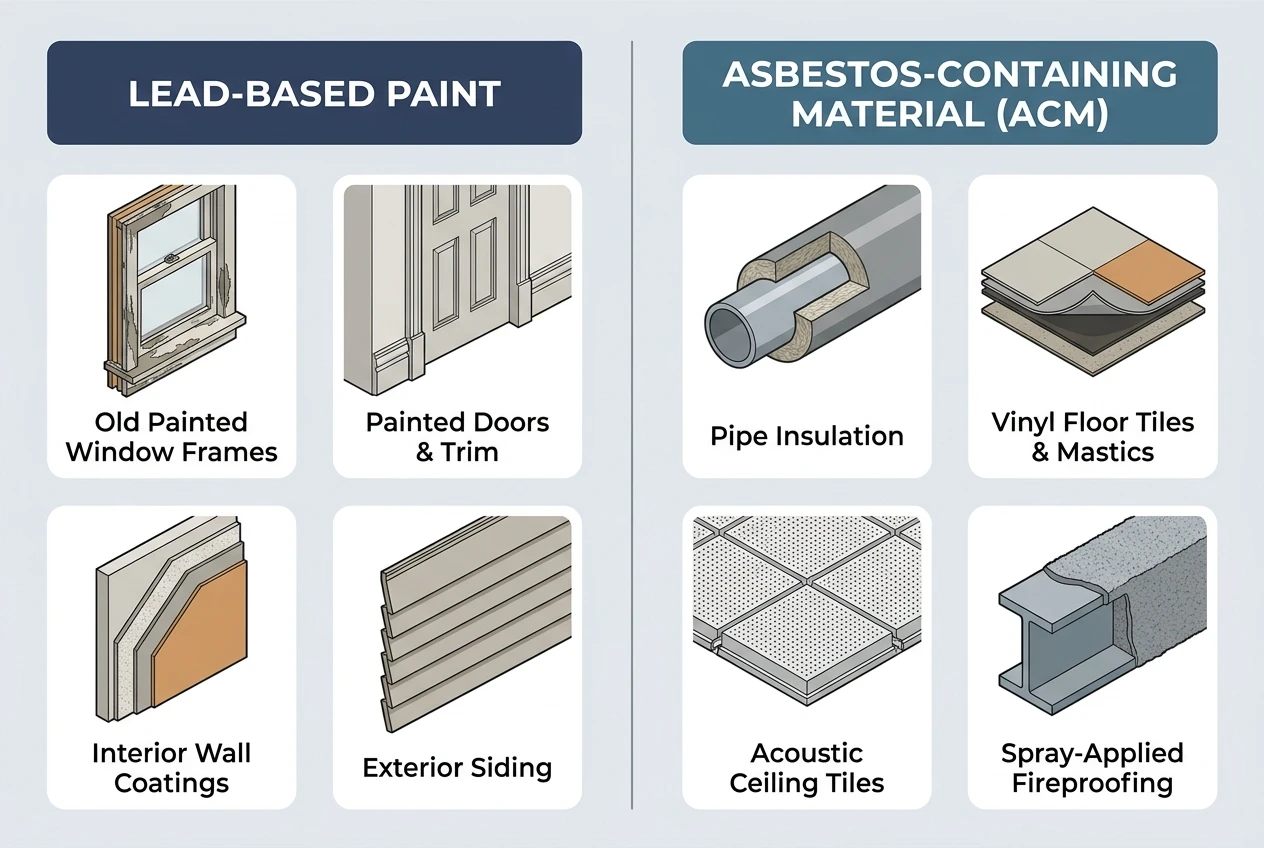
Lead-based paint is paint containing lead at or above the applicable federal regulatory threshold—generally at least 1.0 milligram per square centimeter or 0.5% lead by weight under EPA programs. Lead was banned for residential consumer paint in the US in 1978. Buildings constructed before 1978 may contain lead-based paint on windows, doors, wall surfaces, stairways, railings, decorative trim, and exterior surfaces.
1.2 What Is Asbestos-Containing Material?
Asbestos is a group of naturally occurring mineral fibers historically used in construction for heat resistance and strength. Common suspect materials include pipe and boiler insulation, spray-applied fireproofing, acoustic ceiling materials, vinyl floor tiles, mastics, roofing materials, and cement siding. Under OSHA's asbestos construction standard, asbestos-containing material generally means material containing more than 1% asbestos.
1.3 Why Are These Materials a Concern During Renovation?
| Renovation Activity | Potential Hazard |
|---|---|
| Sanding old painted walls | Lead-containing dust dispersion |
| Replacing old windows | Lead paint disturbance on frames and sills |
| Cutting insulated pipes | Airborne asbestos fiber release |
| Removing old floor tiles & mastics | Potential asbestos exposure |
| Demolishing older ceilings & partitions | Combined lead and asbestos disturbance |
| Replacing boiler insulation | High-risk asbestos fiber exposure |
2. Which Older Buildings Need Lead Paint and Asbestos Assessment?
Building age is an important starting point, but it is not a substitute for a proper material assessment.
2.1 Lead Paint: The Pre-1978 Rule
The EPA's Lead Renovation, Repair and Painting (RRP) Rule generally covers paid renovation activities that disturb painted surfaces in target housing built before 1978 and child-occupied facilities built before 1978. Target housing includes most pre-1978 single-family homes, apartment buildings, multifamily properties, and residential portions of mixed-use buildings.
2.2 Does the Lead RRP Rule Apply to Commercial Buildings?
Not every older commercial property is covered by the EPA RRP Rule. Standard commercial office buildings and retail stores are generally outside the RRP Rule unless they contain a qualifying child-occupied facility. However, OSHA's Lead in Construction Standard (29 CFR 1926.62) still applies to renovation workers who may be occupationally exposed to lead.
2.3 Asbestos: Understanding Building Age and PACM
Under OSHA's construction standard, certain materials installed in buildings constructed no later than 1980 are treated as Presumed Asbestos-Containing Material (PACM) unless rebutted through prescribed laboratory testing. These include thermal system insulation (TSI), surfacing materials, and asphalt/vinyl flooring.
2.4 Quick Comparison: Lead Paint vs. Asbestos
| Factor | Lead-Based Paint | Asbestos |
|---|---|---|
| Historical Reference | Housing built before 1978 | Older buildings (especially pre-1980 PACM) |
| Main Federal Regulator | EPA (and HUD for assisted housing) | EPA (NESHAP) and OSHA |
| Main Health Concern | Lead dust ingestion and inhalation | Inhalation of microscopic mineral fibers |
| Common Locations | Windows, doors, walls, trim | Pipes, boiler insulation, flooring, ceilings |
| Testing Professional | Certified lead inspector or risk assessor | Qualified/accredited asbestos inspector |
| Renovation Regulation | EPA RRP Rule & OSHA Lead Standard | EPA Asbestos NESHAP & OSHA 29 CFR 1926.1101 |
3. EPA Lead Renovation, Repair and Painting (RRP) Rule
The EPA RRP Rule establishes firm certification, renovator training, pre-renovation education, containment, cleanup, and recordkeeping requirements.
- Certified Firms & Renovators: Renovation firms performing covered work for compensation must hold valid EPA (or authorized state) firm certification (typically valid for 5 years) and assign a trained Certified Renovator to supervise work practices and cleaning verification.
- Pre-Renovation Education: Before covered work begins, contractors must distribute the EPA Renovate Right pamphlet and document receipt.
- Lead-Safe Work Practices: Establish containment barriers, cover surfaces, use HEPA-filtered vacuums/shrouds, and avoid prohibited practices (open-flame torching, heat guns above 1,100°F, unshrouded power sanding).
- Minor Repair Exception: Minor repairs disturbing 6 sq. ft. or less per interior room (or 20 sq. ft. or less exterior) may be exempt—except for window replacement, painted-surface demolition, or prohibited practices.
4. EPA and OSHA Requirements for Asbestos Before Renovation
Asbestos compliance involves two overlapping federal frameworks: EPA's Asbestos NESHAP (controlling emissions and waste) and OSHA's construction standard (protecting workers and requiring owner notifications).
4.1 EPA Asbestos NESHAP & Notification Thresholds
Before covered renovation or demolition work begins in commercial, institutional, or public buildings (excluding residential buildings with four or fewer units), the affected area must be thoroughly inspected for asbestos. Federal NESHAP notification (generally at least 10 working days in advance) is triggered when regulated asbestos-containing material (RACM) reaches or exceeds:
| Material Type | Federal NESHAP Threshold |
|---|---|
| RACM on pipes | 260 linear feet |
| RACM on other facility components | 160 square feet |
| RACM where length/area cannot be measured | 35 cubic feet |
Important Note on Local & OSHA Rules
Falling below federal NESHAP thresholds does not exempt a project from OSHA worker protection rules (29 CFR 1926.1101) or stricter state/municipal asbestos rules (such as NYC DEP ACP5/ACP7 requirements).
4.2 Building Owner Responsibilities Under OSHA
Under OSHA 29 CFR 1926.1101, building owners must determine the presence, location, and quantity of ACM or PACM before work begins and communicate this information to bidding contractors, employees, other employers, and affected tenants. Owners must maintain asbestos records for the duration of ownership and transfer them to subsequent owners.
5. How to Conduct a Lead Paint and Asbestos Inspection Before Renovation
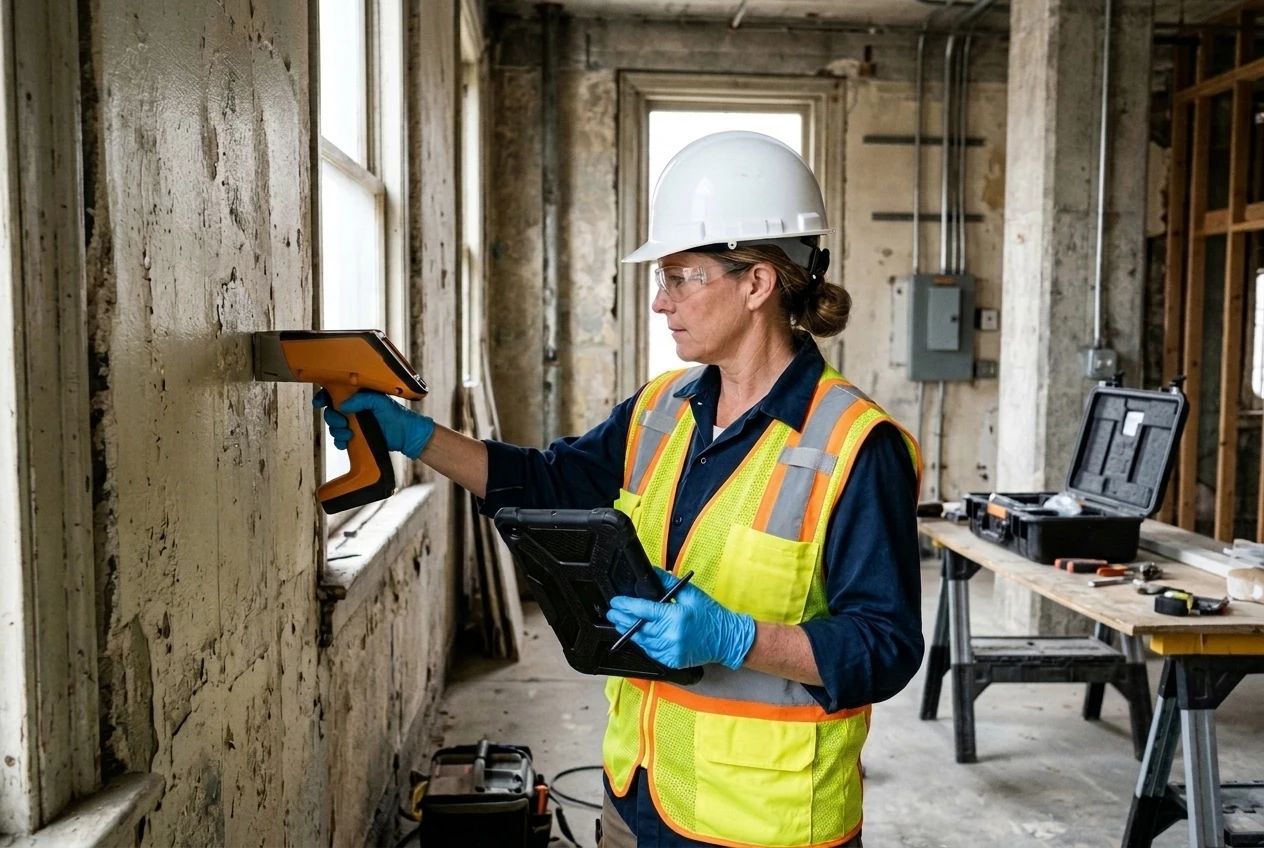
- Review Existing Documentation: Gather original plans, past renovation logs, previous lead reports, asbestos surveys, and abatement records to verify relevance to the exact work area.
- Identify Suspect Materials: Catalog all painted surfaces, pipe insulation, flooring, ceiling tiles, mastics, and fireproofing likely to be disturbed.
- Arrange Qualified Testing: Retain certified lead inspectors (for XRF or paint-chip testing) and accredited asbestos inspectors (for laboratory bulk sample analysis). Never disturb suspect asbestos materials yourself.
- Prepare Hazardous Material Reports: Document inspection locations, lab results, ACM/PACM condition, and special control zones for bidding contractors.
- Determine Management or Removal Strategy: Decide whether intact materials can remain under an Operations & Maintenance (O&M) plan or must be abated prior to construction.
6. HUD Lead Safe Housing Rule: Additional Requirements
Properties receiving federal housing or rehabilitation assistance are subject to HUD's Lead Safe Housing Rule (24 CFR Part 35). Unlike the EPA RRP Rule, HUD often mandates formal lead inspections, risk assessments, certified clearance dust wipe examinations, and tenant relocation protections—meaning EPA RRP certification alone does not automatically satisfy HUD funding requirements.
7. What Happens When Lead Paint or Asbestos Is Found?
Finding hazardous materials does not mean a renovation must stop permanently; it requires selecting an approved management strategy:
- Lead-Based Paint Management: Managing intact surfaces in place, using certified lead-safe renovation practices, stabilizing deteriorating paint, encapsulation, or licensed abatement with clearance testing.
- Asbestos Management Options: Management in Place under an O&M program, Encapsulation (applying sealant), Enclosure (building an airtight barrier), localized Repair, or licensed Removal/Abatement prior to disturbance.
8. What Contractors Must Do Before Starting Renovation Work
Before signing construction contracts, property owners must verify contractor credentials and ensure trade coordination:
- Lead-Safe Contractors: Confirm current EPA or state RRP firm certification, assigned Certified Renovator, containment plan, HEPA equipment, and cleaning verification documentation.
- Asbestos Contractors: Confirm availability of the pre-renovation survey, submitted regulatory notifications, valid state/local asbestos licenses, OSHA competent person assignment, and hazardous waste disposal manifests.
- Multi-Trade Coordination: Distribute hazardous material maps to electrical, plumbing, and HVAC trades so no contractor inadvertently drills or cuts into concealed ACM or lead coatings.
9. How to Manage Hazardous Material Documentation During Renovation
| Document | Purpose | Responsible Party |
|---|---|---|
| Lead Paint Inspection Report | Identifies lead-containing painted surfaces | Qualified lead professional |
| Asbestos Survey & Lab Results | Documents ACM/PACM locations and percentages | Accredited inspector & lab |
| EPA RRP & Renovator Records | Verifies firm and individual certification | Renovation contractor |
| NESHAP Notification | Documents 10-working-day regulatory notice | Owner or operator |
| Waste Disposal & Clearance Reports | Proves compliant hazardous disposal and post-work safety | Abatement contractor & inspector |
10. Common Mistakes to Avoid Before Starting Renovation
- Assuming Post-1978 Buildings Are Asbestos-Free: The 1978 residential lead paint ban does not establish whether a commercial or residential property contains asbestos.
- Assuming RRP Applies to All Commercial Offices: Standard offices are typically outside EPA RRP unless housing a child-occupied facility, though OSHA worker lead standards still apply.
- Starting Demolition Before Surveys: Federal NESHAP mandates thorough asbestos inspections prior to demolition or covered renovation.
- Assuming Small Quantities Are Exempt: Staying below federal NESHAP thresholds does not waive OSHA worker protection or stricter municipal rules.
- Improper Waste Disposal: Lead debris and regulated asbestos waste cannot be discarded with ordinary construction trash.
11. A Practical Pre-Renovation Compliance Checklist
Pre-Renovation Action Checklist
1. Building Assessment: Confirm construction date, define work areas, review historical surveys, and identify suspect paint, insulation, flooring, and ceilings.
2. Lead & Asbestos Compliance: Determine EPA RRP, HUD, OSHA, and NESHAP applicability; complete qualified XRF/bulk testing; verify contractor certifications and state licenses; submit 10-day notices where triggered.
3. Records & Clearance: Distribute survey findings to all trades, retain disposal manifests and post-work clearance reports, and archive records for future renovations.
Conclusion: Assess Lead Paint and Asbestos Before Renovation Begins
Renovating older buildings requires careful upfront planning because lead-based paint and asbestos-containing materials may be concealed behind walls, ceilings, flooring, and mechanical insulation. Understanding how EPA RRP, EPA Asbestos NESHAP, OSHA construction standards, and HUD guidelines intersect protects workers, tenants, and project timelines.
Before removing walls, ceilings, insulation, or painted surfaces, partner with qualified environmental inspectors and certified contractors to execute a compliant pre-renovation survey and remediation plan.