
Understand fire alarm and sprinkler inspection requirements for older commercial buildings, including inspection schedules, NFPA standards, maintenance records, system upgrades, and fire safety compliance responsibilities.
Dual Inspection Frameworks: Fire alarm systems are governed by NFPA 72, while water-based automatic sprinkler systems follow NFPA 25 and local municipal fire codes. Both require periodic testing ranging from quarterly gauge and valve checks to 5-year internal pipe inspections.
Grandfathering vs. Retrofit Triggers: Building age alone does not require automatic system replacement. However, major renovations, alterations, change of occupancy classifications, or unresolvable internal corrosion mandate code-compliant modernizations.
Documentation Liability: Building owners remain legally accountable for maintaining active inspection records (at least 3 years in NYC, with original acceptance test reports retained for the life of the installation).
Introduction: Why Fire Alarm and Sprinkler Inspections Matter in Older Buildings
Older commercial buildings often contain fire protection systems that have been operating for decades. While these systems may still provide essential life safety protection, their operational reliability depends entirely on rigorous inspection, testing, maintenance (ITM), and timely repairs.
Fire alarm control panels, smoke detectors, sprinkler heads, control valves, distribution piping, and municipal water connections deteriorate over time. Decades of tenant build-outs, architectural alterations, and space reconfigurations can inadvertently create blind spots, unmonitored zones, or hydraulic imbalances that compromise fire suppression performance.
For property owners and facility managers, maintaining these systems is not merely a best practice to avoid equipment breakdown. It is a strict legal requirement enforced by local fire marshals, building departments, and insurance carriers under adopted fire codes and referenced National Fire Protection Association (NFPA) standards, primarily:
- NFPA 72: National Fire Alarm and Signaling Code (governing detection, signaling, notification, and control interfaces).
- NFPA 25: Standard for the Inspection, Testing, and Maintenance of Water-Based Fire Protection Systems (governing sprinklers, standpipes, valves, and fire pumps).
This comprehensive guide details the technical requirements, mandatory inspection schedules, common failure points, and upgrade triggers that property owners must manage to keep older buildings safe and fully code-compliant.
1. Understanding Fire Alarm and Sprinkler Systems in Older Buildings
Fire alarm and automatic sprinkler systems serve distinct yet interconnected roles in life safety. A fire alarm system provides early detection, initiates occupant notification, and executes critical building control functions (such as elevator recall and HVAC shutdown). Conversely, an automatic fire sprinkler system responds thermally to localized heat, discharging pressurized water to suppress or extinguish flames before structural failure occurs.
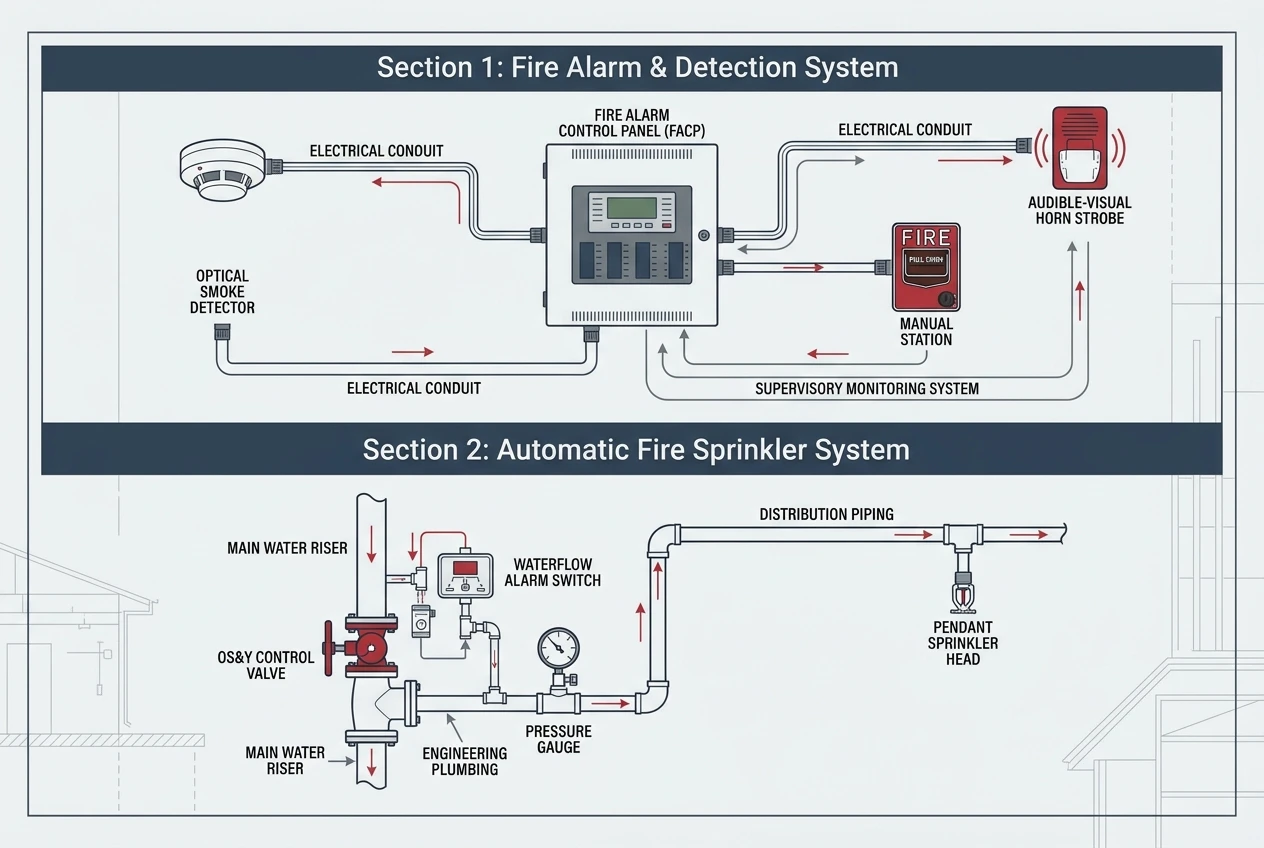 Technical diagram showing commercial fire alarm components, supervisory interfaces, and automatic sprinkler system connections.
1.1 What Does a Fire Alarm System Include?
Commercial fire alarm installations in older buildings range from legacy conventional zoned systems to modern microprocessor-driven addressable networks:
- Fire Alarm Control Units (FACU): The master control panel processing initiating signals, monitoring power supplies, and managing output circuits.
- Initiating Devices: Photoelectric and ionization smoke detectors, thermal heat sensors, duct detectors, and manual pull stations.
- Notification Appliances: High-output audible horns, emergency voice-alarm evacuation speakers, and synchronized strobe lights.
- Supervisory & Monitoring Interfaces: Dedicated connections monitoring sprinkler control valve tamper switches and waterflow pressure switches.
- Auxiliary Emergency Controls: Relay modules executing magnetic fire door releases, stairwell pressurization, and HVAC fire damper closures.
- Secondary Standby Power: Regulated battery banks and emergency generator transfer switches providing 24 to 60 hours of standby operation.
1.2 What Does a Fire Sprinkler System Include?
An automatic sprinkler installation forms a permanent hydraulic barrier against fire spread, consisting of:
- Sprinkler Heads: Thermal bulb or fusible-link discharge nozzles calibrated to open at predetermined temperatures (typically 135°F to 175°F).
- Control & Check Valves: OS&Y (outside screw and yoke) or butterfly valves that isolate system zones and prevent backflow.
- Piping Distribution Network: Black steel, galvanized, or ductile iron branch lines and main risers delivering pressurized water.
- Waterflow Alarm Switches: Mechanical paddle or pressure-activated switches that transmit immediate alarm signals when water flows.
- Fire Department Connections (FDC): Siamese exterior connections allowing FDNY pumper trucks to supplement system water pressure.
- Fire Pumps & Jockeys: Centrifugal pumps and pressure-maintenance booster systems essential for tall multi-story structures.
1.3 Why Are Older Systems More Difficult to Inspect?
Older commercial buildings present complex inspection hurdles that require specialized forensic engineering knowledge:
- Incomplete Historical As-Builts: Decades of renovations without updated riser diagrams make tracing circuits and pipe loops difficult.
- Obsolete Hardware & Discontinued Components: Legacy conventional panels often lack manufacturer replacement parts, requiring custom retrofits.
- Internal Pipe Corrosion & Scaling: Mineral buildup and Microbiologically Influenced Corrosion (MIC) restrict internal hydraulic diameters.
- Architectural Obstructions: Suspended acoustic ceilings, relocated partitions, and oversized HVAC ductwork blocking sprinkler spray arcs.
- Compromised Wiring Insulation: Cloth-jacketed or aged wiring in conduit experiencing ground faults and communication dropouts.
2. Which NFPA Standards Govern Fire Alarm and Sprinkler Inspections?
In the United States, municipal fire prevention bureaus and building departments enforce life safety requirements derived from national standards developed by the National Fire Protection Association (NFPA).
2.1 NFPA 72: Fire Alarm Inspection and Testing
NFPA 72 (National Fire Alarm and Signaling Code) specifies exact visual inspection procedures, physical operational test frequencies, and documentation standards for all initiating, notification, and control components.
2.2 NFPA 25: Fire Sprinkler Inspection and Maintenance
NFPA 25 (Standard for the Inspection, Testing, and Maintenance of Water-Based Fire Protection Systems) establishes baseline wear criteria, hydraulic flow tests, internal obstruction investigations, and component replacement triggers.
While NFPA releases updated editions every three years (such as NFPA 72 2025 and NFPA 25 2026), local municipalities enforce the specific edition formally adopted into municipal law. In NYC, Chapter 9 of the NYC Fire Code and the NYC Building Code govern all inspection mandates with local NYC amendments.
3. Fire Alarm Inspection Requirements for Older Buildings
Comprehensive fire alarm testing goes far beyond confirming that the main control unit displays a green "Normal" LED. Technicians must simulate physical alarm conditions across all initiation loops and verify secondary power integrity.
3.1 Control Panel & Secondary Power Diagnostics
Inspectors must test primary AC voltage inputs, ground-fault detection circuits, supervisory relays, and the physical condition of standby lead-acid gel batteries. Load testing verifies that batteries can sustain normal supervisory standby for 24 hours followed by a full 5-to-15 minute alarm evacuation sequence.
3.2 Smoke & Heat Detector Sensitivity Testing
Beyond annual aerosol smoke testing, NFPA 72 mandates detector sensitivity testing within one year of installation and every alternate year thereafter (or extended up to five years if sensitivity remains stable). In older buildings, dust, paint overspray, and airborne particulates often cause detectors to drift out of UL-listed sensitivity ranges, triggering false alarms or failure to detect real combustion.
3.3 Notification & Auxiliary Control Function Verification
Audible sound levels must achieve at least 15 dBA above ambient noise levels across all occupied tenant suites. Visual strobes must flash in synchronized harmony to avoid triggering photosensitive epileptic seizures. Crucially, inspectors must verify interface relays that drop fire doors, recall elevators to the ground lobby, and trigger smoke dampening dampers in HVAC air handlers.
4. Fire Sprinkler Inspection Requirements for Older Buildings
Sprinkler inspections verify both the physical external condition of distribution hardware and the hidden hydraulic capability of the municipal water supply connection.
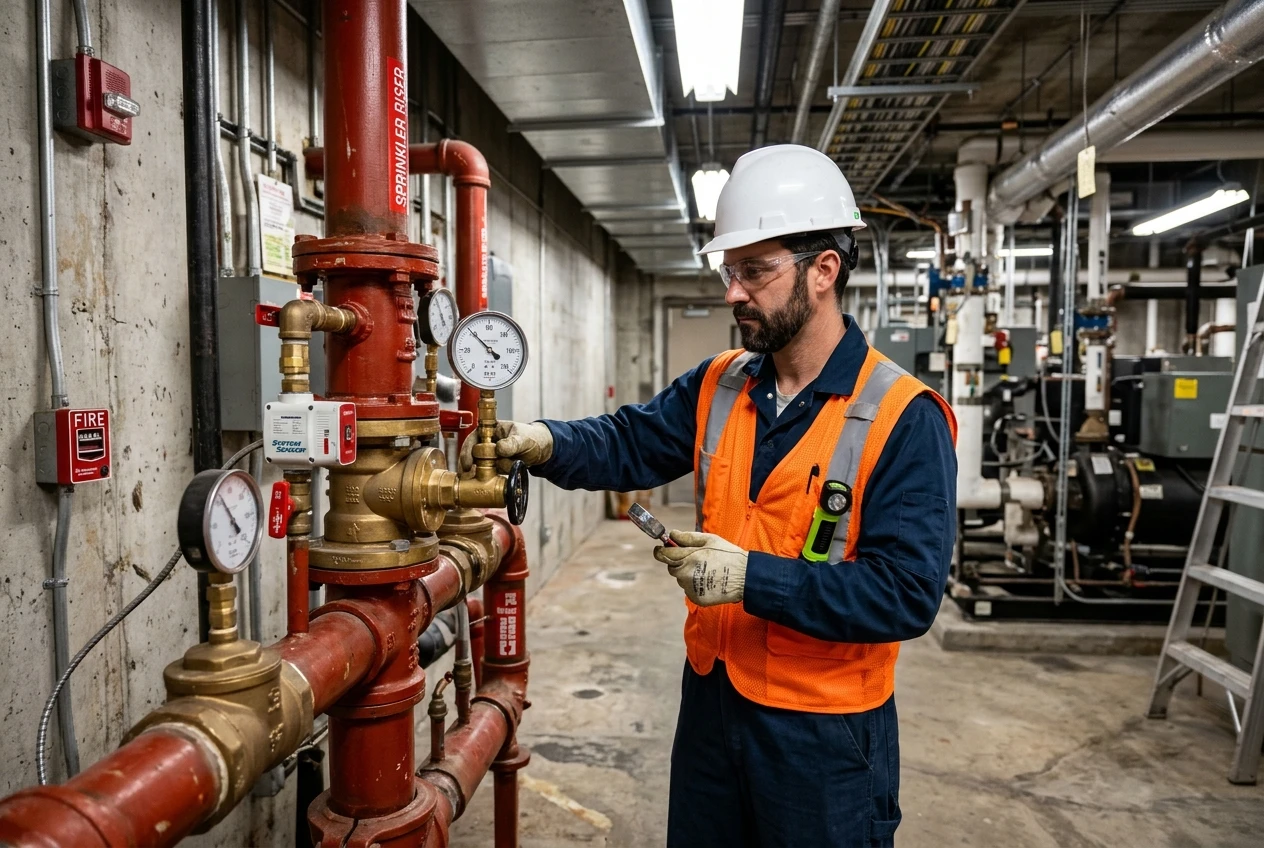 Certified fire protection specialist conducting valve positioning checks and main drain pressure tests on a commercial sprinkler riser.
4.1 Sprinkler Head Physical Condition & Clearance
Sprinkler heads must be inspected annually from floor level. Inspectors look for:
- Paint & Overspray Contamination: Paint on the deflector or thermal bulb insulates the glass bulb, preventing timely heat activation.
- Corrosion & Oxidation: Severe green copper oxidation or rusted frames that compromise structural release mechanisms.
- Deflector Clearance Obstructions: Storage, shelving, or partition walls closer than 18 inches below standard sprinklers (or 36 inches for ESFR heads).
- Physical Orientation & Damage: Bent frames, weeping fluid bulbs, or upright heads installed improperly in pendent configurations.
4.2 Control Valves, Waterflow Switches & Main Drain Tests
A closed control valve is the primary cause of catastrophic sprinkler failure during commercial building fires. Control valves must be visually inspected, exercised through their full travel range, and verified to report supervisory tamper signals to the fire alarm panel. Technicians execute quarterly main drain tests to compare dynamic residual pressure against original hydraulic acceptance baselines, identifying water supply choking or partially closed street valves.
4.3 Five-Year Internal Pipe Obstruction Investigations
Every five years, NFPA 25 mandates an internal assessment of piping. Inspectors uncouple pipe fittings at the system flushing connection and at the end of a representative branch line to inspect for foreign organic material, heavy rust scale, slime, and tubercules. If sediment is discovered, a full obstruction investigation and chemical pipe flushing are legally required.
5. How Often Should Fire Alarm and Sprinkler Systems Be Inspected?
Commercial building compliance requires a multi-tiered inspection schedule. The following comparison tables outline the mandatory intervals under NFPA 72 and NFPA 25 guidelines:
| Fire Alarm Component | Inspection Frequency | Testing Frequency | Key Focus Area |
|---|---|---|---|
| Control Panel & LEDs | Weekly / Monthly | Annual | Trouble, supervisory, and alarm signal verification |
| Standby Batteries | Monthly | Semiannual / Annual | Load voltage testing and terminal corrosion checks |
| Smoke & Heat Detectors | Semiannual | Annual | Aerosol functional response and physical cleanliness |
| Detector Sensitivity | N/A | Every 2 to 5 Years | Calibrated sensitivity range verification per NFPA 72 |
| Manual Pull Stations | Semiannual | Annual | Physical accessibility, glass rod integrity, trip operation |
| Horns, Strobes & Voice | Semiannual | Annual | Decibel output levels and optical strobe synchronization |
| Sprinkler Component | Inspection Frequency | Testing Frequency | Key Focus Area |
|---|---|---|---|
| Control Valves & Seals | Weekly / Monthly | Annual | Valve position, locking chains, and tamper switch signals |
| Pressure Gauges | Weekly / Monthly | 5 Years | Static pressure verification and gauge recalibration |
| Waterflow Alarm Switches | Quarterly | Semiannual | Flow switch paddle movement and alarm transmission time |
| Sprinkler Heads & Piping | Annual | Sample Testing | Visual corrosion, clearance, hangers, and seismic bracing |
| Main Drain Flow Test | N/A | Annual / Quarterly | Dynamic water pressure drop vs baseline street pressure |
| Internal Pipe Obstruction | N/A | Every 5 Years | Coupling removal to inspect for rust sludge, scale, or MIC |
6. Common Fire Protection Problems Found in Older Buildings
During routine inspections of pre-war and older commercial properties, engineering inspectors consistently uncover systemic deficiencies that compromise life safety:
- Painted Sprinkler Heads: Painters spray ceilings without masking sprinkler heads, coating heat-responsive elements and rendering them inoperable.
- Unrecorded Partition Additions: New tenant office cubicles or drywall partitions constructed directly beneath sprinkler throw patterns, creating dry shadows.
- Closed Control Valves: Maintenance crews isolate a riser during tenant plumbing repairs and fail to reopen or re-lock the valve upon completion.
- Failed Alarm Standby Batteries: Unmonitored gel cells past their 3-to-5 year operational lifespan failing instantly during grid power outages.
- Heavy Internal Sludge & MIC: Microbiologically Influenced Corrosion eating through pipe walls from the inside out, causing pinhole leaks and pipe blockage.
- Missing Documentation & Defect Logs: Inability to produce stamped acceptance records or proof of corrected historical violations.
7. Do Older Buildings Need to Upgrade Their Entire Fire Alarm or Sprinkler System?
A building's chronological age does not automatically trigger a mandatory gut replacement of its fire protection systems. Under existing building codes, systems that were legally installed and approved under older codes enjoy grandfathered status—provided they remain functional, properly maintained, and free from severe deterioration.
7.1 When Are Retrofits Legally Mandatory?
Mandatory system modernization is typically triggered by:
- Substantial Renovation (Level 3 Alterations): When work areas exceed 50% of the building aggregate floor area, full modern code compliance is enforced.
- Change of Occupancy Classification: Converting an old warehouse or office into a residential apartment building, assembly hall, or restaurant.
- System Wear & Unavailability of Parts: When more than 50% of a fire alarm circuit or sprinkler distribution network is deteriorated or replacement parts cease to exist.
- Specific Retrofit Legislation: Municipal retroactive safety laws (such as NYC Local Law 26 requiring automatic sprinklers in commercial office buildings 100+ feet in height).
Under NYC Buildings Bulletin 2024-001, property owners can perform minor alterations and component replacements on existing fire alarm systems without triggering a full building-wide system replacement, provided the scope of work remains within defined parameters and does not degrade overall system integrity.
8. Special Considerations for Historic and Pre-War Buildings
Upgrading life safety infrastructure in landmarked and pre-war properties requires balancing life safety with historic preservation mandates:
- Decorative Plaster & Coffered Ceilings: Routing surface-mounted metal conduit across ornate decorative plaster is frequently forbidden by Landmarks Commissions. Engineers must utilize concealed core drilling, false crown moldings, or wireless fire detection technologies where permitted.
- Piping Route Optimization: Concealing sprinkler risers within existing disused utility chases, freight elevator shafts, or closets to preserve historic architectural integrity.
- Structural Weight Limits: Verifying that historic timber or hollow-tile arch floor framing can accommodate the concentrated dead load of large, water-filled sprinkler distribution mains.
9. What Documentation Should Building Owners Maintain?
Maintaining complete, organized fire safety records is as vital as the physical maintenance itself. In the event of a fire incident, insurance claim, or regulatory audit, the burden of proof rests entirely on the property owner.
9.1 Mandatory Compliance Records Checklist
- Original Stamped Plans: Approved hydraulic riser diagrams, electrical one-line drawings, and municipal Letters of Approval.
- Annual NFPA 72 & NFPA 25 Inspection Reports: Complete signed logs from licensed fire protection contractors detailing every tested component.
- Detector Sensitivity & Battery Test Logs: Calibrated test printouts confirming compliant decibel, strobe, and sensitivity performance.
- Five-Year Internal Pipe Inspection Certifications: Formal engineering reports verifying pipe internal cleanliness and flushing results.
- Daily Fire Alarm Logbook: On-site bound logbook recording daily system supervisory status, central station signals, and maintenance visits.
10. Who Is Responsible for Fire Alarm and Sprinkler Inspections?
| Stakeholder | Legal Responsibility | Primary Role |
|---|---|---|
| Building Owner | Statutory Life Safety Accountability | Ensuring systems are operable, contracting licensed specialists, funding repairs |
| Licensed Fire Protection Contractor | Technical Execution & Testing | Conducting NFPA 25 flow tests, internal pipe assessments, and certified repairs |
| Licensed Fire Alarm Electrician | Code-Compliant Alarm Servicing | Executing NFPA 72 device diagnostics, battery tests, and central station programming |
| Fire Protection Engineer (PE) | Hydraulic & Life Safety Engineering | Designing system retrofits, hydraulic flow modeling, and landmark compliance filings |
| Fire Department / Fire Marshal (AHJ) | Regulatory Enforcement & Auditing | Conducting periodic municipal inspections, issuing Notices of Violation, granting approvals |
11. What Happens When a System Fails an Inspection?
Deficiencies identified during routine testing are categorized into two regulatory tiers:
- Non-Critical Deficiencies: Minor issues that do not directly prevent system operation (e.g., missing valve signage, minor corrosion on pipe hangers, or single faulty smoke detectors in non-critical zones). These must be scheduled for prompt repair within 30 to 60 days.
- Critical Impairments: Severe conditions that prevent the system from functioning (e.g., closed main water control valves, frozen or ruptured pipes, failed fire pumps, or dead central fire alarm control panels). Critical impairments require immediate implementation of formal impairment procedures:
- Immediate notification of the local Fire Department and Central Station Monitoring service.
- Posting of physical impairment tags on all affected risers and control panels.
- Establishment of a continuous, round-the-clock physical **Fire Watch** conducted by certified fire guards until normal operation is fully restored and re-tested.
12. How to Prepare an Older Building for Fire Protection Inspections
To ensure smooth regulatory inspections and avoid unnecessary violations, property managers should implement a structured preparation routine:
- Conduct Pre-Inspection Site Walks: Verify that all sprinkler heads have at least 18 inches of clearance and that no devices are painted or obstructed.
- Verify Control Valve Positions: Ensure all OS&Y valves are wide open, chained, padlocked, or electronically supervised.
- Organize Historical Maintenance Binders: Have the last three years of testing logs, battery replacements, and central station certificates on hand for inspector review.
- Coordinate Advance Tenant Access: Notify commercial tenants at least 48 hours in advance of audible alarm testing and mechanical room access.
- Engage Licensed, Certified Professionals: Ensure all servicing contractors possess active municipal licenses and NICET fire protection certifications.
Is Your Older Building's Fire Protection System Up to Date?
Maintaining fire alarms and sprinkler systems in older commercial properties requires careful engineering, certified testing, and meticulous compliance record-keeping. Whether your property needs a comprehensive NFPA inspection, life safety code assessment, sprinkler retrofit, or FDNY violation remediation, our licensed fire protection engineers and compliance specialists are ready to help.