
Introduction: Should You Upgrade or Replace Your Pre-War Building's Steam Heating System?
Pre-war buildings are renowned for their architectural character, historic craftsmanship, high ceilings, and solid masonry construction. However, many of these iconic properties still rely on heating infrastructure that was installed nearly a century ago.
Steam heating systems remain widespread across older residential apartment cooperatives, condominiums, commercial office buildings, and historic brownstones throughout New York City. While these systems can deliver dependable, robust warmth when properly balanced, aging boilers, deteriorating distribution pipes, uneven heating, banging water hammer, and rising fuel expenses create persistent headaches for building owners and property managers.
This reality raises a fundamental question facing board members and facility executives: Is it smarter to upgrade an existing steam heating system or replace it entirely with modern heating technology?
The answer depends on a comprehensive evaluation of multiple building parameters: the remaining service life of the boiler, the physical condition of distribution and condensate lines, water chemistry history, structural envelope integrity, annual energy consumption, and long-term regulatory compliance under mandates such as NYC Local Law 97.
In many buildings, targeted mechanical interventions—such as replacing failed thermostatic steam traps, installing modern high-capacity main air vents, insulating exposed boiler pipes, and implementing smart indoor sensor controls—can dramatically resolve comfort complaints and trim fuel consumption by 15% to 25% at a fraction of full replacement cost.
In other properties, widespread pipe corrosion behind plaster walls, chronic boiler section cracking, or building-wide electrification objectives may make a complete transition to hydronic or heat pump systems the only sensible long-term investment.
This guide analyzes both paths in depth, providing building owners, co-op boards, and engineers with the technical criteria, financial trade-offs, and regulatory considerations required to make an informed capital decision.
1. Understanding Steam Heating Systems in Pre-War Buildings
Steam heating systems were the gold standard for multi-story urban construction during the late nineteenth and early twentieth centuries. Their rapid adoption was fueled by thermodynamics: steam naturally creates its own motive pressure as water boils, allowing heat to rise through multi-story buildings without electrical circulating pumps.
The operating cycle is straightforward: water inside a central basement boiler is heated until it vaporizes into low-pressure steam (typically 0.5 to 2.0 psi). The steam travels upward through a network of vertical pipe risers and enters cast-iron radiators located in individual rooms, releasing its latent heat as it condenses back into liquid water. The dense condensate then flows by gravity back down to the boiler, where the cycle repeats.
Because these legacy systems contain very few moving electromechanical components, many have survived for 70 to 100 years. However, normal building settling, decades of pipe corrosion, improper maintenance, and haphazard alterations have degraded their operational efficiency.
1.1 What Makes Pre-War Steam Heating Systems Different?
Pre-war buildings feature heating infrastructure tightly woven into their historic architectural fabric. Distinctive characteristics include:
- Cast-Iron Radiators: Heavy, high-mass radiant emitters positioned beneath windows to counteract natural drafts and envelope infiltration.
- Large-Diameter Steel or Wrought-Iron Piping: Generously sized supply mains and risers designed for low steam velocities and quiet vapor flow.
- Centralized Basement Boiler Rooms: Massive cast-iron sectional or scotch-marine steel boilers operating on natural gas or fuel oil.
- Gravity Condensate Return: System pitch and elevations engineered to return condensed water back to the boiler or condensate receiver without powered return pumps.
- Lack of Individual Unit Zoning: A single central boiler controlled by an outdoor thermostat or simple timer, frequently resulting in overheating on lower floors and underheating on upper floors.
Crucially, pre-war steam systems were designed during an era when windows were intentionally left open during the winter for fresh air ventilation following the 1918 influenza pandemic. Consequently, most pre-war heating systems are significantly oversized for today's tighter, weather-stripped building envelopes.
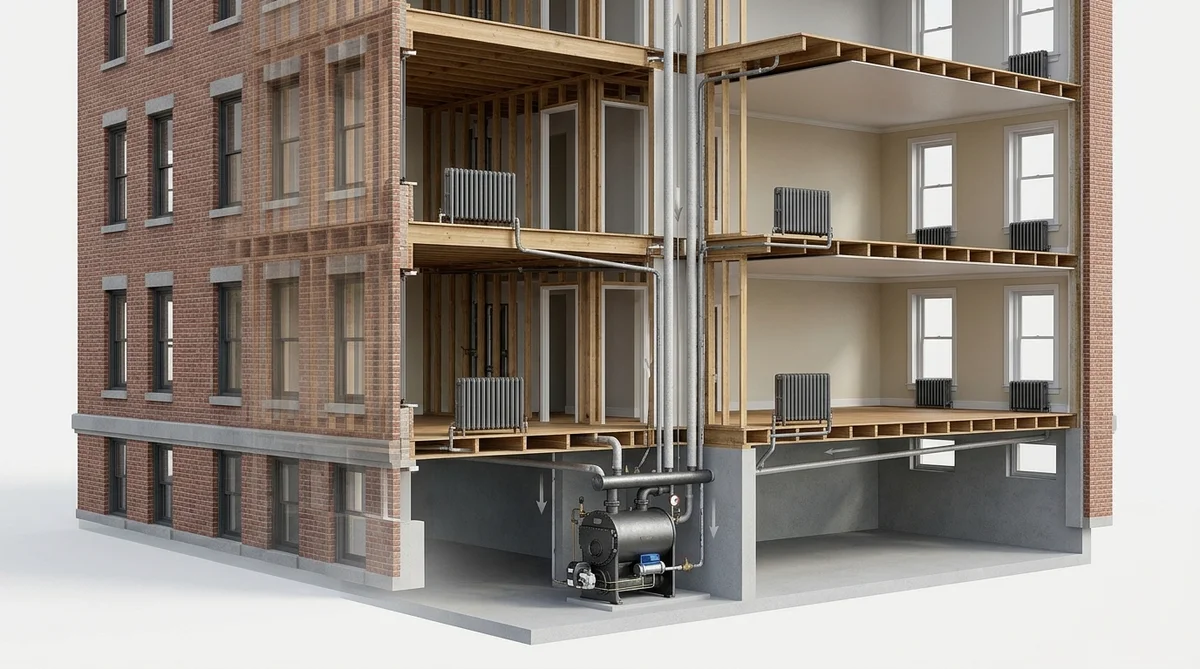 Engineering overview of pre-war steam distribution: basement central boiler, vertical supply risers, cast-iron radiator emitters, and gravity condensate return lines.
1.2 One-Pipe vs. Two-Pipe Steam Heating Systems
Before evaluating retrofit or replacement strategies, building owners must identify whether their property utilizes a one-pipe or two-pipe steam distribution network.
| System Feature | One-Pipe Steam System | Two-Pipe Steam System |
|---|---|---|
| Piping Configuration | Single pipe carries steam up to the radiator and drains condensate down in the opposite direction. | Dedicated supply pipe delivers steam; separate return pipe drains condensate and vents air. |
| Radiator Venting / Traps | Thermostatic air vent mounted on the side of each radiator. No steam trap. | Thermostatic steam trap mounted on the radiator outlet to block live steam while discharging condensate. |
| Operating Pressure | Very low pressure (typically 0.5 to 1.5 psi). Higher pressure prevents condensate drainage. | Low to medium pressure (typically 1.0 to 3.0 psi, or vacuum-assisted in larger complexes). |
| Temperature Control | Valves must be fully open or fully closed; throttling causes loud water hammer. Thermostatic radiator valves (TRVs) require specialized air-vent designs. | Radiator supply valves can be modulated with thermostatic radiator valves (TRVs) without inducing hammer. |
| Common Failure Points | Clogged radiator air vents, missing or undersized main-line vents, improper radiator pitch. | Failed steam traps blowing live steam into return lines, vacuum breaker leaks, condensate pump failures. |
| Primary Upgrade Path | Fast-venting main air vents, radiator TRVs with integral vacuum breakers, boiler pressure cut-out tuning, master energy management systems. | Systematic steam trap testing and replacement, condensate receiver overhauls, vacuum pump tuning, orifice plate balancing. |
2. Common Problems with Aging Steam Heating Systems
When pre-war steam heating malfunctions, building managers often face tenant complaints regarding noise, erratic temperatures, and high utility bills. Diagnosing the underlying root cause is critical to determining whether targeted remediation or capital replacement is needed.
2.1 Uneven Heating Across Apartments and Floors
The universal hallmark of an unbalanced steam system is "first-floor tropical, top-floor arctic." Lower-floor residents open their windows mid-winter because rooms exceed 80°F, while upper-floor or corner-unit tenants use supplemental electric space heaters.
This imbalance is rarely caused by an undersized boiler. In 90% of cases, the culprit is slow distribution venting. Air trapped inside cold pipes resists rising steam. If the basement steam main vents are undersized, rusted shut, or missing, steam crawls through the building unevenly, overheating the units closest to the boiler before steam ever reaches remote radiators.
2.2 Aging Boilers and Frequent Section Failures
The central boiler undergoes extreme thermal stress with every firing cycle. As cast-iron sections age, thermal expansion, mineral scale buildup, and acidic condensate can cause sections to crack, causing boiler water loss and combustion chamber flooding.
Repeated emergency service calls, frequent water feeder cycling, and visible rust along push nipples or tie rods indicate that the boiler is reaching mechanical retirement. However, a failing boiler does not necessarily mean the entire piping infrastructure is defective.
2.3 Pipe Corrosion and Leaking Condensate Lines
Steam itself is relatively non-corrosive, but when dissolved oxygen and carbon dioxide enter the system through fresh make-up water, they react to form carbonic acid in the condensate return lines. Over decades, this acid corrodes the bottom of horizontal return piping, causing pinhole leaks and pipe thinning.
Frequent boiler water feeding accelerates this destructive cycle: adding fresh, oxygen-rich municipal water introduces more corrosive gases, destroying the pipes faster. Identifying whether corrosion is localized to exposed basement returns or pervasive within concealed wall cavities determines project viability.
2.4 High Fuel Consumption and Short-Cycling
Many pre-war boilers were oversized by 50% to 100% when installed, or when previous conversions from coal to oil or gas took place. Oversized boilers generate steam faster than the distribution mains can vent air, driving boiler pressure up rapidly. The pressure switch then shuts the boiler off prematurely before steam reaches the radiators—a costly phenomenon known as short-cycling that wastes substantial fuel and causes severe mechanical wear.
2.5 Loud Water Hammer and Knocking Pipes
Loud banging or metallic clattering inside steam pipes occurs when fast-moving steam (traveling up to 60 mph) collides with pools of trapped, un-drained condensate. The steam rapidly collapses against the cooler water, creating a hydraulic shockwave that rattles pipes and loosens fittings. In one-pipe systems, water hammer is almost always caused by radiators sloping the wrong way, preventing condensate from draining back through the valve.
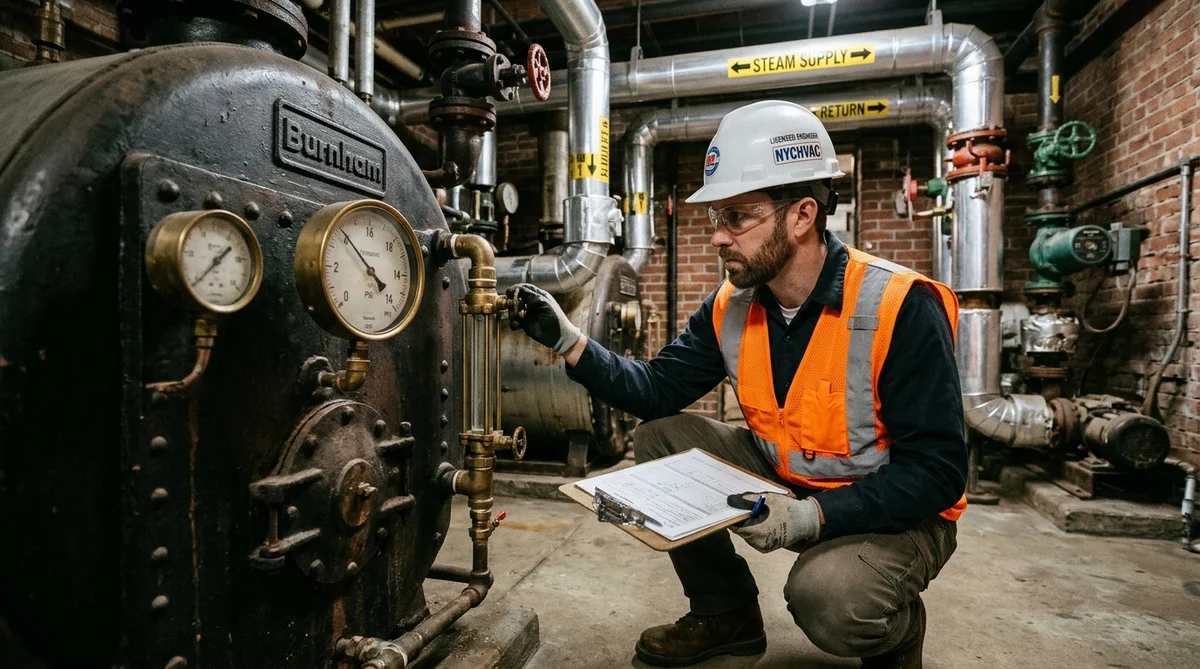 Licensed mechanical technician evaluating commercial steam boiler pressure controls, sight glasses, and insulated piping headers during a comprehensive system audit.
3. Option One: Upgrade the Existing Steam Heating System
For properties where the primary distribution risers and cast-iron radiators remain structurally intact, steam system modernization is frequently the most cost-effective, high-ROI capital improvement available. Targeted engineering upgrades can transform an inefficient, unbalanced steam system into a quiet, comfortable, and efficient heating asset.
3.1 High-Capacity Main-Line Air Venting
Main-line air venting is the single most effective upgrade for pre-war buildings. By installing multiple large commercial air vents (such as Hoffman #75, Gorton #2, or Barnes & Jones vents) at the ends of all basement steam mains and dry returns, air is expelled rapidly at minimal pressure. Steam fills the horizontal mains in minutes rather than hours, allowing all vertical risers to receive steam simultaneously and eliminating top-floor heat delays.
3.2 Comprehensive Steam Trap Replacement (Two-Pipe Systems)
In two-pipe steam systems, a thermostatic radiator trap that fails open allows live steam to blow directly into the dry return line. This pressurizes the return piping, blocks condensate drainage from neighboring radiators, causes catastrophic water hammer, and wastes enormous amounts of fuel. Implementing an annual ultrasonic or thermal trap audit and rebuilding defective trap elements restores proper thermodynamic separation.
3.3 Pipe Insulation and Thermal Jacketing
Uninsulated steam supply mains turn basements into saunas while starving upper-floor apartments of heat. Insulating all bare steam supply and dry return lines with heavy-density fiberglass or mineral wool pipe insulation (minimum 1.5 to 2.0 inches thick with all-service jackets) ensures thermal energy travels directly to residential living spaces.
3.4 Modern Smart Heating Controls and Wireless Sensors
Traditional indoor-outdoor reset timers rely solely on exterior temperatures. Modern steam energy management systems (EMS) utilize wireless temperature sensors placed in representative apartments across all exposures and floors. The intelligent controller modulates boiler firing based on real-time apartment feedback, ensuring the boiler runs only as long as necessary to satisfy the coldest apartment without overheating the rest of the building.
3.5 Proper Boiler Downsizing and Low-Pressure Tuning
Steam systems should operate at low vapor pressures—typically between 0.5 psi cut-in and 1.5 psi cut-out. Tuning pressuretrols to eliminate excessive pressure saves 10% to 20% in fuel consumption. When replacing an end-of-life boiler, engineers should perform a precise radiator square-foot equivalent direct radiation (EDR) survey to size the replacement boiler exactly to the connected load, eliminating over-sizing penalties.
4. Option Two: Replace the Existing Steam Heating System
While upgrading preserves legacy infrastructure, there are circumstances where the physical deterioration of the piping or strategic decarbonization mandates make full system replacement the superior pathway.
4.1 Modern Commercial Boiler Replacement (Keeping Radiators)
A sensible middle ground involves replacing the failing cast-iron boiler with a modern, high-efficiency atmospheric or forced-draft steam boiler while preserving the existing radiator and pipe network. This eliminates boiler reliability risks and lowers burner emissions without requiring intrusive construction in tenant apartments.
4.2 Conversion to Closed-Loop Hydronic (Hot Water) Heating
Converting a two-pipe steam building into a modern closed-loop hydronic system distributes heated water (120°F to 160°F) rather than steam. Advantages include precise apartment-level thermostatic zoning, silent variable-speed circulating pumps, and compatibility with ultra-high-efficiency condensing boilers (up to 95% thermal efficiency).
However, hydronic conversion requires evaluating existing pipe diameters, pressure ratings, and radiator heat transfer capacities at lower water temperatures. Existing one-pipe systems cannot be converted without installing an entire second network of return piping.
4.3 Full Electrification via Variable Refrigerant Flow (VRF) or Heat Pumps
Under aggressive carbon cap legislation such as NYC Local Law 97, commercial and multifamily buildings face escalating financial penalties for fossil fuel combustion. Transitioning from steam boilers to electric air-source heat pumps (ASHPs) or Variable Refrigerant Flow (VRF) systems fully electrifies the property.
Key heat pump strategies include:
- Ductless Mini-Splits / VRF: Decentralized outdoor inverter heat pumps connected via refrigerant tubing to wall-mounted, ceiling-cassette, or concealed ducted fan coils in each room. Delivers individual apartment heating and cooling simultaneously.
- Central Air-to-Water Heat Pumps: Roof-mounted heat pumps producing hot water that circulates through a converted hydronic distribution network, eliminating fossil fuel boilers while reusing piping routes where feasible.
Crucially, heat pump conversions represent major capital undertakings requiring building-wide electrical service upgrades, extensive structural core drilling, and substantial interior tenant disruption.
5. Upgrade vs. Replace: Comprehensive Comparison
Evaluating the optimal path requires weighing mechanical feasibility, financial capital, and long-term operating risk:
| Decision Criteria | Steam System Upgrade | Boiler-Only Replacement | Full Electrification (Heat Pumps) |
|---|---|---|---|
| Capital Expenditure | Lowest ($10,000 – $75,000) | Moderate ($40,000 – $150,000) | Highest ($15,000 – $35,000 per unit) |
| Tenant Disruption | Minimal (minor in-unit vent/trap checks) | None inside apartments (boiler room only) | Significant (wall penetrations, core drilling, electrical rewiring) |
| Energy Savings | 15% – 25% fuel reduction | 10% – 18% fuel reduction | 40% – 60% site energy reduction |
| Cooling Capability | None (heating only) | None (heating only) | Provides integrated high-efficiency air conditioning |
| LL97 Carbon Impact | Reduces near-term emissions; remains fossil-fueled | Incremental carbon reduction | Dramatically lowers or eliminates building carbon fines |
| Electrical Service Impact | None | None | Requires major Con Edison service upgrade |
| Project Timeline | 2 to 6 weeks | 1 to 3 months | 6 to 18 months |
6. Critical Engineering Considerations Before Modernizing
Pre-war buildings hold unique architectural and environmental complexities that design teams must evaluate prior to commencing construction.
1. Asbestos-Containing Materials (ACM): Magnesia pipe insulation, boiler breeching cement, and gasket materials installed prior to the 1970s often contain friable asbestos. A certified asbestos investigator must survey all mechanical spaces. If replacement requires disturbing ACM, professional containment and abatement under NYC DEP Title 15 regulations will add substantial time and cost.
2. Con Edison Electrical Capacity: Electrifying a 50-unit pre-war building with heat pumps can increase peak electrical demand by 200 kW to 400 kW. Existing 120/208V 400A services are routinely inadequate, requiring costly transformer vault construction, service conduit trenching, and switchgear replacement.
3. Structural Facade and Roof Constraints: Pre-war brick parapets, decorative masonry, and timber or terra-cotta roof joists require structural engineering review before mounting commercial heat pump condenser banks or routing exterior refrigerant lines.
7. Recommended Maintenance Program for Upgraded Steam Systems
Preserving heating reliability and efficiency requires an institutionalized preventive maintenance regimen:
| Maintenance Task | Recommended Frequency | Operational Objective |
|---|---|---|
| Low-Water Cut-Off (LWCO) Blowdown | Weekly during heating season | Flushes sediment from float chamber, prevents dry-firing boiler catastrophe. |
| Boiler Water Chemical Treatment | Monthly testing | Controls pH (ideal 9.0–11.0), prevents oxygen pitting and scale accumulation. |
| Main-Line Air Vent Inspection | Pre-season (September/October) | Ensures vents are clear, unpainted, and discharging air freely. |
| Steam Trap Infrared Testing | Annually (mid-season) | Identifies blown traps blowing live steam into condensate returns. |
| Burner Combustion Tuning | Annually | Measures flue gas O2, CO, and stack temperature; sets optimal air-fuel ratio. |
| Sight Glass Cleaning & Gauge Calibration | Semi-annually | Maintains clear visibility of boiler water line and accurate pressure readings. |
Conclusion: Making the Strategic Capital Choice
The choice between upgrading an existing pre-war steam heating system or replacing it with modern technology is not a binary decision. In reality, modern building science provides a continuum of options.
For buildings with fundamentally sound distribution piping, a steam system modernization program—re-venting mains, replacing defective traps, insulating headers, tuning operating pressures to under 1.5 psi, and deploying intelligent apartment-sensor controls—delivers immediate fuel savings, resolves tenant comfort complaints, and costs a fraction of a full mechanical conversion.
Conversely, for properties with failing boilers, extensive underground or in-wall pipe corrosion, and long-term decarbonization commitments, developing an electrification master plan with heat pumps or hybrid systems establishes lasting asset value, eliminates fossil fuel liabilities, and provides essential summer air conditioning.
Before committing capital funds, property owners and boards should retain an independent professional MEP engineer to perform a calibrated heating audit, assess electrical service capacity, and model life-cycle economics tailored to their unique property.