BY NYC Energy Code Team
ON 25 Jun 2026
No Gas Building and Local Law 152 in NYC

Building Without Gas Local Law 152 NYC: What Owners Need to Know
Many New York City property owners assume that Local Law 152 only applies to buildings that actively use natural gas. At first glance, that assumption seems reasonable. After all, if a building has no gas appliances, no gas meters, and no active gas service, why would a gas piping law matter?
The reality is more complicated.
A building without gas service does not automatically mean there is nothing to document, nothing to verify, and nothing to file. In many situations, NYC property records, historical gas installations, or prior utility connections can create compliance questions that owners should address before concluding that Local Law 152 does not apply.
This is why understanding the relationship between a building without gas and Local Law 152 NYC requirements is important. The issue is often less about whether gas is currently being used and more about how the building is documented within city records.
Ignoring the issue can lead to confusion, unexpected notices, compliance concerns, and unnecessary delays when questions arise later.
Understanding Local Law 152
Local Law 152 was established as part of New York City's broader effort to improve gas safety throughout the city.
The law generally requires periodic inspections of exposed gas piping systems in covered buildings. These inspections must be conducted by qualified professionals and certified through the appropriate Department of Buildings (DOB) procedures.
The goal is straightforward:
- Improve public safety
- Identify deteriorated gas piping
- Detect hazardous conditions
- Reduce gas-related incidents
- Maintain accurate compliance records
For buildings with active gas systems, the inspection requirement is usually easy to understand. The confusion begins when a property owner believes the building has no gas.
The Assumption That Creates Problems
A common conversation sounds like this:
"My building doesn't use gas. Therefore Local Law 152 does not apply to me."
While that conclusion may ultimately be correct, the problem is reaching it without verification.
The NYC Department of Buildings relies heavily on records, classifications, historical permits, and property information. What an owner believes about the building may not always match what city records indicate. This mismatch creates risk.
For example:
- A building may have had gas service decades ago.
- Gas piping may still exist behind walls or in mechanical areas.
- Utility records may still show historical gas connections.
- Building filings may indicate prior gas infrastructure.
- Previous owners may have capped service without updating all records.
In these situations, assuming "no gas means no action" can become problematic. The safer approach is to verify the property's actual status and determine whether supporting documentation should be maintained.
No Gas Piping vs No Gas Service
One of the most important distinctions owners should understand is the difference between no gas piping and no active gas service:
No Gas Piping
A building with absolutely no gas piping infrastructure. This may include fully electric buildings, buildings designed without gas systems, or properties where all gas piping was permanently removed. In these situations, there may be little ambiguity regarding the building's status.
No Active Gas Service
A very different scenario. In this case, gas piping may still exist, gas meters may remain installed, service may be capped, lines may be inactive, appliances may have been removed, or utility service may simply be disconnected.
From a compliance perspective, this distinction can matter significantly. The presence of existing gas infrastructure may require additional review before concluding that Local Law 152 obligations do not apply.
Why Historical Records Matter
Many owners focus only on current building conditions. DOB compliance, however, often depends on both current conditions and documented history.
Consider a property that converted from gas heating to electric heating ten years ago. The owner may believe there is no gas usage, no gas bills are being paid, and no gas equipment exists. Yet records may still indicate prior gas service, existing piping, previous gas permits, utility account history, and building systems that once relied on gas.
When city records and owner assumptions differ, documentation becomes extremely important.
The Hidden Risk of Outdated Records
One of the most common issues involves outdated information. Buildings evolve over time. Owners renovate, systems are upgraded, and mechanical equipment changes. However, paperwork does not always keep pace with physical changes.
This can create situations where:
- City records indicate gas infrastructure.
- The owner believes none exists.
- Compliance notices are generated automatically.
- Questions arise during property transactions.
- Future inspections become more complicated.
Keeping documentation current helps reduce these risks.
Why Documentation Is So Important
Many compliance problems begin as documentation problems. The issue is not necessarily that the building failed to comply. The issue is that the owner cannot demonstrate why compliance requirements do not apply.
Documentation may help establish:
- No gas service exists.
- Gas piping was removed.
- Utility service was terminated.
- Prior systems were decommissioned.
- The building's current configuration differs from historical records.
Without documentation, proving these facts later may become more difficult.
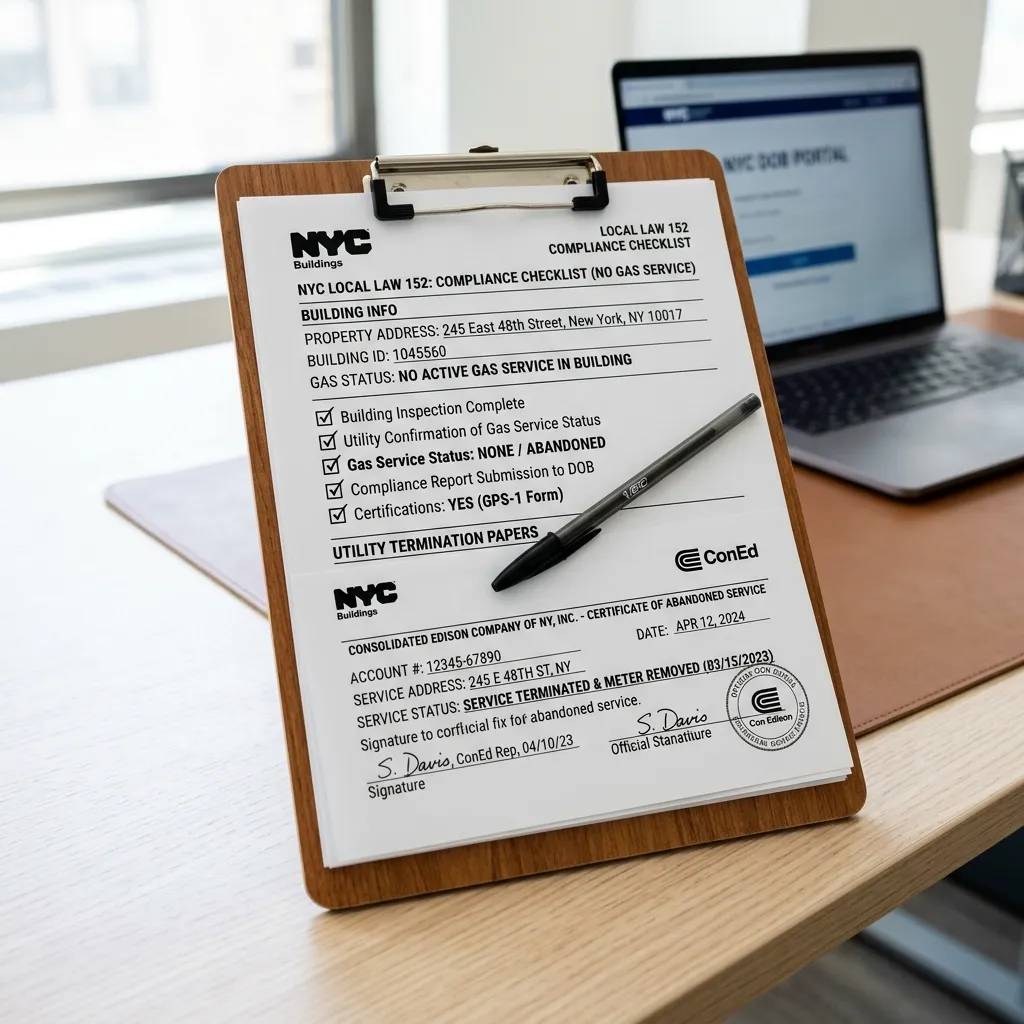
What NYC Property Owners Should Review
Owners of buildings without gas should conduct a careful review of several areas:
Utility Records
Start with utility documentation. Look for active accounts, service termination records, historical gas service information, and utility correspondence. These records often provide important evidence regarding the property's status.
Plumbing Documentation
Review previous plumbing permits, gas work permits, alteration filings, and infrastructure removal records. These documents can help establish what changes were made and when.
Building History
Investigate whether the building ever had gas heating, gas cooking systems, commercial gas equipment, or gas-fired hot water systems. Historical use can affect documentation needs.
DOB Records
Check property information through DOB systems using Address, BBL (Borough, Block, Lot), and BIN (Building Identification Number). This review helps identify discrepancies before they become larger problems.
Common Scenarios for No-Gas Buildings
Scenario 1: Fully Electric New Construction
A newly constructed all-electric building may never have had gas infrastructure. Documentation is typically straightforward because records generally align with physical conditions.
Scenario 2: Former Gas Building Converted to Electric
Many older NYC buildings have undergone modernization projects where gas systems were abandoned or removed. These properties often require closer review because historical records may still reflect previous gas usage.
Scenario 3: Temporarily Inactive Gas Service
Some buildings have gas piping but no current gas supply. This is often the most misunderstood category. The absence of active service does not necessarily mean the building should ignore Local Law 152 considerations.
Scenario 4: Mixed Documentation
Some properties have incomplete records where different documents suggest different conditions. These cases typically benefit from professional review.
What Happens If You Ignore the Issue?
Many owners assume that doing nothing is the safest option. In reality, ignoring uncertainty can create avoidable complications. Potential consequences include compliance notices, DOB inquiries, delays during property sales, increased administrative costs, time spent gathering historical records, and additional professional review requirements. The objective is not to create unnecessary work; the objective is to eliminate uncertainty before it becomes a problem.
The Role of a Licensed Master Plumber
When questions exist regarding gas infrastructure, a Licensed Master Plumber can provide valuable guidance. A qualified professional can inspect existing conditions, verify whether gas piping exists, review infrastructure status, assess previous modifications, evaluate documentation needs, and help determine whether further action is necessary. This review is often less expensive than dealing with compliance disputes later.
Preparing for Future Property Transactions
Documentation becomes especially important when selling a building, refinancing property, obtaining insurance, conducting due diligence, or changing management companies. Future buyers frequently request records relating to gas infrastructure, utility systems, compliance history, and building modifications. Maintaining organized records today can simplify these processes later.
Best Practices for Owners of Buildings Without Gas
Even if a building appears to have no gas infrastructure, owners should maintain a compliance file containing:
- Utility documentation
- Plumbing records & permit history
- DOB correspondence & classification information
- Professional evaluations
- Infrastructure removal documentation
- Historical records related to gas service
This information creates a clear record of the property's status.
A Practical Verification Checklist
Before concluding that Local Law 152 does not affect your property, consider the following questions:
Building Review
- Does the building contain any gas piping?
- Were gas systems previously installed?
- Have gas appliances been removed?
Utility Review
- Is gas service active?
- Was service formally disconnected?
- Are utility records available?
Documentation Review
- Are prior permits available?
- Are removal records available?
- Do DOB records match current conditions?
Professional Review
- Has a qualified professional verified the condition?
- Are there any unresolved questions?
If uncertainty remains, additional review may be worthwhile.
Why This Topic Matters More Than Many Owners Realize
Many Local Law 152 discussions focus exclusively on buildings with active gas systems. As a result, owners of no-gas properties often assume the law has no relevance to them. However, compliance is often driven by records, classifications, and documentation rather than assumptions.
The most effective strategy is not to guess. It is to verify. By confirming building status and maintaining proper records, owners can avoid confusion and ensure their property documentation accurately reflects reality.
Conclusion
A building without gas Local Law 152 NYC issue is not always as simple as it first appears. No active gas service does not automatically mean there is no documentation requirement. NYC property owners should distinguish between buildings with no gas piping and buildings that simply have inactive or discontinued gas service.
Reviewing utility records, plumbing documentation, DOB information, and historical building records can help clarify the property's status and reduce future compliance concerns. The goal is not to create unnecessary filings. The goal is to ensure that building records accurately reflect actual conditions and that owners are prepared if questions arise. When uncertainty exists, consulting a qualified professional can provide clarity and help avoid compliance complications later.
Frequently Asked Questions
Does a building without gas automatically ignore Local Law 152?
No. Owners should verify whether DOB records require supporting documentation, certification, or confirmation of no-gas status.
What is the difference between no gas service and no gas piping?
No gas service means gas may not currently be supplied, while no gas piping means the building lacks gas infrastructure altogether.
Why should owners review historical records?
Historical records may show prior gas installations, utility connections, or permits that affect how the property's status is documented.
What is the risk of assuming nothing is required?
The risk is discovering later that DOB records still expect documentation, resulting in avoidable compliance issues or administrative complications.
Who should review a building's gas status?
A Licensed Master Plumber or another qualified compliance professional can help verify existing conditions and review documentation.
What records should owners keep?
Owners should maintain utility records, plumbing permits, building history documents, DOB correspondence, and any documentation showing gas removal or service termination.
Can a building with capped gas lines still require review?
Yes. Capped or inactive gas infrastructure may still warrant documentation review before concluding that no Local Law 152-related action is necessary.
You may also
like