
Introduction: Who Should Pay When a Building Needs to Meet LL97?
Local Law 97 creates a financial challenge for many NYC co-op and condominium boards. A building may need substantial upgrades to its heating systems, boilers, lighting, insulation, or electrical infrastructure to reduce greenhouse gas emissions. The cost can reach hundreds of thousands or even millions of dollars.
But there is another challenge that can be just as difficult: deciding how to distribute that expense among shareholders or unit owners.
Should every apartment pay the same amount? Should larger apartments contribute more? Should owners of units with higher energy consumption pay a larger share? Should the board use reserve funds, increase monthly charges, or impose a special assessment?
These questions become complicated because LL97 measures emissions at the building level, not by assigning an individual emissions limit to every apartment.
The City establishes an emissions limit for the covered building and holds the building owner responsible for the applicable reporting and compliance obligations. It does not prescribe one universal formula for dividing retrofit expenses among residents.
For co-ops and condos, the internal allocation generally depends on the property's legal structure, governing documents, and applicable New York law.
That distinction matters. A board can pursue a fair and financially responsible compliance plan, but it should not invent a new cost-sharing formula without checking whether its governing documents and legal framework permit it.
Golden Governance Rule:
DOB enforces Local Law 97 at the whole-building level (per BIN), not per apartment. Boards cannot unilaterally create arbitrary cost-splitting schemes (e.g., penalizing high electricity users or billing flat fees). Condominiums must adhere to New York Real Property Law §339-m common interests, while co-ops must follow proprietary lease share allocations and Business Corporation Law §501(c).
1. First, Does Your Co-op or Condo Actually Fall Under LL97?
Before discussing cost allocation, the board should confirm whether the property is covered by Local Law 97.
The main coverage thresholds include:
- An individual building exceeding 25,000 gross square feet.
- Two or more buildings on the same tax lot with a combined area exceeding 50,000 gross square feet.
- Two or more condominium buildings governed by the same board of managers with a combined area exceeding 50,000 gross square feet.
The City's Department of Buildings (DOB) uses Department of Finance property records to determine relevant building areas. Owners should verify their coverage using the current LL97 Covered Buildings List rather than relying only on the property's marketing or management records.
Importantly, LL97 compliance is generally demonstrated at the individual building level using the Building Identification Number (BIN), rather than simply treating an entire tax lot as one building. Special reporting rules apply where multiple buildings share energy services or are part of a condominium structure.
For the 2026 reporting framework, boards should also confirm the applicable ENERGY STAR Portfolio Manager property classification used to calculate emissions limits.
A building should not approve a major assessment based on an assumed LL97 obligation. It should first confirm coverage, the applicable compliance pathway, and the actual emissions position.
2. How LL97 Responsibility Works Differently for Co-ops and Condos
Although co-ops and condos may look similar from the outside, their ownership structures are fundamentally different. That difference affects who manages compliance and how expenses are collected.
Co-op Buildings: The Corporation Owns the Building
In a cooperative, an apartment purchaser buys shares in a corporation and receives a proprietary lease giving them the right to occupy a particular apartment.
The cooperative corporation generally owns the building itself. Shareholders own shares in that corporation, not individual real estate units in the same manner as condominium owners.
The New York State Attorney General explains that co-op maintenance charges are generally based on the number of shares allocated to each apartment.
For LL97 purposes, the cooperative corporation is generally the building's legal owner and the corporation's board of directors oversees the building's compliance and financial decisions.
The board typically coordinates:
- LL97 reporting and professional engineering services.
- Building energy assessments.
- Retrofit planning and contractor selection.
- Financing and reserve allocation.
- Maintenance increases or capital assessments.
- Compliance-related operating decisions.
A shareholder should not automatically assume that an individual apartment owner is personally responsible for submitting the building's LL97 emissions report.
Condo Buildings: Unit Owners Share Ownership of Common Elements
In a condominium, each purchaser owns an individual unit and an associated percentage interest in the building's common elements.
The board of managers is responsible for administering the condominium's common property and financial obligations.
NYC's LL97 reporting rules specifically require a covered condominium building to submit one building emissions report covering all condominium units. The board of managers submits that report to DOB.
This is important because the emissions calculation covers the building as a whole, including the applicable energy use associated with its units.
The board must therefore coordinate whole-building compliance rather than treating every apartment as a separate LL97 reporting property.
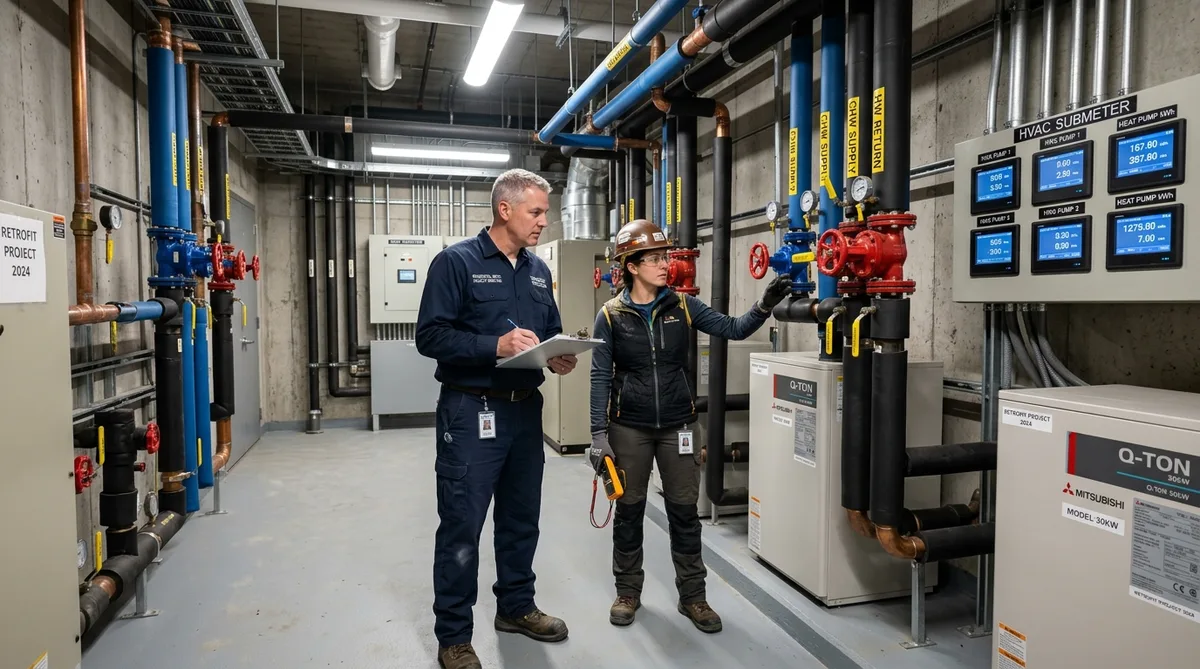 Central mechanical upgrades—such as electrification of domestic
hot water and heating systems—benefit the whole building and legally qualify as common
capital expenses.
Co-op vs. Condo: Key Differences
| Issue | Co-op | Condo |
|---|---|---|
| Ownership structure | Corporation owns the building | Individual owners own units and common interests |
| Resident's interest | Shares and proprietary lease | Unit ownership and common interest |
| Governing body | Board of directors | Board of managers |
| Maintenance/common charges | Generally based on apartment shares | Generally based on common interest |
| LL97 coordination | Cooperative corporation and its board | Condominium board of managers |
| Building emissions reporting | Building owner or authorized representative | One report submitted by the board of managers |
| Cost allocation | Proprietary lease, bylaws, corporate documents, and applicable law | Declaration, bylaws, and applicable condominium law |
The board should establish the correct legal ownership and reporting contact before beginning the financial planning process.
3. Does LL97 Tell Boards How to Split Retrofit Costs?
No.
Local Law 97 establishes emissions requirements and penalties for covered buildings. It does not create a standard apartment-by-apartment formula for dividing the cost of compliance work.
This is where the distinction between regulatory responsibility and internal cost allocation becomes critical.
For example, a covered condominium building may need a $900,000 heating-system upgrade to reduce emissions. DOB evaluates the building's emissions performance. It does not issue a separate emissions-reduction target or retrofit invoice to every condominium unit.
The board must determine how the project should be funded under the building's governing documents and applicable law.
The same principle applies to co-ops: the cooperative corporation manages the building-level obligation, while the board determines how to fund the work through the corporation's lawful financial arrangements.
A board cannot simply assume that every owner must contribute equally or that the apartment with the highest electricity consumption should automatically pay more.
4. How Condominiums Should Allocate LL97 Costs
For NYC condominiums, New York Real Property Law §339-m establishes the general rule for allocating common expenses:
Common expenses are charged to unit owners according to their respective common interests.
There are exceptions. The law permits certain special allocations where authorized by the declaration and bylaws, including specified non-residential units and expenses based on special or exclusive use, availability, or control of particular units or common areas.
This means that the condominium's declaration and bylaws are essential when determining how LL97 expenses should be distributed.
The Standard Common-Interest Method
Suppose a condominium has a $600,000 building-wide retrofit project. Assume an apartment has a common interest of 1.25%.
The owner's illustrative contribution would be $7,500.
Example: Four Condominium Apartments
| Apartment Unit | Common Interest | Share of $600,000 Project |
|---|---|---|
| Unit A | 0.75% | $4,500 |
| Unit B | 1.25% | $7,500 |
| Unit C | 1.80% | $10,800 |
| Unit D | 2.10% | $12,600 |
Actual common-interest percentages must come from the condominium's governing documents. They should not be replaced with an informal calculation based solely on bedroom count or square footage.
Can a Condo Board Charge Certain Units More?
Potentially, but not simply because the board believes those owners should pay more.
Under §339-m, special allocations must fall within the permitted categories and be authorized by the declaration and bylaws.
For example, expenses associated with an exclusively controlled or specially used common area may qualify for different treatment if the governing documents authorize it.
However, an LL97 emissions penalty or a central boiler replacement is not automatically a unit-specific expense just because some apartments consume more energy than others. Before using a special allocation, the board should obtain legal advice and confirm that the proposed method is permitted.
5. How Co-op Boards Should Allocate LL97 Costs
Cooperative buildings follow a different statutory framework.
The New York State Attorney General explains that maintenance charges are generally calculated using the number of shares allocated to each apartment.
New York Business Corporation Law §501(c) also addresses the treatment of maintenance charges and general assessments for residential cooperative corporations. Subject to its stated conditions, those charges must be determined on an equal per-share basis, an equal per-room basis, or as an equal percentage of maintenance charges.
The proprietary lease, bylaws, certificate of incorporation, and offering-plan documents should therefore be reviewed before the board approves an LL97 assessment.
The Per-Share Method
Consider a cooperative with:
- 100,000 issued and outstanding shares.
- A total LL97 retrofit funding requirement of $800,000.
- An apartment allocated 900 shares.
Example: Co-op Assessment by Apartment Shares
| Apartment | Allocated Shares | Contribution at $8 per Share |
|---|---|---|
| Apartment 1A | 500 | $4,000 |
| Apartment 2B | 750 | $6,000 |
| Apartment 3C | 900 | $7,200 |
| Apartment 4D | 1,200 | $9,600 |
| Apartment 5E | 1,500 | $12,000 |
The calculation uses the property's actual share allocation structure. The board should confirm whether its proprietary lease and other governing documents prescribe this method for the particular maintenance charge or capital assessment.
Why Co-op Boards Should Avoid Arbitrary Changes
Suppose a board decides that larger apartments should contribute more to LL97 work, even though the existing proprietary lease calculates maintenance and general assessments per share.
Changing the allocation simply because the board believes square footage is a fairer measure can create legal and governance problems.
A board should not substitute a new formula for the existing contractual or statutory framework without establishing that the change is legally authorized. The starting point should always be the proprietary lease, bylaws, certificate of incorporation, and applicable corporate law.
6. Should Owners Pay According to Apartment Size, Energy Usage, or Ownership Shares?
This is one of the most contentious questions in LL97 planning.
At first glance, it may appear logical to charge larger apartments more because they often have more space and potentially higher energy consumption. Another argument is that owners whose apartments use more electricity or heating should contribute more toward the cost of reducing emissions.
But those ideas do not automatically produce a lawful or accurate allocation method.
A building's LL97 emissions include energy associated with the central building systems and applicable unit-level energy consumption. That does not mean the board has reliable unit-by-unit emissions data or legal authority to use it for a special assessment.
 Transparent board presentations and open communication with
shareholders and unit owners prevent governance disputes when approving decarbonization
capital assessments.
Comparing Possible Allocation Methods
| Allocation Method | Potential Advantage | Main Limitation |
|---|---|---|
| Common-interest percentage | Uses an established condominium ownership allocation | Must follow declaration and statutory requirements |
| Co-op shares | Consistent with the cooperative's established share structure | Must comply with the proprietary lease and corporate law |
| Equal amount per apartment | Simple to explain and calculate | May conflict with proportional allocation rules |
| Apartment square footage | Reflects one measure of unit size | Does not necessarily reflect common interest or legal allocation rights |
| Submetered energy usage | Can measure certain individual energy consumption | Does not establish authority to allocate a building-wide LL97 cost differently |
| Special-use allocation | Can recognize exclusive use or control where permitted | Requires applicable legal and governing-document authorization |
For common building-wide LL97 costs, boards should generally start with the established allocation mechanism: common interests for condominiums, and allocated shares for co-ops. The key is to distinguish an allocation that seems economically reasonable from one the board is legally entitled to impose.
7. Separate Building-Wide Costs From Unit-Specific Expenses
One way to make the financial process more transparent is to divide the LL97 budget into clear cost categories. Not every expense should automatically be treated as the same type of charge.
Category 1: Building-Wide Engineering and Compliance Costs
These expenses may include energy audits under Local Law 87, retro-commissioning, LL97 emissions calculations, registered design professional services, building energy assessments, compliance reporting, and equipment investigations. These services generally support the building's overall compliance process.
Category 2: Shared Building-System Improvements
Examples include central boiler replacement, heat pump installation serving common systems, building-wide HVAC modernization, roof and wall insulation, common-area LED lighting, building management system upgrades, and main electrical infrastructure improvements. These are generally building-wide projects, so the established common-expense allocation rules are an appropriate starting point.
Category 3: Unit-Specific or Exclusively Used Improvements
Certain upgrades may benefit only one apartment or a defined group of units (such as private terrace PTAC units or penthouse cooling systems). A board should review the governing documents before placing such costs on an individual owner.
Category 4: LL97 Penalties and Compliance Shortfalls
A covered building exceeding its applicable Article 320 emissions limit may face a statutory penalty calculated using the amount of excess emissions:
There is also a separate failure-to-file penalty of $0.50 per square foot per month for applicable Article 320 reporting violations.
Article 321 buildings have a different compliance and penalty framework, so boards must confirm which pathway applies before using the Article 320 figures.
Importantly, DOB calculates the building's regulatory liability. LL97 does not instruct the board to assign the penalty to the apartments with the highest individual energy use. The board's internal allocation remains subject to the relevant ownership and governing-document rules.
8. Three Ways Boards Can Finance LL97 Upgrades
Once a board has established the appropriate allocation mechanism, it must decide how the building will fund the work.
Option A: Special Assessment
A special assessment collects money from shareholders or unit owners for a defined project or funding requirement.
- Advantages: Provides capital relatively quickly, creates a clearly identified project budget, avoids long-term interest costs if collected upfront, and allows a defined payment schedule.
- Disadvantages: Owners may face large immediate expenses, fixed-income residents may struggle to make payments, and large assessments can affect apartment marketability and resale values.
Option B: Increase Monthly Maintenance or Common Charges
Instead of collecting the full project cost at once, the board may incorporate the funding requirement into recurring charges, where authorized.
- Advantages: Spreads the financial impact over time, reduces immediate sticker shock, and simplifies long-term capital planning.
- Disadvantages: Increases recurring housing carrying costs, which can permanently affect affordability and resale comparisons.
Option C: Building Loan or Green Financing
Boards can also examine loans or specialized green financing for eligible improvements, such as NYCEEC clean energy loans, Commercial PACE (C-PACE), or conventional bank borrowing.
- Advantages: Spreads capital costs over 10 to 20 years, matches debt service with ongoing energy bill savings, and avoids immediate lump-sum cash assessments.
- Disadvantages: Incurs interest and loan closing fees, requires lender underwriting, and for condos, borrowing can be legally complex because the condominium association does not own the real estate in the same manner as a co-op corporation.
Comparing Funding Methods
| Funding Method | Upfront Owner Cost | Long-Term Cost | Main Consideration |
|---|---|---|---|
| Special assessment | Usually higher | Depends on payment schedule | Immediate affordability for residents |
| Monthly charge increase | Lower initially | Recurring payments | Long-term carrying costs and resale impact |
| Building loan | Potentially lower initially | Principal plus interest | Borrowing eligibility and repayment terms |
| Reserve funds | Potentially no new assessment | Reduces existing reserves | Future capital requirements for roofs, elevators, façades |
| Combination approach | Depends on structure | Depends on financing | Coordination, transparency, and resident approval |
9. A Fair Allocation Example: A $1 Million LL97 Retrofit
Consider a hypothetical NYC residential property with an approved $1 million retrofit budget:
| Project Component | Budget Cost |
|---|---|
| Central heating-system upgrades | $500,000 |
| Building controls and BMS | $180,000 |
| Electrical infrastructure upgrades | $120,000 |
| Building envelope improvements | $150,000 |
| Engineering and commissioning | $50,000 |
| Total Project Cost | $1,000,000 |
Assume the building secures $100,000 in confirmed Con Edison and NYSERDA utility incentives. The net remaining financing requirement is $900,000.
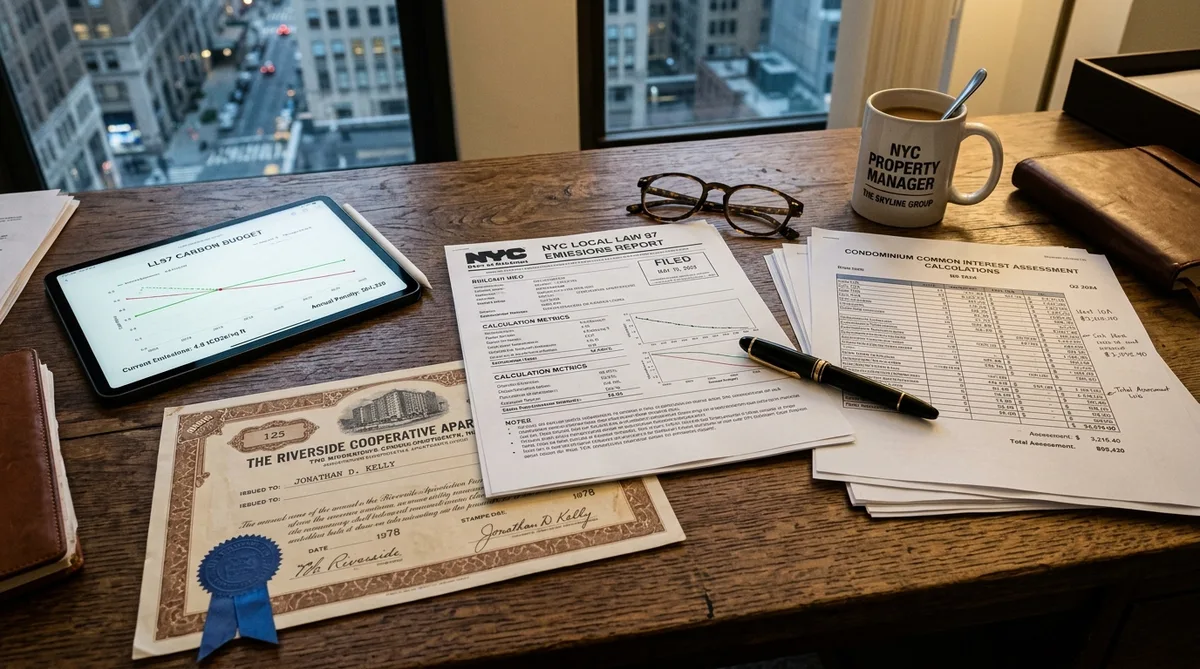 Transparent financial modeling that clearly contrasts condominium
common interest calculations against co-op share allocations is essential for board
approval.
Condo Scenario
Assume a residential unit has a 1.5% common interest percentage:
Co-op Scenario
Assume a cooperative has 100,000 total outstanding shares, and one shareholder owns 1,000 shares:
These calculations demonstrate the two distinct legal mechanisms. They are not interchangeable: condo allocations must follow the declaration's common interest percentages, while co-op assessments follow allocated corporate shares.
10. How Boards Can Make the Process More Transparent
Even when the legal allocation formula is clear, residents may object to the size of an assessment. This often happens because owners see a large payment request without understanding the engineering work, financial calculations, or alternatives considered.
Publish a Detailed LL97 Project Budget
The budget should separate engineering and professional fees, energy audits, equipment purchases, construction, electrical upgrades, financing charges, incentives, contingencies, and any potential penalties. This makes it easier to distinguish mandatory compliance work from optional cosmetic upgrades.
Present the Alternatives
Before approving the funding plan, the board should compare the cost of doing nothing (accruing annual LL97 penalties), the cost of the retrofit, available green financing options, and confirmed utility rebates. Energy savings, emissions reductions, financing costs, and equipment replacement timing must be evaluated separately.
Explain the Allocation Formula
For a condominium, publish each unit's common-interest percentage and the resulting dollar charge. For a cooperative, publish the apartment's allocated shares, the total issued and outstanding shares, and the assessment per share. Residents should be able to verify their individual contribution independently.
Record the Decision
Board meeting minutes should thoroughly document the engineering advice received, funding alternatives evaluated, selected financing method, allocation formula, and the business rationale for the decision. Under New York law, courts evaluate board actions under the Business Judgment Rule, requiring boards to act in good faith and within their corporate authority.
11. What If Some Residents Cannot Afford the LL97 Assessment?
Financial affordability is a pressing concern in residential buildings. A $10,000 assessment may be manageable for one owner but devastating for another, especially seniors on fixed incomes.
Boards can reduce immediate payment pressure without illegally altering proportional ownership shares:
- Extended Payment Plans: Allowing residents to pay assessments over 24 to 36 months with modest carrying charges.
- Building-Level Debt: Securing long-term financing (e.g., C-PACE or NYCEEC) so that capital costs are repaid gradually.
- Phased Construction: Prioritizing high-impact low-cost energy conservation measures first.
- Incentive Stacking: Aggressively pursuing Con Edison Clean Heat and NYSERDA incentives.
However, the board cannot arbitrarily exempt favored owners or shift their financial burden onto neighbors without legal authority.
Special Consideration for Affordable and HDFC Co-ops
Certain affordable housing cooperatives and Housing Development Fund Corporation (HDFC) properties fall under Article 321 of Local Law 97. Article 321 provides an alternative prescriptive compliance pathway requiring 13 prescriptive energy conservation measures rather than strict carbon caps.
Boards should verify their building's exact legal status on the DOB Covered Buildings List before assuming standard Article 320 rules apply.
12. Common LL97 Cost-Allocation Mistakes Boards Should Avoid
- Dividing Costs Equally Per Apartment: An equal-per-unit fee violates standard condo common-interest rules and co-op per-share requirements.
- Using Square Footage Without Legal Authority: Architectural square footage does not automatically override the official common interest recorded in the condo declaration.
- Charging High-Energy Users More: Building-level emissions laws do not authorize boards to arbitrarily penalize individual apartments without explicit governing document authority.
- Mixing Penalties With Capital Retrofits: Regulatory fines must be accounted for separately from depreciable capital improvements.
- Ignoring Financing Fees: Loans spread costs over time, but interest and closing fees increase the total dollar expenditure.
- Draining 100% of Reserve Funds: Depleting reserves to pay for LL97 leaves the property vulnerable to emergency boiler, roof, elevator, or façade repairs.
- Approving Work Without Carbon Projections: Never approve a major retrofit without an engineer's stamped projection proving the project actually achieves LL97 compliance.
Conclusion: Fair Cost Allocation Starts With the Building's Legal Structure
Local Law 97 establishes one collective building emissions limit, but co-ops and condominiums have distinct legal frameworks for funding that obligation.
For condominiums, common expenses generally follow each unit's percentage common interest under New York Real Property Law §339-m.
For cooperatives, maintenance charges and general assessments follow the apartment's allocated shares under proprietary leases and corporate law.
The fairest approach is not an arbitrary equal payment from every resident, but a transparent, legally supportable allocation that strictly follows the building's governing documents.
Before enacting a major assessment, boards should confirm their compliance pathway, obtain an engineering emissions plan, compare financing options, consult legal counsel, and communicate transparently with residents.