BY NYC Energy Code Team
ON
30 October 2026
Good-Faith Efforts Under LL97: What Counts and What Does Not

Can Good-Faith Efforts Protect a Building Owner From LL97 Penalties?
A commercial building exceeds its Local Law 97 emissions limit. The owner has already hired an energy auditor, received proposals for HVAC upgrades, and started coordinating with contractors. However, the major improvements will not be completed in time to bring the building below its emissions limit.
Does NYC recognize those efforts when determining penalties?
Yes. Under Article 320, certain building owners can demonstrate good-faith efforts to comply with LL97 and request penalty mitigation or a mediated resolution. However, simply showing that the owner intends to improve the building is not enough. The effort must meet specific requirements and be supported by the documentation required by the Department of Buildings (DOB).
This distinction matters because LL97 has two separate obligations: submitting the required annual building emissions report and meeting the applicable emissions limit. An owner cannot replace either obligation with a general promise to reduce emissions later.
A Documented Mitigation Pathway, Not an Exemption
Good-faith efforts are a documented penalty-mitigation pathway, not an automatic exemption from LL97. NYC's Article 320 guidance requires owners to demonstrate concrete progress, satisfy reporting prerequisites, and provide evidence of at least one qualifying action. Reference: NYC DOB — Article 320 Information Guide.
What Does Good Faith Mean Under Local Law 97?
Good faith, in this context, means that a building owner has actively planned for and taken documented steps toward reducing building emissions.
The purpose is to recognize situations where an owner is working toward compliance but has not yet completed the necessary improvements.
For example, an owner might have obtained approved plans for a boiler replacement, signed a contract with an HVAC contractor, or started electrical-service upgrades needed for future heat-pump installations.
These actions demonstrate something more substantial than an informal intention. They establish a project scope, financial commitment, expected emissions reduction, and a path toward completion.
Under 1 RCNY §103-14(i)(2), good-faith efforts may result in a mitigated penalty for the calendar year for which the owner makes the claim. The rule applies during the initial 2024–2029 compliance period.
An important distinction: good-faith efforts for penalty mitigation are separate from the good-faith provisions associated with certain reporting-deadline extension requests.
The Three Mandatory Requirements Before Claiming Good Faith
An owner cannot rely on a qualifying retrofit project alone. DOB's Article 320 guidance establishes three reporting prerequisites that must be submitted as part of the good-faith demonstration.
| Requirement | What the Owner Must Provide |
|---|---|
| LL97 annual emissions report | The building's annual emissions report for the preceding calendar year, including applicable DOB-approved adjustments |
| LL84 benchmarking report | The preceding calendar year's required energy benchmarking information |
| LL88 lighting and submetering report | The required lighting-upgrade and tenant-space electrical submetering report or attestation |
These requirements are important because DOB expects an owner seeking penalty mitigation to demonstrate that the property is also addressing related energy-reporting and efficiency obligations.
For the LL88 requirement, this involves the applicable lighting upgrades under Article 310 and electrical submeters under Article 311, subject to the relevant rules.
There is a special consideration for certain properties. Some LL97-covered groups of buildings with more than 50,000 but less than 100,000 gross square feet may not independently fall under LL84 or LL88. DOB's Article 320 guidance explains that certain such properties may need to create the relevant reports as part of their good-faith application.
The practical takeaway: complete the reporting prerequisites first, then establish which qualifying good-faith category applies. Reference: NYC DOB — Article 320 Information Guide, Section VI(A).
Six Actions That Can Qualify as Good-Faith Efforts
The adopted Article 320 framework identifies qualifying circumstances that can support a good-faith demonstration. The evidence and availability of each option depend on the reporting year and applicable deadlines.
Qualifying Action 1
A Certified Decarbonization Plan
A qualifying decarbonization plan must go beyond a basic energy audit or a list of recommended improvements.
The original LL97 provision required the owner to submit an implemented decarbonization plan certified by a registered design professional no later than May 1, 2025.
The required plan included:
- An energy audit prepared by a qualified energy auditor, no earlier than four years before submission.
- An inventory of HVAC, domestic hot-water, electrical, lighting, and conveyance equipment, including installation dates.
- Documentation of qualifying previous work that achieved at least a 10% building emissions reduction, where applicable.
- A schedule of proposed alterations and operational or maintenance changes designed to meet the applicable emissions limits and the city's 2050 net-zero objective.
- Project timelines, a capital plan covering financing and incentives, and estimated emissions reductions for individual measures.
The plan also carried future milestones. The owner had to demonstrate completion of the work necessary to meet the 2024 emissions limit within 24 months of submission and provide evidence by May 1, 2028, that a complete application had been approved for the work necessary to meet the 2030 limit.
The plan cannot rely on removing tenants as a compliance strategy. Owners using this specific route also cannot claim emissions deductions from purchased renewable energy credits for the 2024–2029 compliance period.
What this means today: The May 1, 2025 submission deadline has passed. An owner cannot assume that commissioning a new energy audit or writing a decarbonization roadmap in 2026 automatically qualifies for this time-limited pathway. An owner who submitted a qualifying plan on time must continue meeting its required milestones. Reference: NYC DOB — Article 320 Information Guide, Decarbonization Plan.
Qualifying Action 2
Approved Building Alteration Work That Reduces Emissions
This is one of the most practical routes for owners already investing in energy improvements.
The building owner must provide evidence that a complete application has been approved by DOB for work necessary to achieve compliance with the applicable 2024–2029 emissions limit. The submission must also establish the project's expected completion timeline and projected emissions reductions.
Examples of potentially relevant projects include:
- Replacing inefficient boilers or other fossil-fuel heating equipment.
- Installing heat pumps or improving electrical infrastructure for electrification.
- Upgrading central HVAC equipment and controls.
- Implementing major building-envelope improvements.
- Completing other alterations that produce documented emissions reductions.
The important point is the evidence of an actual project. For work requiring a DOB permit, approved plans and the relevant PW1 documentation can support the submission.
For work that does not require a DOB-issued permit, DOB's penalty-mitigation guidance identifies signed service-provider contracts and paid invoices as supporting evidence. The documents should describe the actual work scope, provide a completion timeline, and include projected emissions-reduction calculations. A contractor quotation or preliminary proposal alone is not equivalent to a documented project underway. Reference: NYC DOB — Article 320 Penalty Mitigation User Guide.
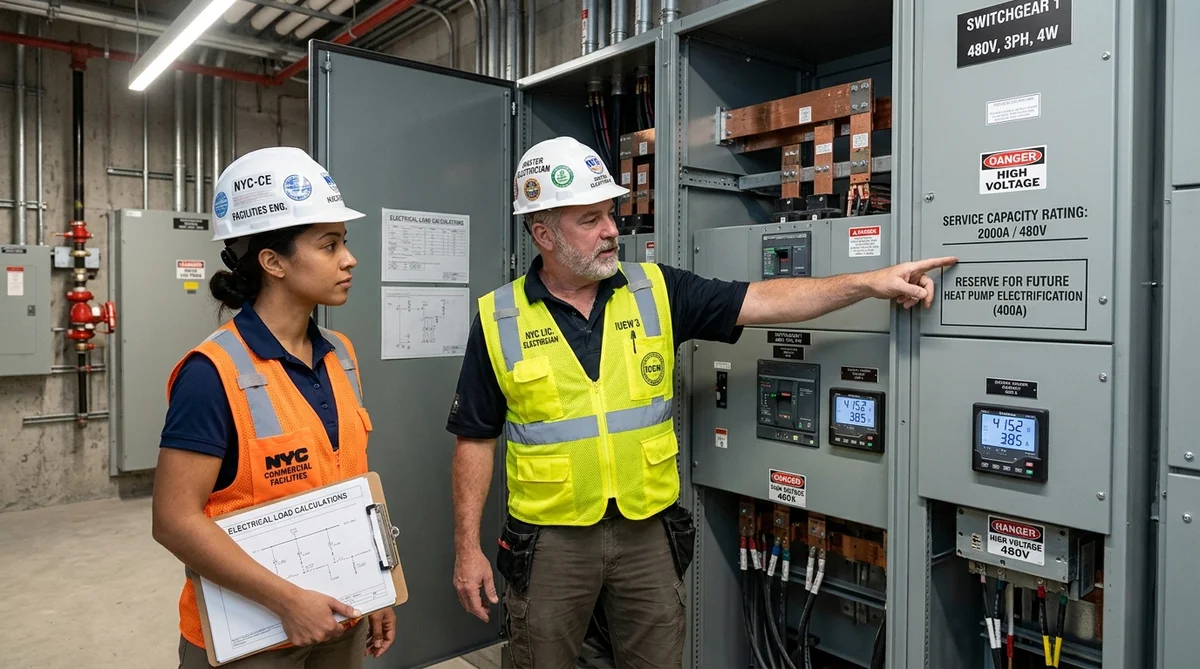
Qualifying Action 3
Electrical Readiness for Future Electrification
Some older buildings cannot immediately replace fossil-fuel equipment with electric systems because their existing electrical service does not have enough capacity. A building may require a service upgrade before it can install larger heat pumps, electric boilers, or other electrification equipment.
LL97 recognizes this constraint as a qualifying good-faith route when the required evidence is provided. The owner must demonstrate:
- An approved electrical alteration application covering the service upgrades needed for future electrification.
- Certification that the utility has received the contractor's work request and/or approved the relevant load letter for the service increase.
- An anticipated project-completion timeline.
For example, an office building may be planning to replace its gas-fired heating equipment with heat pumps. The electrical engineer determines that the existing service needs additional capacity. The owner obtains the appropriate approved electrical filing and the utility confirms receipt of the service-increase request. That is a documented electrification-readiness project. Simply stating that the utility connection is too small, or that the owner has contacted the utility, does not provide the same level of evidence. Reference: NYC DOB — Article 320 Information Guide.
Qualifying Action 4
Previous Compliance With the Emissions Limit
Good-faith efforts can also be demonstrated through a building's previous compliance history. Under the rule, an owner may use an annual building emissions report submitted during the 2024–2029 compliance period that showed the property was under its emissions limit for a preceding calendar year.
For example, imagine a building that:
- Met its applicable emissions limit for calendar year 2024.
- Exceeded its limit for calendar year 2025.
- Had previously submitted the required 2024 annual emissions report showing compliance.
That earlier compliance report may support the good-faith pathway for a later year, subject to the other prerequisites and applicable filing instructions. This is different from simply showing that utility bills were lower in an earlier year. DOB requires the relevant previously submitted annual emissions report demonstrating compliance. The option recognizes that a building may have complied previously and subsequently experienced an emissions increase.
Qualifying Action 5
Demonstrating That the Building Is a Critical Facility
The rules recognize that certain facilities serve essential human-life or safety functions. The definition in 1 RCNY §103-14 includes facilities whose operation is critical to human life or safety, with examples such as:
- Hospitals.
- Dialysis clinics.
- Facilities that manufacture vaccines.
However, simply describing a property as important or essential does not establish qualification. The owner must provide documentation explaining how payment of the LL97 penalty would negatively affect the facility's ability to provide its services.
This means the application should connect the financial impact to the facility's actual critical operations, supported by appropriate records. For an ordinary office or commercial building, this category should not be assumed to apply simply because the property supports local employment or serves the community.
Qualifying Action 6
Applying for or Receiving an LL97 Adjustment
The Article 320 rules also recognize an owner's attestation that they have applied for or been granted an adjustment by DOB under Administrative Code §28-320.7.
An adjustment is a separate regulatory process. It may address eligible circumstances affecting the building's applicable emissions limit. For a good-faith demonstration, the owner must provide the required attestation through the prescribed process.
However, filing an adjustment application does not automatically mean that DOB has approved the adjustment. Where an adjustment has been granted, the owner must also comply with its conditions. An adjustment request should not be treated as a substitute for the underlying emissions report or the other good-faith prerequisites. Reference: 1 RCNY §103-14, reproduced in NYC DOB Article 320 Guide.
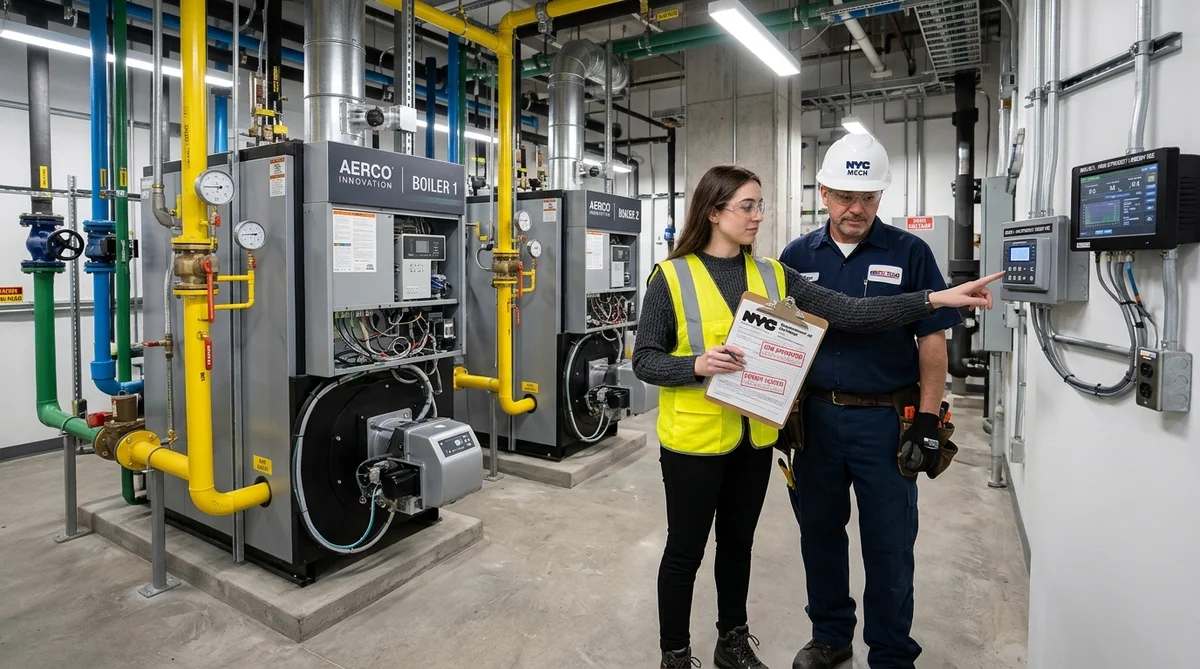
What Does NOT Count as a Good-Faith Effort?
This is where many building owners can misunderstand the rules. An owner may genuinely intend to reduce emissions but still lack the documentation necessary to support penalty mitigation.
| Owner's Action | Why It May Not Qualify on Its Own |
|---|---|
| Obtaining an energy audit | An audit identifies opportunities but does not automatically establish a qualifying project or completed decarbonization plan |
| Receiving contractor quotations | A proposal is not the same as the required approved application or qualifying signed contract and payment evidence |
| Planning to replace a boiler | An informal intention does not demonstrate that qualifying work is underway |
| Contacting the electric utility | A conversation or preliminary inquiry is not a substitute for the required electrical filing and utility confirmation |
| Making ordinary maintenance repairs | Routine maintenance without a documented qualifying emissions-reduction project may be insufficient |
| Installing a smart thermostat | A small upgrade alone does not automatically satisfy the formal good-faith criteria |
| Claiming that the building cannot afford retrofits | Financial difficulty alone is not one of the standalone qualifying project categories described above |
| Showing that tenants are unwilling to cooperate | Tenant coordination problems do not automatically establish a qualifying good-faith category |
The key distinction is between an idea, a preliminary investigation, and a documented action that meets the regulatory criteria.
For example, an owner who has received three heat-pump installation quotations has demonstrated that they are exploring electrification. But unless the work reaches the required documentation stage or qualifies under another recognized category, the quotations alone do not establish the required good-faith effort.
Good Faith Does Not Mean Automatic Penalty Cancellation
This is perhaps the most important point for building owners. LL97 good-faith efforts may result in a mitigated penalty or support a mediated resolution, but the outcome is not guaranteed.
A mediated resolution is an agreement with DOB that may establish conditions or a corrective action plan to bring the building into compliance. The rule requires the owner to have filed the emissions report and demonstrated good-faith efforts or another qualifying effort, and that the proposed resolution must help the building achieve its emissions limit.
This is different from being declared compliant.
| Type of Non-Compliance | Published Penalty Calculation |
|---|---|
| Failure to submit the annual building emissions report | $0.50 per square foot per month |
| Exceeding the applicable emissions limit | $268 per metric tonne of CO₂e above the limit per year |
Good-faith mitigation addresses the penalty framework associated with emissions-limit non-compliance. It does not automatically eliminate the separate obligation to file the annual emissions report.
An owner should also distinguish the good-faith penalty-mitigation process from an application for an extension to submit a report. The procedures have different purposes and documentation requirements. Sources: NYC DOB — LL97 Penalties and Article 320 Information Guide.
Good-Faith Efforts vs Unexpected or Unforeseeable Events
LL97 also provides a separate penalty-mitigation route for certain unexpected or unforeseeable events. This should not be confused with good-faith efforts.
The unexpected-event provision applies when an event or condition outside the owner's control damages the building and prevents compliance during the relevant calendar year. The rule identifies disasters such as:
- Hurricanes.
- Severe flooding.
- Fires.
The owner must provide photographs demonstrating the nature and extent of the damage and a description explaining how that damage prevented compliance. A qualifying demonstration may result in a penalty of zero dollars for that calendar year.
For example, a major fire could damage critical building systems and make planned emissions-reduction work impossible during the reporting period. By contrast, an owner who has not started a planned boiler replacement because of routine budgeting delays should not automatically classify the situation as an unforeseeable event. Reference: NYC Administrative Code and 1 RCNY §103-14 — Article 320 Penalty Framework.
How to Submit an LL97 Good-Faith Effort Application
The process involves DOB NOW and the Building Energy Analysis Manager (BEAM) reporting portal. Follow this step-by-step sequence:
1
Confirm the Building's Compliance Pathway
Check the NYC Sustainability Laws Covered Buildings List and establish whether the property falls under Article 320. Article 321, which covers certain affordable housing properties and houses of worship, has different compliance and mitigation provisions.
2
Submit the Annual Emissions Report
Prepare the preceding calendar year's building emissions report, including any applicable approved adjustments.
3
Complete the Benchmarking and LL88 Requirements
Ensure the required LL84 benchmarking information and LL88 lighting and submetering documentation are available, subject to applicable coverage rules.
4
Prepare the Qualifying Evidence
Identify the good-faith category being claimed. Assemble the relevant approved plans, project scope, contract, invoices, utility confirmation, historical compliance report, or critical-facility documentation.
5
Complete the Required DOB NOW Filing-Fee Process
The DOB Article 320 Penalty Mitigation User Guide explains the required filing-fee and stakeholder-information steps.
6
Submit the Relevant BEAM Reports
The April 2026 DOB processing guidance directs owners to submit the applicable Article 320 Building Emissions Limit and Registered Design Professional Attestation ticket, followed by the Article 320 Penalty Mitigation ticket. A deductions or alternative-calculation ticket may also be necessary depending on the submission.
7
Obtain the Required Professional Review
The penalty-mitigation user guide requires confirmation that the good-faith report has been reviewed by a Registered Design Professional, together with the professional's license information and attestation.
The current portal workflow, eligible selections, fees, and filing deadlines can change by reporting year. Always use the latest DOB instructions rather than relying on an older submission screenshot. Sources: DOB Penalty Mitigation User Guide and DOB Processing FAQs, April 2026.
A Practical Example: How a Building Owner Demonstrates Good Faith
Consider a hypothetical 90,000-square-foot NYC office building that exceeds its 2025 emissions limit.
The property uses an older gas-fired heating system. An engineering assessment determines that replacing the existing equipment with an electric heat-pump system would reduce emissions, but the building's electrical service needs additional capacity.
The owner takes the following steps:
- Hires a design professional to develop the electrification project.
- Obtains an approved electrical alteration application for the required service upgrade.
- Requests a utility service increase and receives confirmation that the utility has accepted the work request.
- Establishes a projected completion timeline.
- Prepares the relevant emissions-reduction documentation.
- Submits the required annual emissions and benchmarking information and addresses the LL88 prerequisites.
This evidence may support the electric-readiness good-faith pathway, provided the project and documentation satisfy the applicable requirements.
Now consider a different owner who merely receives a heat-pump quotation, tells the property manager that electrification is planned, and expects the utility to provide additional power in the future.
The intention may be genuine, but the evidence is not equivalent. It lacks the approved electrical filing, required utility confirmation, and documented timeline.
The difference is not whether the owners want to comply. It is whether their actions meet the formal criteria and can be verified.
What Building Owners Should Prepare Now
Owners should not wait until they receive a penalty notice to organize their compliance documentation.
Start by checking the building's emissions reports and benchmarking records. Verify that the relevant property information, energy consumption, and applicable adjustments are accurate.
Next, review the LL88 lighting and submetering requirements. Establish whether the work is complete and whether the relevant report or attestation has been submitted.
If the building is above its emissions limit, ask a registered design professional to review the potential mitigation categories and identify which evidence is available. A retrofit project that requires permits should be planned with sufficient time for engineering, DOB review, utility coordination, procurement, and construction.
Finally, maintain a single compliance file containing the reports, approved applications, contracts, paid invoices, utility correspondence, projected emissions reductions, and completion schedules.
Good-faith efforts are strongest when the documentary record shows what the owner has actually done and what remains to be completed.
Conclusion
Good-faith efforts under NYC Local Law 97 recognize that some building owners need time to complete the work necessary to reduce emissions. However, penalty mitigation is not automatic, and a general intention to improve a building is not enough.
For Article 320 properties, the owner must satisfy the applicable reporting prerequisites and demonstrate at least one qualifying basis, such as a properly submitted decarbonization plan, approved emissions-reduction work, electrification readiness, previous emissions-limit compliance, critical-facility circumstances, or an eligible adjustment application.
The strongest approach is to organize the evidence early, confirm the appropriate category with a qualified design professional, and follow the reporting-year-specific DOB filing process.
Good faith is demonstrated through documented action, not simply expressed through an intention to comply.
For NYC property owners, understanding that distinction can make the difference between a well-supported penalty-mitigation request and an application that lacks the necessary evidence.
Frequently Asked Questions
Good-faith efforts are documented actions toward meeting the applicable building emissions limits. Under Article 320, qualifying efforts may support a mitigated penalty or mediated resolution during the 2024–2029 compliance period.
No. The qualifying decarbonization-plan route had a May 1, 2025 submission deadline and specific documentation and implementation milestones. Even a qualifying plan does not automatically guarantee penalty cancellation.
Generally, no. An energy audit identifies opportunities for improvement. It may form part of a qualifying decarbonization plan, but an audit alone does not satisfy all the required reporting prerequisites and qualifying-action criteria.
Potentially. The owner must provide evidence of the approved complete application for work necessary to meet the applicable 2024–2029 emissions limit, together with the project timeline and projected emissions reductions. Permitless work has a separate documentation route involving qualifying contracts and payment evidence.
Potentially, under the electric-readiness pathway. The owner must provide an approved electrical alteration application, utility confirmation that the required service-increase request has been received or the relevant load letter approved, and an anticipated completion timeline. A verbal or preliminary inquiry is not enough.
Yes, a previously submitted annual emissions report showing compliance during the 2024–2029 period may be used as one qualifying basis for a later year, subject to the other requirements.
No. The Article 320 good-faith route is designed around emissions-limit penalty mitigation and does not automatically eliminate the separate reporting obligation or its penalties. Certain affordable housing properties and houses of worship under Article 321 follow separate rules.
A qualifying critical facility may use the relevant provision by providing documentation demonstrating how payment of the penalty would negatively affect its ability to provide essential services. The regulation gives hospitals, dialysis clinics, and vaccine-manufacturing facilities as examples.
No. Good-faith efforts demonstrate documented work toward compliance. The separate unexpected or unforeseeable event provision addresses qualifying circumstances, such as severe flooding or fire, where building damage outside the owner's control prevented compliance. The latter may result in a zero-dollar penalty for the affected year.
The owner should coordinate with a Registered Design Professional and, where appropriate, an energy auditor, mechanical engineer, electrical engineer, and LL97 service provider. The professional team can review eligibility, verify project documentation, prepare emissions calculations, and complete the required attestations.
You may also like