Introduction: Why Building Performance Standards Are Becoming Important Across the US
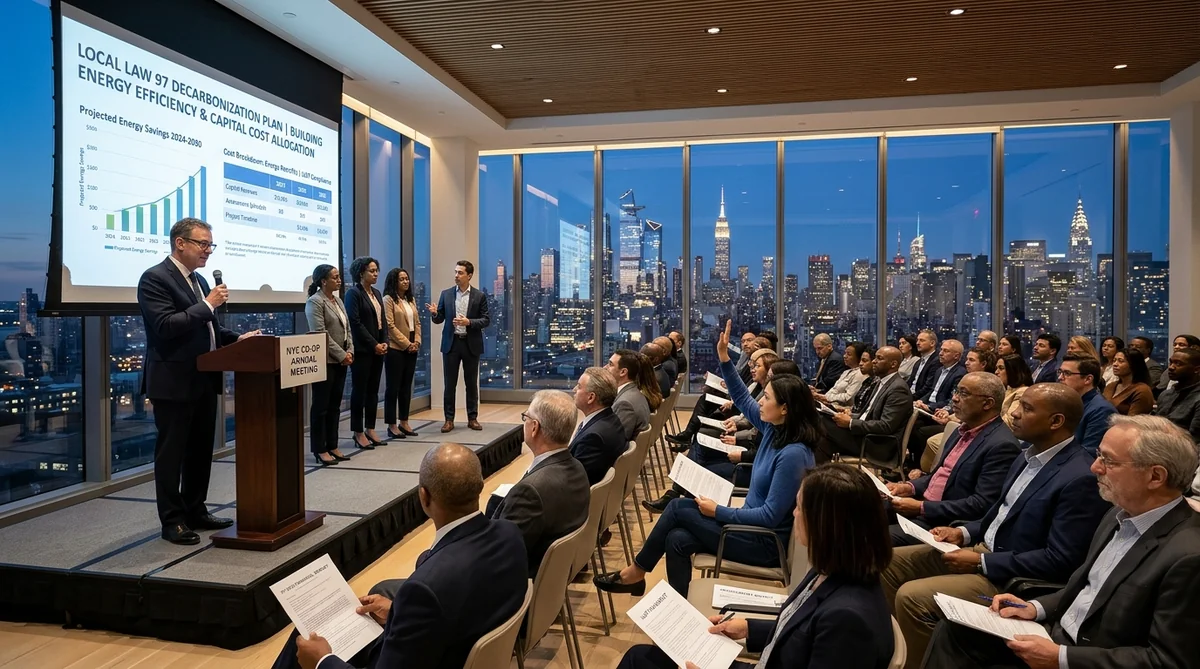
Commercial buildings account for a substantial share of total energy consumption and greenhouse gas emissions in the United States. In major urban centers, the built environment often produces between 50% and 70% of citywide emissions. As municipal and state governments implement ambitious climate legislation, commercial property owners, asset managers, and facility directors face a profound shift in regulatory expectations: the transition from voluntary green building badges to mandatory, legally enforceable Building Performance Standards (BPS).
Unlike traditional building energy conservation codes—which apply almost exclusively to new ground-up construction or major structural renovations—Building Performance Standards directly target existing operational buildings.
These statutes establish quantifiable, mandatory energy-use intensity (EUI) or greenhouse gas emissions limits that covered properties must achieve by specified calendar deadlines. Failing to meet these targets can trigger substantial financial penalties, public rating downgrades, and mandatory corrective actions.
Washington State, Colorado, and Maryland have enacted comprehensive statewide BPS frameworks, while Oregon has established a phased standard under House Bill 3409. Concurrently, major metropolitan centers including New York City (Local Law 97), Denver (Energize Denver), Boston (BERDO), Seattle, and Washington, DC have enacted stringent local decarbonization laws.
For commercial real estate portfolios, navigating this patchwork of state and local standards has become essential to long-term capital planning. Depending on asset location, property classification, and gross square footage, compliance obligations may include:
- Annual energy and water benchmarking via EPA ENERGY STAR Portfolio Manager.
- Formal ASHRAE Level 2 building energy audits.
- Commercial HVAC modernization and variable-speed pumping upgrades.
- Building envelope air-sealing and high-performance insulation.
- Formal Energy Management Plans (EMP) and Operations & Maintenance (O&M) protocols.
- Heating system electrification and fossil-fuel boiler phase-outs.
- Mandatory third-party professional engineering verification and audit filings.
This comprehensive guide examines the major state and municipal Building Performance Standards across the United States, compares their compliance mechanisms, and provides practical roadmaps for commercial property owners preparing for upcoming regulatory milestones.
1. What Are Building Performance Standards (BPS)?
A Building Performance Standard (BPS) is an outcome-based regulatory policy that requires existing commercial, multifamily, and institutional buildings to meet specific, legally binding performance targets for energy use, water consumption, or greenhouse gas emissions over time.
Rather than prescribing specific equipment or construction techniques (such as specifying insulation R-values or window U-factors), a BPS focuses on real-world operational outcomes. Building owners are given the flexibility to determine the most cost-effective combination of retrofits, control adjustments, and equipment modernizations to bring their facility within statutory performance limits.
1.1 How Do Building Performance Standards Work?
Most state and municipal BPS programs follow a structured five-step compliance framework:
- Building Identification & Applicability: Municipalities publish annual Covered Buildings Lists based on gross square footage, occupancy classification, and property tax records.
- Baseline Utility Benchmarking: Property owners aggregate 12 consecutive months of whole-building utility data (electricity, natural gas, fuel oil, district steam) using ENERGY STAR Portfolio Manager.
- Target Assignment: The regulatory authority assigns a specific performance target—such as an Energy Use Intensity Target (EUIt in kBtu/sq. ft./year) or a Greenhouse Gas Emissions Limit (kg CO₂e/sq. ft./year)—based on the property's primary use type and local climate zone.
- Physical & Operational Upgrades: Facilities that exceed their target must execute capital retrofits, such as heat pump installations, building envelope enhancements, LED lighting controls, and smart building management systems (BMS).
- Verification & Reporting: Compliance documentation, energy audit reports, and third-party professional sign-offs are submitted to the governing agency before the statutory deadline.
1.2 What Is the Difference Between Benchmarking and BPS?
Property managers frequently confuse annual benchmarking with building performance standards. While closely linked, they represent fundamentally different legal obligations:
| Comparison Criterion | Energy Benchmarking (e.g., NYC LL84) | Building Performance Standards (e.g., NYC LL97, WA CBPS) |
|---|---|---|
| Core Purpose | Measure and publicly disclose energy/water consumption | Enforce mandatory energy or emissions reductions |
| Performance Target | None (measurement only) | Legally binding EUI or GHG emissions caps |
| Building Upgrades | Voluntary (encouraged by market transparency) | Mandatory if the building exceeds performance limits |
| Audit Requirements | Typically not required annually | Often requires ASHRAE Level 2 audits & engineering plans |
| Penalty Mechanism | Fines for failure to report (e.g., $500/quarter in NYC) | Substantial civil penalties for exceeding emissions/energy caps |
A building can be 100% compliant with annual benchmarking filing deadlines while simultaneously facing tens of thousands of dollars in annual building performance standard penalties if its energy intensity exceeds statutory limits.
2. Washington: Clean Buildings Performance Standard (CBPS)
Enacted under House Bill 1257 in 2019 and expanded under House Bill 1799 in 2022, Washington State's Clean Buildings Performance Standard (CBPS) was the nation's first statewide performance standard for existing commercial buildings. Administered by the Washington State Department of Commerce, the standard establishes aggressive Energy Use Intensity Targets (EUIt) based on ASHRAE Standard 100.
2.1 Covered Building Classifications
- Tier 1 Buildings: Nonresidential commercial buildings, hotels, motels, and institutional dormitories with gross floor area exceeding 50,000 square feet (excluding unconditioned parking).
- Tier 2 Buildings: Commercial buildings between 20,000 and 50,000 square feet, as well as multifamily residential properties exceeding 20,000 square feet.
2.2 Washington Compliance Deadlines
Washington has implemented a phased compliance schedule based on gross square footage:
| Building Tier & Size Category | Gross Floor Area | Statutory Compliance Deadline |
|---|---|---|
| Tier 1 (Large Commercial) | > 220,000 sq. ft. | June 1, 2026 |
| Tier 1 (Mid-Large Commercial) | 90,001 – 220,000 sq. ft. | June 1, 2027 |
| Tier 1 (Standard Commercial) | 50,001 – 90,000 sq. ft. | June 1, 2028 |
| Tier 2 (Commercial) | 20,001 – 50,000 sq. ft. | July 1, 2027 |
| Tier 2 (Multifamily Residential) | > 20,000 sq. ft. | July 1, 2027 |
2.3 Compliance Pathways Under Tier 1
Tier 1 properties must implement an Energy Management Plan (EMP), formal Operations & Maintenance (O&M) protocols, and demonstrate compliance through one of four pathways:
- EUI Target Pathway: Meet or beat the property's weather-normalized EUIt.
- Investment Criteria Pathway: For facilities unable to meet their EUIt, complete an ASHRAE Level 2 audit and implement all energy efficiency measures (EEMs) that meet a 15-year simple payback or life-cycle cost threshold.
- Minimum Energy Reduction: Demonstrate a verified 15% reduction in weather-normalized EUI from the established baseline.
- Space Heating Electrification: Fully replace fossil-fuel heating systems with electric heat pump technology.
3. Colorado: Building Performance Colorado
Enacted under House Bill 21-1286, Colorado's statewide building performance standard—Building Performance Colorado (BPC)—is administered by the Colorado Energy Office (CEO) and enforced through Colorado Air Quality Control Commission Regulation No. 28 (5 CCR 1001-32). The statute covers commercial, institutional, and large residential buildings exceeding 50,000 gross square feet.
3.1 Colorado Dual-Target Architecture
Unlike standards that focus solely on energy consumption, Colorado establishes dual compliance targets: Site EUI Targets and Greenhouse Gas Intensity (GHGI) Targets.
| Compliance Milestone Period | Standard Performance Expectation | Alternative Percentage-Reduction Pathway |
|---|---|---|
| 2026 Performance Period (2026–2029) | Achieve property-specific 2026 EUI / GHGI target | Demonstrate at least 13% reduction from 2021 baseline |
| 2030 Performance Period (2030–2050) | Achieve property-specific 2030 EUI / GHGI target | Demonstrate at least 29% reduction from 2021 baseline |
3.2 Denver's Local Policy: Energize Denver
In addition to state requirements, the City and County of Denver enforces its own landmark ordinance, Energize Denver. Applying to buildings down to 5,000 square feet, Energize Denver establishes strict 2030 EUI targets with interim targets in 2024 and 2027. Covered facilities must monitor both state and municipal filing portals.
4. Maryland: Building Energy Performance Standards (BEPS)
Created by the Maryland Climate Solutions Now Act of 2022 and codified under COMAR 26.28, Maryland's Building Energy Performance Standards (BEPS) represent the most aggressive state-level direct decarbonization mandate in the nation. Administered by the Maryland Department of the Environment (MDE), the statute covers commercial and multifamily buildings with gross floor area of 35,000 square feet or greater.
4.1 Maryland's Net-Direct Emissions Trajectory
Maryland evaluates buildings specifically on net direct greenhouse gas emissions (Scope 1 fossil fuel combustion):
- 2030–2034 Interim Standard: First major reduction in direct fossil-fuel combustion (kg CO₂e/sq. ft.).
- 2035–2039 Interim Standard: Approximately 50% reduction below the initial 2030 threshold.
- 2040 Final Standard: Zero Net Direct Emissions (0.0 kg CO₂e/sq. ft.), requiring complete building electrification or zero-carbon fuels.
4.2 Five-Year Professional Verification Cycle
Maryland mandates third-party data verification by a licensed PE or accredited energy auditor on a strict 5-year recurring schedule (calendar year 2025 verified by June 1, 2026; 2030 data verified by June 1, 2031; continuing every five years).
5. Beyond Washington, Colorado, and Maryland: Emerging Standards
The movement toward mandatory building performance standards is expanding rapidly across states and major metropolitan jurisdictions:
5.1 Oregon Building Performance Standard (HB 3409)
Effective January 1, 2025, the Oregon Department of Energy (ODOE) oversees a statewide standard covering Tier 1 commercial buildings (≥35,000 sq. ft.) and Tier 2 properties (≥20,000 sq. ft.). First Tier 1 compliance filings begin June 1, 2028 for buildings over 200,000 sq. ft., utilizing the state's new Building Energy Analysis Manager (BEAM) platform.
5.2 New York City: Local Law 97 (LL97)
As the cornerstone of NYC's Climate Mobilization Act, Local Law 97 enforces strict annual greenhouse gas emissions limits for properties over 25,000 square feet. Compliance began in 2024, with limits dropping significantly in 2030 to achieve a 40% building emissions reduction citywide and carbon neutrality by 2050. Financial penalties are assessed at $268 per metric ton of CO₂e over the building's statutory limit.
5.3 Boston: BERDO 2.0
Boston's Building Emissions Reduction and Disclosure Ordinance covers non-residential buildings ≥20,000 sq. ft. and residential properties with 15+ units, requiring declining emissions limits starting in 2025 and 2030, targeting net-zero by 2050.
5.4 Washington, DC: BEPS
Enforced by the District Department of Energy and Environment (DOEE), DC's BEPS requires buildings not meeting local median ENERGY STAR scores to reduce energy consumption by 20% over 5-year compliance cycles. Cycle 1 concludes on December 31, 2026, with private building coverage expanding to 25,000 sq. ft. in 2027 and 10,000 sq. ft. in 2033.
5.5 Seattle: Building Emissions Performance Standard
Enacted in late 2023, Seattle's BEPS mandates progressive operational decarbonization for nonresidential and multifamily properties >20,000 sq. ft., requiring greenhouse gas reporting and verification starting in 2027 and complete net-zero emissions by 2050.
6. Complete Comparison of US Building Performance Standards
The following master matrix summarizes the regulatory framework, size thresholds, core metrics, and major compliance deadlines across the leading state and municipal programs:
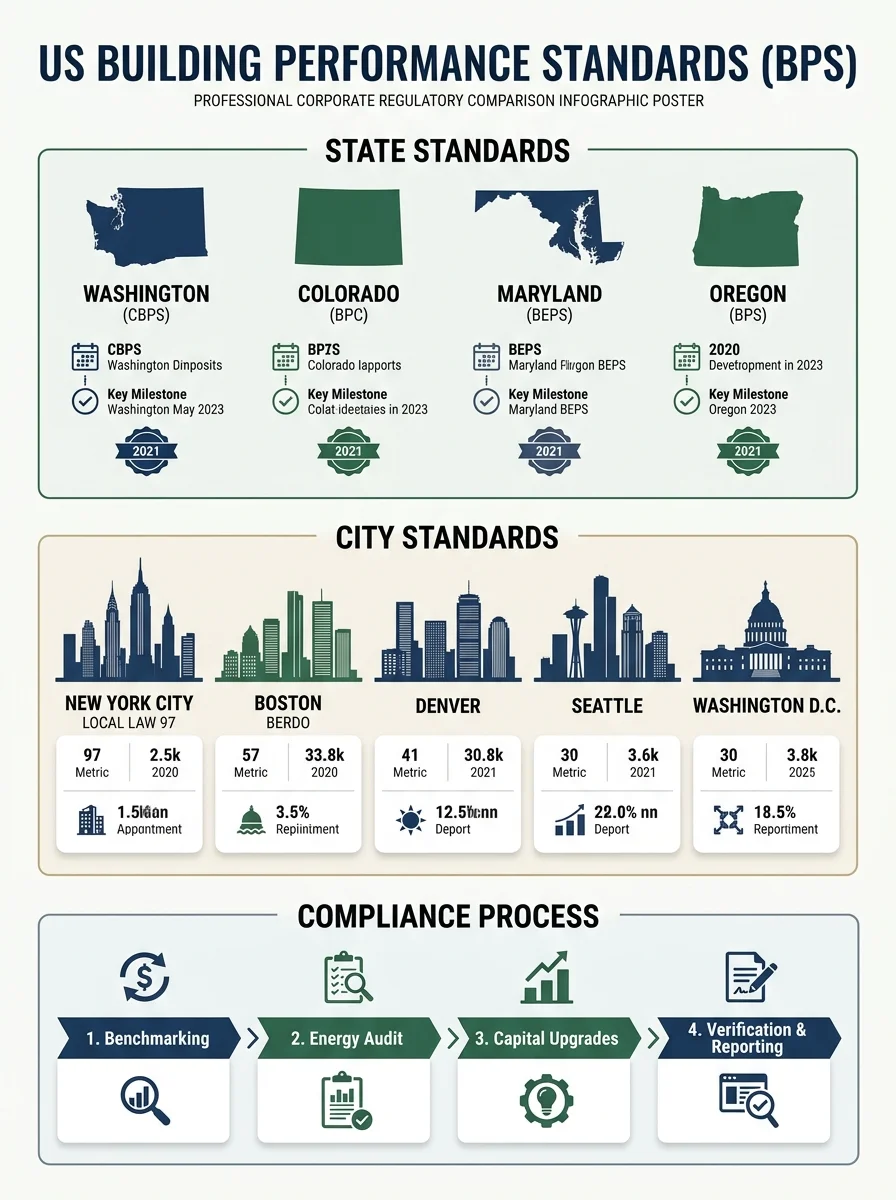 National comparison of Building Performance Standards (BPS) across leading states and cities, outlining covered building thresholds, core performance metrics (EUI vs. Carbon Intensity), compliance milestones, and verification requirements.
| Jurisdiction | Enacted Legislation | Square Footage Threshold | Primary Metric | Initial Compliance Milestone |
|---|---|---|---|---|
| Washington State | Clean Buildings Standard (HB 1257) | Tier 1: > 50,000 sq. ft. Tier 2: > 20,000 sq. ft. |
Weather-Normalized EUI (EUIt) | June 1, 2026 (Large Tier 1) |
| Colorado State | Building Performance Colorado (HB 21-1286) | ≥ 50,000 sq. ft. | Site EUI & GHG Intensity | 2026–2029 (13% reduction) |
| Maryland State | Climate Solutions Now Act (COMAR 26.28) | ≥ 35,000 sq. ft. | Net Direct GHG Emissions | 2030 Interim Target (Zero by 2040) |
| Oregon State | Oregon BPS (HB 3409) | Tier 1: ≥ 35,000 sq. ft. Tier 2: ≥ 20,000 sq. ft. |
Site EUI Target | June 1, 2028 (Phased to 2030) |
| New York City | Local Law 97 | > 25,000 sq. ft. (or > 50k campus) | Whole-Building GHG Emissions | May 1, 2025 (First reporting for 2024) |
| Denver, CO | Energize Denver | ≥ 5,000 sq. ft. | Weather-Normalized Site EUI | 2024 / 2027 Interim (Final 2030) |
| Boston, MA | BERDO 2.0 | ≥ 20,000 sq. ft. or 15+ units | GHG Emissions Intensity | May 15, 2025 (Stricter in 2030) |
| Washington, DC | DC BEPS (DOEE) | Cycle 1: ≥ 50,000 sq. ft. Cycle 2: ≥ 25,000 sq. ft. |
ENERGY STAR Score / Source EUI | December 31, 2026 (Cycle 1 End) |
| Seattle, WA | Seattle BEPS | > 20,000 sq. ft. | GHG Emissions Intensity | October 1, 2027 (Verification & Plan) |
7. What Types of Building Improvements Are Required for BPS Compliance?
While compliance formulas differ across state lines, the physical mechanical and architectural retrofits required to achieve compliance remain consistent across commercial real estate assets:
7.1 HVAC Electrification & Heat Pumps
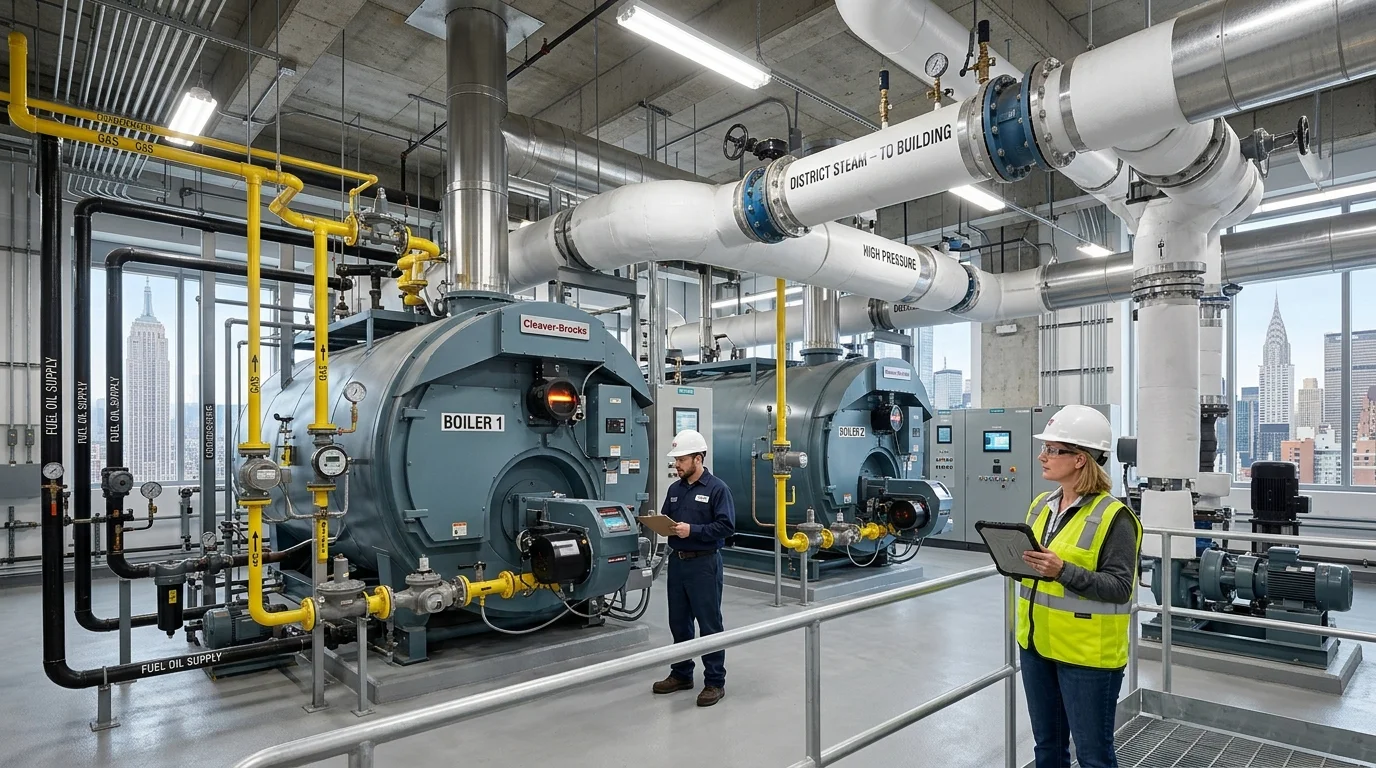
Fossil-fuel boilers burning natural gas or fuel oil represent the single largest driver of direct building emissions. Replacing atmospheric gas boilers with commercial air-source heat pumps (ASHPs) or ground-source heat pump (GSHP) systems eliminates Scope 1 combustion, aligning properties with Maryland, Boston, and NYC LL97 limits.
7.2 Building Envelope Retrofits
Envelope leakage forces HVAC equipment to run continuously. Investing in commercial roof insulation, window film or secondary glazing, and silicone air-barrier sealing drives down base heating and cooling loads, enabling smaller heat pump sizing.
7.3 Advanced Building Automation Systems (BAS)
Legacy pneumatic thermostats and static time-clocks create immense energy waste. Installing modern BACnet-compliant building management systems with occupancy-based temperature resets, static pressure optimization, and automated demand response can slash EUI by 10% to 20% with minimal capital expenditure.
8. How Can Commercial Property Owners Prepare for BPS Compliance?
To avoid sudden capital surprises, compliance penalties, and tenant disruption, facility executives should adopt a proactive multi-year management plan:
 Commercial facility managers rely on centralized building management systems and continuous energy analytics dashboards to monitor weather-normalized EUI, peak electrical demand, and greenhouse gas trajectories against statutory BPS compliance curves.
- Inventory Multi-State Portfolios: Map every property in your portfolio against state and city thresholds. Note that properties in Denver or Seattle are governed by both state and municipal mandates.
- Automate Portfolio Manager Data: Establish electronic data interchange (EDI) with electric and gas utilities to eliminate manual data entry gaps.
- Commission an ASHRAE Level 2 Energy Audit: Engage a qualified professional engineer to evaluate mechanical systems, quantify energy conservation measures (ECMs), and model capital costs against compliance deadlines.
- Develop a 10-Year Capital Decarbonization Plan: Synchronize major HVAC end-of-life replacements with regulatory compliance years to avoid stranded assets.
- Leverage Utility Rebates & Federal Incentives: Utilize Inflation Reduction Act (IRA) Section 179D tax deductions, utility heat pump rebates, and state clean energy incentives to offset up to 40% of project costs.
Building Performance Standards are fundamentally reshaping commercial property valuations. Properties that lag behind compliance curves face mounting civil penalties, tenant turnover, and capital discounting—while proactive decarbonization protects net operating income (NOI) and future-proofs asset liquidity.
Is Your Commercial Building Ready for Building Performance Standards?
Managing commercial properties across diverse state and municipal jurisdictions requires expert engineering guidance. Whether your building is subject to NYC Local Law 97, Washington Clean Buildings, Colorado BPC, or Maryland BEPS, our licensed energy engineering team provides full-service benchmarking, ASHRAE Level 2 energy audits, electrification planning, and penalty mitigation.