Introduction: Understanding Building Energy Benchmarking Requirements Across US Cities
Building energy benchmarking has evolved into an indispensable component of commercial real estate asset management across the United States. As municipal governments enact aggressive climate mandates and decarbonization laws, property owners, facility directors, and asset managers are increasingly required to measure, document, and publicly disclose whole-building energy and water consumption.
However, compliance frameworks are far from uniform. Requirements vary widely by geographic location.
New York City, Chicago, Boston, Washington, DC, and Seattle each administer distinct building energy benchmarking ordinances. They differ significantly across covered-building size thresholds, annual reporting deadlines, mandatory data verification cycles, public grading rules, and non-compliance fines.
For example, a commercial property encompassing 30,000 square feet must annually submit energy data under New York City's Local Law 84, while that same building in Chicago falls below the city's 50,000-square-foot threshold. Meanwhile, Boston incorporates residential unit thresholds (covering properties with 15 or more units), and Washington, DC has phased in private properties as compact as 10,000 square feet.
For national real estate investment trusts (REITs), multi-market property managers, and corporate facility executives, understanding these jurisdiction-specific rules is essential to avoiding costly penalties, preserving asset reputation, and establishing sound capital improvement strategies.
3. What Is Building Energy Benchmarking?
Building energy benchmarking is the continuous process of tracking, recording, and evaluating a facility's energy and water consumption over a 12-month calendar cycle. It establishes an empirical baseline that enables property owners to compare their building's performance against similar peer properties in the same climate zone.
The vast majority of US municipal benchmarking ordinances rely on the U.S. Environmental Protection Agency's (EPA) ENERGY STAR Portfolio Manager platform. This secure web-based tool normalizes utility meter consumption for weather fluctuations, operating hours, occupant density, and square footage.
Standard data points compiled during an annual benchmarking cycle include:
- Whole-building electric utility consumption (grid delivered and on-site solar generated).
- Natural gas, fuel oil (#2, #4), and district steam consumption.
- Gross floor area (GFA), excluding exterior unheated parking structures.
- Primary and secondary architectural space use classifications.
- Weekly operating hours and worker density per 1,000 square feet.
- Weather-normalized Site and Source Energy Use Intensity (EUI).
- 1–100 ENERGY STAR Performance Score (for eligible property types).
- Whole-building greenhouse gas (GHG) operational emissions.
3.1 What Is Energy Use Intensity (EUI)?
Energy Use Intensity (EUI) expresses a building's annual energy consumption relative to its gross floor area, calculated as total annual energy (in thousands of British thermal units, or kBtu) divided by total gross square footage:
EUI = Total Annual Energy Consumption (kBtu) ÷ Gross Floor Area (sq. ft.)
Consider two commercial office facilities located in the same climate region:
| Commercial Property | Annual Energy Consumption | Gross Floor Area | Energy Use Intensity (Site EUI) |
|---|---|---|---|
| Building A (High Efficiency) | 1,000,000 kBtu | 50,000 sq. ft. | 20 kBtu/sq. ft. |
| Building B (Standard Efficiency) | 1,500,000 kBtu | 50,000 sq. ft. | 30 kBtu/sq. ft. |
Building A consumes 33% less energy per square foot than Building B. Accurate EUI comparisons require normalizing for property typology, plug-load intensity, and whether site energy (metered at the building) or source energy (including upstream generation and transmission losses) is assessed.
3.2 Why Do Cities Mandate Energy Benchmarking?
Municipalities mandate energy benchmarking to bring market transparency to commercial real estate and achieve strategic climate objectives:
- Market Transparency: Equips prospective tenants, buyers, and lenders with objective data on building operating costs.
- Targeting Energy Inefficiencies: Reveals operational anomalies, equipment faults, and control drifts across municipal building stocks.
- Accelerating Decarbonization: Provides baseline data required to enforce downstream building performance standards (such as NYC LL97, Boston BERDO, and Washington DC BEPS).
- Guiding Capital Upgrades: Helps owners prioritize high-ROI HVAC, lighting, and envelope investments.
4. NYC: Local Law 84 (LL84) Building Energy Benchmarking
New York City's Local Law 84 of 2009, as expanded by Local Law 133 of 2016, represents one of the nation's longest-standing and most rigorous benchmarking statutes. Governed by the NYC Department of Buildings (DOB), LL84 requires covered commercial and residential buildings to submit annual whole-building utility data through ENERGY STAR Portfolio Manager.
4.1 Which Buildings Must Comply With NYC LL84?
Under NYC administrative code, covered buildings include:
- Individual buildings with gross floor area exceeding 25,000 square feet.
- Two or more buildings situated on the same tax lot with combined gross floor area exceeding 100,000 square feet.
- Two or more condominium buildings governed by the same board of managers with combined gross floor area exceeding 100,000 square feet.
- City-owned municipal facilities exceeding 10,000 gross square feet.
Properties must verify their status annually against the official NYC DOB Covered Buildings List (CBL), indexed by Borough, Block, and Lot (BBL).
4.2 What Information Must Be Reported?
Owners must aggregate 12 consecutive months of whole-building electric, natural gas, fuel oil, and steam data. Additionally, properties listed on the CBL with an automatic water meter reader installed by the NYC Department of Environmental Protection (DEP) must report whole-building water usage.
4.3 NYC Benchmarking Deadline
The statutory annual submission deadline for NYC Local Law 84 is May 1:
| Reporting Cycle | Energy Consumption Period | Filing Deadline |
|---|---|---|
| 2026 Reporting Cycle | Calendar Year 2025 (Jan 1 – Dec 31, 2025) | May 1, 2026 |
| 2027 Reporting Cycle | Calendar Year 2026 (Jan 1 – Dec 31, 2026) | May 1, 2027 |
4.4 NYC Benchmarking Penalties
Failure to submit an acceptable benchmarking report by the May 1 deadline triggers an immediate $500 fine from NYC DOB. If the violation remains uncured, additional $500 fines are assessed at each quarterly milestone:
- May 1 initial deadline: $500 penalty.
- August 1 secondary deadline: Additional $500 penalty.
- November 1 tertiary deadline: Additional $500 penalty.
- February 1 final deadline: Additional $500 penalty.
The maximum cumulative penalty per covered building is $2,000 per calendar year.
4.5 How LL84 Connects to NYC Local Law 33 and Local Law 97
LL84 benchmarking data is directly linked to two other major NYC building laws:
- Local Law 33/95 (Building Energy Efficiency Ratings): Scores generated from LL84 submissions dictate the building's official A through F energy efficiency letter grade, which must be conspicuously posted at every public entrance.
- Local Law 97 (Carbon Caps): LL84 tracks consumption metrics, whereas LL97 establishes binding emissions limits (tCO₂e) with steep civil penalties ($268/tCO₂e) for exceeding statutory thresholds starting in 2024 and tightening dramatically in 2030.
Official Reference: NYC Department of Buildings – Local Law 84 Benchmarking
5. Chicago: Energy and Water Benchmarking Ordinance
Adopted in 2013 under Municipal Code Chapter 18-14, the City of Chicago requires covered commercial, institutional, and residential buildings to track energy consumption, verify data, and report annually for public disclosure.
5.1 Which Buildings Must Comply?
Chicago's ordinance categorizes covered properties into two size groups:
- Group 1: Commercial, institutional, and residential properties with gross floor area of 250,000 square feet or greater.
- Group 2: Commercial, institutional, and residential properties with gross floor area between 50,000 and 249,999 square feet.
Properties sharing the same County Property Index Number (PIN) are evaluated on an aggregate square-footage basis.
5.2 Chicago Reporting Deadline
The annual benchmarking submission deadline in Chicago is June 1:
| Reporting Cycle | Consumption Period | Annual Filing Deadline |
|---|---|---|
| 2026 Reporting Cycle | Calendar Year 2025 | June 1, 2026 |
| 2027 Reporting Cycle | Calendar Year 2026 | June 1, 2027 |
5.3 Chicago's Mandatory Third-Party Verification
A distinctive feature of Chicago's ordinance is the triennial professional data verification mandate. Under municipal code, benchmarking information must be verified by a licensed professional engineer (PE), registered architect (RA), or certified energy manager before the property's initial submission and every third year thereafter.
5.4 Chicago Energy Star Rating Cards
Chicago assigns 1-to-4 star energy performance ratings based on ENERGY STAR scores, providing physical rating cards that must be prominently displayed near primary building entrances. Properties that fail to benchmark on time receive a public 0-star rating.
Non-compliance fines range up to $100 for the initial violation plus $25 for each consecutive day the violation persists.
Official Reference: Chicago Municipal Code Chapter 18-14
6. Boston: Building Emissions Reduction and Disclosure Ordinance (BERDO)
Enacted in 2013 and comprehensively updated in 2021 (BERDO 2.0), Boston's ordinance goes beyond simple benchmarking to mandate direct greenhouse gas emissions cuts for commercial and large residential properties.
6.1 Which Buildings Must Comply With BERDO?
- Non-residential buildings with gross floor area of 20,000 square feet or greater.
- Residential properties containing 15 or more dwelling units.
- Multiple buildings situated on the same parcel totaling at least 20,000 square feet or 15 units.
6.2 Boston BERDO Reporting Deadline
The annual reporting deadline for BERDO is May 15. Owners must submit through both ENERGY STAR Portfolio Manager and the city's proprietary BERDO Reporting Form.
| Reporting Cycle | Consumption Period | BERDO Submission Deadline |
|---|---|---|
| 2026 Reporting Cycle | Calendar Year 2025 | May 15, 2026 |
| 2027 Reporting Cycle | Calendar Year 2026 | May 15, 2027 |
6.3 BERDO Emissions Compliance & Verification Rules
BERDO establishes declining emissions caps starting in 2025 for large buildings (≥35,000 sq. ft.) and 2030 for mid-sized buildings (20,000–34,999 sq. ft.), charting a strict trajectory toward net-zero emissions by 2050.
Third-party verification by a qualified energy professional is mandatory in year one of reporting, the first year of emissions compliance (2026 or 2031), and every five years thereafter.
Official Reference: City of Boston – BERDO
7. Washington, DC: Building Energy Benchmarking Requirements
Under the Clean and Affordable Energy Act of 2008 and subsequent climate amendments, Washington, DC administers one of the country's most inclusive benchmarking programs, enforced by the Department of Energy and Environment (DOEE).
7.1 Progressive Size Threshold Phase-In
Washington, DC has progressively lowered its private-building benchmarking threshold over the past decade:
| Covered Building Size Threshold | Initial Compliance Year |
|---|---|
| Buildings > 200,000 sq. ft. | 2010 |
| Buildings ≥ 50,000 sq. ft. | 2013 |
| Buildings ≥ 25,000 sq. ft. | 2021 |
| Buildings ≥ 10,000 sq. ft. | 2025 (Current Standard) |
With the 10,000 sq. ft. threshold now in effect, thousands of boutique commercial properties, branch banks, and small multifamily assets are subject to mandatory annual filing.
7.2 DC Reporting Deadline & Verification Cycle
The annual DOEE submission deadline is May 1. Third-party data verification is mandated every six years (2024, 2027, 2033, etc.), making 2027 a critical audit year for DC building managers.
Penalties for non-compliance under DC law can reach up to $100 per calendar day until an acceptable submission is completed.
Official Reference: DOEE Energy Benchmarking Program
8. Seattle: Energy Benchmarking Law
Under Seattle Municipal Code Chapter 22.920, the Seattle Office of Sustainability and Environment (OSE) mandates annual benchmarking for non-residential and multifamily buildings larger than 20,000 gross square feet (excluding dedicated parking).
8.1 Seattle Reporting Deadline & Portal Transition
The standard annual submission deadline is June 1 for the previous calendar year's energy performance.
| Building Size Category | Statutory Annual Penalty |
|---|---|
| 20,000 – 49,999 gross sq. ft. | $2,000 per year |
| 50,000 gross sq. ft. or larger | $4,000 per year |
2026 Seattle Compliance Transition Note:
Seattle launched its new Seattle Building & Energy Portal in July 2026. Because of this administrative migration, non-reporting penalties for calendar year 2025 data were temporarily waived during the transition window. Furthermore, on November 17, 2026, Seattle published draft Director's Rule 2026-01 for public comment through November 23, 2026, proposing procedural updates to benchmarking operations.
8.2 Seattle Building Emissions Performance Standard (BEPS)
In December 2023, Seattle enacted a comprehensive BEPS ordinance requiring commercial and multifamily buildings >20,000 sq. ft. to achieve net-zero greenhouse gas emissions by 2050, with phased verification and initial GHG targets beginning in 2027 for properties over 220,000 sq. ft.
Official Reference: Seattle Office of Sustainability and Environment
9. Complete Comparison: NYC vs Chicago vs Boston vs DC vs Seattle
The following master comparison matrix summarizes the governing statutes, administrative thresholds, compliance dates, and audit cycles across all five cities:
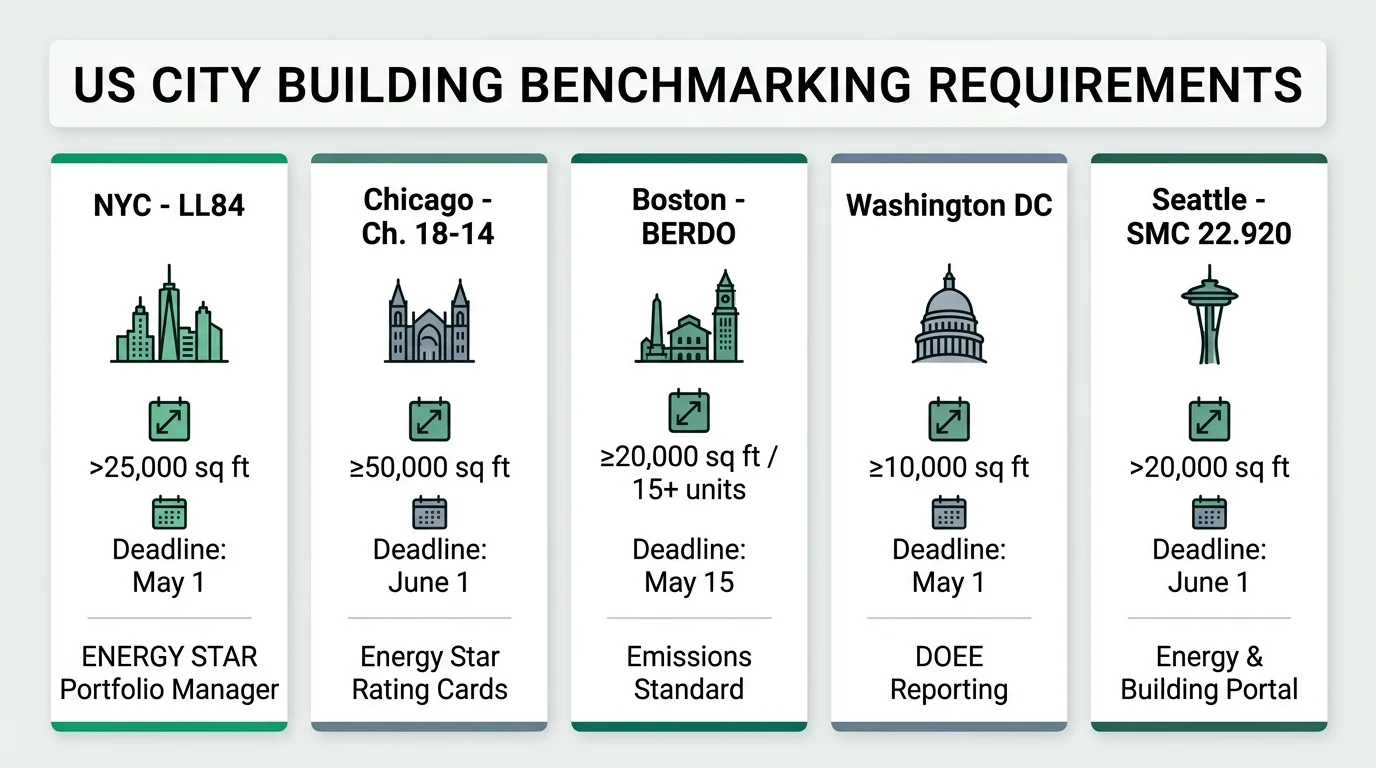 Side-by-side comparison of municipal building energy benchmarking ordinances across New York City, Chicago, Boston, Washington DC, and Seattle, highlighting square-footage thresholds, annual deadlines, verification cycles, and governing agencies.
| Compliance Parameter | New York City | Chicago | Boston | Washington, DC | Seattle |
|---|---|---|---|---|---|
| Governing Law | Local Law 84 / 133 | Municipal Code Ch. 18-14 | BERDO 2.0 | Clean & Affordable Energy Act | SMC Ch. 22.920 |
| Enforcing Agency | NYC Dept. of Buildings | Chief Sustainability Officer | Environment Department | DOEE | Office of Sustainability & Env. |
| Size Threshold | > 25,000 sq. ft. | ≥ 50,000 sq. ft. | ≥ 20,000 sq. ft. or 15+ units | ≥ 10,000 sq. ft. | > 20,000 sq. ft. |
| Annual Deadline | May 1 | June 1 | May 15 | May 1 | June 1 |
| Reporting Portal | Portfolio Manager | Portfolio Manager | Portfolio Manager + BERDO Form | Portfolio Manager + DOEE Link | Portfolio Manager + Seattle Portal |
| Water Benchmarking | Required if DEP AMR installed | Discretionary reporting | Mandatory | Mandatory | Not universally required |
| Third-Party Verification | Not an annual LL84 requirement (separate LL87 audits) | Every 3 years by licensed professional | Year 1, first compliance year, then every 5 years | Every 6 years (2024, 2027, 2033) | Phased schedule under BEPS |
| Public Grading / Card | A through F Letter Grade (LL33) | 1 to 4 Stars Energy Card | Public online emissions dashboard | Public disclosure website | Public energy benchmarking map |
| Companion Performance Law | Local Law 97 | Building Decarbonization Plan | BERDO Emissions Targets | DC BEPS | Seattle BEPS |
| Non-Compliance Penalty | $500 per quarter (up to $2,000/yr) | $100 + $25/day | $150 to $300/day depending on size | Up to $100/day | $2,000 to $4,000/year |
10. What Are the Biggest Compliance Differences Across These Cities?
When operating a multi-market real estate portfolio, facility directors should keep four critical operational differences in mind:
10.1 Thresholds Range from 10,000 to 50,000 Sq. Ft.
There is no national standard. A mid-sized 18,000 sq. ft. commercial building is exempt in NYC, Chicago, Boston, and Seattle—but is fully subject to mandatory reporting and daily fines in Washington, DC. Similarly, residential unit count triggers compliance in Boston regardless of commercial footprint.
10.2 Staggered Annual Filing Deadlines
Benchmarking deadlines span six weeks in late spring:
- May 1: New York City and Washington, DC.
- May 15: Boston.
- June 1: Chicago and Seattle.
Centralized compliance teams must stage utility data aggregation well in advance of April 1 to ensure timely verification and submission.
10.3 Inconsistent Third-Party Verification Intervals
While NYC LL84 permits in-house staff or third-party consultants to file without a mandatory annual PE/RA seal (reserving engineering stamps for 10-year LL87 energy audits), Chicago mandates licensed verification every 3 years, Boston every 5 years, and DC every 6 years.
10.4 Benchmarking vs. Binding Carbon Limits
Benchmarking measures energy consumption. It does not dictate how much energy a building is allowed to consume. However, in NYC (LL97), Boston (BERDO), DC (BEPS), and Seattle (BEPS), benchmarking data directly establishes the baseline for legally binding carbon and EUI caps that carry severe financial liability.
11. How to Prepare Your Building for Benchmarking Compliance
To avoid recurring penalties and maintain data integrity across multi-jurisdictional portfolios, facility teams should implement a disciplined annual compliance protocol:
 Commercial property managers utilize EPA ENERGY STAR Portfolio Manager to aggregate utility meter data, normalize for weather and operating hours, verify data quality, and submit required annual compliance filings.
- Audit Covered Buildings Annually: Verify municipal covered buildings lists every January. Changes in ownership, tenant build-outs, or lot consolidations can alter compliance requirements.
- Automate Utility Data Aggregation: Enroll with local utilities (Con Edison, National Grid, ComEd, Eversource, Pepco, Seattle City Light) for automated whole-building electronic data exchange (EDI) to streamline tenant submeter aggregation.
- Validate Property Use Details: Ensure gross square footage, weekly operating hours, and server room allocations are accurately updated in Portfolio Manager.
- Run Data Quality Checks: Utilize Portfolio Manager's built-in Data Quality Checker to identify missing utility months, overlapping meter entries, or extreme EUI spikes before filing.
- Schedule Required Professional Verification: For Chicago, Boston, and DC assets, engage a licensed PE or accredited energy auditor at least 60 days before the deadline.
- Archive Confirmation Receipts: Store Portfolio Manager submission confirmation emails, reporting receipts, and verification seals for at least six years.
12. Common Mistakes Property Owners Must Avoid
- Mistake 1: Relying on a single national square-footage threshold. Always check local municipal statutes.
- Mistake 2: Missing tenant-paid electric meters. Benchmarking requires 100% whole-building consumption, including all tenant spaces.
- Mistake 3: Confusing Benchmarking with Emissions Compliance. Submitting LL84 does not exempt an owner from LL97 decarbonization penalties.
- Mistake 4: Procrastinating until the final week of April. Utility data requests often require 2–4 weeks for processing.
- Mistake 5: Failing to post public energy ratings. NYC (LL33) and Chicago require printed rating cards to be physically displayed near building entrances.
13. Conclusion: Why Understanding Local Benchmarking Rules Matters
Building energy benchmarking is no longer an optional green building badge; it is a foundational legal responsibility that influences property valuations, tenant leasing decisions, and municipal penalty risk. By taking a proactive approach to utility data management, facility managers can streamline compliance, eliminate recurring fines, and uncover actionable energy-saving opportunities.
Energy benchmarking is not merely a bureaucratic check-the-box exercise. It is the core operational baseline that dictates municipal energy letter grades, tenant perceptions, and future capital exposure under building performance standards like NYC Local Law 97.
Need Help Navigating Building Energy Benchmarking Requirements?
Managing commercial properties across multiple US cities can create complex reporting, data verification, and compliance responsibilities. From NYC Local Law 84 and Chicago's benchmarking ordinance to Boston BERDO, DC benchmarking, and Seattle regulations, our energy engineering team provides full-service utility aggregation, verification, and automated filing.