
Introduction: Does Your Building Need an Engineer to Sign Its Benchmarking Report?
Preparing an annual energy benchmarking report involves more than collecting electricity and gas bills. Building owners must confirm property information, verify utility consumption, check floor areas, assign the correct building types, and submit complete data through ENERGY STAR Portfolio Manager.
One question regularly causes confusion: Does a building owner need a licensed professional to verify and sign off on the benchmarking report?
The answer depends on what is being submitted.
For a standard NYC Local Law 84 (LL84) annual benchmarking report, the Department of Buildings (DOB) does not identify a routine requirement for a Professional Engineer (PE) or Registered Architect (RA) to sign and seal the submission. Owners may assign a representative to work with building staff and submit the report.
However, professional certification is required in several related situations. These include certain LL84 exemption claims, ENERGY STAR building certification applications, Local Law 97 emissions reports, and specific Local Law 87 and Local Law 88 compliance submissions.
Confusing these requirements can lead to unnecessary professional fees or, in the opposite direction, an improperly certified compliance filing.
This guide explains who can verify benchmarking information, when professional involvement becomes mandatory, and what NYC property owners should check before submitting their data.
Key Regulatory Rule:
Data validation is not the same as professional attestation. Anyone trained in ENERGY STAR Portfolio Manager can perform utility bill auditing and data validation for routine LL84 benchmarking. However, when official statutory certifications (such as LL97 Article 320 carbon reports or LL84 garden-style exemptions) are submitted, NYC DOB strictly requires a New York State licensed Registered Design Professional (PE or RA).
1. What Does Benchmarking Data Verification Actually Mean?
Benchmarking data verification is the process of checking whether a building's reported energy and water information accurately represents its actual operations.
The data is generally entered into the US Environmental Protection Agency's (EPA) ENERGY STAR Portfolio Manager platform.
For NYC benchmarking, the information can include:
- Building identification and ownership information.
- Gross floor area and individual property uses.
- Electricity consumption.
- Natural gas consumption.
- Fuel oil and other energy sources.
- District steam or chilled water consumption, where applicable.
- Water consumption for buildings required to report it.
- Operating characteristics used in benchmarking calculations.
The purpose is to produce a reliable picture of annual building performance.
For example, consider a commercial building that reports 1.2 million kWh of annual electricity consumption. Before submitting its benchmarking data, the owner or assigned representative should establish that the reported figure:
- Covers the correct calendar year.
- Includes the required whole-building consumption.
- Does not omit tenant electricity usage.
- Does not duplicate any utility meter data.
- Is assigned to the correct building and property record.
- Uses the correct units and billing-period information.
This is data validation. It is not necessarily a professional engineering certification.
Data Validation vs. Professional Certification
| Activity | What It Means | Professional Sign-Off Normally Required? |
|---|---|---|
| Utility bill review | Checking reported consumption against bills | No |
| Floor-area verification | Checking gross floor area and property-use areas | No routine PE/RA requirement for LL84 submission |
| ENERGY STAR Portfolio Manager review | Checking benchmarking entries and alerts | No routine PE/RA requirement for LL84 submission |
| NYC LL84 annual filing | Submitting required benchmarking information | No routine PE/RA signature requirement |
| ENERGY STAR certification application | Verifying the building's certification application | Yes, licensed PE or RA |
| LL97 Article 320 annual emissions report | Certifying reported building emissions | Yes, registered design professional |
| LL88 lighting and submetering report | Attesting to completed upgrades and installations | Yes, an eligible professional or licensed electrician |
The important distinction is that checking the accuracy of reported information does not automatically require a licensed professional. A professional signature becomes necessary when a specific law, certification program, or compliance pathway requires it.
2. Local Law 84: Does Annual Benchmarking Require a Licensed Professional?
Local Law 84 requires applicable NYC buildings to benchmark their annual energy and, where required, water consumption using ENERGY STAR Portfolio Manager.
Under the current coverage criteria, buildings generally fall within LL84 when they meet one of these conditions:
- An individual building exceeds 25,000 gross square feet.
- Two or more buildings on the same tax lot together exceed 100,000 gross square feet.
- Two or more condominium buildings governed by the same board of managers together exceed 100,000 gross square feet.
- A qualifying City-owned building.
Owners should check the current DOB Sustainability Law Covered Buildings List because a property's status can change from year to year.
Who Can Submit an LL84 Benchmarking Report?
NYC DOB expressly states that building owners may assign a representative to work with building operating staff to submit the benchmarking report.
This means the day-to-day benchmarking process can be handled by an appropriately authorized:
- Property manager.
- Building manager.
- Facility manager.
- Sustainability consultant.
- Energy benchmarking service provider.
- Other owner-designated representative.
The routine LL84 submission process does not require the owner to hire a PE or RA merely to review and submit the annual utility data.
However, the owner remains responsible for ensuring the submission is accurate and complete. Delegating the data-entry work does not transfer the owner's underlying compliance responsibility.
What Does DOB Expect Owners to Verify?
Before submitting an annual benchmark, DOB's instructions direct owners to check the following:
| Information | What Must Be Checked |
|---|---|
| Property type | Correct building use in Portfolio Manager |
| Gross floor area | Accurate total building area |
| Property-use areas | Individual use areas add up to the reported total |
| BBL | Correct Borough-Block-Lot number |
| BIN | Correct Building Identification Number |
| Energy consumption | Complete annual usage for each relevant meter |
| Water consumption | Full-year data where reporting is required |
| EUI | Realistic energy use intensity |
| Error alerts | Possible errors identified by Portfolio Manager |
DOB specifically recommends checking that EUI is not below 5 kBtu per square foot or above 1,000 kBtu per square foot, and reviewing the property summary for possible errors.
These are screening instructions, not universal energy-performance limits or proof that a building is compliant simply because its EUI falls within that range.
For an ordinary LL84 annual filing, focus on source documents, meter coverage, property information, and data quality. A professional stamp is not a substitute for accurate benchmarking records.
3. When Does LL84 Actually Require a Registered Design Professional?
There is an important exception that owners should understand.
NYC recognizes a specific exclusion for certain garden-style apartment properties. To qualify, the property must satisfy the applicable physical and ownership conditions, including:
- No more than three stories.
- A series of attached, detached, or semi-detached dwellings.
- Individual dwelling-unit owners responsible for maintaining their HVAC and hot-water heating systems.
- No HVAC or hot-water heating system serving more than two dwelling units in the series.
The exclusion must be supported by certification from a registered design professional.
In other words, an owner seeking this specific LL84 exclusion cannot simply decide that the property resembles a garden-style apartment and stop benchmarking.
The required professional certification establishes that the property's characteristics meet the statutory exception.
Who Can Sign This Certification?
A Registered Design Professional (RDP) in NYC means:
- A New York State licensed and registered Professional Engineer (PE), or
- A New York State licensed and registered Registered Architect (RA).
The professional should be appropriately qualified to assess the property characteristics being certified.
This is a specific exemption-related requirement. It should not be confused with the ordinary annual LL84 reporting process.
4. ENERGY STAR Certification: When a Licensed PE or RA Must Verify the Application
Another common source of confusion is the difference between receiving an ENERGY STAR score and applying for official ENERGY STAR building certification.
A building can receive an ENERGY STAR score through Portfolio Manager without automatically obtaining ENERGY STAR certification.
For eligible commercial buildings, ENERGY STAR certification requires a score of at least 75 and a separate application verification process.
The EPA requires the application to be verified and stamped by a licensed Professional Engineer or Registered Architect.
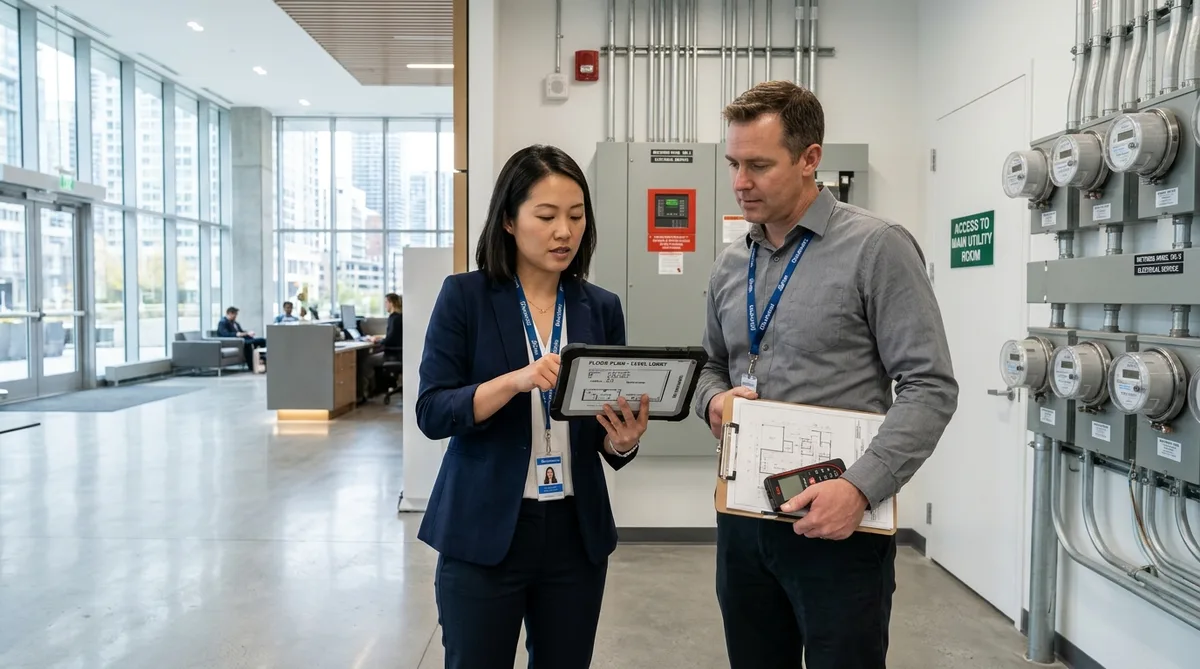 On-site verification by a licensed PE or RA is mandatory for official ENERGY STAR certification, requiring physical verification of tenant floor areas, HVAC controls, and indoor environmental standards.
The verification includes three important areas:
- Property-use characteristics: The verifier reviews how the building is used, including its reported square footage.
- Energy data: The verifier checks the energy information submitted in the application.
- Indoor environment criteria: The verifier confirms whether the applicable indoor environmental conditions have been met.
The EPA also provides a directory of professionals who have experience with ENERGY STAR verification.
ENERGY STAR Score vs. ENERGY STAR Certification
| Feature | ENERGY STAR Score | ENERGY STAR Certification |
|---|---|---|
| Generated through Portfolio Manager | Yes | Yes |
| Requires eligible property type | Yes, for a score to be available | Yes |
| Minimum score of 75 | Not required to receive a score | Required |
| PE/RA application verification | Not routinely required just to calculate a score | Required |
| Formal ENERGY STAR recognition | No | Yes |
For example, an office building might receive an ENERGY STAR score of 82 through Portfolio Manager. That score does not mean a PE or RA must sign its ordinary NYC LL84 benchmarking report. However, the owner must obtain the required licensed professional verification when pursuing ENERGY STAR certification.
This distinction can prevent unnecessary professional expenses.
5. Local Law 97: Professional Certification Is Required for Annual Emissions Reporting
Local Law 97 is different from ordinary benchmarking.
It establishes greenhouse gas emissions limits for covered buildings and requires applicable owners to submit annual emissions reports.
Under Article 320, covered buildings must file a report detailing annual greenhouse gas emissions, and the report must be certified by a registered design professional.
The professional reviews and certifies the applicable emissions reporting information rather than simply confirming that the owner uploaded utility bills.
The reporting process may involve:
- Building emissions calculations.
- Applicable property-type classifications.
- Energy consumption information.
- Regulatory emissions factors.
- Applicable deductions or alternative calculation methods.
- Building emissions limits.
- Compliance status and supporting documentation.
NYC DOB uses the Building Energy Analysis and Management (BEAM) platform for this process. Its filing workflow includes an LL97 Building Emissions Limit and RDP Attestation ticket.
Who Signs an LL97 Article 320 Report?
The required professional is a New York State-licensed and registered architect or professional engineer acting as a Registered Design Professional.
An ordinary energy consultant or property manager cannot replace the required RDP certification simply by reviewing the figures.
Some specialized compliance processes allow a qualifying retro-commissioning agent to participate in limited circumstances, but this does not remove the Article 320 professional certification requirement for the annual emissions report.
A successful LL84 benchmarking submission does not automatically establish that an LL97 report is accurate or compliant. Both processes may use related energy consumption data, but their reporting obligations and professional requirements are different.
6. Local Law 87: Energy Audits and Retro-Commissioning Have Separate Professional Requirements
Local Law 87 requires applicable buildings to complete periodic energy audits and retro-commissioning.
These activities involve professional evaluation of building systems, not simply the submission of utility consumption data.
NYC's rules establish specific qualifications for energy auditors and retro-commissioning agents.
Energy Audit Requirements
The energy auditor performing or supervising the audit must be a registered design professional and cannot be an employee of the building being audited.
The auditor or an individual working under the auditor's direct supervision must also have one of the recognized professional credentials, including:
- Certified Energy Manager (CEM).
- Certified Energy Auditor (CEA).
- ASHRAE High-Performance Building Design Professional.
- ASHRAE Building Energy Assessment Professional.
- Building Performance Institute Multifamily Building Analyst, for qualifying multifamily audits.
- Energy Management Professional certification.
The audit scope must meet at least the equivalent of an ASHRAE Level 2 energy audit. The energy auditor must certify that the report satisfies the applicable requirements.
Retro-Commissioning Requirements
The retro-commissioning agent must meet one of the qualifications specified under NYC rules. Depending on the circumstances, this can include:
- A registered design professional.
- A Certified Refrigerating System Operating Engineer.
- A licensed High Pressure Boiler Operating Engineer.
The agent or an individual working under direct supervision must also possess a recognized commissioning or retro-commissioning qualification.
This is why an LL87 Energy Efficiency Report should not be treated as a simple benchmarking spreadsheet signed by any energy consultant. It involves a defined professional assessment and reporting process.
7. Local Law 88: Who Can Certify Lighting Upgrades and Submeter Installations?
Local Law 88 addresses lighting system upgrades and electrical submeter installation in applicable buildings.
Unlike routine LL84 benchmarking, LL88 requires an attestation confirming that the applicable improvements have been completed.
However, the law permits more than one category of professional to provide the required certification.
NYC DOB identifies the following eligible signatories:
- New York State registered design professional (PE or RA).
- Licensed Master Electrician.
- Licensed Special Electrician.
The professional certifies that the relevant lighting upgrades or submeter installations have been completed and comply with the applicable technical requirements.
This distinction matters because an owner may not always need to hire an architect or engineer for the LL88 attestation. A properly licensed electrician can qualify for the specified certification.
8. Who Needs a Licensed Professional? A Compliance Comparison
The following table brings the different requirements together:
| Requirement | Professional Sign-Off? | Who Can Sign? |
|---|---|---|
| Standard LL84 annual benchmarking | No routine requirement | Owner or authorized representative handles submission |
| LL84 garden-style apartment exclusion | Yes | Registered Design Professional |
| ENERGY STAR building certification | Yes | Licensed PE or RA |
| LL97 Article 320 annual emissions report | Yes | Registered Design Professional |
| LL87 energy audit | Yes | Qualified energy auditor who is an RDP |
| LL87 retro-commissioning | Yes | Professionally qualified retro-commissioning agent under NYC rules |
| LL88 lighting upgrades | Yes | RDP, Licensed Master Electrician, or Licensed Special Electrician |
| LL88 electrical submetering | Yes | RDP, Licensed Master Electrician, or Licensed Special Electrician |
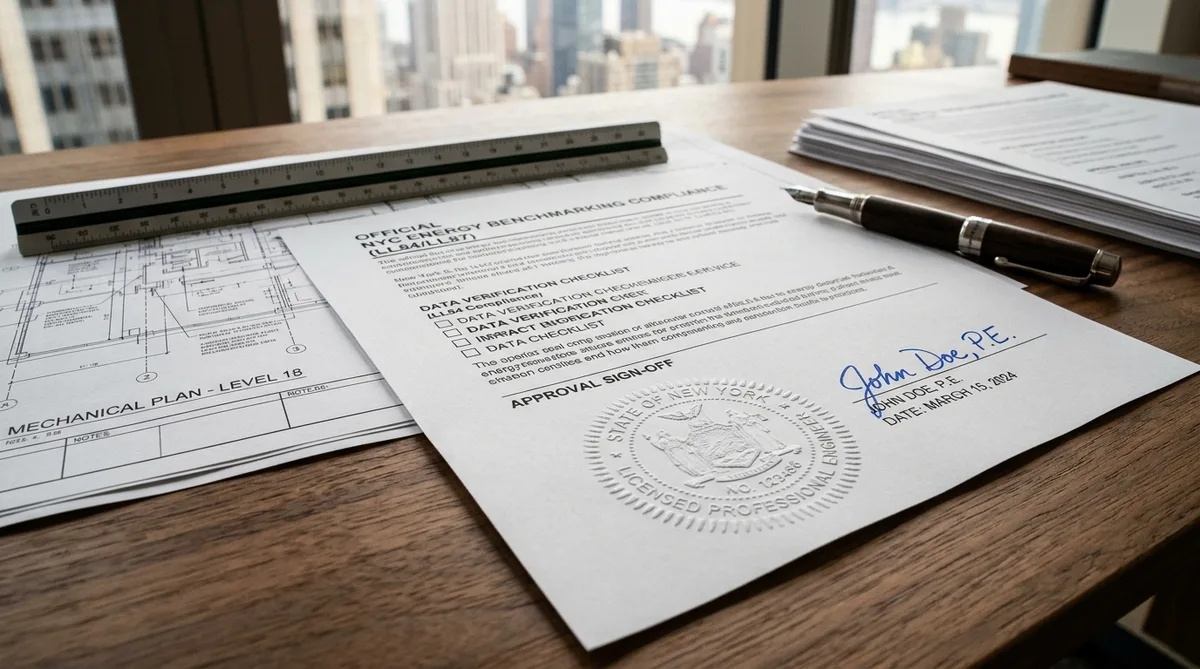 Affixing a professional engineering seal is legally binding. Understanding exactly which Local Laws require an RDP prevents unnecessary fees while guaranteeing statutory compliance.
The distinction is not simply whether a report contains building energy data. It is whether the particular law or certification program requires a professional to take responsibility for a technical assessment or formal attestation.
9. What Happens If DOB Finds Problems With Your Benchmarking Data?
Submitting a benchmarking report does not mean that every figure has been independently approved by DOB.
NYC Buildings states that submitted information is subject to audit by the DOB Bureau of Sustainability. The Department may contact the owner or building representative if additional information or verification is necessary.
Owners should therefore retain the documentation used to prepare the benchmarking submission.
Common Benchmarking Data Problems
| Issue | Potential Problem |
|---|---|
| Missing utility bills | Incomplete annual consumption |
| Incorrect gross floor area | Distorted EUI |
| Wrong property type | Incorrect benchmarking comparison |
| Missing tenant usage | Underreported whole-building consumption |
| Duplicate meter entries | Inflated consumption |
| Incorrect BBL or BIN | Data assigned to the wrong property |
| Manual fuel entry errors | Incorrect fuel consumption |
| Missing water data | Incomplete reporting where water data is required |
| Unresolved Portfolio Manager alerts | Data-quality concerns |
If DOB requests supporting information, the owner should provide the relevant records and correct the original benchmarking data where necessary.
Depending on the issue, a property manager or energy consultant may be able to resolve an administrative discrepancy. A technical or legal question involving a professional attestation may require an appropriately licensed professional.
Does a Successful Submission Mean DOB Has Approved the Data?
No.
DOB's confirmation email establishes that the benchmarking information was successfully submitted or received through the reporting process. The Department separately reserves the right to audit the information and request additional verification.
Owners should retain the submission confirmation and supporting documents rather than treating the confirmation as a blanket approval of every underlying figure.
10. How to Prepare Your Data Before Hiring a Professional
Even when a PE or RA must sign a particular report, owners can reduce avoidable review time by preparing complete records. A professional should not have to reconstruct the building's basic utility history because the property manager failed to maintain it.
A practical preparation process includes:
Step 1: Confirm the Building's Reporting Obligations
Check the latest DOB Sustainability Law Covered Buildings List. Confirm whether the property is required to benchmark under LL84 and whether other requirements, including LL97, LL87, or LL88, apply.
Remember that NYC benchmarking compliance is measured at the individual building level using its BIN, even when multiple properties appear under the same tax lot or BBL.
Step 2: Organize Annual Utility Consumption
Collect the full calendar year's electricity, natural gas, fuel oil, district energy, and other relevant energy records. Include tenant and base-building consumption where required.
NYC DOB instructs owners to report whole-building usage. Consumption not supplied by the relevant utility may need to be entered manually into Portfolio Manager.
Step 3: Verify Floor Area and Property Use
Check the gross floor area against reliable property documentation. Confirm that all reported property-use areas add up to the building's total gross floor area.
For mixed-use properties, ensure that the correct primary and secondary use classifications are selected.
Step 4: Check BBL and BIN Information
Confirm the Borough-Block-Lot number and Building Identification Number against NYC property records. Incorrect identifiers can create reporting errors or cause a submission to be associated with the wrong building.
Step 5: Review Data Quality Alerts
Use Portfolio Manager's Error Checker and Summary tab to identify unusual EUI figures and other possible reporting problems. Resolve the alerts before sharing the property with NYC.
Step 6: Determine Whether an Attestation Is Required
Before paying for professional verification, identify the exact filing or certification involved. Is the building simply completing LL84 benchmarking? Is the owner claiming a garden-style apartment exclusion? Is the application for ENERGY STAR certification? Is it an LL97 emissions report?
The answer determines whether a licensed professional is legally required.
Conclusion: Do Not Pay for a Professional Sign-Off You Do Not Actually Need
NYC benchmarking requirements distinguish between submitting energy data and certifying a technical or regulatory result.
For standard LL84 benchmarking, owners can assign a representative to manage the submission. A routine PE or RA signature is not identified as a general requirement.
Professional involvement becomes necessary when the owner claims a qualifying garden-style apartment exclusion, applies for ENERGY STAR building certification, submits an LL97 Article 320 emissions report, or undertakes compliance work governed by LL87 or LL88.
The practical approach is to identify the applicable law first, validate the underlying energy data, and hire the right professional for the specific certification required.
A property owner should not confuse a benchmarking submission confirmation with independent technical verification. Equally, hiring a licensed professional for a routine data-entry task does not automatically improve the quality of the underlying information.
The goal is accurate records, correct reporting, and professional certification wherever the applicable rules actually require it.