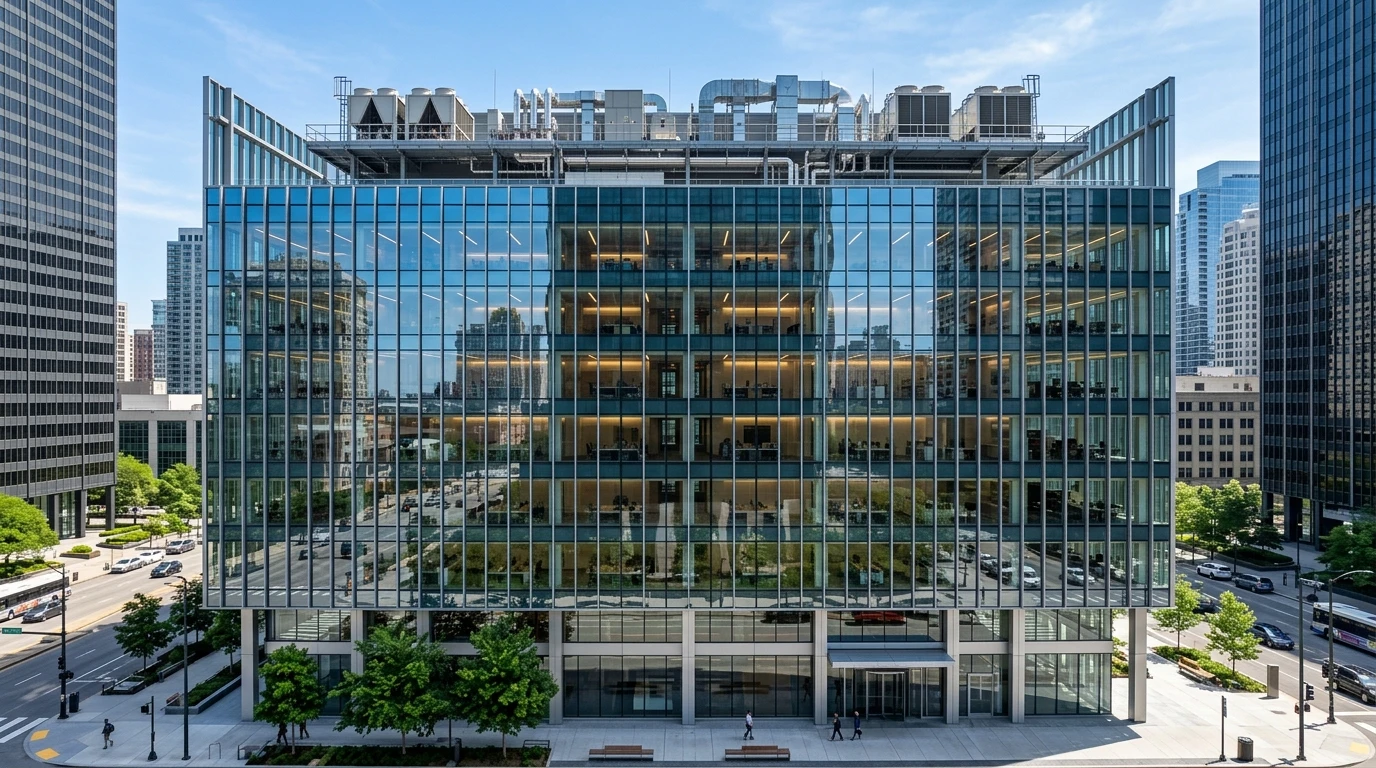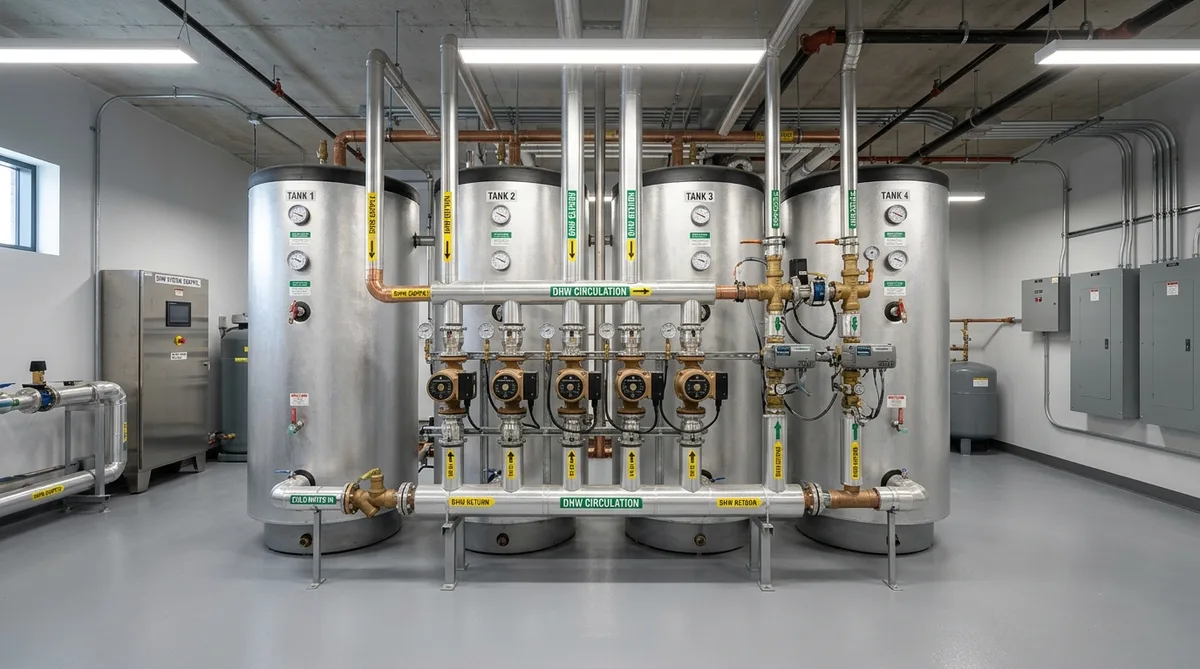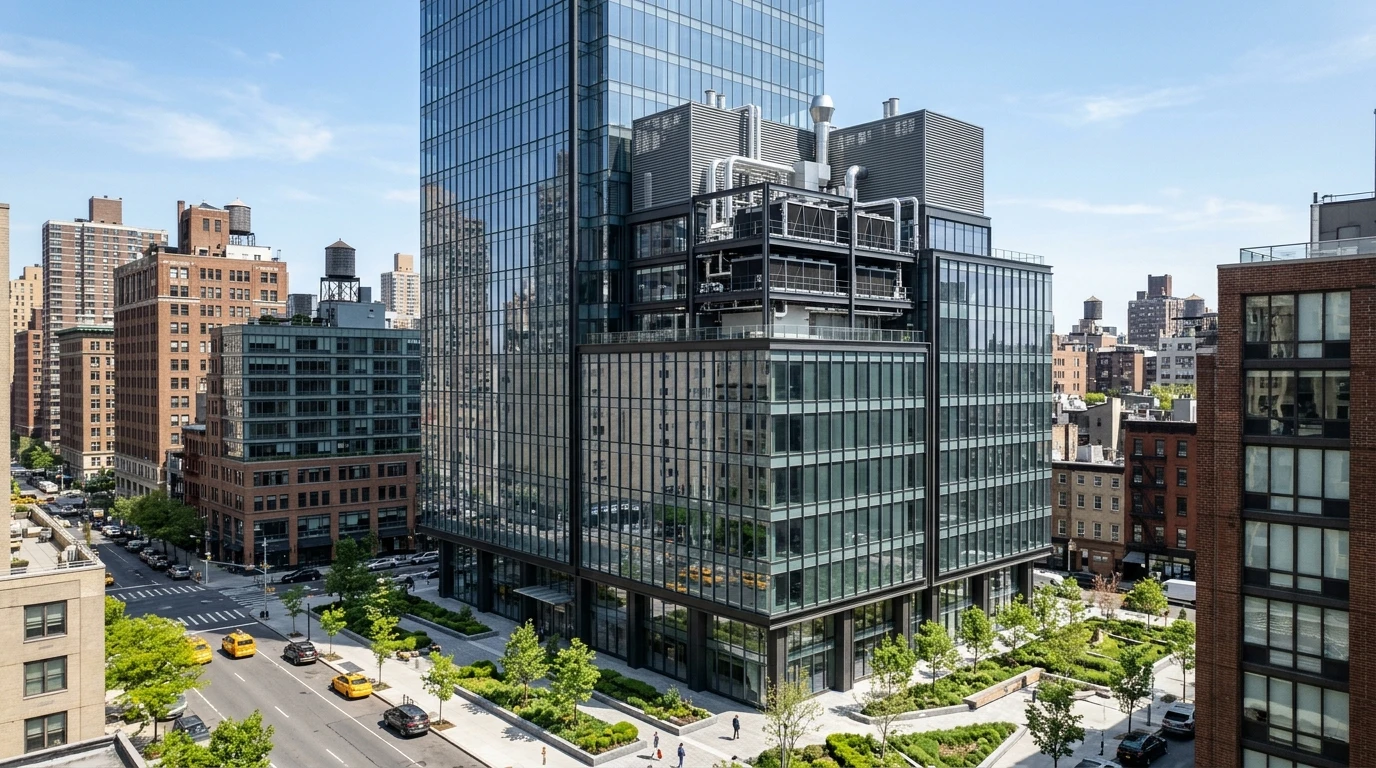
Explore the latest New York City Energy Conservation Code requirements for commercial and residential buildings. Understand effective dates, insulation standards, HVAC efficiency, energy credits, testing requirements, historic building exemptions, and what developers must prepare before submitting construction plans.
Introduction: What Building Owners Need to Know About the 2025 NYC Energy Conservation Code
New York City continues to strengthen its building energy efficiency requirements as part of its broader efforts to reduce energy consumption and greenhouse gas emissions. For building owners, developers, architects, and construction professionals, understanding the latest energy regulations is essential before beginning new construction, major alterations, or building renovations.
The 2025 New York City Energy Conservation Code (NYCECC) introduces updated energy efficiency requirements covering building envelopes, HVAC systems, lighting, hot water equipment, energy management, and existing building improvements. It also adds mandatory energy efficiency credits, expanded testing and documentation rules, and revised requirements for historic buildings.
Although the underlying 2025 New York State Energy Conservation Construction Code became effective on December 31, 2025, NYC Department of Buildings (DOB) enforcement of the 2025 NYCECC began on March 30, 2026. This guide explains the major requirements, identifies which projects are covered, and outlines what building owners and developers must prepare to maintain compliance.
1. What Is the 2025 NYC Energy Conservation Code?
The 2025 NYCECC was adopted through Local Law 47 of 2026 (Intro 1490-2025). It incorporates the 2025 New York State Energy Conservation Construction Code (based on the 2024 IECC and ASHRAE 90.1-2022) with specific New York City amendments.
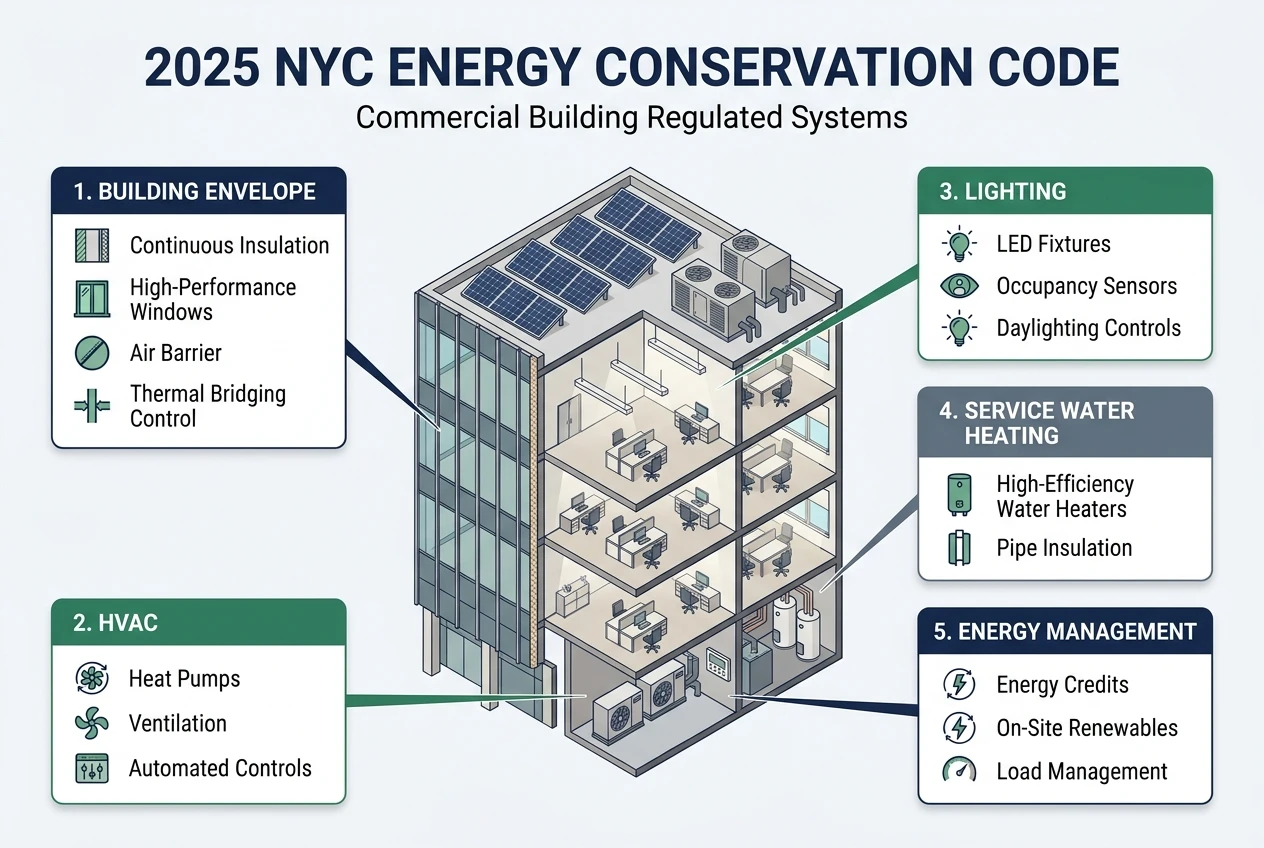
1.1 Regulated Building Systems
- Building Envelope: Exterior walls, roof insulation, windows/doors, thermal barriers, air leakage, and thermal bridging mitigation.
- HVAC Systems: Heating and cooling equipment efficiency, ventilation energy recovery, air distribution, and automated controls.
- Lighting & Electrical: Interior lighting power density, occupancy sensors, daylight-responsive controls, and power management.
- Service Water Heating: High-efficiency water heaters, heat pump water heating, pipe insulation, and circulation controls.
- Additional Energy Requirements: Efficiency credits, renewable energy, load management, and third-party commissioning/testing.
1.2 How Is the 2025 Code Structured?
| Code Section | Coverage |
|---|---|
| Chapter 1 | Administration and general requirements |
| Chapters R2–R6 & Appendix RF | Residential building requirements & alternative envelope insulation options |
| Chapters C2–C6 | Commercial building requirements |
| 2025 NYC ASHRAE 90.1 | Modified commercial building energy standard |
2. Effective Dates and Project Applicability
The 2020 NYCECC remained enforced by NYC DOB through March 29, 2026. Starting March 30, 2026, all new complete applications fall under the 2025 NYCECC.
| Application Situation | Applicable Energy Code |
|---|---|
| Complete application filed on or before March 29, 2026 | 2020 NYCECC |
| Complete application filed on or after March 30, 2026 | 2025 NYCECC |
| Incomplete application submitted before March 30, 2026 | May be subject to 2025 NYCECC |
| Material compliance change after March 30, 2026 | Generally subject to 2025 NYCECC |
What Does DOB Consider a Complete Application?
Under Buildings Bulletin 2026-005, an application is only considered complete if construction documents meet minimum completeness criteria, include a complete energy analysis, and are diligently pursued to completion. Pre-filing status or incomplete energy submissions before March 30, 2026 do not lock in the 2020 code.
3. Major Changes in the 2025 NYC Energy Conservation Code
3.1 Additional Energy Efficiency Credits (Section C406 & R408)
Commercial projects must achieve additional energy efficiency credits (and renewable/load management credits for larger properties) beyond baseline code compliance:
| Commercial Project Scope | Additional Credit Requirement |
|---|---|
| Conditioned floor area > 2,000 sq. ft. | Additional energy efficiency credits (C406) |
| Conditioned floor area > 5,000 sq. ft. | Efficiency credits + renewable & load management credits |
| Build-outs > 1,000 sq. ft. (without prior final lighting/HVAC) | Applicable tenant build-out credit requirements |
3.2 Historic Buildings Are No Longer Automatically Exempt
Under the 2025 code, historic designation alone no longer grants a blanket exemption. Applicants seeking relief for specific elements must file a Historic Building Report demonstrating the building's historic status, the specific character-defining feature impacted, and an alternative partial-compliance strategy. Additions to historic buildings are treated as new construction.
4. Building Envelope Requirements
The 2025 NYCECC tightens thermal envelope performance and introduces expanded documentation requirements:
- Insulation & Fenestration: Strict U-factor and Solar Heat Gain Coefficient (SHGC) limits. Prescriptive commercial vertical glazing is capped at 30% of gross above-grade wall area (up to 40% with qualifying daylighting).
- Air Barrier Continuity: Drawings must explicitly trace continuous air barriers across roof-wall joints, window perimeters, and mechanical penetrations.
- Thermal Bridging Mitigation: Expanded rules require modeling and mitigating heat loss across balcony slabs, structural steel projections, and window frames.
5. HVAC, Lighting, and Electrical Efficiency
Mechanical and electrical designs must incorporate higher equipment efficiencies, energy recovery ventilation (ERV), demand-controlled ventilation, automated building controls, reduced lighting power density (LPD), occupancy sensors, daylight-responsive dimming, and sub-metering/load management readiness.
6. Air Leakage Testing and Required Inspections
One of the most impactful practical changes in the 2025 NYCECC is mandatory envelope air leakage testing for all new construction.
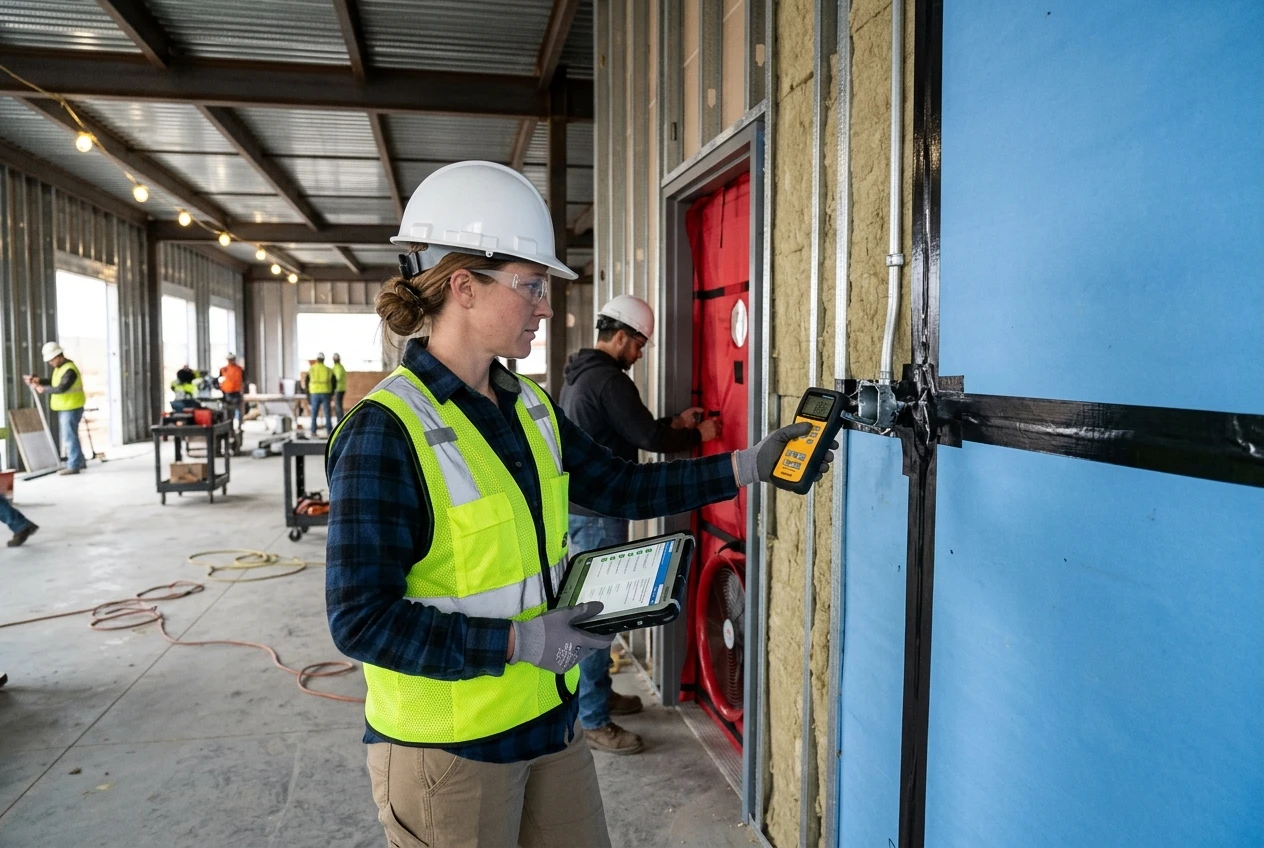
- Commercial Air Leakage Limit: Under Section C402.6.2, tested buildings must not exceed 0.35 cfm/sq. ft. of thermal envelope area at 75 Pascals.
- Independent Third-Party Testing: Commercial whole-building blower door testing must be conducted by an approved independent third party separate from the permit holder.
- TR8 Progress Inspections: Envelope, insulation, mechanical, and lighting installations must be verified via TR8 progress inspections before DOB energy sign-off.
7. Existing Buildings, Legalizations, and Change of Occupancy
Untouched existing building areas generally do not require automatic retrofits. However, replacing HVAC equipment, legalizing unpermitted installations, or executing a change of occupancy (such as converting a warehouse to residential units) triggers applicable 2025 NYCECC requirements for the affected systems.
8. Demonstrating Compliance & DOB NOW Energy Submissions
Energy submissions are filed separately from the main construction drawing set via DOB NOW and must include:
- Signed & Sealed Professional Statement: Formal compliance or exemption attestation by a registered design professional.
- NYC-Specific Energy Analysis: Using 2025 NYC REScheck, 2025 NYC COMcheck, or approved DOE-2 whole-building modeling (standard 2024 IECC versions are not accepted as direct substitutes).
- Supporting Documentation Index: Cross-referencing insulation schedules, window specs, C406 credit calculations, and control diagrams across architectural and MEP sheets.
9. 2025 NYC Energy Code vs. 2020 NYC Energy Code
| Compliance Area | 2020 NYCECC | 2025 NYCECC |
|---|---|---|
| Code Foundation | 2020 NYS Energy Code | 2025 NYS Code (2024 IECC & ASHRAE 90.1-2022) |
| Additional Energy Credits | No equivalent broad credit system | Mandatory C406/R408 efficiency, renewable & load credits |
| Historic Buildings | Broad exemption pathways | Feature-specific exceptions requiring Historic Building Report |
| Air Leakage Testing | Limited testing scope | Mandatory blower door testing for all new construction (0.35 cfm/sq. ft.) |
| Thermal Bridging | Basic provisions | Expanded thermal bridge detailing & mitigation |
10. How the NYCECC Relates to Local Law 97 and Local Law 154
While the NYCECC governs design and construction, Local Law 97 regulates ongoing operational greenhouse gas emissions. Meanwhile, Local Law 154 restricts onsite fossil-fuel combustion in new construction—with DOB listing July 2, 2027 as the filing-date trigger for all occupancies including service hot water (separate from the court-suspended statewide NYS fossil-fuel ban).
11. Practical Compliance Checklist & Common Mistakes
Developer & Design Team Checklist
Planning: Confirm filing completeness date (March 29 vs. March 30, 2026) and evaluate LL154 electrification triggers.
Design: Detail continuous air barriers, mitigate thermal bridges, calculate C406 credits, and verify 2025 NYC-specific software.
Construction: Schedule TR8 progress inspections early and coordinate independent third-party blower door testing prior to closeout.
Conclusion: Prepare Your Project Early
The 2025 NYC Energy Conservation Code reshapes how new developments and major renovations are engineered, documented, and inspected in New York City. Coordinating architects, MEP engineers, energy modelers, and TR8 progress inspectors during schematic design eliminates costly redesigns and DOB approval delays.