Step-by-step walkthrough for setting up properties, adding utility meters, and submitting LL84 benchmarking.
BY NYC Energy Code Team
ON
08 September 2026
What Your LL84 Energy Grade Actually Measures
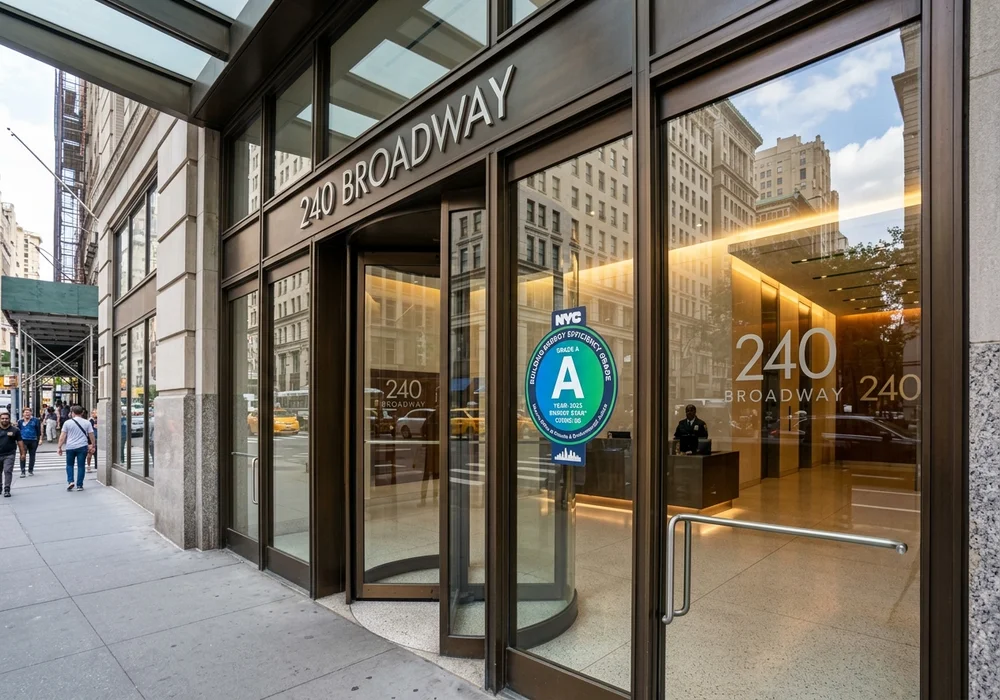
If you own or manage a covered NYC building, you may have seen an A, B, C, D, F, or N energy grade posted near the building entrance. But what does that letter actually tell you?
One important clarification comes first: LL84 is NYC's benchmarking law, while the building energy grade is assigned under Local Law 33, as amended by Local Law 95. LL84 requires covered buildings to report annual energy and water consumption through the EPA's ENERGY STAR Portfolio Manager. The resulting ENERGY STAR score is then used for the building's energy efficiency grade.
So, your energy grade is essentially a benchmark of how your building's energy performance compares with similar buildings, not a direct rating of your HVAC equipment, windows, or individual building systems.
Core Takeaway for Building Owners
An NYC energy grade is a comparative score based on whole-building energy consumption across 12 months. It provides a standardized high-level snapshot of performance relative to peer properties nationwide, rather than an isolated assessment of mechanical or architectural components.
What Is an NYC Energy Grade?
The energy grade is based on a building's 1–100 ENERGY STAR score generated through ENERGY STAR Portfolio Manager.
The score compares the building's energy performance with similar buildings, taking into account the property's type and relevant operating characteristics. NYC uses that score to assign a letter grade.
The current grading scale is:
| NYC Grade | ENERGY STAR Score | Performance & Compliance Status |
|---|---|---|
| A | 85 – 100 | Top Tier Energy Efficiency (Exemplary Performance) |
| B | 70 – 84 | Above Average Building Performance |
| C | 55 – 69 | Moderate / Average Building Efficiency |
| D | Below 55 | Below Average Performance (Action Recommended) |
| F | N/A (Missing Submission) | Required annual benchmarking was not submitted |
| N | N/A (Exempt Property) | Property type is exempt or not eligible for a 1–100 score |
What Does the Grade Actually Measure?
At its core, the grade reflects whole-building energy performance relative to comparable properties.
The benchmarking process uses annual energy consumption data submitted to ENERGY STAR Portfolio Manager. NYC requires covered buildings to benchmark annually, generally by May 1.
The underlying benchmarking data can include energy consumed from sources such as electricity and natural gas, along with information about the building and its operations.
The resulting score is therefore influenced by much more than the efficiency of a single piece of equipment.
For example, your score can be affected by:
- Building type and use: The specific mix of spaces (office, multifamily, retail, restaurant, parking, data center) dictates baseline expectations.
- Energy consumption: Total annual consumption across all fuel types (kWh of grid electricity, therms of gas, gallons of fuel oil, lbs of district steam).
- Floor area: Gross Floor Area (GFA) verified against accurate architectural plans and tax records.
- Occupancy and operating characteristics: Weekly operating hours, number of workers, number of personal computers, and percent heated/cooled space.
- Heating and cooling requirements: Weather-normalized data that accounts for local heating degree days (HDD) and cooling degree days (CDD).
- Lighting and plug loads: Base building lighting, tenant plug loads, server rooms, and common area power.
- Building operating practices: Setpoint schedules, ventilation airflow rates, simultaneous heating/cooling, and overnight setbacks.
- Quality and completeness of benchmarking data: Accuracy of meter configurations, whole-building aggregated utility data, and space allocations.

What the Grade Does Not Tell You
An A grade does not mean every system in the building is efficient.
Likewise, a D grade does not automatically mean that the building needs to replace its HVAC system.
The grade is a high-level performance indicator. It does not provide a detailed diagnosis of individual building systems.
For example, a building could have relatively efficient HVAC equipment but still perform poorly because of excessive operating hours, poor controls, high plug loads, envelope problems, or other factors.
That is why owners should use the grade as a starting point for investigation rather than treating it as an engineering assessment.
LL84 vs. LL95: What's the Difference?
These laws are often confused because they are closely connected.
| Regulatory Framework | Core Purpose & Compliance Role |
|---|---|
| LL84 Benchmarking | Requires covered buildings (25,000+ sq ft) to collect and report whole-building annual energy and water consumption through EPA ENERGY STAR Portfolio Manager by May 1 each year. |
| LL33 / LL95 Energy Grading | Translates the annual ENERGY STAR 1–100 score into a public letter grade (A, B, C, D, F, or N) and mandates printing and displaying the official DOB decal near all public building entrances by October 31. |
LL84 provides the benchmarking data, while the energy-grading requirement uses the resulting score to produce the A–F/N rating.
This distinction matters when evaluating your building's compliance strategy.
Why Your Score Can Change From Year to Year
A building's energy grade is not necessarily permanent.
Changes in energy consumption or building operations can affect the underlying ENERGY STAR score from one reporting year to another.
HVAC improvements → Lighting upgrades → Control optimization → Operational changes
But the opposite can also happen.
Increased occupancy, longer operating hours, inefficient equipment, or unusually high energy consumption can reduce performance.
A change in grade therefore does not automatically prove that a particular piece of equipment caused the change.
Why Accurate Benchmarking Data Matters
Because the energy grade is based on benchmarking, data quality matters.
NYC expects owners to report the building's energy consumption accurately. Whole-building benchmarking may require obtaining tenant energy-use information in addition to base-building consumption when the property is not master-metered.
Incorrect floor area, incomplete utility data, missing meters, or inaccurate property information can affect the reliability of the benchmark.
Owners should therefore review their benchmarking inputs rather than focusing only on the final letter grade.

What Does a Low Grade Mean?
A low grade can be a useful signal that a building's energy performance deserves further investigation.
It does not, by itself, identify the exact cause.
A building receiving a D might investigate:
Diagnostic Investigation Areas
- Utility consumption: Spikes in winter gas/steam or summer peak electrical demand.
- HVAC operation: Runtime hours, economizer dampers, chiller sequencing, and boiler staging.
- Controls and schedules: Unoccupied setback temperatures, sensor calibration, and BMS programming.
- Lighting systems: Transitioning remaining fluorescent/halogen fixtures to LEDs with daylight harvesting.
- Building envelope: Air leakage at windows, facade joints, parapets, and roof insulation deficiencies.
- Domestic hot water: Storage temperature settings, recirculation loop balancing, and pipe insulation.
- Tenant energy use: Submetering, lease provisions, and excessive off-hours server/plug loads.
- Equipment maintenance: Dirty filters, fouled coils, steam trap leaks, and pump seal degradation.
- Opportunities identified through an energy audit: ASHRAE Level II energy audits that deliver calculated ROI and payback periods.
This approach turns the grade from a passive label into a useful starting point for building-performance improvements.
Can You Improve Your Energy Grade?
Potentially, yes.
Energy-efficiency measures that reduce unnecessary consumption may improve a building's future benchmarking performance.
Examples can include:
- HVAC optimization and variable frequency drive (VFD) retrofits
- Building automation and smart thermostat improvements
- LED lighting retrofits and networked occupancy sensors
- Occupancy controls and smart scheduling algorithms
- Improved insulation, weatherstripping, and air sealing
- Better equipment scheduling and night/weekend setback enforcement
- Domestic hot-water heat pump retrofits and thermostatic controls
- Energy-efficient equipment replacement (high-efficiency heat pumps, condensing boilers, modular chillers)
However, improvements should be selected based on the building's actual operating conditions rather than trying to achieve a particular grade through one generic upgrade.
Does an A Grade Mean the Building Is Fully Compliant?
No.
This is one of the most important distinctions for building owners.
An energy grade is not a substitute for compliance with other NYC building requirements. A building can have a good energy grade and still have separate obligations under laws or regulations governing benchmarking, emissions, energy audits, gas piping, facades, or other requirements.
Similarly, a lower grade does not automatically mean the owner has violated every energy-related requirement.
The grade should be viewed as one part of the property's overall building-performance and compliance picture.
A Simple LL84 Energy Grade Checklist
Confirm applicability: Verify whether your property meets covered building criteria (25,000+ sq ft individually or 50,000+ sq ft in aggregate).
Submit complete annual benchmarking: Ensure all electric, gas, fuel oil, steam, and water utility data is uploaded to Portfolio Manager by May 1.
Review ENERGY STAR score: Check the resulting 1–100 score in Portfolio Manager and verify that data quality checks show zero fatal errors.
Check resulting NYC energy grade: Access DOB NOW: Safety to download and print the official Building Energy Efficiency Grade decal.
Compare historical performance: Track annual score trajectories to detect early operational drift or unexpected utility spikes.
Investigate major consumption changes: Drill down into weather-normalized source EUI versus baseline metrics.
Review core subsystems: Check HVAC operating schedules, lighting controls, ventilation rates, and building envelope condition.
Consider an energy audit: Leverage ASHRAE Level II audits or retro-commissioning (RCx) under LL87 to uncover root causes.
Track improvement projects: Measure post-retrofit consumption reductions to verify ENERGY STAR score improvements.
Maintain mandatory records: Keep benchmarking submissions, utility logs, and DOB posting verification on file for at least 3 years.
Conclusion
Your NYC energy grade is best understood as a whole-building energy-performance benchmark, not a detailed inspection report.
LL84 requires covered buildings to benchmark their annual energy and water use, while the resulting ENERGY STAR score feeds into the energy grade assigned under NYC's energy-grading requirements.
An A grade indicates a high ENERGY STAR score, while a lower grade can signal that the building's energy performance deserves closer attention. But the letter alone cannot tell you which system is responsible or what upgrade will provide the best return.
For owners, the most useful approach is to look beyond the letter: review the underlying energy data, understand the building's performance, identify inefficiencies, and use that information to prioritize improvements.
Frequently Asked Questions
Not exactly. LL84 requires annual energy and water benchmarking. The energy efficiency grade is assigned under Local Law 33, as amended by Local Law 95, using the building's ENERGY STAR score.
An A means the building has an ENERGY STAR score of 85 or higher under NYC's current grading scale.
No. The energy grade and LL97 greenhouse-gas-emissions requirements are separate measurements and compliance programs.
Changes in energy consumption, building operations, occupancy, or benchmarking information can affect the ENERGY STAR score and therefore the resulting grade.
Yes. An energy audit can investigate building systems and operations in greater detail and identify potential efficiency improvements. The audit provides information that the A–F grade itself does not.