Learn how energy submetering helps commercial building owners track tenant consumption, improve accountability, identify waste, and support NYC LL88 compliance.
BY NYC Energy Code Team
ON
1 October 2026
How Variable Frequency Drives (VFDs) Cut Energy Costs
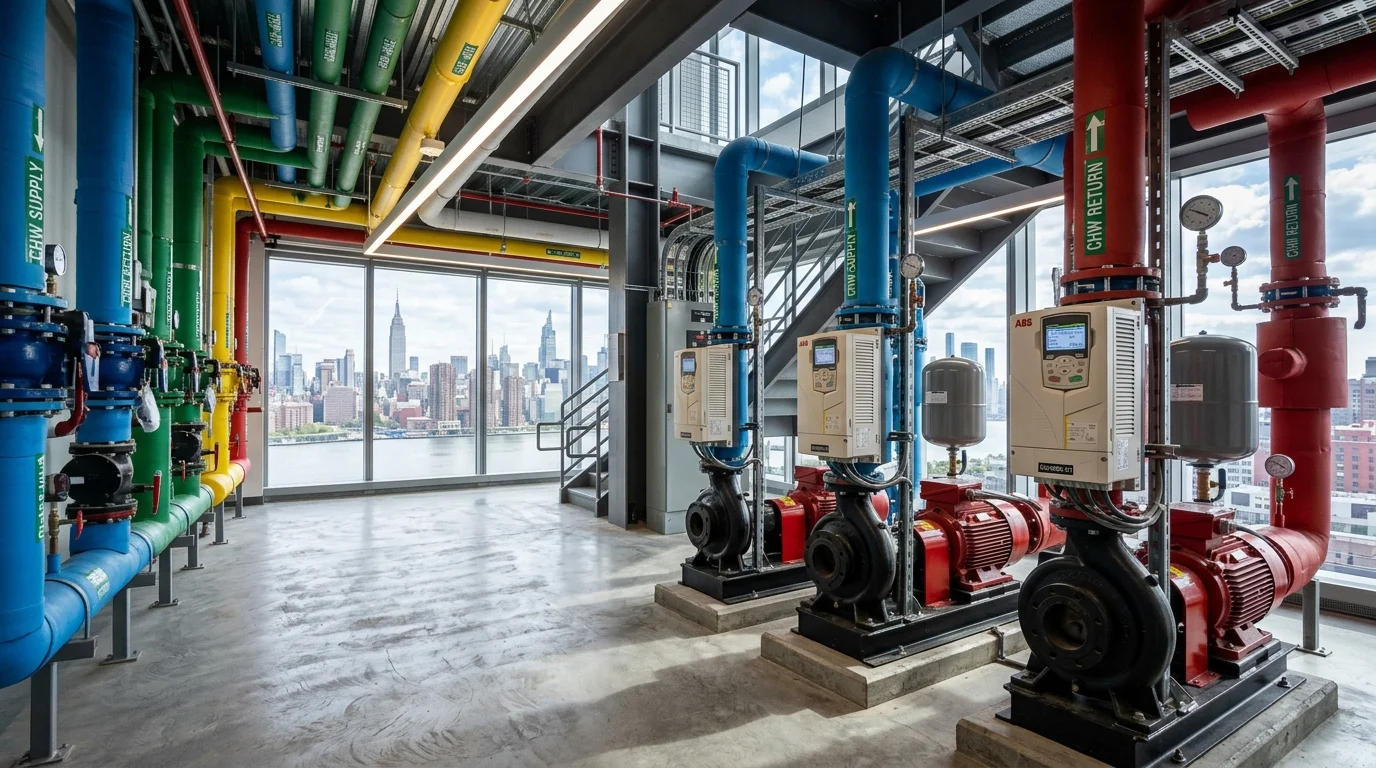
A motor does not always need to run at full speed.
Yet in many commercial buildings, fans and pumps are designed around the building's maximum possible demand and then operate at that speed even when actual demand is much lower.
That is where a Variable Frequency Drive (VFD) can make a major difference.
A VFD controls the speed of an electric motor by adjusting the frequency and voltage supplied to it. Instead of running a fan or pump continuously at full speed and regulating the output with dampers or valves, the system can often slow the motor down when demand falls.
The result can be significant energy savings because, for many variable-torque fan and pump applications, a relatively small reduction in speed can produce a much larger reduction in motor power.
The U.S. Department of Energy identifies variable-speed drives as an efficiency opportunity for commercial fan and pump systems.
What Is a VFD?
A VFD is an electronic motor controller that allows the operating speed of an AC motor to be varied.
A conventional constant-speed arrangement might work like this:
Motor ON → full speed → airflow or water flow controlled mechanically
A VFD-based system can instead operate like:
Low demand → lower motor speed
High demand → higher motor speed
This is especially useful for centrifugal fans and pumps, where the required flow changes throughout the day.
The VFD itself does not create the energy savings. The savings come from allowing the motor and driven equipment to operate at a speed that better matches the actual load.
Why Reducing Speed Can Save So Much Energy
This is where the fan and pump affinity laws become important.
For similar variable-torque applications, power demand can vary approximately with the cube of rotational speed.
In simplified terms:
Power ∝ Speed³
So if a fan operates at approximately 80% of full speed:
0.8³ = 0.512
That means the idealized shaft-power relationship is roughly 51% of the full-speed value, before accounting for real-world motor, drive, fan, system, and control characteristics.
This does not mean every VFD installation will cut energy use by 49%. Real buildings are more complicated. System pressure requirements, control sequences, motor efficiency, minimum speeds, equipment curves, and operating conditions all affect actual savings.
But the principle explains why speed control can be much more efficient than simply throttling flow.
VFDs in HVAC Systems
Commercial HVAC systems are a particularly common application.
Consider a large air-handling unit.
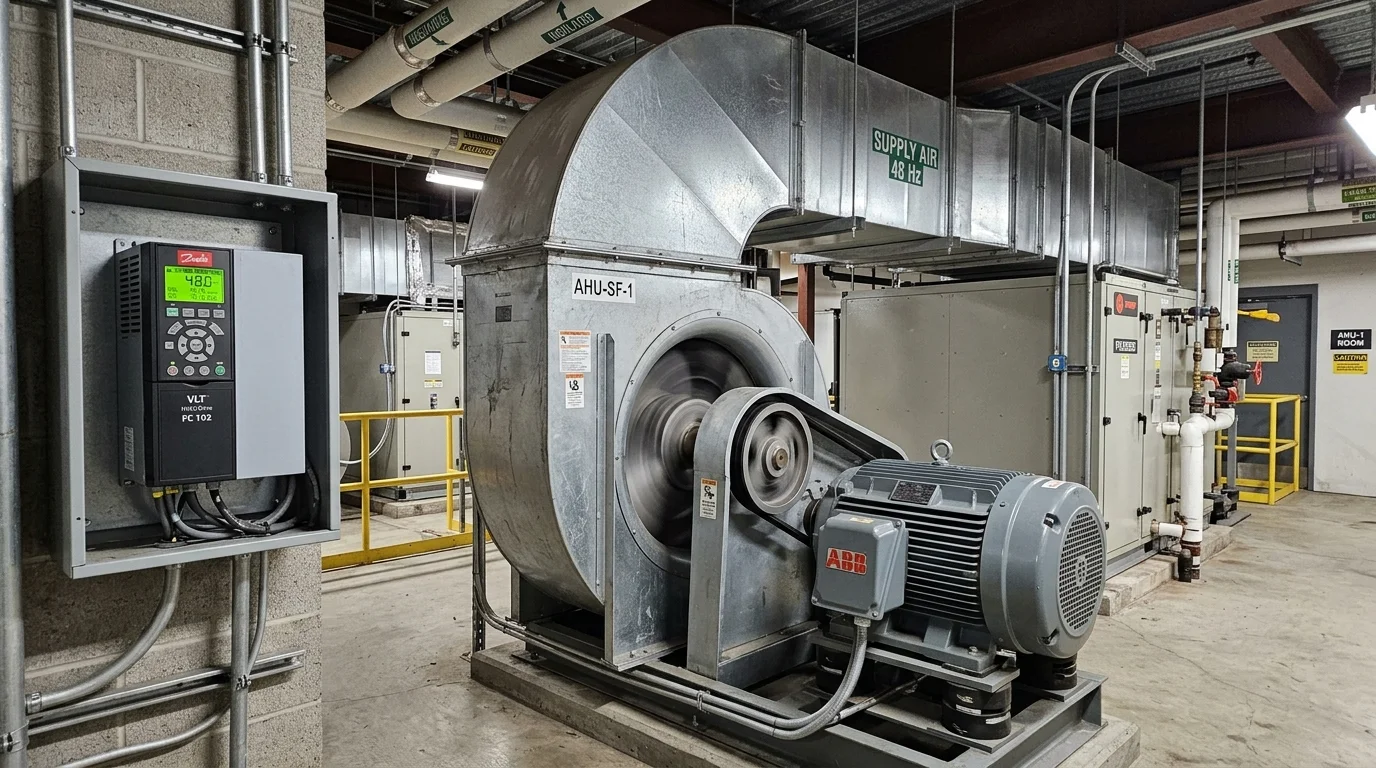
At peak cooling conditions, the supply fan may need to move a high volume of air. But at partial load, the building may require much less airflow.
Without variable-speed control:
Fan runs near full speed → airflow reduced elsewhere → unnecessary motor energy
With appropriate VFD control:
Cooling demand falls → fan speed falls → motor power falls
The savings continue whenever the system operates at reduced speed.
DOE research also identifies optimized control of variable-speed drives on fans and pumps as a practical strategy for improving HVAC system efficiency.
Where VFDs Are Commonly Used
VFDs are particularly useful where equipment demand changes substantially over time.
Typical applications include:
- Supply and return fans
- Chilled-water pumps
- Condenser-water pumps
- Cooling-tower fans
- Heating-water pumps
- Domestic-water booster pumps
The stronger the variation in load, the greater the opportunity to benefit from speed control.
A pump that genuinely requires almost full speed all the time has less energy-saving potential than one that frequently operates at partial flow.
VFD vs. Throttling
This is one of the most important concepts for understanding VFD economics.
Suppose a water system needs less flow.
A traditional pump can continue operating at high speed while a control valve restricts the flow.
The motor is still doing much of the work.
With a properly designed VFD system, the pump can slow down instead.
Conceptually:
Throttling → pump still works hard + valve wastes pressure
VFD → pump slows down + less power is required
The exact savings depend on the pump curve and system characteristics, but the second approach can be significantly more efficient in variable-flow applications.
The Difference Between Load and Speed
A common misunderstanding is that reducing speed by 10% automatically reduces electricity consumption by 10%.
It does not.
For variable-torque equipment, the relationship can be nonlinear.
A simplified example:
| Speed | Approx. Theoretical Power Relationship |
|---|---|
| 100% | 100% |
| 90% | 73% |
| 80% | 51% |
| 70% | 34% |
| 60% | 22% |
These values illustrate the cubic relationship and are not guaranteed electrical-energy savings for an actual building.
Real equipment efficiency and system pressure requirements can produce different results.

VFDs and Building Automation
A VFD becomes more useful when it is integrated with the building's control system.
For example:
Occupancy changes → ventilation requirement changes → static-pressure setpoint changes → VFD adjusts fan speed
Or:
Cooling load changes → required chilled-water flow changes → pump speed changes
This allows the motor to continuously respond to building conditions instead of following a fixed operating schedule.
DOE's research on commercial building controls found substantial potential for properly tuned control strategies, reinforcing the broader point that equipment efficiency and control strategy need to work together.
VFDs in NYC Energy-Efficient Design
VFDs are not simply retrofit equipment; they are also integrated into modern energy-code design approaches.
NYC's 2025 Energy Conservation Code is currently in enforcement, and the commercial provisions address fan-system efficiency and variable-air-volume systems. NYC's 2025 ASHRAE 90.1 provisions, for example, require certain VAV fan systems in the modeled budget building design to be represented with variable-speed drive operation, subject to the applicable requirements and exceptions.
The code also includes requirements related to fan motor sizing, fan efficiency, and electronic speed-control devices.
That does not mean every existing motor must simply be fitted with a VFD. Applicability depends on the project, system, equipment, and applicable code path.
How Much Can a VFD Save?
There is no single percentage that should be used for every building.
A realistic savings estimate depends on:
Motor size + annual operating hours + load profile + control strategy + speed range + electricity cost
Imagine a 30-horsepower fan motor operating thousands of hours every year.
If the building frequently operates at significantly less than design airflow, there may be a substantial opportunity.
Now consider a different 30-horsepower fan that operates close to full load almost continuously.
The same VFD may produce much less savings.
The technology is the same. The load profile is different.
A Simple ROI Example
Suppose a building spends:
$35,000 on a VFD installation, including controls integration.
The project produces:
$10,000/year in electricity savings.
Ignoring financing, maintenance, and other factors:
Simple Payback = $35,000 ÷ $10,000 = 3.5 years
This is only a simplified illustration.
A stronger financial analysis should also consider reduced maintenance, equipment life, incentives, demand charges, control upgrades, and any costs associated with installation.
The Biggest VFD Opportunity May Be an Existing System
VFDs are particularly interesting when an existing fan or pump has:
Constant-speed motor + variable load + throttling or damper control
That combination is often a strong candidate for investigation.
The question is not:
“Can this motor accept a VFD?”
The better question is:
“Does this system have enough operating variability to justify speed control?”
That distinction can prevent owners from installing VFDs where the savings opportunity is too small.
VFDs and Motor Selection
A successful VFD installation requires more than purchasing the drive.
The motor, drive, driven equipment, controls, electrical infrastructure, and operating conditions all need to be compatible.
Engineers should evaluate issues such as:
- Motor compatibility
- Minimum operating speed
- Harmonics and power quality
- Bypass requirements
- Cooling at reduced speed
- Control signal integration
- Equipment vibration
- System operating range
These considerations are particularly important for larger motors and critical HVAC equipment.
VFDs Are Not Always the Answer
There are situations where a VFD may not provide the expected benefit.
For example, if a fan operates at nearly constant airflow throughout the year, reducing speed may not be practical.
Similarly, a pump serving a system with essentially constant flow may have limited variable-speed potential.
A VFD should therefore be evaluated as part of a system optimization study, not as a standalone product.
VFDs and Retro-Commissioning
A VFD can also be paired with retro-commissioning.
Suppose an existing system already has a VFD but consistently operates near 100% speed.
That raises a different question:
“Is the VFD being controlled correctly?”
Perhaps the static-pressure setpoint is too high. Maybe a sensor is incorrectly located. Or the control sequence may never command the motor to slow down.
In that case, the building may already own the hardware needed to save energy.
The problem is the control strategy, not the motor.
That is exactly why commissioning and control optimization can be as important as equipment installation.
How Building Owners Should Evaluate a VFD Project
Start with the operating data.
Look at:
Motor size → operating hours → speed/load history → current control method → electricity cost
Then determine whether the system regularly operates at partial load.
If it does, model the expected performance under variable-speed operation.
A good feasibility study should compare the existing system with the proposed system rather than assuming savings based solely on motor horsepower.
Common Mistakes
1
Assuming a VFD Automatically Saves Energy
A VFD can save energy when it allows the equipment to operate efficiently at lower speed. It is not a guaranteed savings device for every motor.
2
Using the 80% Speed = 50% Savings Rule Blindly
The affinity-law relationship is an idealized engineering principle, not a guarantee of whole-building electricity savings.
3
Ignoring Controls
A VFD that runs at 100% all the time provides little of the benefit associated with variable-speed operation.
4
Installing a VFD Without Reviewing the Entire System
Fans, pumps, valves, ducts, pipes, sensors, controls, and operating requirements all interact.
5
Forgetting Maintenance and Commissioning
Incorrect control settings can eliminate much of the intended benefit.
Conclusion
Variable Frequency Drives cut energy costs by allowing fans, pumps, and other compatible motor-driven equipment to operate at speeds that better match actual demand.
The biggest opportunity appears in systems where demand varies substantially and the equipment currently relies on constant-speed operation, throttling, dampers, or other inefficient control methods.
The reason VFDs can be so powerful is the nonlinear relationship between speed and power in appropriate variable-torque applications. A modest reduction in speed can produce a disproportionately large reduction in theoretical power demand, although real-world savings depend on the entire system.
For NYC building owners, VFDs are also relevant to modern energy-efficient HVAC design, with the 2025 NYCECC and NYC ASHRAE 90.1 provisions addressing variable-speed operation and fan-system efficiency in applicable systems.
The smartest approach is to begin with the load profile, not the equipment catalog.
Find the motors that regularly operate below design demand, understand how they are currently controlled, and then determine whether variable-speed operation produces enough energy and operational value to justify the investment.
Frequently Asked Questions
A Variable Frequency Drive controls the speed of an AC motor by varying the electrical frequency and voltage supplied to it. This allows compatible fans and pumps to adjust output based on actual demand.
They can reduce electricity consumption by allowing motor-driven equipment to slow down during periods of lower demand. In appropriate variable-torque applications, power can decrease much faster than speed according to the affinity-law relationship.
No. They are widely used for HVAC fans and pumps, but can also be applied to other compatible motor-driven equipment where variable-speed operation is useful.
No. For idealized variable-torque fan and pump applications, the affinity laws indicate that power varies approximately with the cube of speed. At 80% speed, the theoretical power relationship is about 51%, but actual electrical savings depend on the motor, drive, equipment curve, controls, and system.
Certain NYC energy-code provisions address variable-speed control and fan-system efficiency for applicable systems, particularly in modern HVAC design. Whether a particular VFD is required depends on the building, system, project scope, and applicable compliance path.
Often, yes. Existing constant-speed fans and pumps can be evaluated for VFD conversion, but motor compatibility, operating range, controls, electrical requirements, and system behavior should be reviewed first.
There is no universal payback period. A system with high operating hours and significant partial-load operation may have a much stronger business case than one that operates near full load most of the time.
It can, particularly when equipment operates at lower speed during periods that would otherwise create high electrical demand. The actual demand reduction depends on the equipment and building load profile.
Yes. Retro-commissioning can identify cases where an existing VFD is incorrectly programmed, poorly integrated with sensors, or operating at unnecessarily high speeds. In such cases, control optimization may unlock savings without replacing the entire system.