Learn how mechanical, electrical, and plumbing modernization cuts operating expenses and emissions.
BY NYC Energy Code Team
ON
30 August 2026
Boiler vs Heat Pump: Making the Switch in Older NYC Buildings
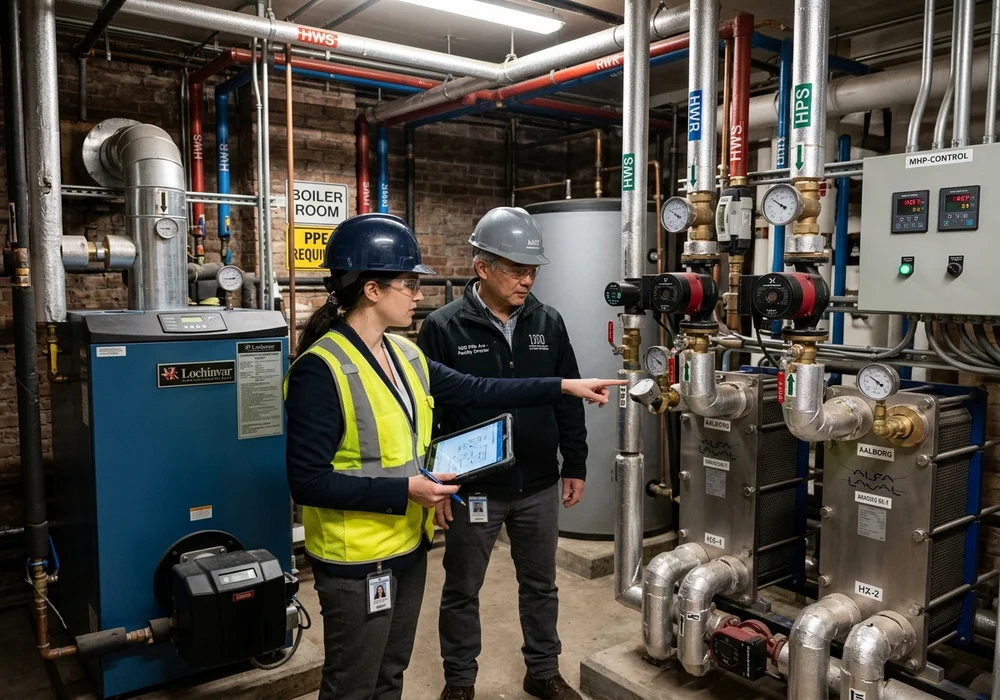
For owners of older New York City buildings, replacing a heating system is rarely a simple equipment swap.
Many prewar properties still rely on legacy steam or hydronic boilers that have operated for decades. At the same time, heat pumps have become the centerpiece of New York City's aggressive building electrification strategy.
That creates a critical fork in the road: Should you replace the aging boiler with another modern boiler, or execute a capital transition to heat pumps?
The Fundamental Distinction
- Boiler: Burns fuel (natural gas or fuel oil) on-site to generate thermal energy.
- Heat Pump: Uses electricity to transfer existing heat from outdoor air or ground water into the building—delivering both heating and air conditioning without on-site fossil-fuel combustion.
Why Boilers Are Still Common in Older NYC Buildings
Walk through Manhattan or Brooklyn apartment buildings, and you will find centralized cast-iron or steel boilers connected to well-established distribution infrastructure:
- Single-pipe and two-pipe steam radiators
- Cast-iron hot-water radiator loops
- Existing flue stacks, chimneys, and gas meters
- Established facility maintenance routines
Re-boilering represents minimal tenant disruption because existing risers, piping networks, and radiator enclosures remain intact. However, dropping in another boiler locks the building into fossil-fuel emissions for another 25 to 30 years—right as Local Law 97 emissions limits drop sharply in 2030 and 2035.
The #1 Engineering Challenge: Electrical Service Capacity
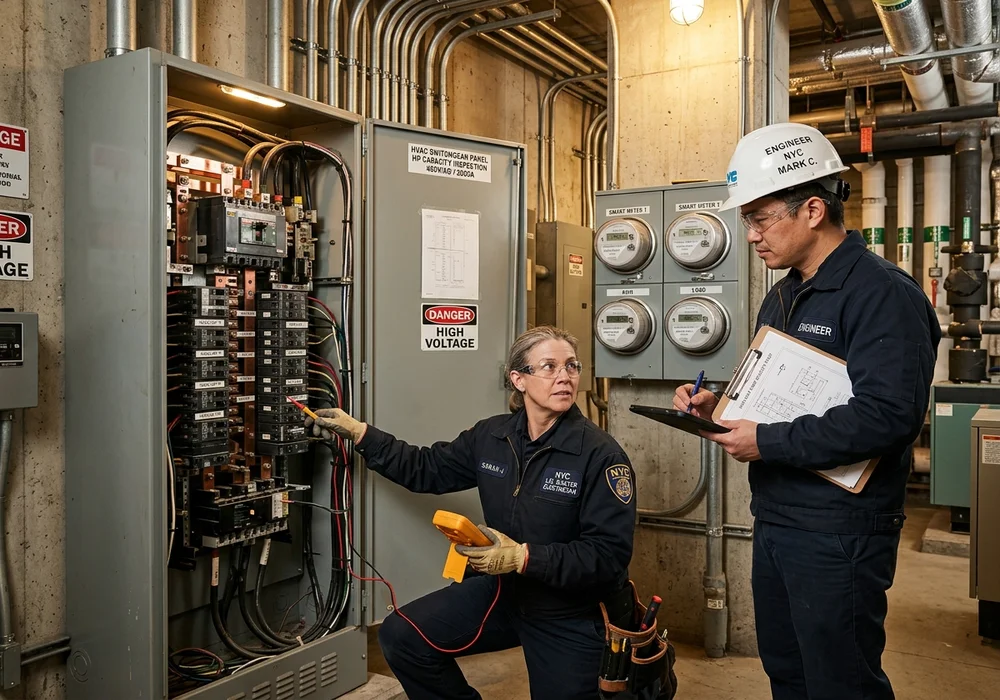
When transitioning from fossil fuels to electric heat pumps, the building's winter peak electrical demand skyrockets.
Before selecting equipment, an MEP engineer must perform an electrical load calculation to determine whether the utility service entrance can support the compressor amperage:
Electrical Feasibility Checklist
- Main Utility Service: Con Edison transformer capacity, service entrance conduits, and main disconnect rating.
- Basement Switchgear: Amperage capacity of main distribution panels and breaker space.
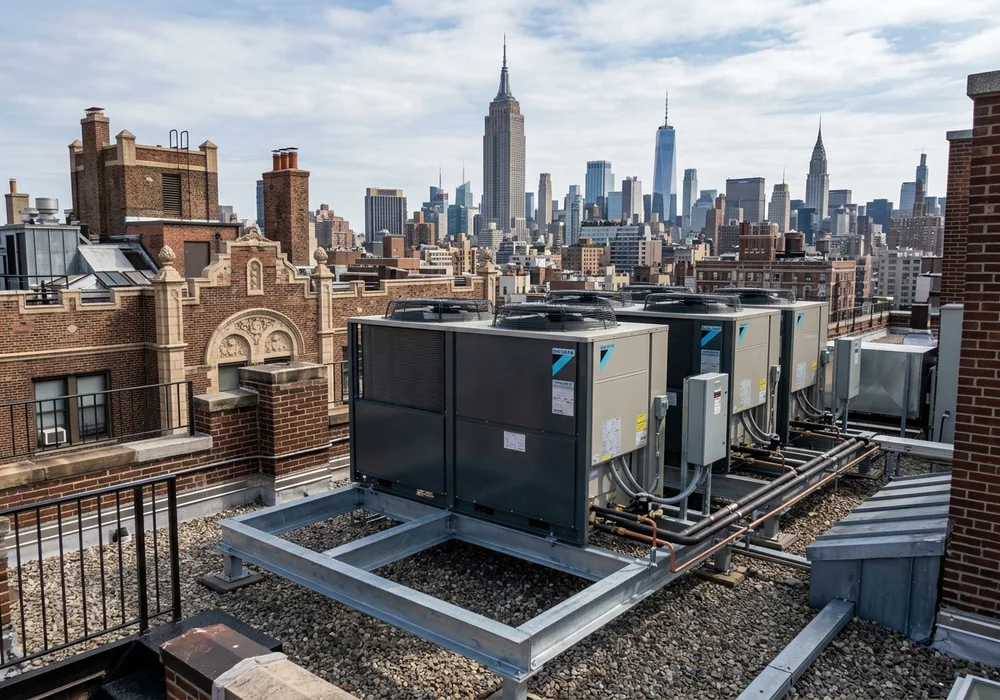
- Riser Feeders: Electrical conduit pathways running from basement switchboards up to rooftop condenser dunnage.
Can Heat Pumps Heat an NYC Building During Freezing Winters?
Yes. Modern cold-climate heat pumps (ccHP) utilize inverter-driven variable-speed compressors and enhanced vapor injection (EVI) to deliver 100% rated heating capacity down to 5°F (-15°C) and operate reliably down to -15°F.
Rather than burning fuel at 80% to 90% efficiency, heat pumps achieve a Coefficient of Performance (COP) of 2.5 to 3.5—meaning they deliver 2.5 to 3.5 units of heat for every 1 unit of electrical energy consumed.
Boiler vs Heat Pump: Comprehensive Comparison
| Evaluation Factor | Boiler Replacement | Cold-Climate Heat Pump |
|---|---|---|
| Upfront Capital Cost | Lower (Reuses piping and distribution) | Higher (Includes electrical & rooftop dunnage) |
| Operating Efficiency | 80% – 95% Thermal Efficiency | 250% – 350% COP Equivalent |
| Cooling Capability | None (Requires separate window/split A/Cs) | Integrated Summer Air Conditioning |
| LL97 Carbon Risk | High ongoing fossil fuel emissions exposure | Substantially lower carbon footprint |
| Incentive Availability | Minimal utility rebates | Major NYSERDA & ConEd Clean Heat incentives |
| Tenant Disruption | Low (Confined to boiler room) | Moderate to High (Riser & in-unit installation) |
Hybrid Systems: A Practical Phased Middle Ground
Building owners do not always have to choose an "all-or-nothing" approach. A hybrid dual-fuel strategy often provides the ideal transition path:
The Hybrid Architecture
Heat Pumps handle 85%–90% of annual heating hours when outdoor temperatures range between 30°F and 60°F.
The existing boiler operates as an auxiliary backup during rare sub-zero polar vortex peaks, eliminating the need to oversize electrical service entrances.
Smart 8-Step HVAC Decision Roadmap
1
Building Envelope Audit: Perform infrared thermography and air-sealing to lower design heating loads before sizing equipment.
2
Electrical Capacity Assessment: Verify main panel amperage, transformer headroom, and riser pathways.
3
Evaluate Distribution Options: Compare VRF refrigerant risers, hydronic fan coils, or central air handling.
4
Model LL97 Emissions Penalties: Forecast 2030–2040 carbon fines under natural gas vs electrified operations.
5
Secure NYSERDA & ConEd Clean Heat Rebates: Lock in utility incentives prior to equipment procurement.
6
Review Domestic Hot Water (DHW): Integrate heat pump water heaters (HPWH) for comprehensive decarbonization.
7
Select Equipment & Hybrid Strategy: Finalize mechanical drawings and DOB permit filings.
8
Installation & Commissioning: Execute phased installation and complete functional performance testing.
Final Takeaway
The boiler vs. heat pump decision is not simply a hardware choice—it is a 30-year capital asset strategy.
A boiler replacement may offer low initial disruption, but heat pumps deliver whole-building electrification, eliminate window air conditioning units, reduce LL97 carbon penalty liabilities, and leverage hundreds of thousands of dollars in utility incentives.
Before signing a contract for another fossil-fuel boiler, engage an experienced MEP engineering firm to perform an investment-grade feasibility study and lifecycle cost model tailored to your building.
Frequently Asked Questions
Not automatically. Heat pumps offer high-efficiency heating and cooling and eliminate on-site combustion, but older buildings often require electrical service upgrades, distribution alterations, and envelope weatherization. Boilers remain easier to drop in when steam or hydronic piping is sound.
Yes. Modern cold-climate Variable Refrigerant Flow (VRF) and hydronic heat pumps operate efficiently in NYC winters down to -15°F, provided electrical capacity and distribution pathways are properly engineered.
Perform a lifecycle cost and engineering assessment first. Evaluate remaining boiler lifespan, available electrical capacity, potential cooling consolidation, NYSERDA/Con Edison incentives, and future Local Law 97 carbon limit penalties.
Heat pumps cannot directly deliver high-pressure steam through 1-pipe steam radiators. Conversions typically involve replacing steam radiators with ductless VRF fan coils, packaged terminal heat pumps (PTHPs), or hydronic distribution loops.
Heat pumps operate at 250% to 350% seasonal efficiency (COP 2.5–3.5). However, because NYC electricity rates per MMBtu are higher than natural gas, overall utility bill savings depend heavily on building insulation and system coefficient of performance.
A high-efficiency condensing boiler marginally reduces natural gas emissions, but heat pumps substantially decarbonize space heating by shifting thermal generation to an increasingly greening New York electric grid.
No. NYC does not mandate the immediate removal of existing operational boilers. Local Law 154 restricts combustion in new construction, while Local Law 97 enforces annual carbon emissions caps on existing covered buildings.
Yes. NYSERDA's Clean Heat Program and Con Edison Clean Heat incentives provide substantial cash rebates per MMBtu or per ton of heating capacity, significantly offsetting upfront capital costs.
Yes. Improving envelope airtightness and roof/wall insulation reduces peak heating design loads, allowing you to install smaller, lower-amperage heat pump systems that avoid costly utility service upgrades.
A hybrid system combines electric heat pumps for baseline heating and cooling (covering 80–90% of hours) with an existing or smaller auxiliary boiler that fires only during extreme winter sub-zero peak cold snaps.
Commission an investment-grade MEP engineering feasibility study to evaluate electrical service capacity, hybrid configurations, and long-term carbon penalty liabilities before locking in 25 years of fossil fuel dependency.