Explore how the transition from fossil fuel heating to electric heat pumps impacts building infrastructure, costs, and compliance.
BY NYC Energy Code Team
ON
13 September 2026
How Utility Demand Response Programs Work for Commercial Buildings
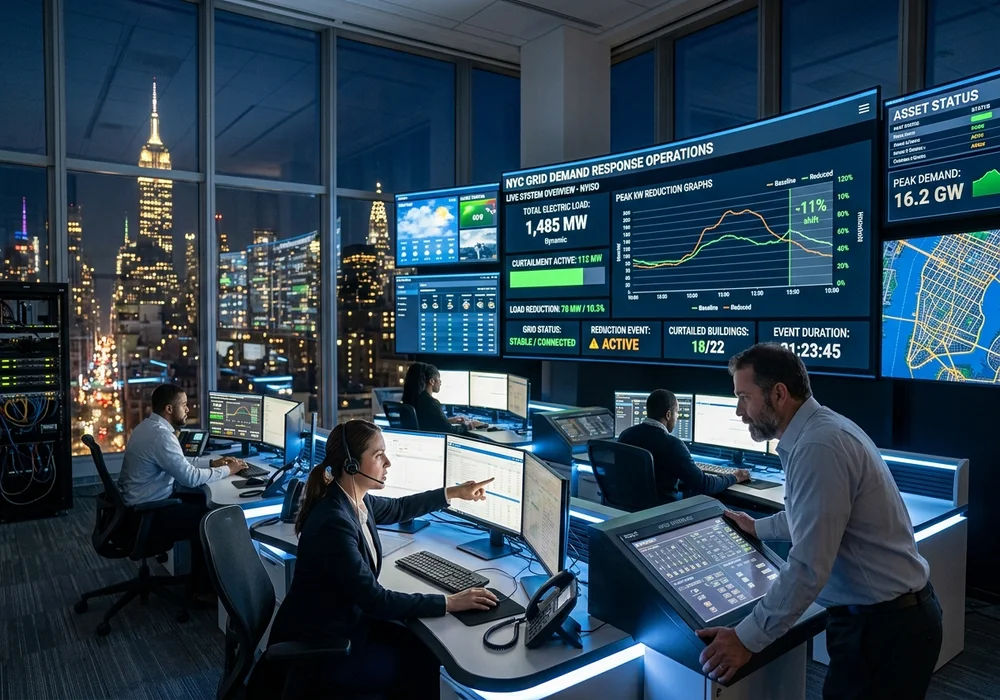
Commercial buildings do not use the same amount of electricity throughout the day. Demand can rise sharply during hot summer afternoons when air-conditioning systems, lighting, elevators, and other equipment are operating at high levels.
Utility demand response programs are designed to address these periods of high electricity demand. Instead of generating additional supply to meet every peak, utilities or program operators can encourage participating customers to temporarily reduce or shift electricity consumption.
For commercial building owners, demand response can provide an opportunity to lower peak demand, support grid reliability, and potentially receive financial incentives for participating.
Strategic Energy Value
Demand response should not be viewed as simply shutting off systems. It is an organized strategy that allows buildings to maintain tenant comfort and operational continuity while earning revenue and lowering expensive utility peak-demand charges.
What Is Demand Response?
Demand response is a strategy in which electricity customers change their normal energy consumption in response to signals, events, or pricing from a utility or demand-response provider.
A simplified example looks like this:
Normal operation
Demand-response event
Reduce electricity use
Event ends
Normal operation resumes
The reduction may last from a relatively short period to several hours, depending on the specific program.
The goal is not necessarily to shut down the building. Instead, participating buildings identify loads that can be temporarily reduced, delayed, or shifted without creating unacceptable impacts for occupants.
Why Utilities Use Demand Response
Electricity demand can become especially high during certain periods.
For example, on a very hot weekday:
Outdoor temperature rises
Air-conditioning demand rises
Building electricity use increases
System-wide demand peaks
During these periods, utilities may need additional generation or other grid resources to maintain reliability.
Demand response provides another option: reduce consumption from participating customers during the highest-demand periods.
This can help utilities manage peak conditions while giving customers an opportunity to participate in grid-support programs.
How a Commercial Building Participates
A typical demand-response strategy involves four stages.
Stage 1
Enrollment
The building owner or energy manager enrolls in an available demand-response program and agrees to its operating requirements.
Stage 2
Baseline and Measurement
The program establishes how the building's electricity use will be measured and, where applicable, how its expected consumption will be determined.
Stage 3
Event Notification
The participant receives a signal or notification that a demand-response event is occurring, either day-ahead or with short lead-time.
Stage 4
Load Reduction
The building implements its agreed strategy and reduces electricity use. After the event, the building returns to its normal operating schedule.
The exact enrollment, measurement, notification, and payment structure varies by program.
Which Building Loads Can Be Reduced?
The most useful demand-response loads are generally those that can be adjusted temporarily without significantly affecting building operations.
| Building Load | Possible Demand-Response Strategy |
|---|---|
| HVAC | Adjust temperature setpoints and cycle compressors |
| Ventilation | Reduce airflow where permitted while preserving indoor air quality |
| Lighting | Dim nonessential lighting in corridors, atriums, and perimeter zones |
| Electric Water Heating | Shift heating periods or pre-heat water tanks ahead of events |
| Battery Storage | Discharge stored energy behind the meter during peak hours |
| EV Charging | Delay charging, reduce charge rates, or sequence sessions |
| Pumps & Motors | Optimize speed via VFDs or temporarily curtail secondary pumps |
| Noncritical Equipment | Shift nonessential operational schedules outside peak hours |
The appropriate strategy depends on the building's systems, occupancy, controls, and program requirements.
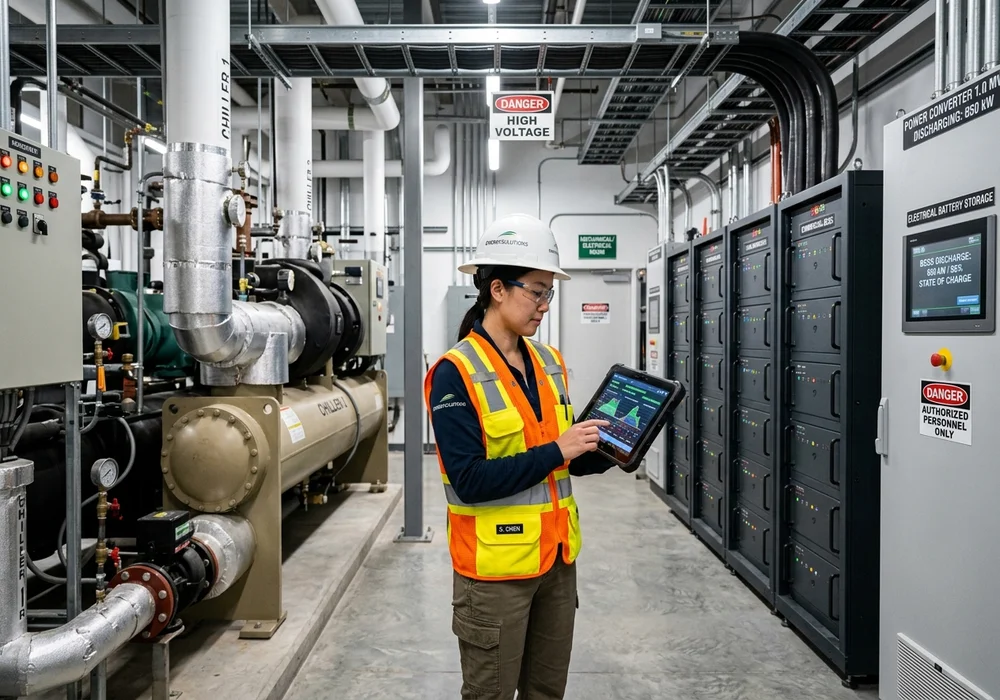
HVAC Is Often a Major Opportunity
HVAC systems can represent a substantial portion of commercial building electricity use, particularly during hot weather.
A building may temporarily reduce demand by:
- Raising cooling setpoints slightly (e.g., 2°F to 4°F) during peak event windows
- Reducing cooling in lightly used or vacant zones
- Adjusting ventilation rates where code and occupancy levels allow
- Pre-cooling spaces before an event to leverage building thermal mass
- Coordinating staging across multiple chillers and air-handling equipment
For example:
Before event: Pre-cool building
During event: Slightly relax cooling setpoints
After event: Return to normal operation
The control strategy needs to be carefully designed so that temporary savings do not create a larger demand spike immediately afterward (known as a "rebound peak").
Battery Storage and Demand Response
Battery storage can provide another way to participate without requiring changes to tenant spaces.
Instead of reducing building consumption directly, a battery can discharge during a demand-response event and supply part of the building's electricity needs.
Battery Load Offset Calculation
Building Gross Demand: 500 kW
Battery Discharge Output: 100 kW
Net Grid-Supplied Demand: Approximately 400 kW
The actual operating strategy depends on the battery system, tariff structure, and demand-response program.
This can make battery storage useful for both demand management and resilience, although the financial case should be evaluated based on the building's specific load profile.
EV Charging as a Flexible Load
EV charging can also provide demand-management opportunities.
Charging does not always need to happen at full power immediately. A building with managed charging may be able to:
- Delay charging sessions during peak curtailment events
- Reduce charging power output to active ports
- Prioritize certain mission-critical fleet vehicles
- Shift charging to overnight or lower-demand periods
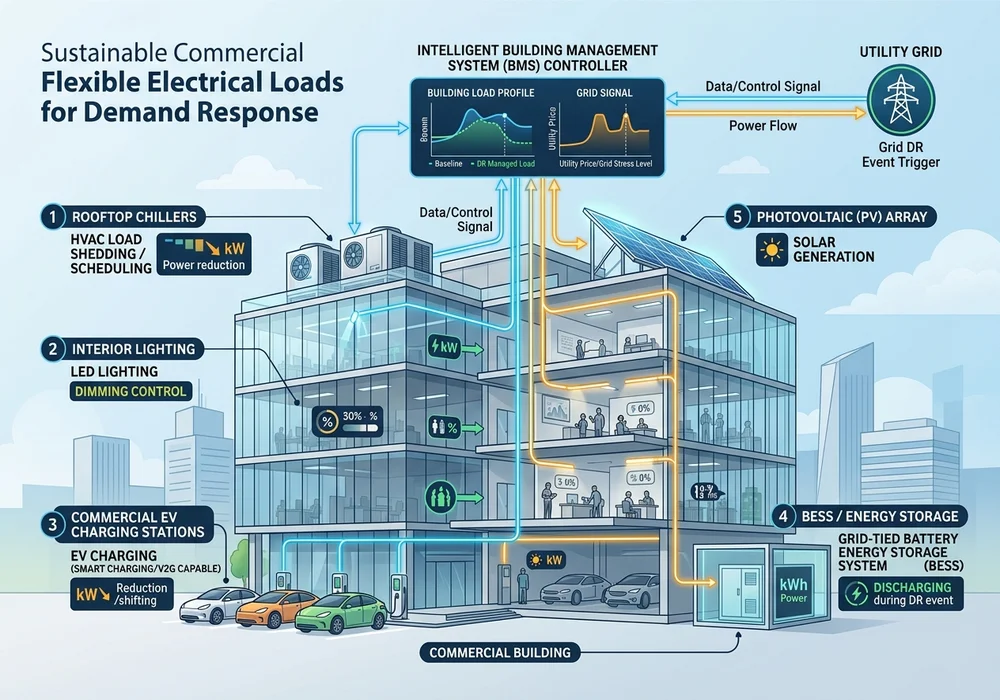
For a property with many EV chargers, this can be an especially useful strategy because charging loads are often more flexible than essential building systems.
Demand Response vs. Energy Efficiency
These concepts are related but distinctly different in purpose and execution.
| Feature | Energy Efficiency | Demand Response |
|---|---|---|
| Primary Focus | Reduces energy consumption over time | Temporarily changes or shifts consumption |
| Timing | Usually focused on ongoing baseline savings | Focused on peak periods and targeted grid events |
| Key Examples | LED lighting upgrades, high-efficiency chillers, building envelope retrofits | Thermostat setpoint adjustments, load shifting, BESS discharge, managed EV charging |
| Financial Impact | Lowers overall kWh usage on monthly bills | Reduces kW peak-demand charges and earns capacity incentives |
A building can benefit substantially from both. For example, an efficient HVAC system may lower normal electricity consumption, while smart controls can temporarily reduce its demand further during a grid event.
Why Building Controls Matter
Automated controls can make demand response much easier to manage.
Instead of asking building staff to manually adjust dozens of systems, a building automation system (BAS) can execute predefined sequences seamlessly:
Demand-response signal received
HVAC setpoints adjusted
Noncritical lighting dimmed
EV charging reduced
Battery begins discharge
Event ends
Systems return to normal operation
Automation can improve response consistency, ensure compliance with program curtailment targets, and eliminate the risk of human error.
What Are the Financial Benefits?
The financial structure varies significantly among programs. Depending on the program, participants may receive compensation for:
- Enrollment or availability: Recurring capacity payments just for being on standby to reduce load when called upon.
- Actual load reductions: Performance-based payments for every kilowatt-hour (kWh) shaved during declared events.
- Performance during events: Bonus incentives for exceeding baseline targets or rapid response capabilities.
- Capacity committed to the program: Guaranteed seasonal payments for pre-committed shed capacity (kW).
Some programs can also create indirect financial benefits by reducing exposure to high-demand utility tariffs and peak coincident charges.
However, building owners should evaluate the economics carefully. The value depends on program rules, expected load reduction, equipment controls investment, operational requirements, and event frequency.
What Should Building Owners Evaluate?
Before joining a demand-response program, owners and operators should carefully review five essential aspects:
1. Building Load Profile
Identify when electricity demand is highest throughout the year and which equipment groups account for the largest demand spikes.
2. Flexible Loads
Determine which loads can be temporarily reduced or delayed without compromising safety, tenant productivity, or occupant comfort.
3. Automation Capabilities
Check whether the building automation system or smart metering infrastructure can receive OpenADR or utility signals and execute automated response sequences.
4. Tenant Considerations
Understand whether changes to HVAC setpoints, lighting, or elevator speeds could trigger tenant complaints or violate commercial lease covenants.
5. Program Requirements & Penalties
Review event duration, notice timelines, mandatory performance thresholds, measurement and verification (M&V) methods, and potential non-performance penalties.
Common Demand-Response Mistakes
Reducing Critical Loads: Life-safety systems, server rooms, emergency egress, and essential security systems should never be included in curtailment plans.
Relying Entirely on Manual Controls: Manual intervention is prone to delays, inconsistencies, and staffing constraints during unscheduled grid emergencies.
Ignoring Occupant Comfort: Overly aggressive thermostat setpoint adjustments or lighting shutdowns can trigger tenant dissatisfaction and operational pushback.
Failing to Understand the Baseline: Settlement payments depend strictly on how the utility calculates the customer baseline (CBL). Misinterpreting baseline rules can lead to zero earnings.
Choosing Loads That Cannot Recover Easily: Rapidly restarting heavy equipment after an event can create massive rebound peaks that trigger even higher monthly utility demand charges.
Demand Response Readiness Checklist
Review the building's hourly interval electricity demand data.
Identify recurring peak-demand periods and key contributing systems.
Categorize flexible electrical loads versus non-negotiable critical loads.
Review HVAC controls, VFDs, and building automation capabilities.
Evaluate battery energy storage (BESS) and smart EV charging opportunities.
Define acceptable occupant-comfort and temperature-drift thresholds.
Review available utility (e.g., Con Edison) or third-party curtailment programs.
Understand notice periods, curtailment duration, and measurement protocols.
Establish automated control sequences and gradual post-event recovery ramps.
Test the response strategy during non-critical hours before real events occur.
Monitor event settlement reports, track earnings, and refine sequences annually.
Conclusion
Utility demand response programs for commercial buildings allow building owners to temporarily reduce or shift electricity use when the grid needs it most.
The strategy works best when the building has flexible loads, effective controls, and a clear understanding of its peak-demand profile. HVAC, lighting, EV charging, battery storage, and other controllable systems can all potentially contribute.
For commercial property owners, demand response should not be viewed as simply turning equipment off. It is a coordinated approach to managing when and how electricity is consumed.
When combined with energy efficiency, building automation, storage, and smart EV charging, demand response can become an important part of a modern building's energy-management strategy.
Frequently Asked Questions
It is a program that encourages electricity customers to temporarily reduce or shift electricity consumption during periods when grid demand is high or when other system conditions require it.
Potentially. Many programs provide financial compensation based on participation, committed capacity, or measured load reductions. The exact structure depends on the program.
HVAC, lighting, EV charging, battery storage, water heating, and other flexible loads can be useful. The best candidates depend on the building's systems and operational requirements.
Not always, but automation can make participation more reliable and scalable, especially for larger commercial buildings with multiple controllable loads.
No. Energy efficiency reduces energy consumption on an ongoing basis, while demand response temporarily changes electricity consumption during targeted periods. A building can use both strategies together.