BY NYC Energy Code Team
ON 10 Aug 2026
Industry Trends
How Climate Week NYC Is Shaping the Future of Building Compliance
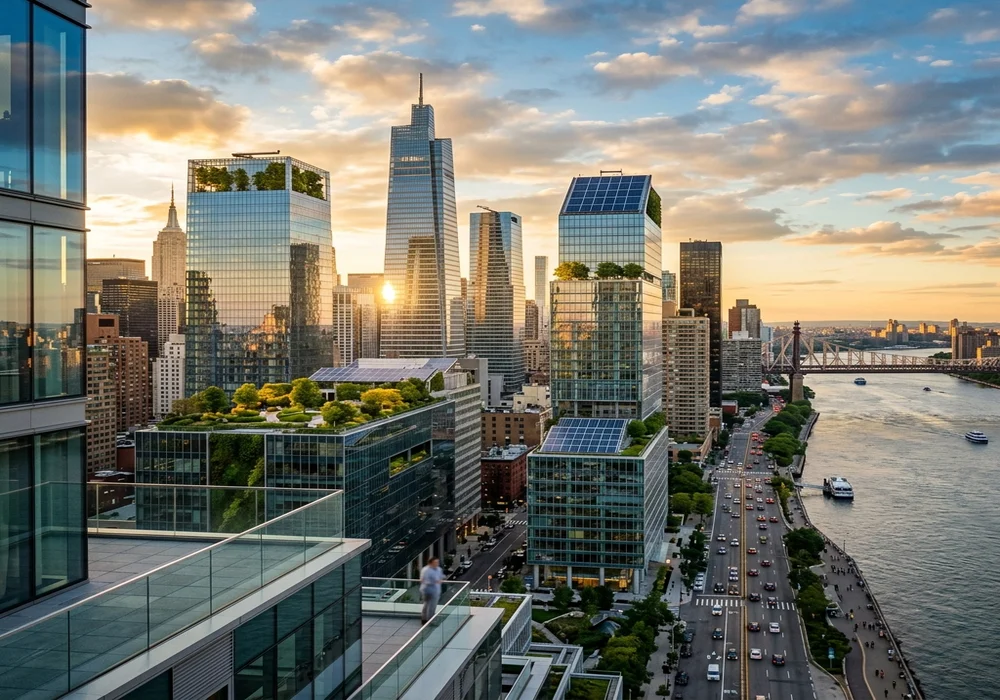
Every year, Climate Week NYC brings together policymakers, investors, engineers, developers, and building owners in one place. On the surface, it looks like a global climate event. In reality, it acts as a pressure point—accelerating how building compliance rules evolve in New York City.
If you’re a building owner, ignoring it is a mistake. Not because it creates laws directly—but because it shapes what laws will look like next.
What Climate Week NYC Actually Does
Climate Week NYC is not just a conference. It’s one of the largest climate-focused gatherings globally, with 100,000+ participants and over 1,000 events focused on energy, infrastructure, finance, and policy.
More importantly, it happens alongside the UN General Assembly, which means global decision-makers are already in New York. That creates a unique environment where:
- Policies get influenced
- Partnerships get formed
- Investment priorities shift
- Regulatory direction becomes clearer
This isn’t theory—it’s where alignment happens between government, capital, and industry.
Why Buildings Are at the Center of the Conversation
One of the core themes every year is Buildings and Infrastructure. The reason is simple:
- Buildings are one of the largest sources of emissions
- Energy demand is rising due to electrification and AI
- Cities need retrofits, not just new construction
Climate Week discussions consistently focus on:
- Retrofitting older buildings
- Electrification of heating systems
- Grid capacity and energy demand
- Resilient infrastructure
- Smart building technologies
In short: everything that directly affects compliance laws in NYC.
The Direct Link to NYC Building Laws
Climate Week doesn’t pass laws—but it influences the direction of laws like:
- Local Law 97 (emissions caps)
- Local Law 84 (benchmarking)
- Local Law 95 (energy grades)
These laws come from the Climate Mobilization Act, which aims to reduce building emissions significantly over time.
Here’s the structural connection:
| Climate Week Discussion | Real-World Impact |
|---|---|
| Decarbonization | Stricter LL97 emission limits |
| Electrification | Pressure to phase out gas systems |
| Data transparency | More detailed benchmarking requirements |
| ESG & finance | Compliance tied to funding and valuation |
| Technology adoption | Smart building and IoT integration |
If a concept gains traction during Climate Week, it often shows up in policy discussions within the next few years.
From “Ambition” to “Enforcement”
A key shift in recent years is that the conversation is no longer about goals—it’s about implementation.
Climate Week explicitly focuses on turning climate ambition into real-world action. That aligns directly with what NYC is doing:
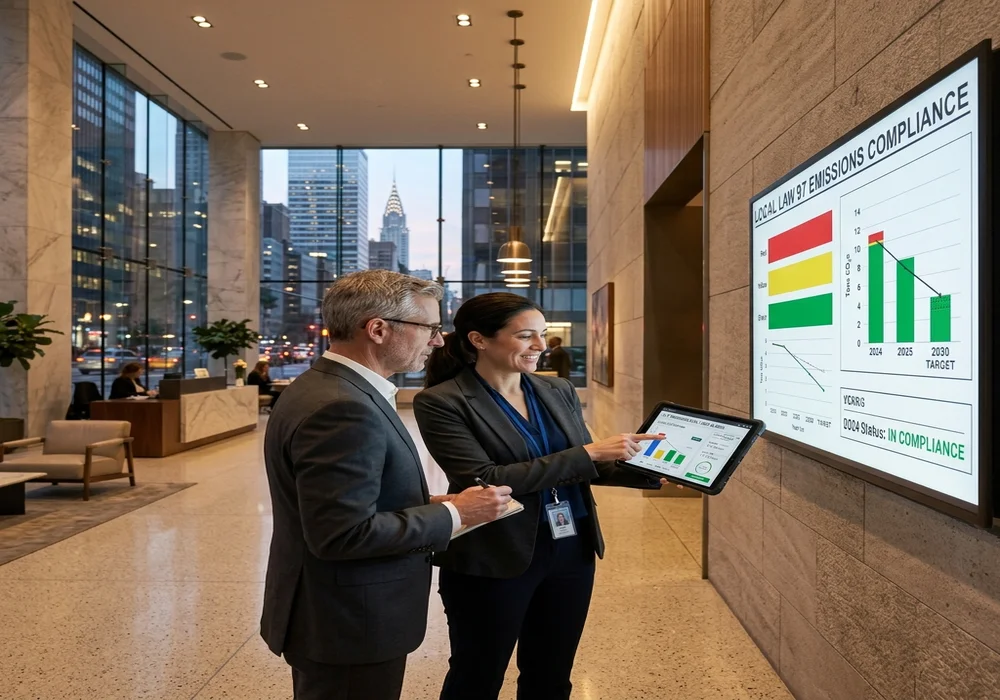
- LL97 already requires annual emissions reporting
- Penalties are enforced for exceeding limits
- Compliance is tied to verified data
- Buildings must show measurable progress
Even enforcement gaps—like inconsistent monitoring—are now being identified and criticized, which increases the likelihood of stricter oversight in future years.
Financial Pressure Is Increasing
Another consistent theme at Climate Week is capital flow.
Investors, lenders, and asset managers are now evaluating buildings based on:
- Carbon emissions
- Energy efficiency
- Compliance risk
- ESG reporting
This creates a second layer of pressure beyond regulations.
Example of Compounding Compliance Financial Risk
- A non-compliant building may face steep LL97 penalties.
- At the same time, it may lose financing options or see reduced property valuation.
Climate Week accelerates this shift by aligning financial institutions with sustainability goals.
Technology Is Becoming Mandatory, Not Optional
Smart building tech, AI-driven energy management, and IoT systems are no longer “nice to have.”
They are being positioned as:
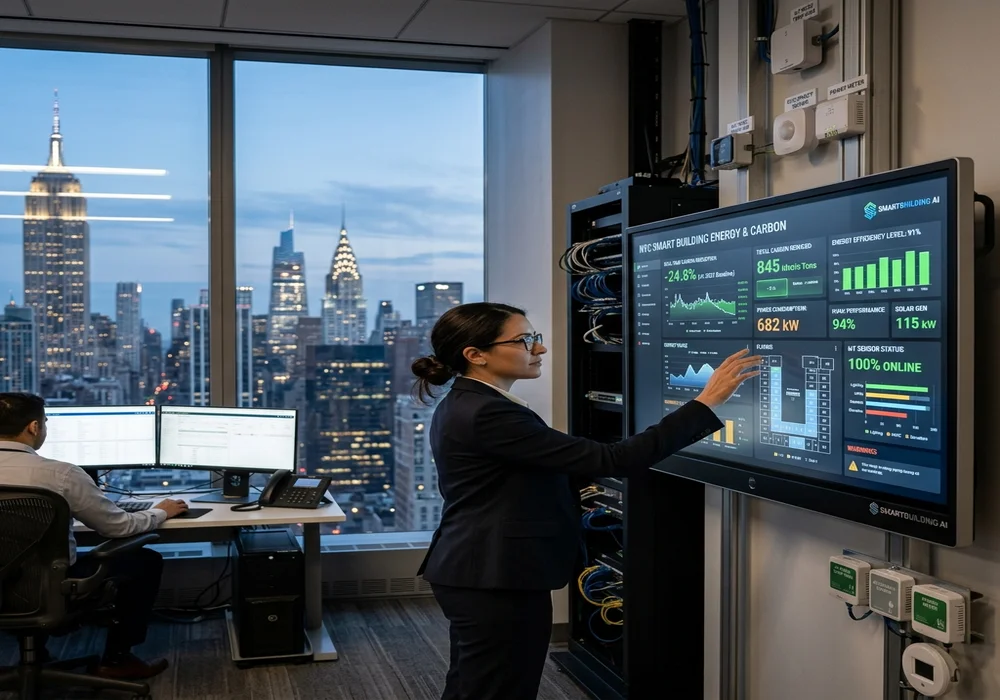
- Tools for compliance tracking
- Methods for reducing emissions
- Systems for real-time energy monitoring
As energy demand increases (especially from digital infrastructure), manual energy management becomes insufficient. This signals a likely future where real-time reporting becomes standard, annual reporting evolves into continuous monitoring, and compliance becomes data-driven.
The Risk You’re Ignoring
If you treat compliance as a checklist, you’re already behind. Climate Week discussions show a clear pattern:
- Regulations will tighten
- Enforcement will increase
- Transparency will expand
- Costs of non-compliance will rise
There’s already evidence of this: buildings exceeding emissions limits face financial penalties, some properties are at risk of millions in fines, and enforcement gaps are being flagged for improvement. Waiting until rules are enforced is structurally inefficient.
What This Means for NYC Building Owners
If you translate Climate Week trends into action, the implications are direct:
Trend 1
1. Compliance Will Become Continuous
Annual filings will not be enough. Expect more frequent monitoring and real-time data verification.
Trend 2
2. Retrofits Will Become Inevitable
Older buildings will need comprehensive HVAC and envelope upgrades—not optional improvements.
Trend 3
3. Energy Data Will Drive Decisions
Performance metrics will influence everything from daily operations to debt financing and asset valuations.
Trend 4
4. Costs Will Shift Earlier
You either invest now in proactive upgrades or pay significantly more later through penalties and emergency retrofits.
Practical Takeaways
If you’re operating in NYC, the rational approach is not to wait for enforcement. Instead:
- Start tracking energy performance monthly
- Identify high-emission systems early
- Plan phased retrofits
- Invest in monitoring technology
- Keep compliance documentation updated
This aligns your building with where regulation is going—not where it is today.
Conclusion
Climate Week NYC doesn’t create building laws—but it shapes the environment in which those laws are written, enforced, and funded. It aligns policymakers, investors, and industry leaders around one direction: lower emissions, higher efficiency, and measurable performance.
For NYC building owners, the implication is straightforward: compliance is no longer a static requirement. It’s a moving target—and Climate Week is one of the forces pushing it forward.
Frequently Asked Questions
Does Climate Week NYC create new laws?
No. It influences policy direction, investment trends, and industry priorities that
eventually shape regulations.
Why is Climate Week relevant to building
owners?
Because many discussions focus on building decarbonization, energy efficiency, and
compliance strategies that later influence NYC laws.
How does Climate Week affect Local Law
97?
It reinforces the push toward stricter emissions limits, better enforcement, and
faster adoption of energy-efficient technologies.
Is building compliance getting stricter
every year?
Yes. Emissions limits tighten over time, and enforcement mechanisms are becoming
more structured.
Should building owners act before
regulations change?
Yes. Waiting for enforcement often leads to higher costs and limited upgrade
options.
What is the biggest trend coming out of
Climate Week?
The shift from climate “goals” to measurable, enforceable performance-based
compliance.
You may also
like