Learn how green roofs provide thermal insulation, reduce cooling loads, retain stormwater, and support NYC Local Law 92 and 94 compliance.
BY NYC Energy Code Team
ON
28 September 2026
Understanding Embodied Carbon in Building Materials
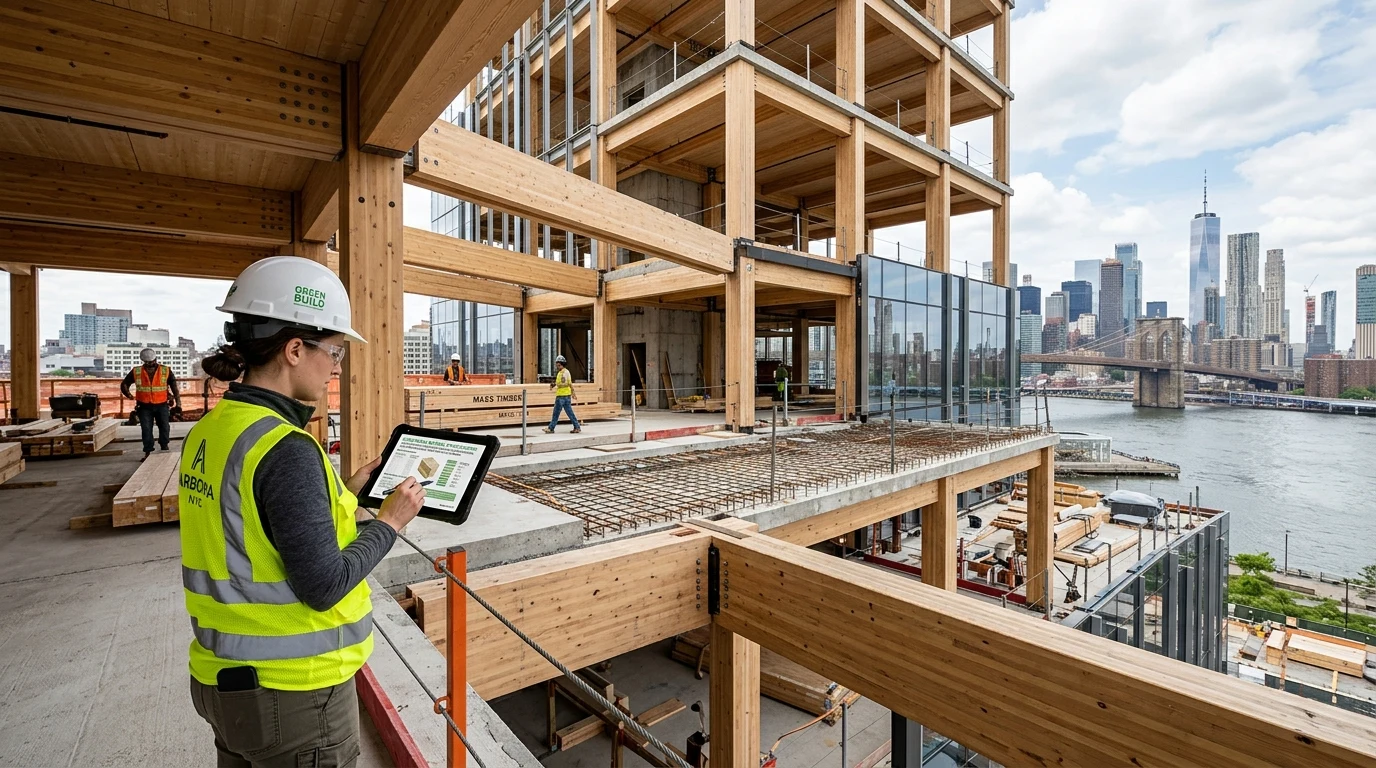
When building owners think about carbon emissions, the first thing that usually comes to mind is energy used to operate the property: heating, cooling, lighting, ventilation, and electricity.
But a building creates emissions before anyone turns on the lights.
Concrete has to be produced. Steel has to be manufactured. Glass has to be processed. Materials have to be transported to the project, installed, maintained, replaced, and eventually removed or disposed of.
These emissions are generally referred to as embodied carbon.
The U.S. Department of Energy defines embodied carbon in buildings as greenhouse-gas emissions associated with the manufacturing, transportation, installation, maintenance, and disposal of building materials and products over the building's life cycle, excluding the operational or use phase.
For property owners, the concept is becoming increasingly important because improving operational energy performance does not eliminate the emissions associated with constructing and renovating the building itself.
Embodied Carbon vs. Operational Carbon
The easiest way to understand embodied carbon is to compare it with operational carbon.
Operational carbon comes from running the building.
Think:
Heating + cooling + lighting + ventilation + plug loads
Embodied carbon comes from the materials and construction activities that make the building possible.
Think:
Raw materials + manufacturing + transportation + construction + maintenance + replacement + end of life
Together, these form the building's broader life-cycle carbon footprint. The U.S. Department of Energy describes life-cycle carbon as including both operational and embodied emissions across the building's life.
This distinction matters because a project can reduce operational energy while simultaneously adding new embodied emissions through a major renovation.
Where Does Embodied Carbon Come From?
Embodied emissions can occur at several points in a material's life.
A simplified lifecycle looks like:
Raw material extraction → manufacturing → transportation → construction → use and maintenance → replacement → demolition → reuse/recycling/disposal
The emissions are not necessarily concentrated in one stage.
For some products, manufacturing dominates. For others, transportation, replacement, or end-of-life activities may make a more meaningful contribution.
That is why embodied carbon should be considered as a life-cycle issue, rather than simply asking whether a material is “green.”
Why Concrete, Steel, and Glass Matter
Construction materials such as concrete, steel, and glass are important parts of embodied-carbon discussions because manufacturing them can require substantial energy and industrial processing.
DOE identifies materials including concrete, steel, lumber, and glass among major sources of embodied carbon in building materials.
But there is an important nuance:
There is no universal “lowest-carbon material” for every application.
A material's impact depends on its quantity, manufacturing process, recycled content, transportation, durability, product performance, and the specific alternative being considered.
The smarter comparison is therefore:
“Which product performs the required function with the lowest appropriate life-cycle impact?”
What Is Upfront Carbon?
You will often hear the term upfront carbon when discussing construction materials.
In many U.S. construction-material datasets, upfront embodied carbon is reported for production stages A1–A3:
- A1 — raw material supply
- A2 — transportation to manufacturing
- A3 — manufacturing
EPA notes that most U.S. construction-material EPDs have historically used a cradle-to-gate scope covering A1–A3.
Other assessments can go further and include transportation to the site, installation, maintenance, replacement, and end-of-life stages.
That difference in system boundary is critical.
Two products should not be compared using numbers that represent completely different life-cycle scopes.
Environmental Product Declarations: The Building Material “Data Sheet”
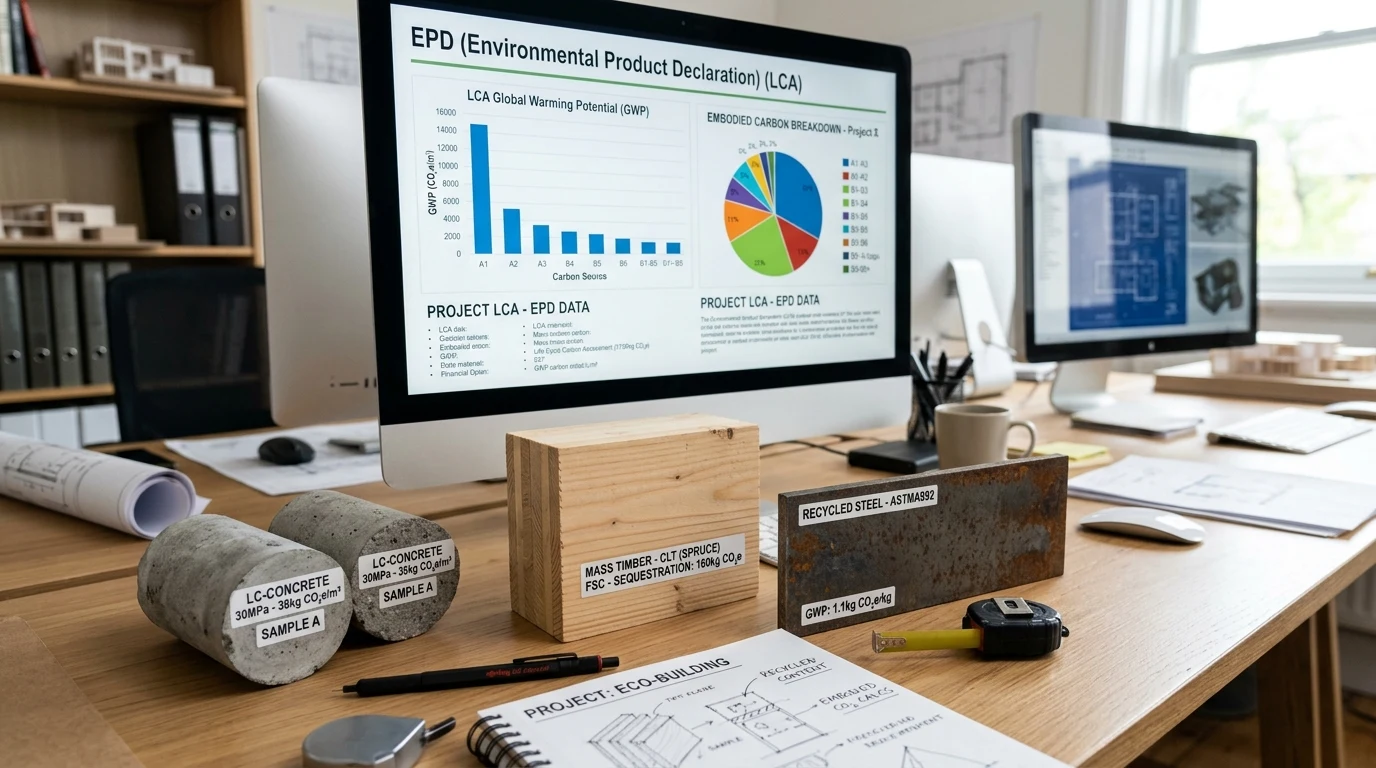
One of the most useful tools for evaluating embodied carbon is an Environmental Product Declaration (EPD).
An EPD provides standardized environmental information about a product based on life-cycle assessment and applicable product-category rules.
Instead of a manufacturer simply saying:
“Our concrete is sustainable.”
an EPD can provide quantitative environmental information that allows project teams to evaluate products more consistently.
EPA describes EPDs as a key mechanism for providing transparent, verifiable environmental information about construction products and notes that they are developed using life-cycle assessment and product-category rules.
For a material-selection decision, the process can look like:
Specify material → collect EPDs → compare comparable products → evaluate quantities → select appropriate option
Why Quantity Matters as Much as Material Intensity
A low-carbon material is not automatically the lowest-carbon project.
Consider two structural options.
A
Option A
Lower-carbon material but a very large quantity
B
Option B
Slightly higher-carbon material but substantially less material
The total embodied carbon could favor either option.
A simplified calculation is:
Total Embodied Carbon = Embodied Carbon Intensity × Material Quantity
Suppose a product has an embodied-carbon intensity of:
300 kgCO₂e per cubic meter
and the project uses:
200 m³
Then:
300 × 200 = 60,000 kgCO₂e
or approximately:
60 metric tons CO₂e
This is why structural optimization and material efficiency can be as important as selecting a different product.
USGBC similarly highlights whole-building life-cycle assessment as a way to investigate structural optimization and material choices rather than evaluating products in isolation.
Reuse Can Be More Important Than Replacement
One of the most powerful embodied-carbon strategies is sometimes the simplest:
“Don't replace something that can be retained.”
A major renovation can introduce new emissions through demolition, manufacturing, transportation, and installation of replacement materials.
By retaining an existing structure or reusing existing components where appropriate, a project can avoid some of those new material-related emissions.
DOE's national buildings strategy specifically identifies repurposing existing buildings, reducing material quantities, salvaging or reusing materials, and designing for deconstruction as important strategies for reducing embodied emissions.
This is one reason adaptive reuse and renovation can sometimes have a meaningful embodied-carbon advantage over demolishing an existing building and constructing a new one—but the result still needs to be evaluated project by project.
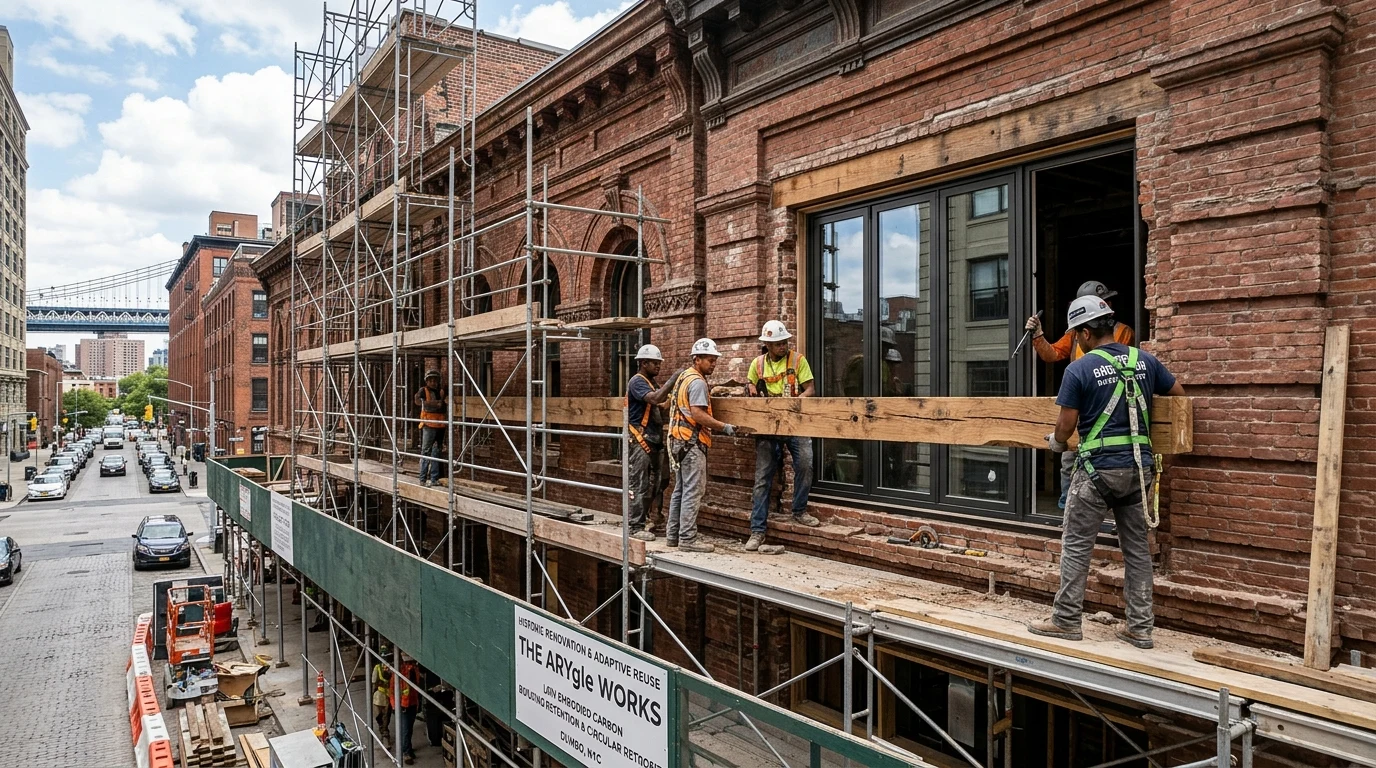
Renovation Can Have an Embodied-Carbon Tradeoff
Energy retrofits are generally associated with reducing operational energy use.
But consider a window replacement project.
New windows may provide:
Lower heating and cooling loads
while also creating:
New manufacturing + transportation + installation emissions
The project therefore has two sides:
- Operational carbon ↓
- Embodied carbon ↑
That does not mean the retrofit is a bad idea.
It means the full decision should consider both sides of the carbon equation.
A whole-building life-cycle assessment can help evaluate this tradeoff rather than looking only at annual energy savings.
Whole-Building Life-Cycle Assessment
A whole-building life-cycle assessment (LCA) evaluates the environmental impacts associated with the building's materials and systems over a defined life cycle.
GSA explains that whole-building LCA can be used to compare structural systems, material selections, refurbishment versus demolition and reconstruction, and other design alternatives.
A simplified project workflow might be:
Concept design → material quantities → LCA → compare alternatives → revise design → LCA again
This is particularly valuable early in design because material quantities and structural decisions become harder to change as a project progresses.
A Simple Example: Concrete Selection
Imagine a project requiring:
500 cubic yards of concrete
Supplier A provides an EPD showing:
250 kgCO₂e/yd³
Supplier B provides an EPD showing:
190 kgCO₂e/yd³
Ignoring other differences for the moment:
| Supplier | EPD Carbon Intensity | Total Volume | Total Embodied Carbon |
|---|---|---|---|
| Supplier A (Standard Mix) | 250 kgCO₂e/yd³ | 500 yd³ | 125,000 kgCO₂e |
| Supplier B (Low-Carbon Mix) | 190 kgCO₂e/yd³ | 500 yd³ | 95,000 kgCO₂e |
The difference is:
30,000 kgCO₂e (approximately 30 metric tons CO₂e)
This illustrates how EPD data can transform a sustainability discussion into a measurable procurement decision.
However, the comparison is meaningful only when the concrete products are functionally comparable and the EPD boundaries and assumptions are appropriately aligned.
Embodied Carbon and Building Design
Material choices are only one part of the equation.
Building design itself determines how much material is required.
A larger structural span, additional floor area, thicker structural elements, or unnecessary material quantities can increase embodied emissions even if the selected products have relatively favorable carbon intensities.
This is why material efficiency matters.
Instead of asking:
“Which low-carbon product should we buy?”
a design team should also ask:
“Do we need this much material in the first place?”
That question can sometimes produce a larger reduction than simply switching suppliers.
Embodied Carbon in NYC Projects
NYC is increasingly incorporating embodied-carbon considerations into its energy and building-performance framework.
The 2025 NYC Energy Conservation Code, adopted through Local Law 47 of 2026, includes an Embodied Energy/Carbon Tracking option among additional-efficiency credits for certain residential projects. The applicable provision requires specified documentation, including EPD information and material quantities, when that credit is pursued.
This does not mean NYC currently imposes one universal embodied-carbon limit on every building project.
Rather, it shows that embodied carbon is becoming part of the technical information considered within certain energy-code pathways.
For a specific project, the applicable code edition, project type, and compliance path should always be confirmed before assuming a particular embodied-carbon requirement applies.
Embodied Carbon vs. LL97
It is also important not to mix up embodied carbon with Local Law 97.
LL97 establishes greenhouse-gas-emissions requirements for covered buildings using NYC's regulatory methodology. Embodied-carbon accounting, by contrast, generally looks at emissions associated with materials and their life-cycle stages.
These are related sustainability concepts but are not interchangeable calculations.
A building can therefore have a strong LL97 compliance strategy while still having significant embodied-carbon impacts from a major construction project.
Likewise, reducing embodied carbon does not automatically resolve operational emissions requirements.
How Building Owners Can Reduce Embodied Carbon
The most effective strategies often happen before materials are ordered.
Start by asking whether existing structures and materials can be retained. Then reduce unnecessary quantities, optimize structural and architectural design, compare product-specific EPDs, consider recycled or salvaged materials where appropriate, and evaluate durability so that replacements are not required prematurely.
The basic hierarchy is:
Reuse what already exists → reduce material quantities → choose lower-carbon products → design for longer life and future reuse
DOE identifies these types of reuse, material-efficiency, low-carbon-material, and design-for-reuse strategies as important pathways for reducing embodied building emissions.
What Makes a Good Embodied-Carbon Comparison?
A useful comparison should be functionally equivalent.
For example, don't compare two materials solely because one has a lower number in an EPD.
Ask:
- Do they serve the same function?
- Do they have equivalent performance?
- Do they have comparable service lives?
- Are the EPD boundaries comparable?
- Are the quantities different?
- Will one option require more maintenance or replacement?
This prevents a common mistake: choosing a product because its carbon-intensity number looks lower without evaluating what the project actually needs.
Common Mistakes
1
Looking Only at Operational Energy
A highly efficient building can still have substantial embodied emissions from construction and materials.
2
Choosing a Material Based on a Marketing Claim
Look for credible, comparable environmental data rather than relying on labels such as “green” or “eco-friendly.”
3
Comparing EPDs With Different Boundaries
A cradle-to-gate A1–A3 result should not be compared casually with a whole-life result covering many additional stages.
4
Ignoring Material Quantity
A lower-carbon product can still create more total emissions if the project uses substantially more of it.
5
Demolishing Before Evaluating Reuse
Retaining an existing structure can sometimes avoid large quantities of new material and associated emissions.
6
Treating Every Bio-Based Material as Automatically Lower Carbon
Material performance, sourcing, durability, manufacturing, transport, and end-of-life assumptions all matter.
A Practical Embodied-Carbon Workflow
For a new construction or major renovation project, a sensible process is:
1
Establish the project scope
Determine which materials and life-cycle stages will be evaluated.
2
Quantify materials
Obtain reliable quantities from design documents, BIM models, specifications, or takeoffs.
3
Collect EPDs
Use product-specific or appropriate industry EPDs with comparable boundaries.
4
Run the comparison
Calculate embodied carbon using quantity and the relevant carbon-intensity data.
5
Test alternatives
Evaluate material efficiency, structural optimization, reuse, and lower-carbon products.
6
Reassess the whole building
Confirm that a reduction in one component has not created a larger impact elsewhere.
This is essentially what turns embodied carbon from a concept into a design and procurement tool.
Conclusion
Embodied carbon in building materials represents the greenhouse-gas emissions associated with making, moving, installing, maintaining, replacing, and ultimately managing materials over their life cycle, depending on the accounting boundary being used.
For building owners, the most important lesson is that carbon performance begins long before a building starts consuming electricity.
The strongest strategy is not simply to search for a “green material.” It is to consider the whole decision:
- Can we reuse what already exists?
- Can we reduce the amount of material required?
- Can we select a functionally equivalent product with lower embodied carbon?
- Will the material last?
- What happens at the end of its useful life?
EPDs and whole-building LCA can make these questions measurable, allowing designers and owners to compare alternatives using actual data rather than marketing claims.
As buildings become more energy efficient, understanding embodied carbon becomes an increasingly important part of evaluating the total carbon impact of construction and renovation.
Frequently Asked Questions
Embodied carbon refers to greenhouse-gas emissions associated with building materials and products across relevant life-cycle stages, including activities such as raw-material extraction, manufacturing, transportation, installation, maintenance, replacement, and end of life. The exact boundary depends on the accounting methodology.
Concrete, steel, glass, and other manufactured construction products can have significant embodied-carbon impacts because their production can involve energy-intensive industrial processes. The actual impact depends on the specific product, quantity, manufacturing process, and life-cycle boundary.
An Environmental Product Declaration is a standardized document that communicates environmental information about a product based on life-cycle assessment and applicable product-category rules. EPDs can help project teams compare functionally similar construction products.
No. Embodied carbon is associated with materials and their life-cycle stages, while operational carbon is associated with operating the building, such as energy used for heating, cooling, lighting, and other building functions.
It can. Reusing an existing structure may avoid some emissions associated with manufacturing and installing new materials. DOE identifies repurposing existing buildings and reusing materials as important embodied-emissions reduction strategies.
A simplified material-level calculation is: Embodied Carbon = Material Quantity × Embodied Carbon Intensity. A whole-building LCA can expand this approach to multiple materials and life-cycle stages.
NYC's current 2025 Energy Conservation Code includes an Embodied Energy/Carbon Tracking option among additional-efficiency credits for certain residential projects. This is not the same as a universal embodied-carbon cap applying to every NYC building project.
Start with the largest decisions: retain usable existing structures and materials where practical, reduce unnecessary material quantities, optimize designs, compare credible EPD data, select lower-carbon products where appropriate, and consider durability and future reuse.