Learn how green real estate addresses environmental challenges through sustainable building practices.
BY NYC Energy Code Team
ON
27 August 2026
WELL Certification vs LEED: What's the Difference?
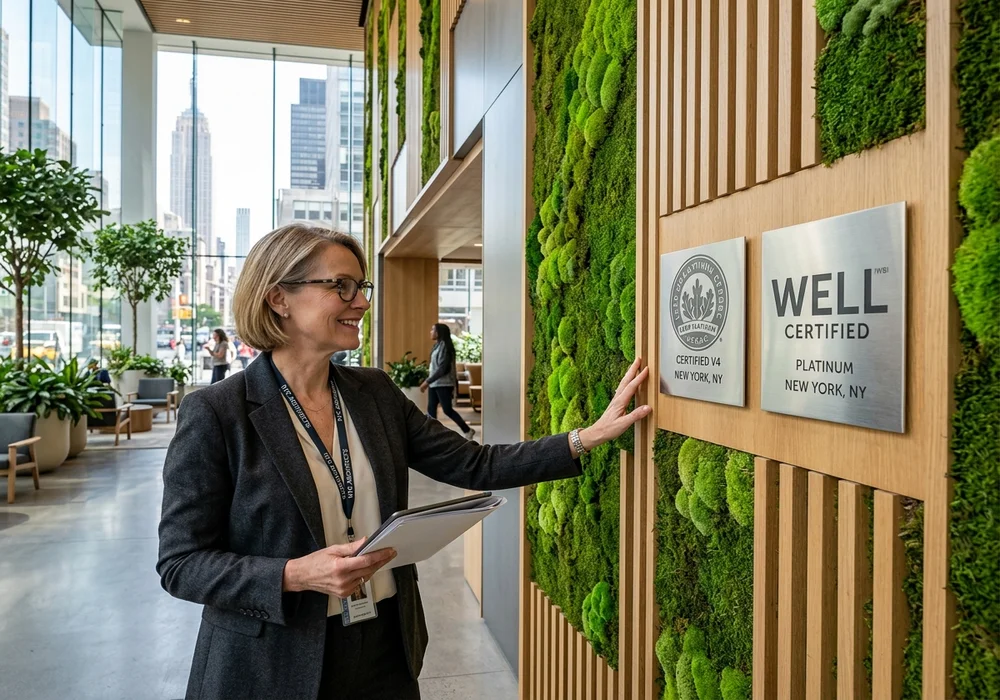
When building owners, architects, and corporate tenants begin researching sustainable real estate certifications, LEED and WELL are almost always the first two frameworks that arise.
They are often treated as direct competitors in market discussions, but that view misses the core architectural distinction:
- LEED: Focuses primarily on the planet and physical asset—measuring whole-building energy efficiency, embodied carbon, water conservation, and sustainable construction materials.
- WELL: Focuses primarily on the human occupant—measuring how indoor environmental quality, lighting biology, acoustics, air filtration, and wellness policies impact human physical and cognitive health.
The Complementary Relationship
There is significant synergy between both programs. High-performance air filtration, non-toxic materials, and circadian daylighting benefit both building energy systems and human biology. Today, the U.S. Green Building Council (USGBC) and the International WELL Building Institute (IWBI) provide a streamlined dual-certification pathway with an official credit crosswalk.
What Is LEED?
Created by the U.S. Green Building Council (USGBC), LEED (Leadership in Energy and Environmental Design) is the world's most widely recognized green building rating system.
LEED assesses the environmental performance of a building across its entire lifecycle—from design and construction through ongoing operations. Projects earn points across credit categories including Sustainable Sites, Water Efficiency, Energy & Atmosphere, Materials & Resources, and Indoor Environmental Quality.
Based on the verified score, projects achieve four distinct certification tiers:
- LEED Certified: 40–49 points earned
- LEED Silver: 50–59 points earned
- LEED Gold: 60–79 points earned
- LEED Platinum: 80+ points earned
What Is WELL Certification?
Administered by the International WELL Building Institute (IWBI), the WELL Building Standard is a performance-based system dedicated exclusively to human health and wellness in the built environment.
Grounded in medical and scientific research, WELL v2 evaluates buildings across 10 Core Concepts: Air, Water, Nourishment, Light, Movement, Thermal Comfort, Sound, Materials, Mind, and Community.

Unlike design-only standards, WELL requires mandatory on-site Performance Verification conducted by an independent testing agent who physically measures air particulates, VOC concentrations, acoustic reverberation, water purity, and lux levels before awarding certification:
- WELL Bronze: 40 points (Single-asset / interiors)
- WELL Silver: 50 points (All prerequisites met)
- WELL Gold: 60 points
- WELL Platinum: 80 points
WELL vs LEED: Side-by-Side Comparison
| Feature | WELL Building Standard (IWBI) | LEED Certification (USGBC) |
|---|---|---|
| Primary Focus | Occupant biological health, comfort, & wellness | Environmental sustainability & resource efficiency |
| Core Question | "How well does this building support the people inside?" | "How efficiently and sustainably does this building operate?" |
| Energy & Carbon | Addressed via thermal comfort & daylighting | Major primary driver (Energy & Atmosphere category) |
| Indoor Air Quality | Critical priority with strict on-site testing | Evaluated as part of Indoor Environmental Quality (IEQ) |
| Materials Focus | Toxicity, VOCs, endocrine disruptors, occupant safety | Embodied carbon, recycled content, local sourcing |
| Verification Method | Mandatory on-site environmental laboratory testing | Engineering design submittals, commissioning, & documentation |
| Tiers | Bronze, Silver, Gold, Platinum | Certified, Silver, Gold, Platinum |
| Dual Pathway | Streamlined Crosswalk Available | Streamlined Crosswalk Available |
The Core Distinction: People vs. Planet
The clearest illustration of how WELL and LEED differ is in how they approach identical building systems:
Lighting Design
LEED: Evaluates lighting power density (watts/sq ft), automated vacancy sensors, and exterior light pollution to reduce kilowatt-hour usage.
WELL: Evaluates Equivalent Melanopic Lux (EML), glare control, and circadian rhythm alignment to support occupant sleep cycles and mental alertness.
HVAC & Ventilation
LEED: Focuses on economizer cycles, heat recovery ventilators (HRVs), and VAV static pressure resets to minimize energy consumption.
WELL: Focuses on MERV 13+ or HEPA filtration, dedicated outdoor air systems (DOAS), continuous PM2.5/TVOC monitoring, and mold prevention.

Can You Pursue Both? The LEED + WELL Streamlined Process
Yes. In fact, leading NYC developers increasingly pursue dual certification to capture institutional capital while winning premium commercial leases.
Recognizing that project teams were spending unnecessary hours compiling redundant submittals, USGBC and IWBI developed a formal LEED + WELL Crosswalk. This allows teams to submit shared documentation once—for instance, acoustic baseline reports or low-emitting paint certifications—and receive credit across both platforms simultaneously.
Voluntary Certification vs. NYC Mandatory Compliance
Building owners in New York City must never confuse voluntary green building credentials with municipal legal mandates:
NYC Regulatory Reality Check
Holding a LEED Platinum plaque or WELL Gold seal does not exempt a building from NYC Local Laws. Owners must still file annual LL84 benchmarking, complete 10-year LL87 energy audits and retro-commissioning, and comply with strict greenhouse gas emissions caps under Local Law 97.
Which Certification Fits Your Property?
Choose LEED when: Your primary goals are energy reduction, operational utility savings, capital market ESG benchmarking (e.g., GRESB), or major base-building core & shell renovations.
Choose WELL when: You are marketing high-end commercial office space, improving employee productivity and retention, or branding a residential development around healthy living.
Choose Both when: You are developing or repositioning a flagship Class A asset that must satisfy both institutional sustainability funds and Fortune 500 tenant wellness mandates.
Final Takeaway
WELL and LEED are not competitors—they are two sides of the modern sustainable real estate coin.
LEED protects the planet by ensuring your physical asset consumes less energy, generates fewer emissions, and minimizes environmental footprint. WELL protects the people by ensuring the air they breathe, the water they drink, and the light they work under actively support their physical and psychological vitality.
Define your core business and tenant objectives early in the project design phase to select the framework—or dual combination—that delivers the greatest financial and operational return.
Frequently Asked Questions
No. LEED is a broad green-building rating system focused on environmental sustainability, carbon reduction, and resource efficiency, while WELL focuses primarily on human health, well-being, and the occupant experience inside the building.
Neither is universally better. LEED is generally more appropriate when environmental sustainability, energy efficiency, and building performance are the primary goals. WELL is more appropriate when occupant wellness, indoor air quality, and employee health are the main focus.
Yes. Projects can pursue dual certification. The International WELL Building Institute (IWBI) and U.S. Green Building Council (USGBC) offer a streamlined LEED + WELL dual review process with a crosswalk mapping overlapping credits and features.
No. While there is substantial credit synergy identified in the official crosswalk, each program maintains distinct documentation, testing, and threshold requirements. Earning one does not automatically award the other.
Yes. LEED includes an Indoor Environmental Quality (IEQ) credit category covering low-emitting materials, daylighting, and minimum ventilation, but its core focus remains holistic environmental sustainability.
Energy is considered where it directly impacts occupant comfort (such as HVAC thermal controls and circadian lighting), but WELL's primary mandate is human biological and psychological health rather than whole-building energy modeling.
Under the WELL v2 standard, certification levels are Bronze (40 points), Silver (50 points), Gold (60 points), and Platinum (80 points), requiring on-site performance verification.
LEED certification levels are Certified (40–49 points), Silver (50–59 points), Gold (60–79 points), and Platinum (80+ points), based on verified design and construction documentation.
No. Both LEED and WELL are voluntary market certification standards. NYC property owners are separately mandated to comply with statutory laws including LL84 (benchmarking), LL87 (energy audits), and LL97 (carbon emissions limits).
Choose LEED if your goal is whole-building energy performance, lower operating utility costs, and institutional green real estate recognition. Choose WELL if you are competing for top-tier corporate tenants who prioritize employee recruitment, retention, and wellness.