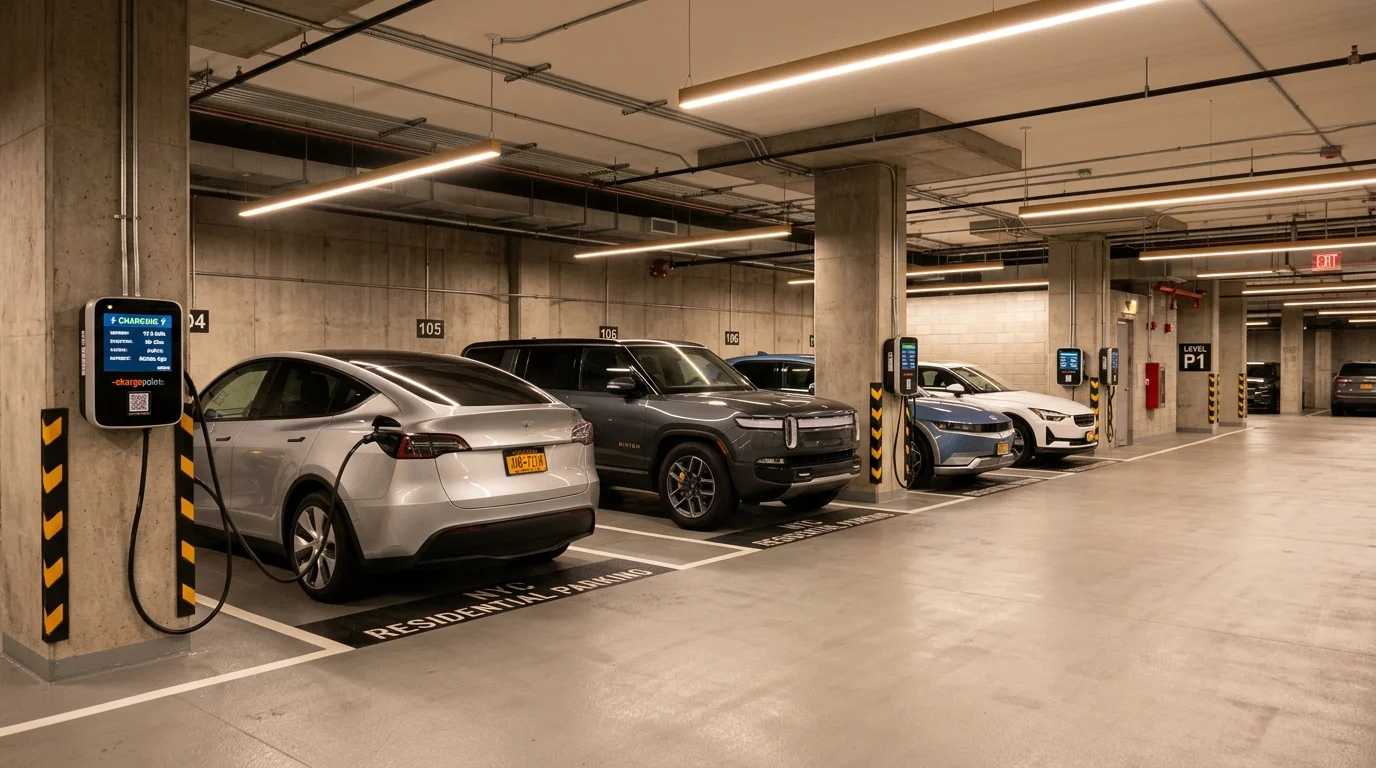
Who Pays When a Tenant Plugs In an EV?
A landlord installs electric vehicle (EV) chargers in a residential garage or commercial parking facility. The equipment works, residents appreciate having charging access, and the property's EV-readiness improves. But one financial question remains: who pays for the electricity that goes into each vehicle?
If the chargers run from the building's main electrical service, the electricity bill may initially arrive in the property owner's name. Unless the arrangement is carefully structured, the landlord could end up absorbing the energy costs, network subscription fees, maintenance expenses, and even demand charges associated with charging.
Alternatively, tenants may be charged for their electricity consumption, pay a fixed monthly fee, or access charging through a third-party network that handles payments.
There is no single billing model that fits every building. The right approach depends on who owns the chargers, how the electrical supply is metered, the terms of the lease, the property's operating costs, and the rules governing the particular arrangement.
For NYC landlords and property managers, the goal is to establish a transparent charging policy before residents begin using the equipment—not after the first unexpectedly high electricity bill arrives.
The Three Main Ways to Pay for Tenant EV Charging
Most tenant charging arrangements fall into three broad categories: the landlord absorbs the cost, tenants pay through an agreed billing arrangement, or a third-party charging provider manages payment collection.
| Billing model | Who pays the initial electricity bill? | How the tenant pays | Best suited for |
|---|---|---|---|
| Included or complimentary charging | Landlord or building operator | No separate charging fee, subject to the lease or amenity policy | Properties offering charging as a resident benefit |
| Tenant-paid charging | Landlord, utility account holder, or charging operator initially, depending on the setup | Metered usage, an agreed fee, or another compliant arrangement | Buildings seeking transparent cost allocation |
| Third-party network billing | Depends on the ownership and utility arrangement | Driver pays through an app, account, or charging network | Properties seeking payment processing and usage management |
These models can overlap. A building may provide free charging to selected residents, charge other users based on an agreed arrangement, and allow guests to use a public-facing charging network.
The important distinction is between who receives the utility bill and who ultimately bears the cost. Those are not necessarily the same party.
Model 1: The Landlord Pays and Charging Is Included
Under this arrangement, the property owner absorbs the cost of charging instead of billing each tenant separately. Electricity expenses may be treated as part of an amenity or the property's general operating budget, subject to the lease and applicable law.
This can work well in a smaller residential building where only a few residents use the chargers. It may also be attractive for a commercial property that offers workplace charging as an employee benefit.
The advantage is simplicity. There is no need to calculate an individual charging fee for every session, and residents understand the benefit immediately.
The trade-off is that usage can grow without the landlord receiving additional revenue. A small number of frequent users could account for a large share of the electricity consumption, while residents without EVs may indirectly bear some of the operating expense if it is recovered through a permissible shared-cost arrangement.
Consider a building where EV charging consumes 1,200 kWh per month. At an illustrative effective electricity cost of $0.28 per kWh, the electricity expense would be:
That is $336 per month for electricity alone. It does not include charger maintenance, networking fees, or any additional demand charges not already reflected in the assumed rate.
The landlord should therefore decide whether complimentary charging is a deliberate amenity investment and budget for it accordingly.
Model 2: Tenants Pay for Their Own Charging
When tenants pay for charging, the property needs a defined method for allocating the cost to each user.
The most direct approach is to measure charging consumption and use an agreed billing formula. However, a charge can include other components, such as equipment operation or maintenance, where permitted and clearly disclosed.
Per-kWh billing
Under a per-kilowatt-hour model, the tenant pays according to the amount of electricity attributed to the charging session.
For example, assume a tenant receives 240 kWh of charging in one month and the agreed energy component is $0.28 per kWh:
The illustrative energy charge is $67.20. If the agreement also includes a disclosed, permissible monthly service fee, the total invoice would include that fee separately.
Per-kWh billing can link payment more closely to use than a flat fee. NYSERDA identifies charging by unit of electricity as one of the options available to charging-station hosts. It also notes that this model does not, by itself, encourage drivers to move a fully charged vehicle out of the space. [Source: NYSERDA — Charging Station Host FAQs].
The metering and billing setup matters. Owners should verify that the charging data and billing method meet applicable requirements and accurately describe the electricity delivered to the vehicle.
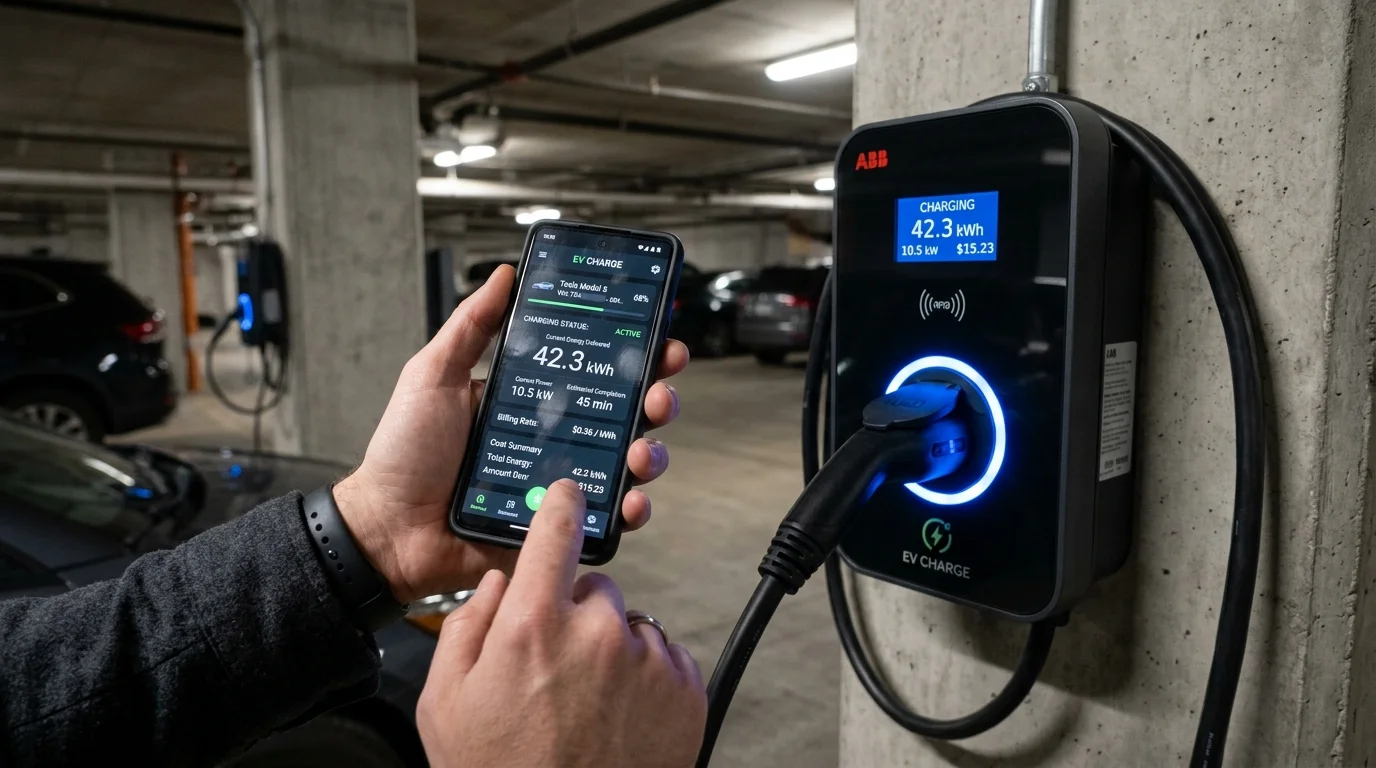 EV charging mobile app interface displaying real-time kWh consumption, session pricing, and billing summary
Fixed monthly fee
A building may instead offer an agreed monthly charging fee.
This can make costs predictable for both parties, especially where residents charge regularly and the building wants simple administration. The challenge is setting a fee that remains reasonable when usage differs significantly between residents.
If one tenant consumes 100 kWh per month and another consumes 500 kWh, the same monthly fee produces very different effective costs per unit of energy. A fixed fee should therefore be based on a realistic usage profile, clearly documented in the agreement, and reviewed if actual utilization changes substantially.
New York State Department of Agriculture and Markets guidance dated March 3, 2026, states that a tenant or employee may be charged a fixed fee under a contract or agreement, provided the arrangement does not charge a unit price per hour and makes clear how many kWh were transferred to the vehicle for each transaction. Owners should check the current guidance and confirm that their proposed arrangement complies with the applicable weights-and-measures requirements. [Source: NYS Department of Agriculture and Markets — EVSE Consumer FAQs].
Per-session or time-based fees
A per-session fee charges a defined amount for each charging session. This can be relatively easy to administer in settings where sessions are short and usage is predictable.
Time-based charges require more caution. Vehicles and chargers deliver electricity at different rates, so a charge based only on elapsed time may produce inconsistent effective energy prices. New York's guidance specifically cautions against charging tenants or employees a unit price per hour in the context described above.
A separate idle or parking fee may serve a different purpose—for example, encouraging a driver to move a vehicle after charging is complete—but it should be structured and disclosed appropriately. The lease, charging terms, and applicable state rules should be reviewed before implementation.
Model 3: A Third-Party Charging Network Handles Billing
Some property owners prefer to let a charging network provider manage the customer-facing side of the operation.
Depending on the contract, a network provider may handle user accounts, payment processing, session records, pricing displays, access control, customer support, and usage reporting. The property may pay the network a subscription fee, a transaction fee, or other agreed charges.
This approach reduces the administrative burden on the property manager, especially when a building has multiple chargers or plans to allow guest charging.
However, outsourcing payment collection does not automatically mean the network provider pays the building's electricity bill. That depends on the ownership and service agreement.
Before signing, determine who purchases the electricity, who sets the user price, how payment-processing fees are deducted, who is responsible for charger repairs, and whether the property receives adequate usage data.
The U.S. Department of Energy's Alternative Fuels Data Center recommends considering electricity, maintenance, networking, pricing, and utilization when planning EV charging operations. [Source: DOE AFDC — EV Charging Operation and Maintenance].
The Hidden Cost: Demand Charges and Network Fees
Electricity consumption is not always the only significant cost of running a charging installation.
Some commercial utility rates include demand charges based on the highest level of power drawn during a particular interval in the billing period. If many vehicles charge simultaneously, EV charging may increase the building's peak demand—even if total monthly kWh consumption appears manageable.
For multifamily properties, the financial impact depends on the utility rate, the existing building load, charging schedules, and the way the charging infrastructure is metered. The U.S. Department of Energy's Building America Solution Center notes that managed smart charging can help reduce peaks or shift charging toward lower-cost periods, depending on the utility arrangement. [Source: DOE — Electric Vehicle Charging for Multifamily Housing].
Network fees and maintenance can also affect the cost per session. A landlord charging tenants only for the raw energy cost may recover too little to cover the entire service, while a high flat fee may make the amenity unattractive.
A practical costing model should distinguish:
- Electricity consumption and applicable utility charges.
- Any incremental demand charges attributable to the charging setup.
- Network or payment-processing fees.
- Charger maintenance, repairs, and warranty costs.
- Any agreed service, parking, or administration fee that is permitted under the arrangement.
The owner should avoid counting the same expense twice or treating the full building utility bill as an EV charging cost without a defensible allocation method.
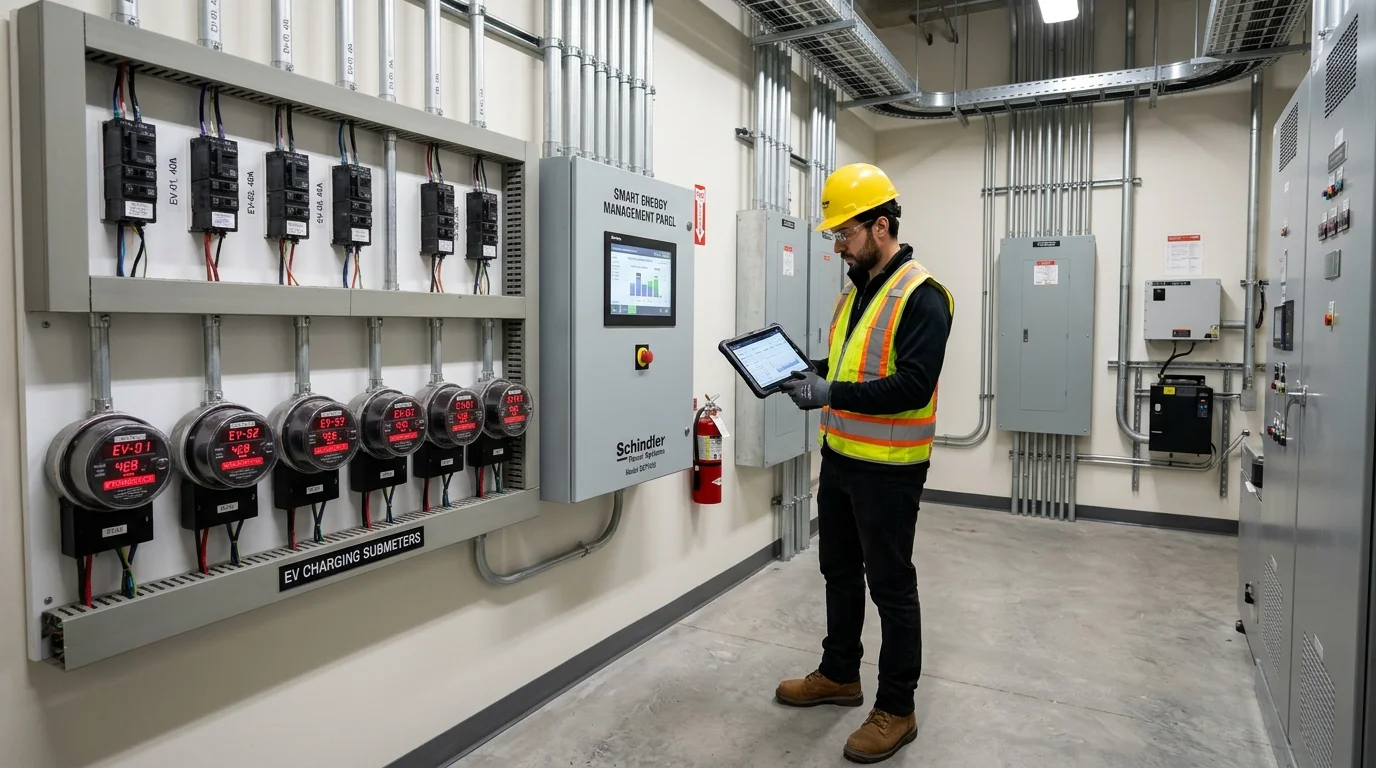 Dedicated electrical submeters and smart energy management panels monitoring tenant EV charging circuits
A Simple Example: Calculating a Fair Tenant Charging Charge
Imagine a multifamily building has eight charging ports connected to a common electrical service. The owner wants to recover the costs of electricity and basic charger operations without making resident billing complicated.
Assume the building records 2,000 kWh of charging during a month and has an effective electricity cost of $0.28 per kWh for the charging load. For illustration, the operator also allocates $120 per month in network and maintenance costs across all eight ports.
| Cost component | Monthly amount |
|---|---|
| Charging electricity: 2,000 kWh × $0.28 | $560 |
| Network and maintenance allocation | $120 |
| Total modeled operating cost | $680 |
If a tenant used 250 kWh during the same month, the energy component at $0.28 per kWh would be $70.
The operator would then apply the billing model agreed with tenants. It could allocate eligible service costs through a disclosed fee or another permitted arrangement, but it should not automatically add one-eighth of the $120 to every resident's bill unless that allocation is appropriate and contractually supported.
The key is to distinguish the measured energy cost from shared operating expenses and assign each component transparently. These figures are illustrative; actual electricity costs, permitted charges, and cost-allocation rules vary by building and contract.
What NYC Landlords Need to Know About Submetering
NYC has a specific electricity submetering requirement for certain covered tenant spaces. Under Administrative Code § 28-311.3, effective January 1, 2025, covered tenant spaces generally must have their electrical consumption measured by one or more submeters, subject to an exception for spaces where consumption is measured by a dedicated utility meter.
The law includes covered-building criteria and rules for shared submeters on floors with multiple tenancies. Section 28-311.4 also addresses monthly statements showing measured electricity consumption and any amount charged to the tenant. [Sources: NYC Administrative Code § 28-311.3] and [§ 28-311.4].
There is an important distinction here: the tenant-space submetering rules do not, by themselves, prescribe one universal pricing formula for EV charging. Their applicability depends on the covered property and tenant space, while EV-specific billing must also be assessed under the relevant charging, metering, contract, and utility rules.
For a building considering tenant-paid charging, the owner should confirm whether the charging equipment has suitable metering, whether the existing electrical configuration supports accurate allocation, and whether the proposed fee arrangement is permissible, particularly when designing green lease cost-sharing provisions.
A dedicated EV charger meter may make cost tracking easier, but metering, payment authorization, and the right to charge tenants are separate questions. The owner should not assume that installing a meter alone makes every billing method compliant.
How to Set Up a Clear Tenant EV Charging Policy
A successful billing arrangement starts with a written policy before the first charging session.
First, establish who owns and operates the charging equipment and who is responsible for the utility account. Then select a billing model that fits the property—complimentary charging, an agreed fixed fee, a permitted per-kWh arrangement, or third-party network billing.
Next, document the cost components and explain how usage is measured. Tenants should be able to understand what they pay, what is included, whether service or parking fees apply, and how disputes about a session or invoice will be handled.
The policy should also deal with day-to-day access. Where chargers are shared, rules for reservations, charging priority, vehicle relocation, idle fees where allowed, and reporting equipment faults can reduce friction between residents.
Finally, confirm the lease provisions and applicable requirements before the arrangement goes live. Charging policies should be consistent with the lease, any parking agreement, the equipment contract, and relevant state and city rules.
Common Billing Mistakes to Avoid
The most common problem is installing chargers first and working out the financial model later. That can leave the owner absorbing unexpected costs or lead to disagreements about charges that tenants did not clearly understand.
Another mistake is confusing total building electricity use with EV charging consumption. If the chargers share the building's main meter, the owner needs a defensible method to identify the charging load before allocating costs.
A third mistake is overlooking demand charges, payment fees, and maintenance. Pricing only the energy consumed may fail to recover the full cost of operating the service.
Finally, do not assume that a fixed monthly fee or a time-based charging rate is automatically appropriate for every tenant arrangement. New York's specific rules on EV charging transactions and measurement should be checked before choosing the fee structure, especially given broader carbon penalty thresholds under NYC Local Law 97.
Conclusion
Tenant EV charging can be offered as a complimentary amenity, billed through an agreed tenant payment model, or managed by a third-party charging network. Each approach has different implications for electricity costs, administration, transparency, and cost recovery.
For NYC property owners, the most important step is to decide how the utility cost will be attributed before charging begins. Separate the energy expense from network, maintenance, and demand-related costs, establish clear terms, and verify the applicable metering and billing requirements.
A well-designed billing model makes it easier to manage operating expenses while giving tenants a clear understanding of what they are paying for. The best arrangement is one that fits actual usage, can be administered reliably, and is documented before disputes arise.