BY NYC Energy Code Team
ON
12 October 2026
Smart Charging vs Basic Charging: How Load Management Saves Panel Upgrades
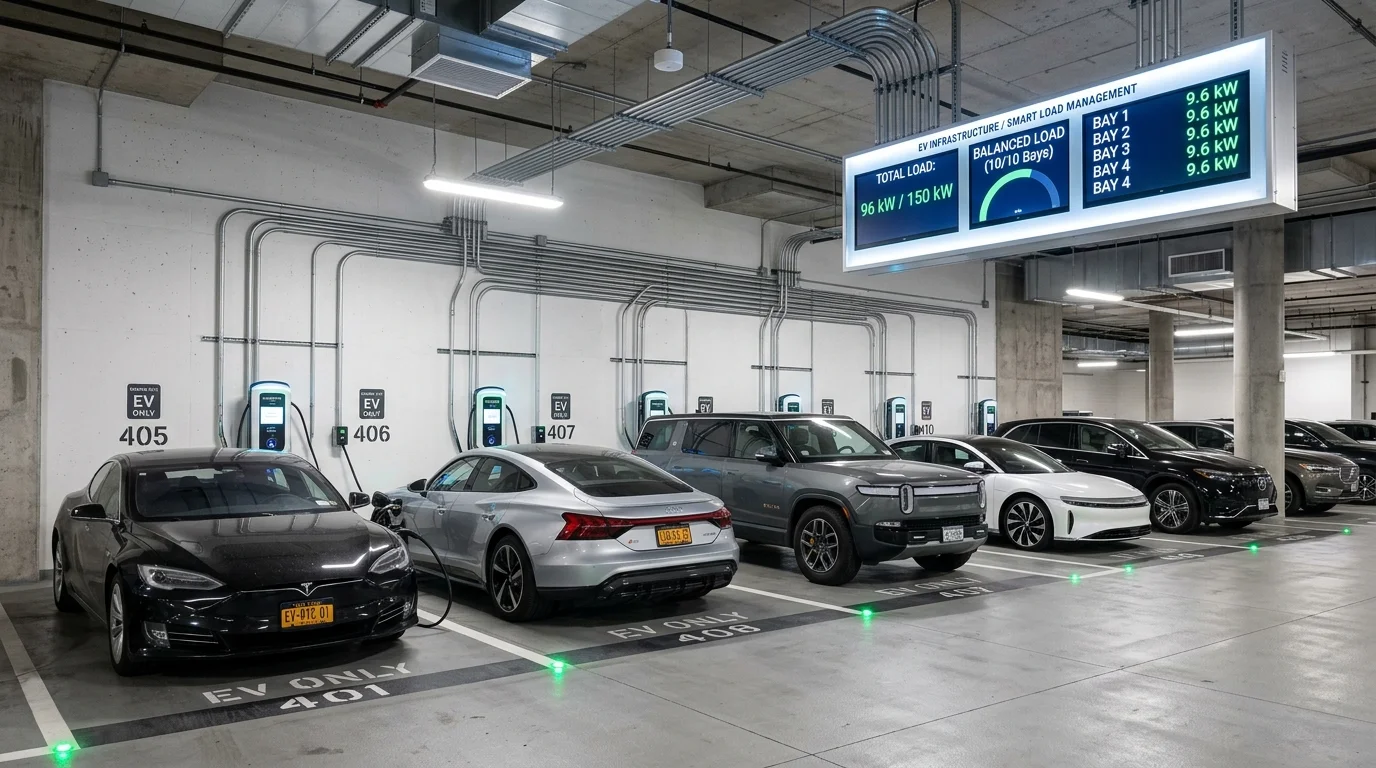
Installing electric vehicle (EV) chargers in a multifamily building can uncover a problem that is easy to overlook: the electrical system may not have enough spare capacity to support every charger running at full power simultaneously.
For an owner planning charging for 10, 20, or even 50 parking spaces, the conventional solution may appear straightforward—upgrade the electrical service, install larger distribution equipment, and provide additional capacity. But that work can be expensive, disruptive, and dependent on utility coordination.
There is another option worth evaluating first: smart charging with electrical load management.
Instead of allowing every connected vehicle to draw power without considering the building's existing demand, a managed system limits the combined charging load and distributes the available capacity among vehicles. Depending on the building's electrical conditions, this can support more charging ports without immediately requiring a larger service or panel.
The key is understanding how basic charging differs from smart charging, what load management actually controls, and when a service upgrade remains necessary.
The Load Management Advantage
Rather than designing electrical capacity for 100% simultaneous peak draw across all chargers, an Automatic Load Management System (ALMS) allows building owners to share an allocated electrical budget across multiple vehicles. This can prevent costly service upgrades and utility delays while maintaining reliable overnight charging for residents.
What Is Basic EV Charging?
For this comparison, basic charging means chargers operate at their configured power level when a vehicle requests energy, without a coordinated system controlling the combined demand of all chargers at the site.
Imagine a residential garage with eight Level 2 chargers. Each charger is configured to deliver up to 7.2 kW. If all eight vehicles charge simultaneously at that rate, their combined demand could reach:
8 × 7.2 kW = 57.6 kW
That is an additional potential load of 57.6 kW before accounting for the building's other electrical equipment.
If the property has limited spare capacity, the electrical design may require upgrades to safely accommodate the new load. The actual requirement depends on the service, distribution equipment, applicable load calculations, and other project conditions.
Basic charging is not inherently inefficient or unsafe when properly designed. It simply does not, by itself, coordinate multiple chargers to stay within a shared site-wide power limit.
What Is Smart Charging and Load Management?
Smart charging coordinates charging power across one or more EV chargers. A system may adjust charging rates, delay sessions, or allocate available power based on vehicle demand and the electrical capacity assigned to charging.
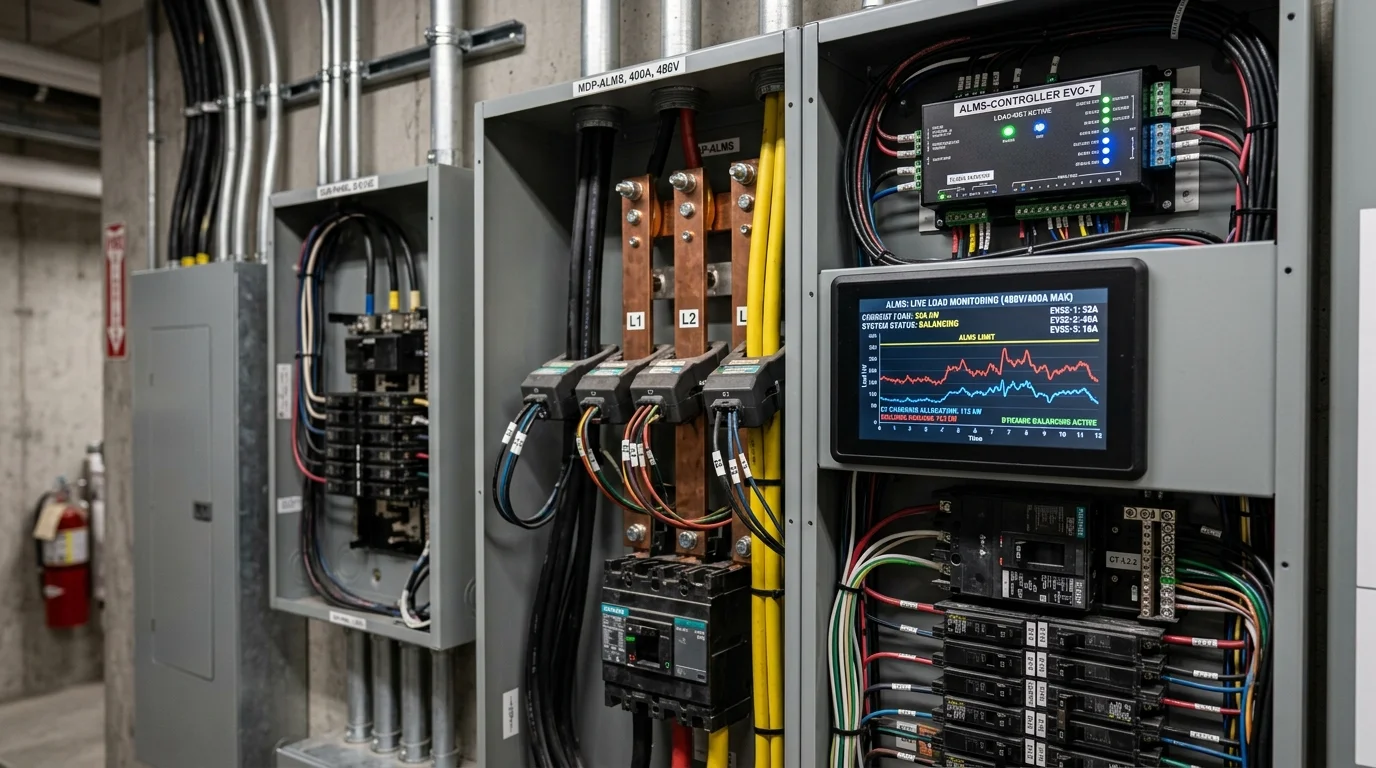
A more advanced approach uses an Automatic Load Management System (ALMS) or equivalent control system to enforce a maximum combined charging load.
For example, the system could monitor an allocated 30 kW charging limit. When only two vehicles are connected, those vehicles may receive relatively high charging power. When eight vehicles connect, the system distributes the same available capacity among them.
Some systems adjust only the charging network's total demand. Others also monitor building loads and dynamically change the EV charging limit as the building's electrical demand rises or falls.
The U.S. Department of Energy identifies managed charging as a way to reduce peak demand and potentially avoid costly electrical infrastructure upgrades by coordinating vehicle charging with available capacity. Source: U.S. Department of Energy — Managed EV Charging.
Smart Charging vs Basic Charging: The Practical Difference
The fundamental differences between basic unmanaged charging and smart load management reflect how electrical infrastructure is shared.
| Feature | Basic Charging (Uncoordinated) | Smart Charging with Load Management |
|---|---|---|
| Charging behavior | Each charger can operate up to its configured limit when a vehicle requests charging | Power is coordinated across chargers within a defined limit |
| Combined demand | Can rise when several vehicles charge simultaneously | Can be capped or adjusted dynamically |
| Electrical capacity | May require more capacity if the simultaneous load exceeds what is available | May use existing spare capacity more effectively |
| Number of supported ports | Limited by the electrical design and permitted charging load | May support more ports sharing a constrained supply |
| Charging speed | Can be higher when capacity is available | May be reduced or staggered when demand is high |
| Best application | Sites with adequate capacity or limited charging demand | Multifamily buildings, shared garages, workplaces, and other sites with multiple chargers |
Smart charging does not necessarily mean every vehicle charges faster. Its advantage is that the system can manage the total demand while delivering useful charging to multiple vehicles over time.
Office or Apartment Garage Example: How Load Management Can Avoid an Upgrade
Consider a hypothetical NYC multifamily property with eight parking spaces earmarked for EV charging.
The electrical engineer determines that, after evaluating the building's load and applicable requirements, the charging system can be allocated up to 30 kW without increasing the existing service capacity. This is an illustrative assumption, not a rule that every building has 30 kW available.
The proposed chargers can each deliver up to 7.2 kW.
Option 1: Basic charging. If all eight chargers can simultaneously draw their full configured power, the total could reach 57.6 kW. If the available electrical capacity is insufficient for that demand, the project may need additional capacity or a different, code-compliant charging design.
Option 2: Smart charging. The charging system is configured to maintain a combined maximum of 30 kW.
| Measure | Basic Charging | Smart Charging |
|---|---|---|
| Number of chargers | 8 | 8 |
| Maximum configured power per charger | 7.2 kW | 7.2 kW |
| Potential combined charging demand | 57.6 kW | 57.6 kW without controls |
| Enforced combined charging limit | Not coordinated in this example | 30 kW |
| Average allocation if all eight charge equally | 7.2 kW each | 3.75 kW each |
With all eight vehicles charging equally under the managed system, each would receive an average of 3.75 kW in this simplified example. In practice, power may be distributed unevenly depending on vehicle requests, system settings, battery needs, and departure times.
The crucial distinction is that the smart system does not allow the combined EV charging demand to exceed its 30 kW allocation.
If the existing electrical system can support that allocation and the design complies with all applicable requirements, the property may be able to install the charging ports without an immediate capacity-driven service upgrade.
That is the potential saving: managing peak demand rather than designing for every charger to operate at full power simultaneously.
The example does not establish that an upgrade is avoidable for any particular property. A professional electrical assessment must determine the permitted capacity and suitable control strategy.
Static Load Sharing vs Dynamic Load Management
Not every smart charging system works the same way. Understanding the difference can help an owner avoid purchasing more functionality—or less—than the property needs.
Static load sharing sets a fixed maximum for a group of chargers. The system distributes that capacity among active vehicles without necessarily responding to the rest of the building's electricity consumption.
Dynamic load management adjusts charging power in response to changing conditions. Depending on the system's design, it can monitor building demand or another defined electrical limit and increase or reduce the EV allocation accordingly.
For example, a building might have substantial electrical demand during evening cooking and heating periods but more spare capacity overnight. A dynamic system that is designed and configured to monitor the relevant loads could reduce charging during busy periods and allow more power when demand falls.
Dynamic controls can make better use of variable capacity, but they depend on suitable monitoring, compatible chargers, reliable communications, correct commissioning, and appropriate failure behavior.
Where the Savings Come From
Load management can save money in several ways, although savings depend on the property's design and charging needs.
1
1. Potentially Avoiding or Deferring Electrical Upgrades
A larger service, transformer, switchboard, or feeder may be unnecessary if the managed charging design can operate within existing capacity and satisfies applicable electrical requirements. Avoiding an upgrade can reduce construction expense and disruption. It may also reduce the time spent coordinating new utility service, depending on the project's circumstances.
2
2. Supporting More Charging Ports
A building does not always need every charger to deliver its maximum power continuously. Residents who park overnight or employees who stay at work for several hours may be able to receive the energy they need with a managed allocation. This can allow a project to serve more parking spaces within a constrained electrical budget. Whether it meets users' needs depends on battery sizes, driving patterns, parking duration, and how often many vehicles require charging at once.
3
3. Managing Peak Electricity Demand
A coordinated system can reduce the chance that EV charging coincides with a building's existing peak. Depending on the utility rate and billing structure, reducing peak demand may also lower certain electricity costs. Demand-charge savings are not guaranteed: not every account is billed in the same way, and shifting charging times may have different financial effects under different tariffs.
The Department of Energy discusses these potential infrastructure and energy-cost benefits in its Smart Charge Management guidance.
When Smart Charging Is Not Enough
Load management is a design strategy, not a substitute for checking electrical safety and capacity.
An upgrade may still be necessary if the existing service, panel, feeders, or distribution equipment cannot safely support the proposed installation under the applicable code and approved design. The building may also need upgraded equipment because of its condition, available circuits, protective devices, or future electrification plans.
Smart charging also has practical limits. If most residents plug in at the same time and need substantial energy before an early-morning departure, a tight power cap could result in inadequate charging. In that case, the project team may need a higher charging allocation, additional electrical capacity, different charging schedules, or a combination of measures.
A property should not select a load limit simply because it avoids construction costs. The limit must be supported by a proper electrical assessment, and the system must be configured to maintain the intended limit reliably.
How NYC Building Owners Should Evaluate a Smart Charging Project
For a New York City property, start with an electrical load analysis rather than a quote for chargers alone. NYSERDA recommends assessing a facility's electrical demand before installing EV charging stations because available service capacity is a major factor in installation cost. Source: NYSERDA — Charging Station Host FAQs.
A practical evaluation should establish the building's existing electrical conditions, the capacity available for EV charging, the number and type of ports proposed, and the time windows in which drivers need to charge.
The team should then compare the cost of an upgrade with the cost of a managed charging system, including controls, communications, commissioning, ongoing software fees where applicable, and maintenance. A lower upfront price is not necessarily the least expensive long-term solution if the system cannot deliver enough energy to users.
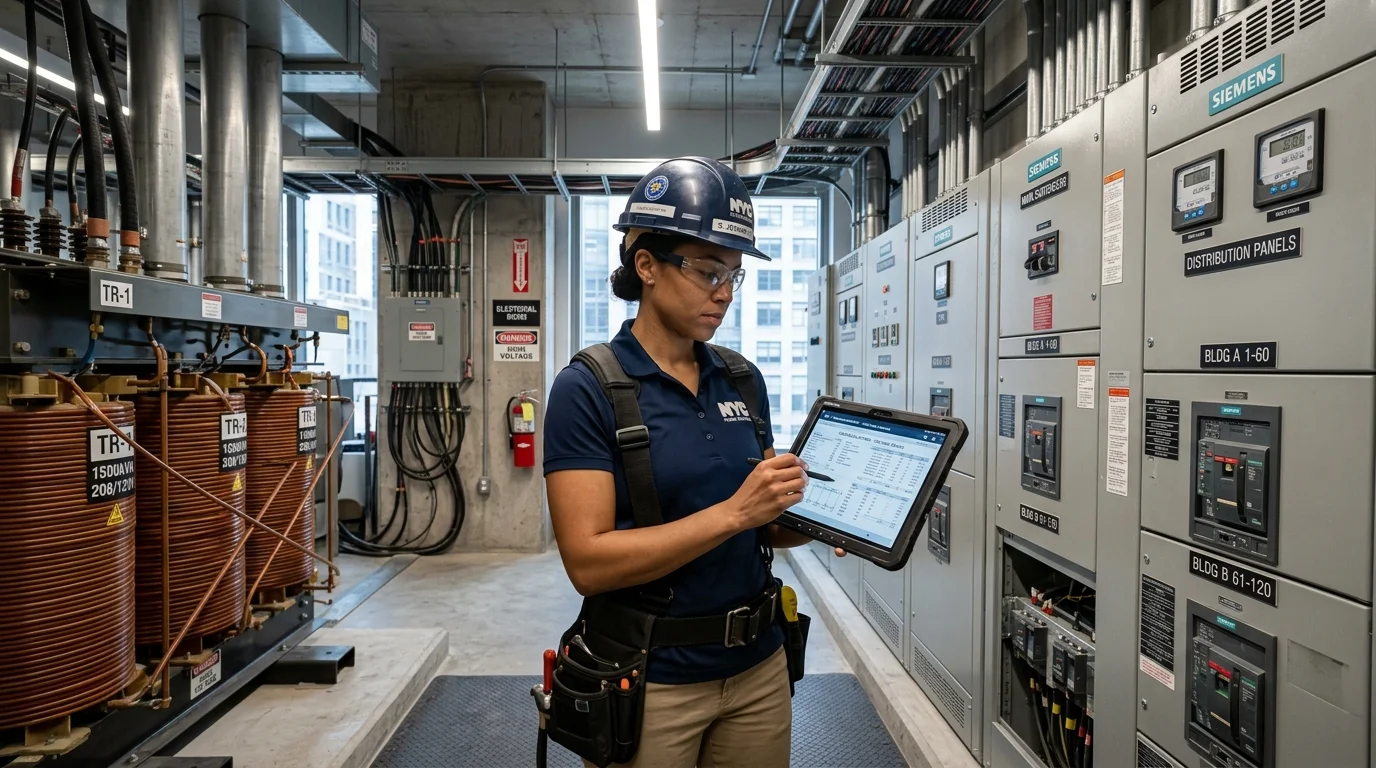
NYC's Building Code includes specific provisions recognizing EV load management for certain open parking lots subject to applicable requirements. These provisions should not be treated as a blanket exemption from electrical design or permitting requirements. NYC DOB states that electrical installation work requires an Electrical Permit, with plan review required for certain projects based on their scope. Consult the applicable code, project requirements, and qualified design professional before proceeding. NYC Building Code § 406.9.8 · NYC DOB Electrical Project Guidance.
Conclusion
Basic EV charging can create a high combined electrical demand when many vehicles charge at once. Smart charging addresses that challenge by coordinating power across chargers and, in some systems, adapting to the building's changing electrical demand.
For multifamily buildings, this can potentially reduce the need for expensive panel or service upgrades while supporting more charging ports. But the result depends on actual spare capacity, the charging schedule, equipment compatibility, and the applicable electrical requirements.
The smartest first step is a professional load analysis followed by a comparison of conventional charging, static load sharing, and dynamic load management. That process helps owners determine whether they can safely use existing capacity, need some infrastructure improvements, or should plan a larger electrical upgrade.
Frequently Asked Questions
Basic charging without coordinated load management allows each charger to operate up to its configured limit when charging is requested. Smart charging coordinates the charging rate or timing across chargers so the combined load stays within a defined limit.
Sometimes. If a suitable, code-compliant load management system allows the proposed chargers to operate within existing available capacity, an upgrade may be avoidable. The outcome must be confirmed through an electrical assessment.
A load management system distributes a defined amount of electrical power among active chargers. Depending on its design, it may allocate power based on the number of connected vehicles, individual charging needs, schedules, or measured building demand.
It can. When many vehicles request power simultaneously, the system may reduce individual charging rates or stagger sessions. Over longer parking periods, vehicles may still receive the energy they need, depending on the available capacity and charging requirements.
An ALMS coordinates EV charging equipment to control the combined charging demand according to a defined limit or control strategy. Whether a particular system is acceptable for a project depends on its equipment, installation, approved design, and applicable requirements.
No universal requirement should be assumed. The applicable requirements depend on the property, work scope, parking type, and relevant code provisions. Some NYC parking-lot provisions specifically recognize EV load management, but that does not mean every installation must use it or that it automatically avoids an upgrade.
Obtain an electrical load analysis, confirm the capacity that can be allocated to charging, estimate how many vehicles need energy and when, and compare upgrade costs with the full cost of load-managed charging. The final design should be reviewed by the appropriate electrical professional and submitted for required approvals.
You may also like