Learn the speed, voltage, electrical capacity, and equipment costs across all EV charging levels.
BY NYC Energy Code Team
ON
06 September 2026
How to Calculate Electrical Load Capacity Before Adding EV Chargers
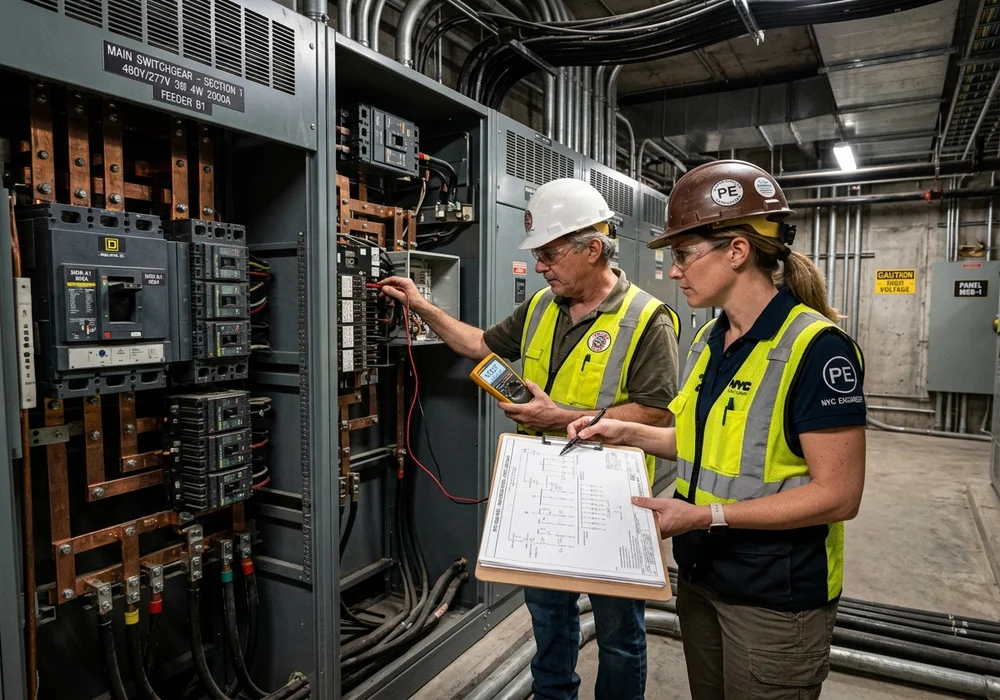
Adding electric vehicle (EV) charging stations to a commercial, multifamily, or mixed-use building is far more complex than mounting hardware on a garage wall and running conduit to the nearest breaker panel. Before purchasing equipment, property owners and facility managers must determine whether the building's electrical distribution infrastructure has sufficient capacity to support the substantial additional load safely and in full compliance with the NYC Electrical Code (NFPA 70 / NEC).
A rigorous engineering load evaluation identifies whether the utility service entrance, main switchgear, step-down transformers, distribution subpanels, and branch feeders can handle new EV demand. It also reveals whether capital-intensive utility service upgrades are necessary—or if smart Automated Load Management Systems (ALMS) can deliver the desired number of charging ports within the existing electrical headroom.
The Core Capacity Equation
$$\text{Existing Peak Demand} + \text{Proposed EV Charging Load} + \text{Future Electrification Reserve} \le \text{Service Capacity}$$
Under NEC Article 625, EV charging is classified as a continuous load. That means equipment must be calculated at 125% of its rated nameplate amperage for wire sizing, panel schedules, and overcurrent protection devices.
The 7-Step Electrical Load Evaluation Process
Step 1: Document the Existing Electrical Service Entrance
Review the utility service size from Con Edison or local utility. Determine the nominal service voltage (e.g., 120/208V 3-phase, 277/480V 3-phase, or 120/240V split-phase), main switchgear bus rating (e.g., 800A, 1200A, 2000A, 4000A), transformer kVA ratings, and available breaker spaces in the main distribution panel (MDP).
Step 2: Determine Actual Peak Building Electrical Demand
Review the past 12 to 24 months of utility 15-minute interval demand data ($\text{kW}$ and $\text{kVA}$). Identify the historic peak coincident demand (typically during summer cooling peaks). Under NEC Article 220.87, maximum measured demand can establish existing baseline load if 12 months of meter history is documented.

Step 3: Calculate the Proposed EV Charging Connected Load
Calculate total power requirement based on charger voltage and amperage:
- Single-Phase (208V / 240V, 32A Output): $7.7\text{ kW}$ per port $\times 1.25\text{ continuous factor} = 40\text{A}$ dedicated circuit breaker.
- 10-Port Level 2 Array ($7.2\text{ kW}$ each): $72\text{ kW}$ connected $\times 1.25 = 90\text{ kW}$ total electrical service demand.
- Three-Phase Current Formula: $I = \frac{P}{\sqrt{3} \times V \times \text{PF}}$ where $V = 208\text{V}$ or $480\text{V}$.
Step 4: Evaluate Simultaneous Charging & Diversity Factors
The key design question is coincident utilization: how many vehicles charge simultaneously at maximum power? While unmanaged systems require $100\%$ capacity for every port, smart networked charging can dynamically throttle charging rates during peak building hours.
| Installation Scale | Number of Level 2 Ports | Raw Connected Load | Continuous Design Load (125%) | Smart ALMS Managed Load |
|---|---|---|---|---|
| Small Scale | 2 × 7.2 kW | 14.4 kW (60A @ 240V) | 18.0 kW (75A @ 240V) | 14.4 kW (Full Output) |
| Medium Scale | 10 × 7.2 kW | 72.0 kW (200A @ 208V 3Φ) | 90.0 kW (250A @ 208V 3Φ) | 36.0–48.0 kW Managed |
| Large Scale | 25 × 7.2 kW | 180.0 kW (500A @ 208V 3Φ) | 225.0 kW (625A @ 208V 3Φ) | 72.0–100.0 kW Managed |
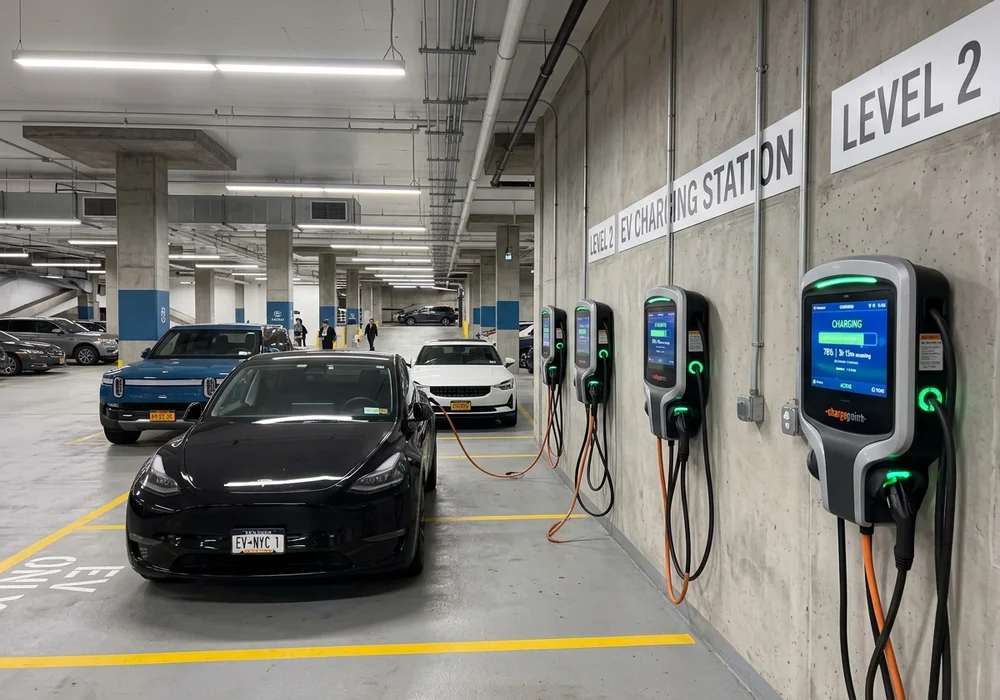
Step 5: Trace the Entire Electrical Path to Uncover Local Bottlenecks
A building may have 400A of spare capacity at the main Con Edison utility service entrance, but the garage subpanel or riser feeder conduit may only be rated for 100A. The load study must verify:
Utility Transformer → Main Service Switchgear → Distribution Feeders → Garage Subpanels → EV Branch Circuits.
Step 6: Integrate Future Electrification & Local Law 97 Roadmap
Never allocate $100\%$ of remaining electrical headroom solely to EV chargers if the property must electrify space heating (air-to-water heat pumps) or domestic hot water (HPWH) to meet upcoming Local Law 97 carbon emissions limits. Coordinated master planning prevents stranded capacity.
Step 7: Deploy Automated Load Management Systems (ALMS)
Under NEC Article 625.42 and 750, smart energy management software can dynamically adjust charging power across all vehicles. When the building's chillers and elevators spike in demand, EV charging slows down; when demand drops at night, charging resumes at full speed. This enables installing 3x to 4x more charging ports without upgrading utility transformers.
Worked Example: Commercial Building Capacity Evaluation
Project Scenario:
- Service Rating: 1,200 Amps at 120/208V 3-Phase ($432\text{ kVA}$ total service capacity).
- Measured 12-Month Peak Demand: $780\text{ Amps}$ ($281\text{ kVA}$).
- Theoretical Raw Headroom: $1,200\text{A} - 780\text{A} = 420\text{ Amps}$ ($151\text{ kVA}$).
- Proposed Charging Project: 12 Dual-Port Level 2 Stations (24 ports total @ $7.2\text{ kW}$ each).
Unmanaged Approach: 24 ports $\times 7.2\text{ kW} \times 1.25 = 216\text{ kW}$ ($600\text{ Amps}$ continuous demand). This exceeds available headroom ($420\text{A}$), triggering a costly $\$150,000+$ Con Edison transformer and switchgear service upgrade.
Smart ALMS Solution: Applying dynamic load sharing caps total EV array demand at $250\text{ Amps}$ ($90\text{ kW}$). All 24 vehicles charge overnight when building base load drops to $300\text{A}$—saving hundreds of thousands in capital infrastructure upgrades.
Common Electrical Load Calculation Mistakes to Avoid
- Equating Nameplate Rating with Available Amperage: Assuming a 2,000A switchgear has 2,000A free without analyzing concurrent mechanical and tenant loads.
- Omitting the 125% Continuous Load Requirement: Failing to apply the $1.25$ multiplier required by NEC 625, resulting in tripped main breakers and DOB inspection rejections.
- Ignoring Intermediate Transformer Bottlenecks: Forgetting that stepping down from 480V to 208V requires adequate local dry-type transformer kVA ratings.
- Overlooking Con Edison Make-Ready Incentives: Neglecting to apply for the Con Edison PowerReady incentive program before finalizing engineering filings.
Electrical Load Capacity Planning Checklist
Utility Service Audit: Record voltage, phase configuration, main disconnect size, and utility meter numbers.
12-Month Interval Demand Analysis: Obtain 15-minute kW interval demand data from Con Edison.
Downstream Feeder & Panel Survey: Verify spare breaker slots and busbar ampacities in parking garage subpanels.
Continuous Load Calculations: Calculate proposed EV kW with the 125% continuous duty multiplier.
Load Management Architecture: Evaluate whether ALMS dynamic power sharing eliminates the need for utility upgrades.
Future Electrification Reservation: Reserve electrical capacity for heat pumps, hot water, and battery storage.
Professional PE Certification: Engage a NYS Licensed Professional Engineer (PE) to stamp electrical filings and DOB permits.
Conclusion
Calculating electrical load capacity before adding EV chargers is the critical foundation of any successful fleet or tenant charging deployment.
By analyzing empirical utility demand data, accounting for continuous load codes, identifying local panel bottlenecks, and leveraging intelligent load-management systems, building owners can deploy robust EV infrastructure safely, cost-effectively, and in harmony with broader building electrification goals.
Work with an experienced electrical and energy engineering team to conduct a comprehensive load study and capture all available utility make-ready incentives for your building.
Frequently Asked Questions
You need to compare the existing calculated electrical demand and available system capacity with the proposed EV charging load and other planned loads. A qualified electrical professional should verify the result.
No. Some buildings have sufficient spare capacity, while others may be able to use managed charging to reduce peak demand. A service upgrade is needed only when the existing system cannot adequately support the planned installation.
They can be, especially when several chargers operate simultaneously. The impact depends on the number of ports, charger power rating, operating schedule, and building infrastructure.
Potentially. Managed charging can limit or shift charging power when building electrical demand is high. Whether it can avoid an upgrade depends on the specific electrical system and project requirements.
Yes. Planned heat pumps, electric water heating, additional HVAC equipment, and other major electrical loads can materially change the building's future capacity requirements.