Learn the differences between Scope 1, 2, and 3 greenhouse gas emissions in commercial real estate and how to report them accurately.
BY NYC Energy Code Team
ON
26 September 2026
Building a Simple ESG Reporting Framework for a Small Portfolio

ESG reporting can sound like something designed for multinational companies with dedicated sustainability departments, consultants, and sophisticated reporting platforms.
A small real estate portfolio does not need that level of complexity to get started.
For an owner with five, ten, or even a few dozen buildings, a useful ESG framework can begin with a simple question:
What do we need to measure consistently across every property, and how will we use the information to make better decisions?
The objective is not to create a massive report filled with metrics nobody uses. It is to build a repeatable system that connects building performance, environmental impact, social considerations, governance, and investment decisions.
What ESG Actually Means for a Property Portfolio
ESG stands for Environmental, Social, and Governance.
For real estate, the categories can be translated into practical building-management questions.
| ESG Area | Real Estate Example |
|---|---|
| Environmental | Energy, greenhouse-gas emissions, water, waste |
| Social | Occupant comfort, health, safety, accessibility |
| Governance | Compliance, policies, data quality, accountability |
The important shift is from thinking of ESG as a separate reporting exercise to treating it as an extension of property management and asset management.
For example, energy consumption is not only an environmental metric. It is also an operating expense, a building-performance indicator, and potentially a capital-planning issue.
Start With a Portfolio Baseline
Before creating targets, establish a reliable baseline.
For each property, collect the information that can reasonably be obtained consistently. Energy and water data are usually a good starting point because they are relatively measurable and can be tracked over time.
ENERGY STAR Portfolio Manager can be particularly useful for this purpose. EPA describes it as a tool for tracking energy, water, waste, and greenhouse-gas emissions across portfolios, while also allowing owners to compare performance across buildings and against previous periods.
A basic portfolio dataset could therefore include:
Property → floor area → energy use → energy cost → emissions → water → major ESG projects
The goal at this stage is consistency, not perfection.
Choose a Small Set of Core KPIs
A small portfolio does not need hundreds of metrics.
Start with indicators that actually influence property decisions.
For environmental performance, useful measures can include energy use intensity (EUI), total energy consumption, greenhouse-gas emissions, water consumption, and waste where reliable data is available.
For social performance, the portfolio might track safety incidents, accessibility improvements, indoor-environment initiatives, or tenant engagement.
Governance metrics can cover compliance status, inspection tracking, reporting responsibility, and documentation quality.
Portfolio Manager itself provides more than 100 metrics covering areas such as energy, cost, emissions, water, and waste, allowing owners to choose a manageable subset rather than trying to report everything.
Build One Portfolio Dashboard
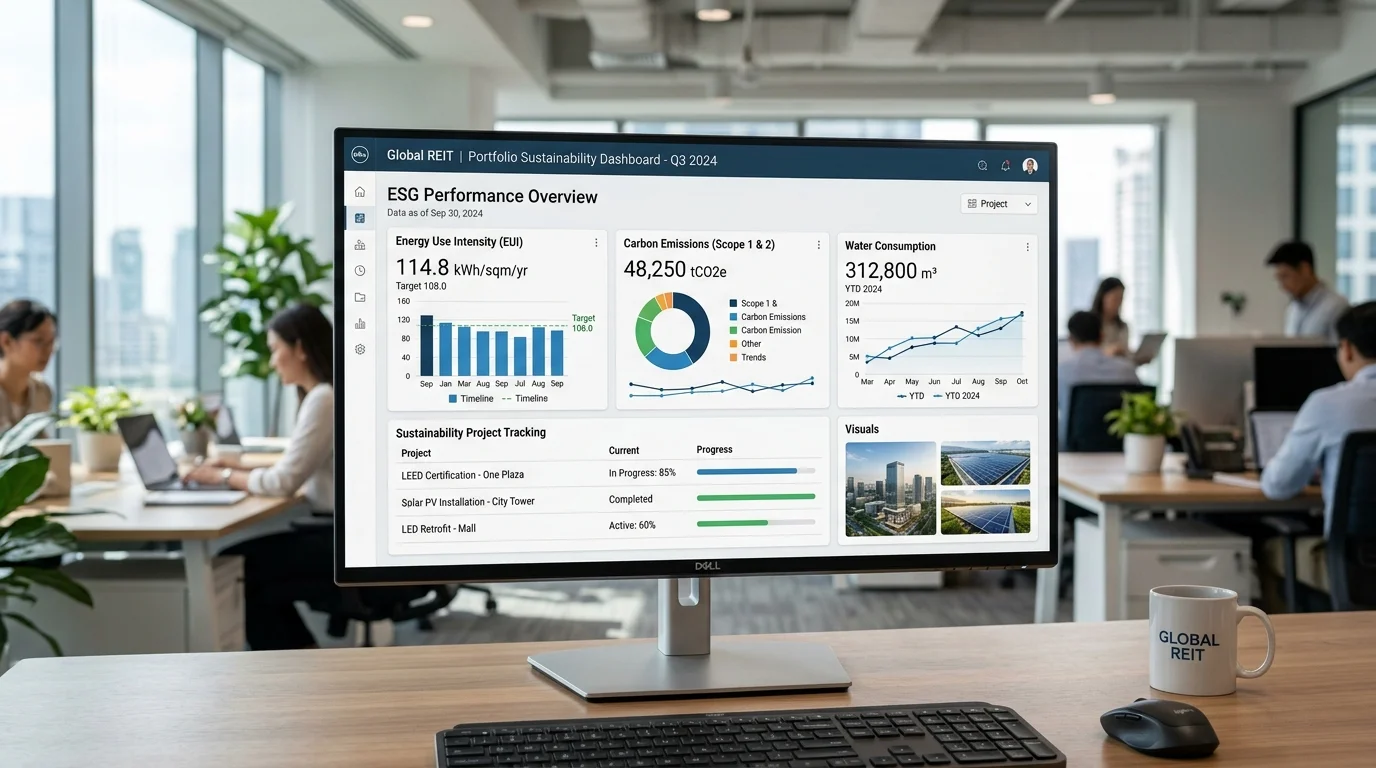
The most useful ESG system for a small portfolio may be a spreadsheet rather than an expensive software platform.
Imagine a dashboard containing ten properties:
| Property | EUI | Emissions | Water | ESG Projects | Compliance |
|---|---|---|---|---|---|
| Building A | 82 | 1,240 tCO₂e | 18M gal | HVAC | Current |
| Building B | 61 | 890 tCO₂e | 12M gal | LED | Current |
| Building C | 104 | 1,670 tCO₂e | 22M gal | Controls | Review |
| Building D | 73 | 950 tCO₂e | 14M gal | Solar | Current |
The numbers above are illustrative.
What matters is that the owner can immediately see where performance differs and where investigation may be justified.
EPA specifically recommends using benchmarking to identify underperforming properties, prioritize investments, and verify whether efficiency improvements are actually producing savings.
Don't Compare Buildings Blindly
One of the biggest mistakes in portfolio ESG reporting is treating every property as though it should have the same performance target.
A 100-year-old multifamily building, a new office tower, and a warehouse do not operate in the same way.
Even within the same portfolio, building use, occupancy, climate exposure, floor area, and operating schedules can be very different.
Portfolio Manager allows owners to compare properties using metrics such as weather-normalized energy use intensity and other performance indicators, which can provide more useful context than raw consumption alone.
The better question is not:
“Which building uses the least energy?”
It is:
“Which building is performing poorly relative to an appropriate benchmark, and why?”
Add an Emissions Layer
Energy data becomes much more useful when translated into greenhouse-gas emissions.
For broader corporate ESG reporting, the GHG Protocol provides the widely used framework for developing organizational greenhouse-gas inventories. Its standards cover corporate emissions accounting as well as value-chain emissions under Scope 3.
For a property portfolio, this can create a simple structure:
Energy consumption → emissions calculation → portfolio emissions → reduction targets
The owner can then track whether efficiency projects are actually changing the portfolio's emissions profile.
It is important, however, to keep corporate GHG accounting separate from regulatory calculations that may use different definitions or methodologies.

Add Targets Only After You Have Good Data
A common ESG mistake is announcing a target before establishing a credible baseline.
A better sequence is:
Measure → validate → benchmark → identify opportunities → set target → implement → track
For example, an owner might discover that three buildings account for most of the portfolio's energy consumption.
Rather than applying the same retrofit strategy to every property, the owner can focus capital on those high-impact buildings first.
This turns ESG reporting into a capital-allocation tool.
Connect ESG Reporting to Capital Planning
The framework becomes significantly more useful when it is connected to the owner's existing investment process.
Suppose a building has high energy intensity and an aging HVAC system.
The ESG dashboard identifies the performance issue.
The capital plan identifies an upcoming HVAC replacement.
The engineering assessment identifies the available efficiency options.
The result is:
ESG data → capital planning → retrofit → measured outcome
This is much more valuable than publishing a sustainability report once a year and putting it away.
Keep Governance Simple
Governance does not need to mean creating layers of bureaucracy.
For a small portfolio, define three things clearly:
1
Who owns the data?
For example, the property manager can collect utility information and verify bills.
2
Who reviews it?
An asset manager can review portfolio trends, identify outliers, and track milestones.
3
Who approves actions?
Ownership and senior leadership can approve major capital investments and target adjustments.
A simple data dictionary should also define exactly what each KPI means.
For example, “energy use” should not mean site energy for one property and source energy for another unless that distinction is deliberately documented.
Consistency is one of the most important qualities of a useful ESG system.
Create an Annual ESG Reporting Cycle
A practical reporting cycle might run like this:
Q
Quarterly
Collect and review utility and performance data.
M
Mid-year
Investigate outliers, review operational discrepancies, and update project plans.
Y
Year-end
Calculate portfolio KPIs and evaluate annual progress against targets.
F
Following year
Adjust targets, integrate findings into budgets, and reset capital priorities.
This keeps ESG reporting connected to normal property-management activity rather than turning it into a once-a-year scramble.
What About Formal ESG Frameworks?
A small portfolio does not necessarily need to begin by adopting every available sustainability framework.
Frameworks and standards can become relevant as reporting needs grow. For example, the GHG Protocol provides corporate greenhouse-gas accounting standards, while tools such as ENERGY STAR Portfolio Manager provide practical building-level performance tracking.
The right approach is to build a foundation first:
Reliable property data → defined KPIs → documented methodology → repeatable reporting
More sophisticated frameworks can then be layered on top when investors, lenders, tenants, regulators, or other stakeholders require them.
A Simple ESG Architecture for a Small Portfolio
A practical structure can be thought of as five layers:
1
1. Property data
What buildings do we own and how do they operate?
2
2. Performance data
How much energy, water, and other resources do they consume?
3
3. Impact data
What emissions and other environmental impacts result?
4
4. Risk and governance
Are compliance, safety, documentation, and accountability being managed?
5
5. Actions and outcomes
What are we changing, how much are we investing, and what happened afterward?
This structure is simple enough to manage but expandable as the portfolio grows.
Common ESG Reporting Mistakes
1
Measuring Too Much
A dashboard filled with metrics that nobody reviews becomes administrative overhead instead of a management tool.
2
Mixing Definitions
Changing the methodology from one property to another can make portfolio comparisons unreliable.
3
Reporting Without Action
An ESG metric has limited value if it never influences operations, investment, or risk management.
4
Setting Targets Without a Baseline
Targets should be based on credible historical data and an understanding of what the portfolio can realistically influence.
5
Treating ESG as Only an Environmental Issue
Social and governance factors matter too, particularly around occupant experience, safety, accessibility, compliance, and accountability.
Conclusion
A simple ESG reporting framework for a small portfolio does not need to be complicated.
Start with reliable property data, establish a manageable group of KPIs, benchmark buildings appropriately, calculate emissions using a consistent methodology, and connect the results to capital planning and operational decisions.
Tools such as ENERGY STAR Portfolio Manager can provide a practical foundation for tracking building energy, water, waste, and emissions, while the GHG Protocol can provide a broader structure for organizational greenhouse-gas accounting.
The real value of ESG reporting is not the report itself.
It is the ability to answer, with reasonable confidence:
Which properties are performing well? Which require attention? What risks are emerging? Where should capital go? And did our investments actually improve performance?
For a small portfolio, a consistent system built around those questions can be more useful than an elaborate reporting process that produces impressive documents but little actionable information.
Frequently Asked Questions
There is no single framework that every small portfolio must use. However, a structured approach to tracking energy, emissions, water, social factors, and governance can make property performance and investment decisions easier to manage.
A practical starting point includes energy use, EUI, energy cost, greenhouse-gas emissions, water consumption, compliance status, safety or occupant-related indicators, and major sustainability projects.
Yes. EPA states that Portfolio Manager can be used to track energy, water, waste, and greenhouse-gas emissions across portfolios and compare properties within the portfolio.
For organizations conducting a broader corporate greenhouse-gas inventory, the GHG Protocol provides standards covering Scope 1, Scope 2, and Scope 3 accounting. The relevance of each category depends on the organization's reporting boundary and objectives.
Monthly or quarterly data collection can support operational management, while a more formal portfolio-level review can be performed annually. The right frequency depends on the size of the portfolio and how quickly performance or risk can change.
Not necessarily. Building type, age, occupancy, operating patterns, and physical characteristics can make direct comparisons misleading. Portfolio Manager supports comparisons using appropriate metrics such as weather-normalized EUI and other performance measures.
Consistency. Reliable data definitions, repeatable collection methods, clear ownership, and a documented methodology are more useful than having a large number of poorly maintained metrics.