Understand how GRESB portfolio benchmarks, LEED green building certifications, and ENERGY STAR scores compare for real estate ESG.
BY NYC Energy Code Team
ON
10 September 2026
How Scope 1, 2, and 3 Emissions Apply to Commercial Buildings
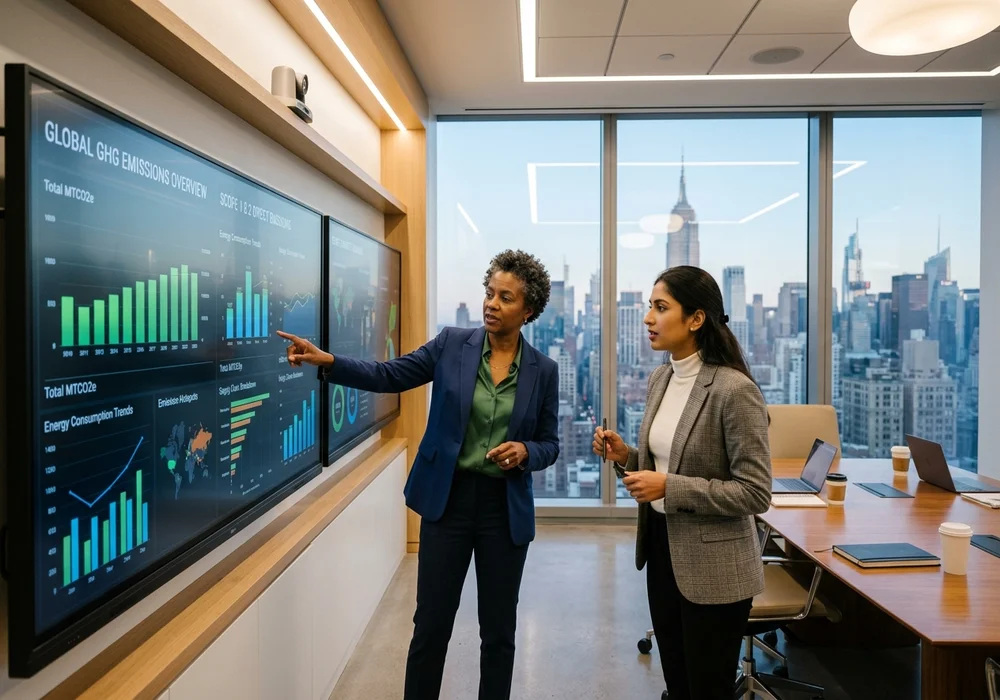
When discussing building sustainability, Scope 1, Scope 2, and Scope 3 emissions provide a framework for understanding where greenhouse gas emissions come from.
For commercial buildings, the distinction is particularly useful because emissions can occur directly inside the property, at a power plant supplying the building, or elsewhere in the building's broader value chain.
The GHG Protocol defines Scope 1 as direct emissions from sources owned or controlled by the reporting organization, Scope 2 as indirect emissions associated with purchased or acquired electricity, steam, heat, and cooling, and Scope 3 as other indirect emissions occurring throughout the organization's value chain.
Core Framework for Real Estate Carbon Accounting
Understanding the boundaries between Scope 1 (onsite fuel combustion), Scope 2 (purchased utility energy), and Scope 3 (embodied materials, tenant activity, and supply chain) allows commercial property owners to develop accurate GRESB disclosures, corporate sustainability reports, and strategic decarbonization plans.
What Are the Three Emission Scopes?
At the simplest level:
- Scope 1 = emissions from sources you own or control (direct combustion).
- Scope 2 = emissions associated with purchased energy (indirect utility generation).
- Scope 3 = other indirect value-chain emissions (upstream suppliers, tenant activities, embodied carbon).
For commercial real estate, this can be visualized as:
Building Equipment → Scope 1 | Purchased Grid Electricity → Scope 2 | Materials, Waste, Tenants → Scope 3
Exactly which activities belong in a company's inventory can depend on the organization's reporting boundary and accounting approach.
Scope 1: Direct Building Emissions
Scope 1 covers direct greenhouse gas emissions from sources owned or controlled by the reporting organization.
For a commercial building, a common example is onsite combustion.
This can include fuel burned in:
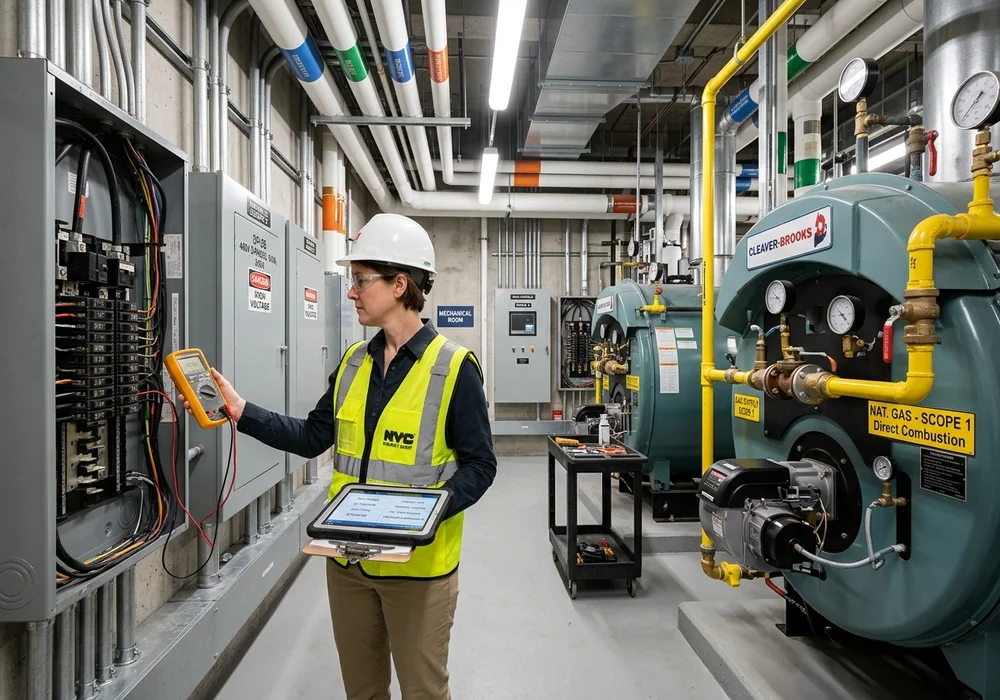
- Natural-gas boilers and domestic hot water heaters
- Furnaces and direct-fired makeup air units
- Rooftop gas-fired heating equipment
- Combined heat and power (CHP) cogeneration systems
- Diesel and gas backup emergency generators
- Other combustion equipment controlled by the organization
For example, if a building owner operates a natural-gas boiler to heat a property, the emissions produced by burning that gas can fall within the owner's Scope 1 inventory.
This is one reason building electrification can have an important effect on an organization's emissions profile: replacing onsite fossil-fuel combustion with appropriately sourced electric systems can shift the associated operational emissions from direct onsite emissions toward purchased-energy emissions.
Scope 2: Purchased Energy Emissions
Scope 2 covers emissions from the generation of purchased or acquired electricity, steam, heat, and cooling consumed by the reporting organization.
For commercial buildings, purchased electricity is usually the most familiar Scope 2 example.
Consider an office building that purchases electricity from the utility. The emissions from operating the building's:
Lighting + Elevators + Plug Loads + HVAC Chillers + Water Pumps
are not necessarily produced at the building itself. The electricity is generated elsewhere, and the associated generation emissions are accounted for as Scope 2 by the electricity-consuming organization under the GHG Protocol framework.
This distinction is important: No combustion at the building does not necessarily mean zero emissions. An all-electric building can still have Scope 2 emissions depending on the electricity supply and applicable accounting method (location-based vs. market-based accounting).
Scope 3: Other Indirect Emissions
Scope 3 covers other indirect emissions that occur from activities connected to an organization's value chain but from sources it does not own or control. The GHG Protocol organizes Scope 3 into 15 categories covering upstream and downstream activities.
For commercial buildings, potential Scope 3 sources can include areas such as:
- Purchased goods and services: Janitorial, property management, security, and maintenance contracts.
- Capital goods: HVAC chillers, transformers, and building envelope retrofits.
- Waste generated in operations: Solid municipal waste, recycling transport, and wastewater treatment.
- Business travel: Property manager and corporate executive business transit.
- Employee commuting: Daily transportation of building staff and on-site workforce.
- Upstream transportation: Freight logistics for building replacement parts and supplies.
- Downstream leased assets: Energy consumed by tenant-controlled spaces when outside the landlord's operational control.
- Other value-chain activities: End-of-life disposal of decommissioned mechanical equipment.
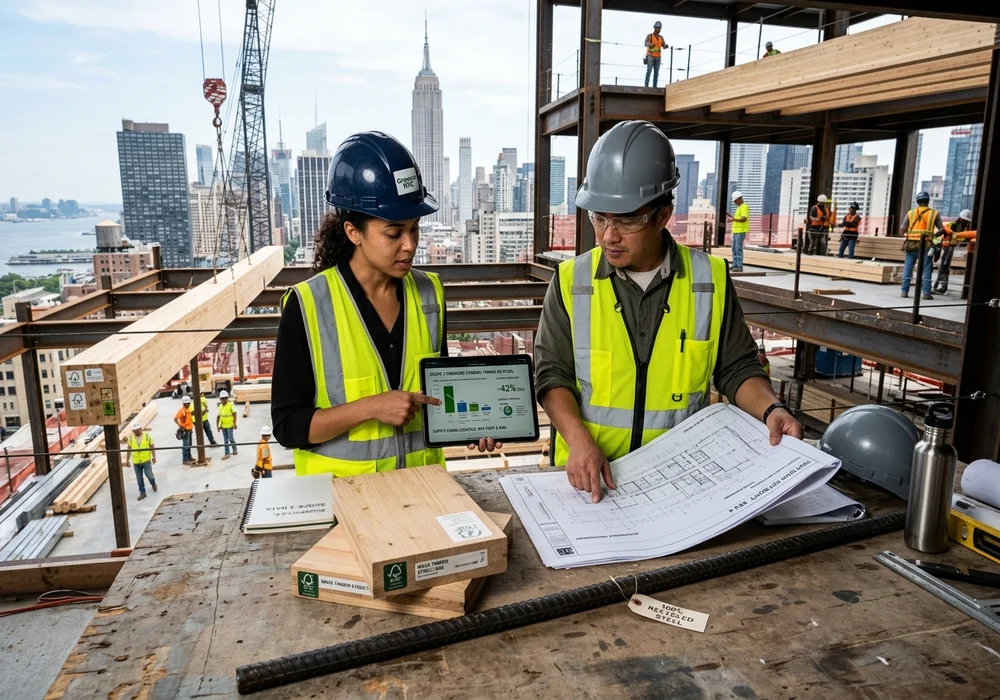
Building construction can also create substantial embodied emissions through the manufacture and transportation of materials used in the project. The GHG Protocol's built-environment guidance distinguishes these embodied emissions from operational emissions associated with energy use during building operation.
A Commercial Building Example
Consider a large commercial office property. The building has gas-fired boilers, purchases electricity from the grid, contracts for waste services, and periodically undertakes major renovation projects.
A simplified emissions inventory classification might look like this:
| Building Activity & Operational Source | GHG Protocol Scope |
|---|---|
| Natural gas burned in owner-controlled boiler | Scope 1 |
| Diesel fuel used in an owner-controlled backup generator | Scope 1 |
| Purchased grid electricity for common areas and chillers | Scope 2 |
| Purchased district steam or high-temperature water | Scope 2 |
| Embodied carbon in concrete and steel for major renovations | Scope 3 |
| Executive and management business travel | Scope 3 |
| Building operations staff and tenant employee commuting | Scope 3 |
| Third-party vendor maintenance and security services | Scope 3 |
| Building solid waste hauling and landfill degradation | Scope 3 |
This is an illustrative classification. Actual accounting depends on who owns or controls the source and the reporting organization's chosen organizational boundary (financial control, operational control, or equity share).
Why the Owner-Tenant Relationship Matters
Commercial buildings often involve multiple parties:
Property Owner → Asset Manager → Tenants → Facility Contractors → Utility Providers
Determining emissions responsibility can therefore become complicated.
For example, leased facilities and tenant spaces may fall into different scopes depending on the organizational boundary and leasing arrangement used by the reporting company. The GHG Protocol specifically notes that leased assets can be classified as Scope 1, Scope 2, or Scope 3 depending on these factors.
Under the operational control approach, if a tenant has direct operational control over their own HVAC package units and utility submeters, those emissions may be classified as Scope 3 (Category 13: Downstream Leased Assets) for the landlord, while representing Scope 1 and 2 for the tenant.
Operational vs. Embodied Emissions
Another fundamental distinction in commercial real estate ESG is between operational carbon and embodied carbon.
1. Operational Emissions (Scope 1 & Scope 2)
Associated with the day-to-day energy consumption required to heat, cool, ventilate, power, and light the building throughout its occupied lifespan.
2. Embodied Emissions (Scope 3)
Associated with the full lifecycle of building materials—from raw resource extraction, refining, manufacturing, and global transport to on-site assembly, maintenance, and ultimate demolition.
For new developments and major adaptive reuse projects, embodied emissions can account for up to 50% of the building's total lifetime carbon footprint.
Why Scope 3 Is Harder to Calculate
Scope 1 and Scope 2 emissions are relatively straightforward to measure because they rely on precise utility meters, monthly fuel delivery receipts, and utility bills.
Scope 3 accounting requires aggregating disparate data streams across numerous external supply chain partners:
Supplier Environmental Product Declarations (EPDs) → Procurement Logs → Freight Distances → Waste Manifests → Commuter Surveys
While Scope 3 reporting is more data-intensive, it frequently represents over 70% of a real estate fund's total climate impact and uncovers substantial long-term supply chain efficiencies.
How Building Upgrades Affect the Scopes
Different decarbonization and capital improvement strategies impact specific emissions scopes differently:
| Energy & Decarbonization Upgrade | Potential Emissions Impact & Scope Reduction |
|---|---|
| Replace gas boiler with electric heat pump | Eliminates direct onsite fossil combustion (Scope 1 reduction), while shifting operational load to grid power (Scope 2). |
| Optimize HVAC controls & BMS schedules | Reduces overall energy consumption, directly cutting both Scope 1 gas and Scope 2 electricity emissions. |
| Install LED lighting & occupancy sensors | Cuts base-building electrical kilowatt-hour usage, reducing reported Scope 2 emissions. |
| Procure offsite renewable energy (PPA / RECs) | Reduces market-based Scope 2 emissions to zero for qualifying clean electricity volumes. |
| Specify low-carbon concrete & mass timber | Substantially cuts upfront embodied carbon in capital goods (Scope 3, Category 2). |
| Adaptive reuse of existing structural frame | Avoids heavy demolition waste and new raw material extraction (Scope 3). |
| Implement tenant green leasing & submetering | Empowers tenants to lower their energy use, reducing landlord downstream leased asset emissions (Scope 3, Category 13). |
Scope 1, 2, and 3 vs. NYC LL97
Scope accounting and NYC's building-emissions regulations are related to sustainability but are not interchangeable systems.
A corporate GHG inventory can use Scope 1, 2, and 3 to understand an organization's broader emissions footprint across national or global portfolios under the GHG Protocol and GRESB.
NYC's Local Law 97, by contrast, establishes legally binding annual carbon emissions limits (in metric tons of CO2 equivalent) specifically for covered NYC buildings based on fixed statutory carbon coefficients for grid electricity, natural gas, #2 fuel oil, and steam.
Therefore, a company's Scope 1 or Scope 2 inventory should not automatically be assumed to equal the emissions calculation used for LL97 compliance. Owners should evaluate each reporting framework according to its governing regulations.
A Commercial Building Carbon-Accounting Checklist
Define organizational boundary: Select either operational control, financial control, or equity share for corporate GHG boundaries.
Inventory Scope 1 sources: Document all on-site gas boilers, backup diesel generators, and fleet vehicles.
Gather Scope 2 utility records: Compile 12 months of utility electricity, district steam, and chilled water invoices.
Screen relevant Scope 3 categories: Identify applicable upstream and downstream categories (construction materials, tenant energy, waste).
Review tenant leasing terms: Determine whether tenant spaces are submetered and establish green lease clauses.
Track embodied carbon in capital projects: Require Environmental Product Declarations (EPDs) from general contractors.
Document waste streams: Track landfill diversion rates and organic waste recycling metrics.
Apply recognized emissions factors: Use eGRID regional grid factors and GHG Protocol emission coefficients.
Separate corporate ESG from LL97: Maintain distinct calculation models for voluntary ESG reporting and municipal compliance.
Track decarbonization milestones: Measure emissions reductions from heat pump conversions, LED upgrades, and efficiency retrofits.
Common Mistakes to Avoid
1. Assuming All Building Energy Use Is Scope 1
Purchased grid electricity represents indirect Scope 2 emissions, not Scope 1. Only on-site fossil fuel combustion falls under Scope 1.
2. Completely Ignoring Scope 3
Direct building operations represent only part of the full lifecycle impact. Capital goods, tenant energy use, and supply chains often dwarf operational emissions.
3. Confusing Energy Consumption With Carbon Intensity
Two identical buildings consuming the exact same kWh can have drastically different Scope 2 footprints depending on the regional grid mix and renewable procurement.
4. Equating Corporate Scope Accounting with NYC LL97
The GHG Protocol corporate standards and NYC Local Law 97 regulatory penalties use different boundaries, emissions coefficients, and reporting mechanisms.
Conclusion
Understanding Scope 1, 2, and 3 emissions in commercial buildings gives owners and companies a more complete picture of their climate impact.
Scope 1 generally covers direct emissions from controlled sources such as onsite fuel combustion. Scope 2 covers emissions associated with purchased or acquired energy, particularly electricity. Scope 3 expands the boundary to other indirect value-chain emissions, including many activities connected to construction, purchasing, transportation, waste, and leased assets.
For commercial real estate, the most useful strategy is to look at all three scopes together. Doing so can help organizations identify where emissions originate, prioritize reduction strategies, and distinguish between operational improvements and broader value-chain opportunities.
Frequently Asked Questions
Scope 1 generally includes direct greenhouse gas emissions from sources owned or controlled by the reporting organization, such as fuel burned in an owner-controlled boiler or generator.
Scope 2 covers emissions associated with purchased or acquired electricity, steam, heating, or cooling consumed by the reporting organization.
Scope 3 includes other indirect value-chain emissions outside the organization's owned or controlled sources. Potential examples include construction materials, purchased services, business travel, commuting, waste, and certain leased assets.
Not necessarily. Replacing onsite fossil-fuel combustion can reduce direct Scope 1 emissions, but the electricity used by the new equipment can create Scope 2 emissions depending on the electricity supply and accounting method.
Yes. Construction materials, purchased goods and services, transportation, waste, and other value-chain activities can contribute to a building-related organization's broader emissions footprint. Embodied emissions are particularly relevant during construction and major renovation.