Learn how retro-commissioning measures are documented and reported under NYC Local Law 87, and what DOB expects in the EER filing.
BY NYC Energy Code Team
ON
25 September 2026
Reading Your LL87 Audit Report: A Plain-English Guide

An LL87 energy audit report can look intimidating. Pages of equipment schedules, energy calculations, tables, recommendations, and technical terminology can make it difficult for a building owner to understand one simple question:
What does this report actually tell me about my building?
The easiest way to read it is to stop treating the report as a technical document and instead think of it as a roadmap. It explains how the building currently uses energy, where inefficiencies may exist, what improvements were identified, and which measures could be worth pursuing.
Under Local Law 87, covered buildings must undergo an energy audit and retro-commissioning and submit an Energy Efficiency Report (EER) to the NYC Department of Buildings. The City's current guidance requires the energy audit to meet the applicable Level 2 reporting framework and uses the U.S. Department of Energy's Asset Score Audit Template as the LL87 energy-audit data collection tool.
First: Understand What the Audit Is Trying to Do
An LL87 audit is not simply an inspection of whether equipment is old.
NYC defines an energy audit as a survey and analysis of building energy use intended to identify opportunities to reduce energy consumption without negatively affecting building operations.
That means the report should answer three broad questions:
1
Where is the building using energy?
Establishing baseline consumption across all major mechanical and electrical loads.
2
Why is it using that energy?
Analyzing system operational schedules, building envelope performance, occupancy demands, and control settings.
3
What could reasonably be changed?
Identifying practical capital and operational improvements to reduce waste while protecting tenant comfort.
Once you understand those three questions, the rest of the report becomes much easier to navigate.
1. Start With the Building Overview
Early sections generally establish the basic facts about the property.
Look for information describing:
- Building size and use
- Major occupancy types
- Existing mechanical systems
- Lighting
- Domestic hot water
- Electrical equipment
- Building envelope
- Energy sources
The purpose is to establish the physical and operational context for everything that follows.
For an owner, this is also a good place to check whether the report's description actually matches the property.
If the report says the building operates as a 24-hour facility but most tenant areas operate only during business hours, that difference could affect the analysis significantly.
2. Find the Energy Use Breakdown
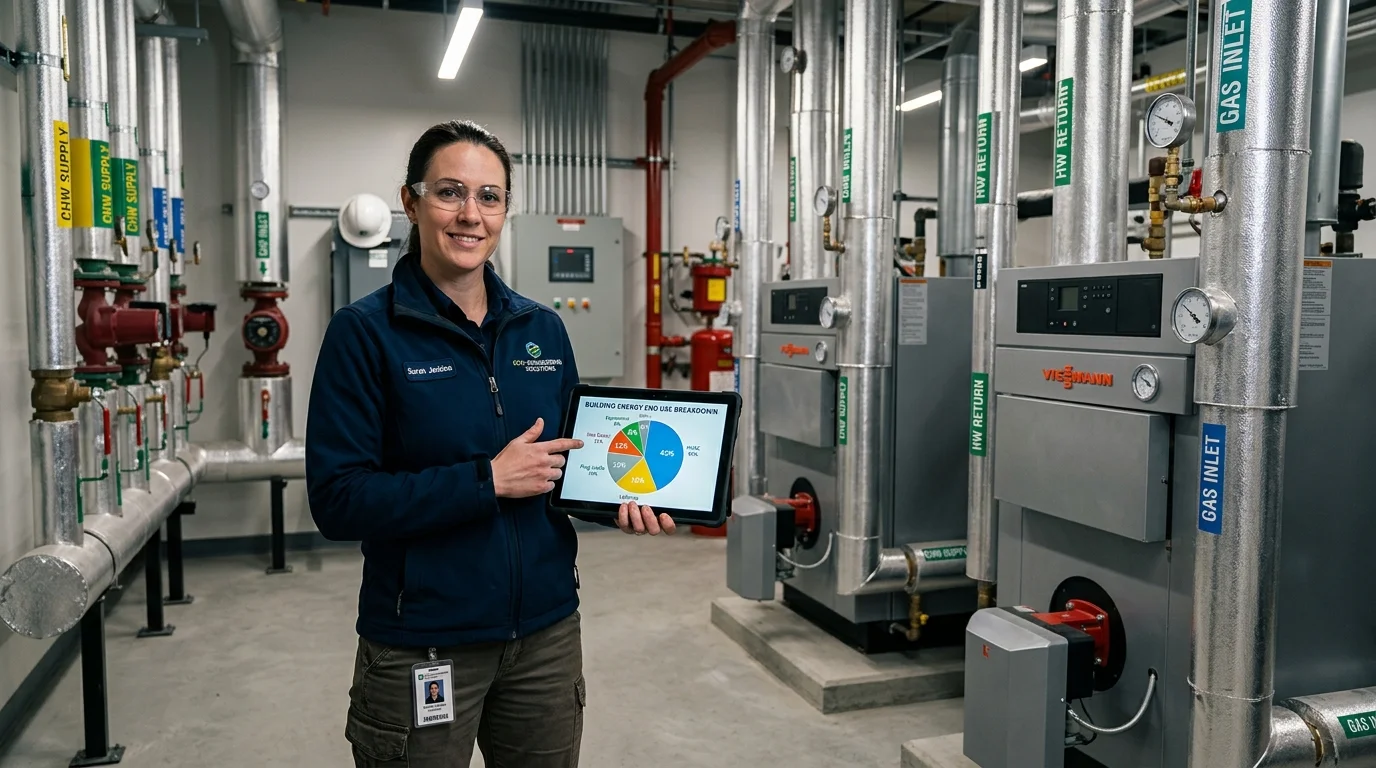
One of the most useful sections is the energy end-use breakdown.
NYC's sustainability guidance specifically identifies energy end-use information and energy conservation measures as part of the LL87 audit information reported to the City.
Instead of seeing one large annual utility number, the audit attempts to show where energy is going.
For example:
| End Use | Illustrative Share |
|---|---|
| Heating | 32% |
| Cooling | 20% |
| Lighting | 15% |
| Domestic hot water | 10% |
| Plug/equipment loads | 13% |
| Other | 10% |
These numbers are purely illustrative.
The important insight is the relative contribution of each end use.
If heating represents a large portion of consumption, improving lighting may have less impact on total building energy than addressing the heating system or building envelope.
3. Look at the Equipment Inventory
The report should give you a clearer picture of the major building systems.
You may see information about:
Boilers → chillers → air-handling units → pumps → fans → lighting → controls → domestic hot water
Do not focus only on the age of a piece of equipment.
A 15-year-old piece of equipment is not automatically an inefficient piece of equipment, just as a newer system is not automatically performing well.
The more useful questions are:
- How does it operate?
- How efficiently does it operate?
- How often does it run?
- Are the controls working correctly?
That distinction becomes particularly important when the audit recommendations are reviewed.
4. Find the Energy Conservation Measures
This is often the section owners care about most.
The report should identify energy conservation measures (ECMs) that could improve building performance.
An ECM might involve:
1
Lighting
Replace inefficient fixtures and install occupancy/daylight sensors.
2
HVAC
Improve equipment efficiency, install VFDs, or upgrade controls.
3
Envelope
Address window insulation, roof thermal barriers, or air leakage.
4
Operations
Correct setback schedules, reset curves, or ventilation setpoints.
5
Domestic hot water
Improve generation efficiency, pipe insulation, and recirculation controls.
Each recommendation should be evaluated in context rather than simply choosing the measure with the largest projected energy saving.
A measure with high savings but a very large capital cost may have a different business case from a low-cost control adjustment that saves less energy but pays back quickly.
5. Pay Attention to Cost and Savings Together
A good energy audit should help owners understand the relationship between investment and expected benefit.
Suppose an audit identifies two hypothetical measures:
| Measure | Implementation Cost | Annual Savings |
|---|---|---|
| HVAC controls optimization | $40,000 | $18,000 |
| Major HVAC replacement | $600,000 | $55,000 |
The first measure has a much smaller investment and could potentially have a much shorter simple payback.
The second might still be worth considering because of equipment age, reliability, future electrification plans, emissions requirements, or avoided replacement costs.
This is why an LL87 report should not be read as a list of “recommended equipment replacements.” It is better understood as a set of investment opportunities requiring additional owner decisions.
6. Understand Simple Payback—But Don't Stop There
Energy audit recommendations often include a simple payback calculation.
The basic formula is:
Simple Payback = Implementation Cost ÷ Annual Savings
For a $100,000 project generating $20,000 in annual savings:
$100,000 ÷ $20,000 = 5 years
That is useful, but it does not account for every financial consideration.
A building owner may also need to consider:
Energy-price changes + maintenance savings + incentives + financing + equipment life + compliance value
A project with a seven-year simple payback might make more sense than a four-year project if the first project also addresses a major equipment replacement that the owner will otherwise have to fund later.
7. Separate “Energy Saving” From “Building Need”
This is one of the smartest ways to read the recommendations.
An audit might identify a measure because it saves energy.
But another measure might be necessary because the building's existing equipment is deteriorated or near the end of its useful life.
Those are different reasons for doing a project.
For example:
Old boiler + low efficiency + high maintenance
is a stronger replacement case than:
Old boiler
Age alone is not enough.
Similarly, an LED retrofit might make sense because of energy savings, maintenance savings, lighting quality, or another project already planned for the space.
8. Read the Recommendations as a Portfolio
Avoid evaluating each recommendation independently.
Several measures may interact.
For example:
Building envelope improvement → lower heating/cooling loads → different HVAC requirements
Or:
LED retrofit → lower lighting electricity → lower internal heat gains → lower cooling demand
The value of the overall retrofit package may therefore be different from adding the projected savings of each measure independently.
This is where energy modeling or more detailed engineering analysis can become useful for larger capital decisions.
9. Look for “Low-Cost” Opportunities
Not every useful recommendation requires major construction.
The audit may identify improvements involving:
- Scheduling
- Temperature setpoints
- Controls
- Sensor calibration
- Operating procedures
- Preventive maintenance
These measures can sometimes provide a relatively inexpensive first step.
This is especially valuable when the owner wants to begin improving performance before funding larger capital projects.
10. Connect the Audit to Retro-Commissioning
LL87 combines energy auditing with retro-commissioning, but the two activities are not identical.
The energy audit primarily investigates energy consumption and identifies conservation opportunities.
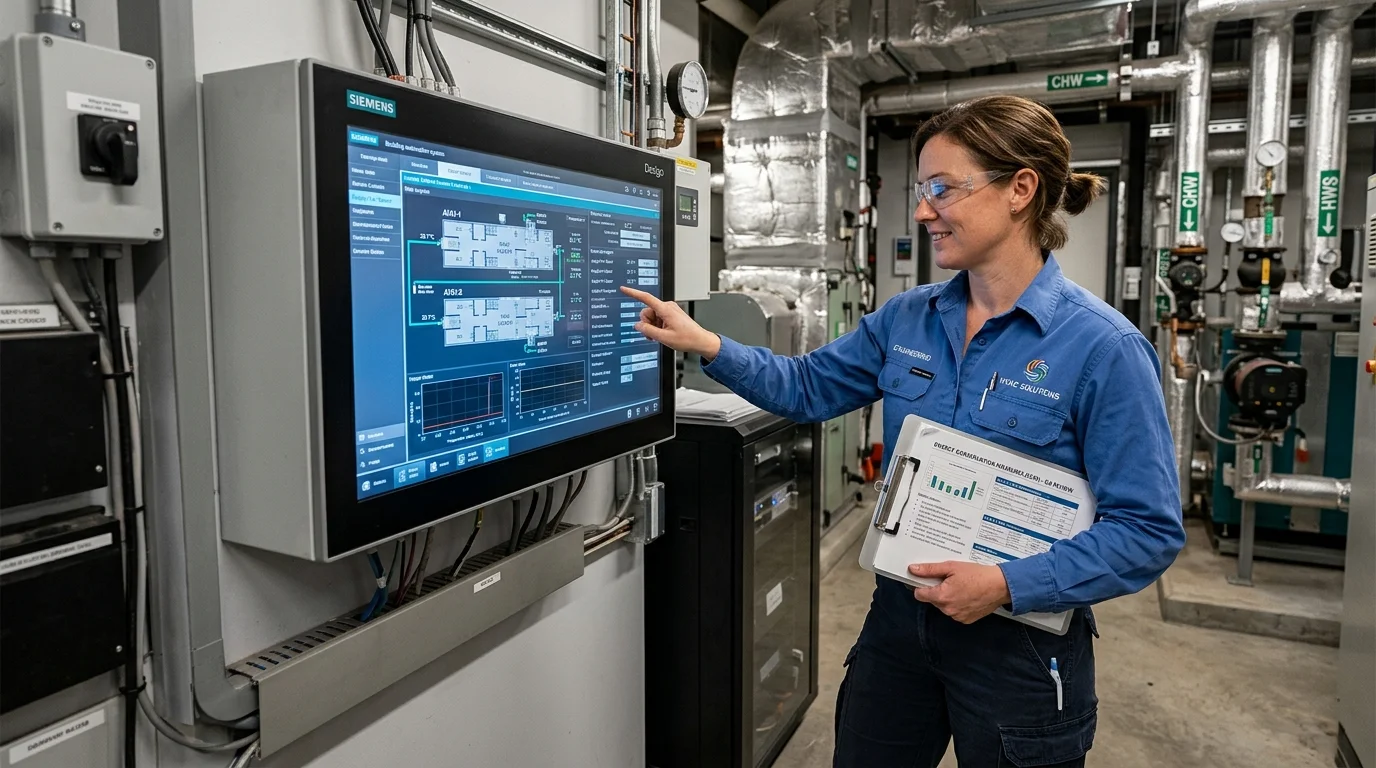
Retro-commissioning focuses on ensuring that existing building systems operate according to the owner's operational needs and intended performance. NYC requires a Current Facility Requirements document as part of this process, based on factors including building age, interviews, available drawings, lease terms, and changes in occupancy or space use.
That means your LL87 package may reveal two different types of opportunities:
Capital improvement → replace or upgrade equipment
Operational improvement → make existing equipment work correctly
Both can matter.
11. Find the Deep Energy Retrofit Analysis
The broader EER submission can also include a Deep Energy Retrofit Plan Analysis (DERPA) report. NYC's current filing materials identify DERPA as part of the LL87 reporting framework.
This is useful for owners thinking beyond individual upgrades.
Instead of asking:
“What can I replace this year?”
the long-term question becomes:
“What would a significantly lower-energy version of this building look like?”
That perspective can help prevent short-term investments from conflicting with future retrofit plans.
What the Report Does Not Tell You
An LL87 audit is valuable, but it should not be treated as a guarantee of future savings.
Actual building performance depends on:
Weather + occupancy + operating schedules + maintenance + controls + equipment performance
Similarly, a projected $50,000 annual saving does not mean the building will automatically achieve exactly $50,000 every year.
The audit provides a structured technical basis for decision-making. It does not eliminate uncertainty.
What Should a Building Owner Do After Reading the Report?
The report becomes most useful when its findings are turned into a capital plan.
A practical sequence is:
Audit findings → prioritize measures → verify costs → identify dependencies → evaluate incentives → design → implement → measure performance
For example, a building might choose to first correct controls, then upgrade lighting, and later coordinate HVAC replacement with a larger electrification strategy.
The LL87 report can therefore become the starting point for a multi-year energy retrofit roadmap, rather than something that sits in a compliance folder.
A Practical Way to Read Your LL87 Report
When reviewing the document, ask these five questions:
- 1. Where is most of our energy going?
- 2. Which systems appear to be underperforming?
- 3. Which recommendations require little capital?
- 4. Which recommendations require major investment?
- 5. Which projects should be coordinated rather than completed separately?
Those questions turn a technical report into an actionable business document.
Common Mistakes When Reading an LL87 Audit
1
Looking Only at the Executive Summary
The headline findings are useful, but the equipment inventory and end-use analysis often explain why those findings matter.
2
Choosing the Highest-Savings Measure Automatically
The largest energy-saving opportunity is not necessarily the best first investment.
3
Ignoring Operational Measures
A control adjustment or scheduling correction may sometimes deliver meaningful savings without major construction.
4
Treating Payback as the Only Financial Metric
Long-term asset condition, maintenance, incentives, financing, and future compliance needs can materially change project economics.
5
Filing the Report and Forgetting It
The audit is most valuable when its recommendations feed directly into future capital planning.
Conclusion
An LL87 energy audit report is essentially a detailed explanation of how a building uses energy and where opportunities for improvement may exist.
The most important sections to understand are the building and equipment inventory, energy end-use breakdown, energy conservation measures, projected savings, implementation costs, and longer-term retrofit opportunities. NYC's LL87 framework specifically requires covered buildings to report audit findings and recommendations along with retro-commissioning information.
The smartest way to read the report is not to ask, “Which recommendation should we implement?”
Start with:
“What is the building telling us about its energy performance?”
Once that picture is clear, the owner can decide which improvements make sense now, which should be coordinated with future capital work, and which require deeper engineering or financial analysis.
Frequently Asked Questions
The audit evaluates building energy use and identifies energy conservation opportunities. The broader LL87 submission includes required audit information, building and equipment information, energy-use analysis, conservation measures, and supporting documentation.
No. The audit involves analysis of energy use and identification of opportunities to reduce consumption. It is broader than simply inspecting whether equipment is present or functioning.
Start with the energy end-use breakdown, major equipment inventory, and energy conservation measures. These sections help explain where the building uses energy and where improvement opportunities have been identified.
The audit identifies opportunities and recommendations; it does not mean every recommendation must automatically become a capital project. Owners should evaluate costs, savings, building conditions, priorities, and applicable requirements before proceeding.
Simple payback estimates how long it would take for annual financial savings to recover the project's initial implementation cost. It does not account for every lifecycle or financing consideration.
They are complementary parts of the LL87 process. The audit evaluates energy use and conservation opportunities, while retro-commissioning evaluates whether existing building systems are operating effectively according to the owner's operational requirements.
NYC DOB states that individuals performing or supervising LL87 energy audits for inclusion in an EER must be appropriately qualified New York State-licensed registered design professionals, such as Professional Engineers or Registered Architects, and cannot be employees of the building being audited.
Covered buildings generally undergo the LL87 energy audit and retro-commissioning process every ten years, with the EER due in the calendar year corresponding to the final digit of the property's tax block number.