Learn what inspectors look for during an audit, equipment checks, and compliance reporting steps.
BY NYC Energy Code Team
ON
24 August 2026
ASHRAE Level 1 vs Level 2 Audits: What NYC Owners Should Know
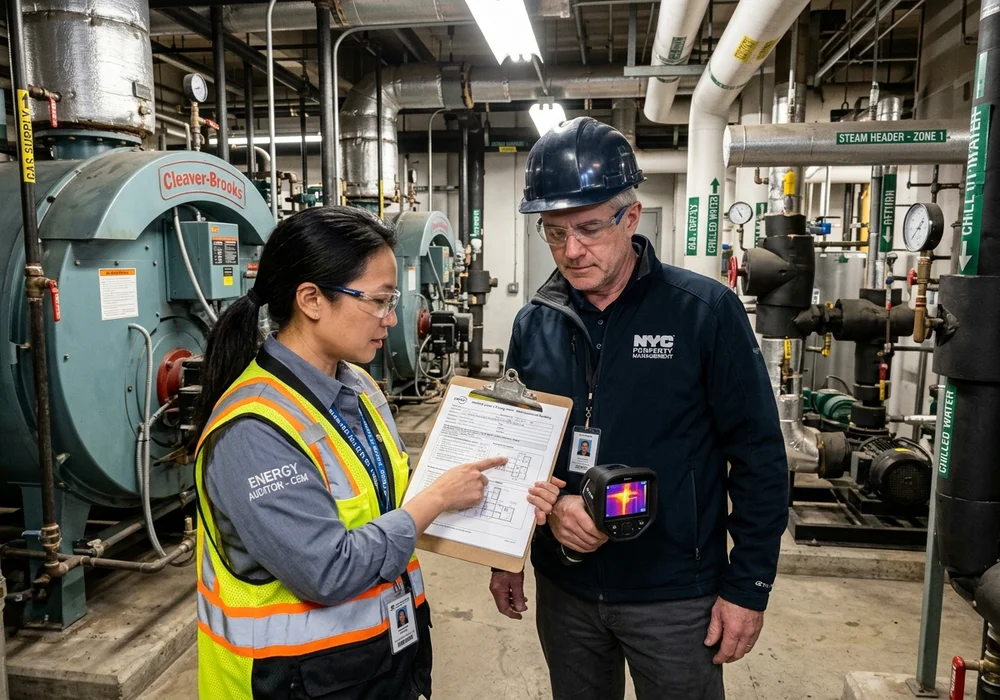
If you're an NYC building owner or property manager evaluating energy efficiency upgrades, you've likely encountered the terms ASHRAE Level 1 audit and ASHRAE Level 2 audit.
They are not simply two price points for the same service.
An ASHRAE Level 1 audit is a relatively fast walk-through assessment designed to identify obvious energy-saving opportunities and qualitative operational flaws. In contrast, an ASHRAE Level 2 audit is a rigorous, data-driven energy survey and engineering analysis that quantifies building system performance, analyzes 12 to 36 months of utility bills, and provides detailed financial modeling for capital improvements.
The Critical Regulatory Mandate for NYC Owners
Level 2 is the mandatory minimum audit level required for Local Law 87 (LL87) compliance. NYC Department of Buildings rules explicitly state that an energy audit submitted as part of an Energy Efficiency Report (EER) must be no less stringent than an ASHRAE Level II Energy Survey and Analysis. A Level 1 walkthrough will be rejected by the DOB.
What Is an ASHRAE Level 1 Audit?
A Level 1 audit is essentially a preliminary screening of a building's energy performance.
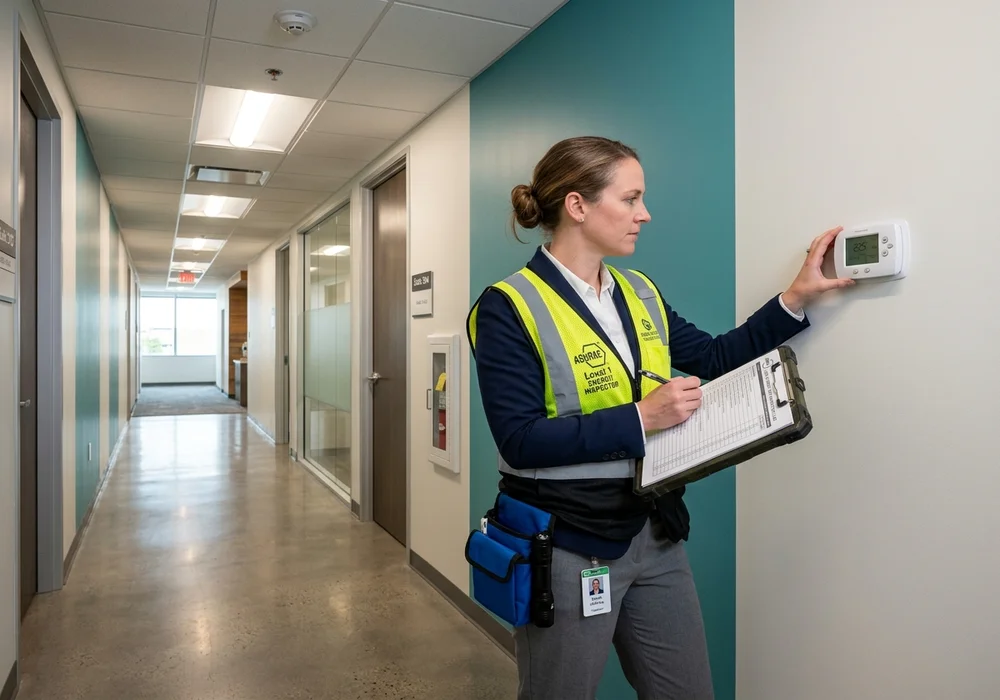
The auditor reviews historical utility consumption and costs, conducts a brief visual walk-through of the property, and highlights obvious, visible opportunities to reduce energy consumption.
ASHRAE defines Level 1 as a Walk-Through Analysis that pinpoints low-cost/no-cost operational adjustments and flags potential capital energy conservation measures (ECMs) that warrant further engineering investigation.
- Utility Billing Summary: High-level review of annual electricity, gas, fuel oil, and steam bills.
- Visual Equipment Inspection: Quick physical check of central boilers, chillers, RTUs, lighting fixtures, and building envelope.
- Low-Cost Fixes: Immediate recommendations such as programming setback thermostats, replacing damaged pipe insulation, or fixing steam traps.
- Objective: Answers: "Where are the biggest energy leaks, and does this building warrant a deeper, capital-grade investigation?"
What Is an ASHRAE Level 2 Audit?
An ASHRAE Level 2 audit goes significantly deeper into engineering mechanics and quantitative analytics.
It couples intensive site investigation with granular energy-use disaggregation. The engineer measures equipment efficiencies in the field, models thermal loads, evaluates building automation system (BAS) trend logs, and performs life-cycle cost analysis (LCCA) for each recommended energy conservation measure.
Energy End-Use Disaggregation
A Level 2 audit establishes a comprehensive energy balance, breaking down total building consumption into distinct sub-categories: space heating, domestic hot water (DHW), space cooling, ventilation fans, pumps, interior lighting, and tenant plug loads. This prevents overestimating energy savings from interactive measures.
Level 1 vs. Level 2: Side-by-Side Comparison
| Audit Parameter | ASHRAE Level 1 (Walk-Through) | ASHRAE Level 2 (Energy Survey & Analysis) |
|---|---|---|
| Core Objective | Preliminary energy screening & obvious defect identification | Comprehensive engineering analysis & financial investment modeling |
| Site Investigation | Brief walkthrough (2–4 hours) | Detailed physical survey, diagnostic testing, submeter inspection |
| Utility Data Analysis | Basic monthly total energy bills | Granular 24–36 month billing analysis, rate structure review, interval data |
| Equipment Inventory | High-level visual check of primary equipment | Complete nameplate inventory, operating hours, baseline efficiencies |
| Energy Conservation Measures | Qualitative list of low/no-cost recommendations | Engineered ECMs with quantified energy savings, capital costs, and ROI |
| Financial Modeling | Rough estimates / simple payback ranges | Life-cycle cost analysis (LCCA), Net Present Value (NPV), Simple Payback |
| NYC LL87 Compliance | Not Compliant | Minimum Legal Standard |
Why Level 2 Is Legally Mandated for NYC Local Law 87
Under NYC Local Law 87 (LL87), covered properties must submit an Energy Efficiency Report (EER) to the Department of Buildings once every 10 years, based on the last digit of the property's tax block number:
- Individual commercial or residential buildings exceeding 50,000 gross square feet.
- Two or more buildings on the same tax lot that together exceed 100,000 gross square feet.
- Two or more condominium buildings governed by the same board of managers that combined exceed 100,000 gross square feet.
NYC DOB filing rules require the official PDF upload of a complete ASHRAE Level 2 Energy Audit Report stamped by a licensed Professional Engineer (PE) or Registered Architect (RA), alongside an energy auditor certified by the Association of Energy Engineers (CEM) or ASHRAE (BEAP/BEMP).

Capital Budgeting: Why Level 2 Delivers Real Financial Value
The true value of a Level 2 audit extends far beyond basic regulatory compliance. It provides building owners, co-op boards, and asset managers with actionable data for long-term capital planning and Local Law 97 carbon penalty mitigation.
Consider an aging steam boiler plant:
Level 1 Recommendation
"Boilers are over 30 years old and operating inefficiently. Consider replacing heating equipment." (Offers no sizing, cost estimates, or fuel options).
Level 2 Recommendation
"Current seasonal efficiency is 68%. Installing dual-fuel condensing modular boilers or hybrid VRF heat pumps will reduce therm consumption by 32%, saving $54,000/yr with an estimated capital cost of $210,000 and simple payback of 3.9 years."
What About an ASHRAE Level 3 Audit?
ASHRAE Level 3 is designated as a Detailed Analysis of Capital-Intensive Modifications, often termed an Investment-Grade Audit (IGA).
Level 3 audits involve long-term submeter data logging, calibrated hourly thermodynamic computer simulations (such as EnergyPlus or eQUEST), and detailed contractor bid specifications. Level 3 is typically commissioned when an owner is pursuing an Energy Performance Contract (EPC), third-party PACE financing, or multi-million dollar plant electrification retrofits.
Energy Audit vs. Retro-Commissioning (RCx): Two Halves of LL87
A frequent point of confusion among NYC owners is assuming an energy audit covers the entire Local Law 87 requirement. LL87 mandates two distinct engineering tasks:
1. Energy Audit (ASHRAE Level 2)
Evaluates how efficiently the building uses energy, benchmarks EUI, and identifies capital energy conservation measures (ECMs) for future upgrades.
2. Retro-Commissioning (RCx)
Tests whether existing base-building equipment operates according to design intent, requiring hands-on operational tune-ups, sensor calibrations, and maintenance corrections.
What Owners Should Ask Before Hiring an Energy Auditor
Scope Verification: Does your proposal include a full ASHRAE Level 2 Energy Survey and Analysis that satisfies 1 RCNY §103-07?
Engineer Credentials: Will the final EER submission be stamped by a NYS Licensed Professional Engineer (PE) with certified CEM/BEAP credentials?
Retro-Commissioning Inclusion: Does the proposal cover both the Energy Audit AND the required Retro-Commissioning testing and implementation?
LL97 Carbon Penalty Integration: Will the audit calculate how each recommended ECM impacts our 2024–2030 Local Law 97 carbon emissions caps?
Final Takeaway
ASHRAE Level 1 and Level 2 audits serve fundamentally different purposes in a building's lifecycle.
While Level 1 is a helpful high-level screening tool, ASHRAE Level 2 is the legal baseline for NYC Local Law 87 compliance.
Before accepting an energy auditing proposal, verify that the engineering scope satisfies NYC DOB requirements and provides the quantitative financial data needed to guide your building's capital investments.
Frequently Asked Questions
Level 1 is a walk-through analysis focused on basic energy use and obvious savings opportunities. Level 2 is a more detailed energy survey and engineering analysis covering building systems and energy conservation measures.
The LL87 energy audit must meet at least the ASHRAE Level II Energy Survey and Analysis standard.
No. A Level 1 walk-through does not meet the required Level II audit standard for LL87 compliance.
It can include utility consumption, equipment inventory, energy end uses, HVAC, lighting, controls, domestic hot water, and potential energy conservation measures.
No. Level 2 is the minimum audit standard for LL87. Level 3 is a more detailed analysis generally used for complex or capital-intensive projects.
Not automatically. Under LL87, energy auditing and retro-commissioning are separate but related components of the compliance process.
The Energy Efficiency Report is generally required every ten years according to the building's assigned filing year.
Ask which audit level they are providing, whether the scope meets LL87, what systems will be analyzed, what documentation you'll receive, and whether the work will support your EER submission.
No. An audit identifies opportunities and provides analysis. Actual savings depend on which recommendations are implemented and how successfully the building operates afterward.
No. The appropriate audit level depends on the building and the purpose of the work. However, covered buildings subject to LL87 need an audit meeting the applicable Level II standard.