Understand the technical requirements, scope differences, and compliance benefits between Level 1 walk-throughs and Level 2 detailed audits.
BY NYC Energy Code Team
ON
09 September 2026
How Retro-Commissioning Measures Get Reported Under LL87
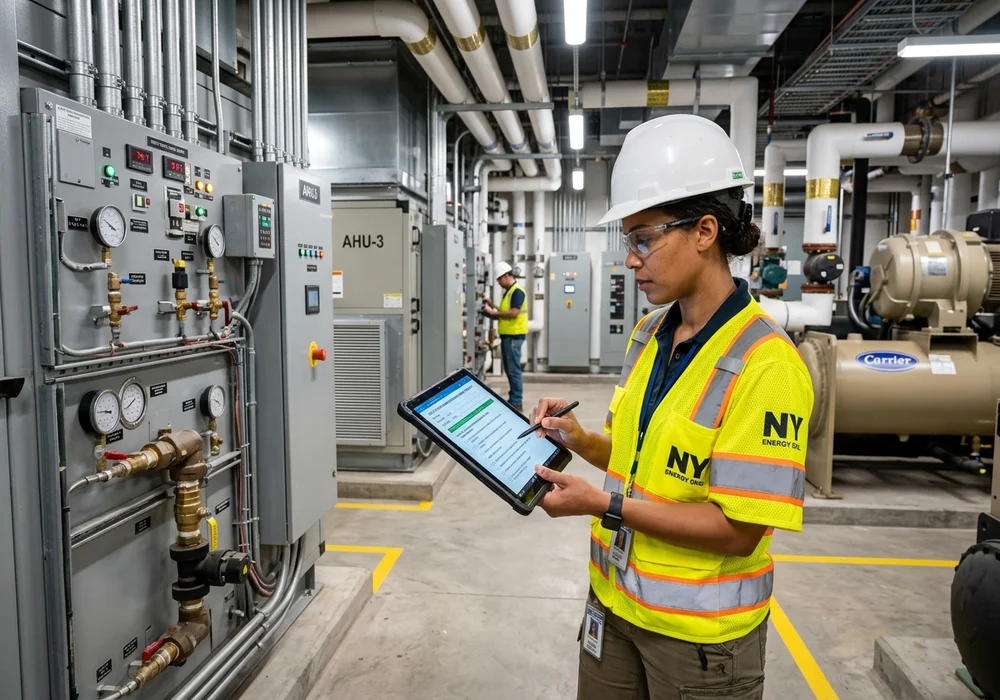
For many NYC building owners, retro-commissioning under Local Law 87 (LL87) can sound like a technical building-engineering exercise. But there is an equally important part of the process: documenting what was investigated, what was found, what was corrected, and how the building systems were tested.
LL87 requires covered buildings to conduct energy audits and retro-commissioning and submit an Energy Efficiency Report (EER) to the NYC Department of Buildings. The EER summarizes the results and includes information collected through the City's required reporting tools.
Understanding how retro-commissioning measures are reported can help owners prepare the right documentation and avoid treating the EER as simply a final checklist.
Core Takeaway for NYC Property Owners
Retro-commissioning under LL87 is not merely an observational study—it is an actionable tuning and verification process. Every deficiency identified must be resolved, re-tested, and officially logged into the NYC DOB Retro-commissioning Data Collection Tool before your Energy Efficiency Report can be certified.
What Is Reported Under LL87?
NYC's LL87 reporting framework includes information about the building, the retro-commissioning team, and the retro-commissioning measures identified through the process.
The City's current guidance identifies the following broad information categories:
| Reporting Category | What It Covers |
|---|---|
| Team Information | Registered Design Professionals (PE/RA), certified commissioning agents, field technicians, and official filing representative credentials. |
| Building Information | Borough-Block-Lot (BBL), gross square footage, primary occupancy classifications, operating hours, and historic status. |
| Equipment/System Information | Comprehensive inventory of base-building boilers, chillers, cooling towers, pumps, air handlers, ventilation fans, and domestic water heaters. |
| Current Facility Requirements (CFR) | Documented baseline defining how the property is intended to operate based on current occupancy, tenant leases, and equipment design limits. |
| Testing & Protocols | Written functional performance test procedures, sampling ratios, seasonal diagnostic methods, and sensor cross-calibrations. |
| Retro-commissioning Measures | Specific operational, scheduling, tuning, or control improvements identified across all base-building mechanical and electrical systems. |
| Corrections & Repairs | Field actions implemented to rectify all identified deficiencies prior to final EER certification. |
| Supporting Reports & Certification | Detailed engineering narrative, test logs, trend data, photos, and signed professional seal retained on file for DOB audit compliance. |
The dedicated Retro-commissioning Data Collection Tool includes worksheets for Submittal Information, Team Information, Building Information, and Retro-commissioning Measures.
What Is a Retro-Commissioning Measure?
A retro-commissioning measure generally addresses an operational or control improvement identified while evaluating existing base-building systems.
The objective is to make sure systems operate effectively according to the building's Current Facility Requirements (CFR).
Examples may involve:
- HVAC temperature setpoints: Adjusting heating and cooling supply water and discharge air setpoints to match seasonal outdoor conditions.
- Equipment operating schedules: Aligning fan, pump, and boiler runtimes with actual building tenant occupancy hours.
- Control sequences: Fixing faulty economizer lockouts, optimum start/stop routines, and variable air volume (VAV) box minimum damper positions.
- Sensor calibration: Recalibrating drifted temperature, humidity, static pressure, and carbon dioxide (CO2) sensors.
- Economizer operation: Repairing seized damper linkages, failed actuators, and outdoor air enthalpy sensors.
- Ventilation control: Tuning demand-controlled ventilation (DCV) dampers to prevent over-ventilation during low occupancy.
- Simultaneous heating and cooling: Eliminating zone fighting where perimeter heating operates concurrently with overhead cooling.
- Equipment staging: Optimizing lead/lag boiler and chiller sequencing to run equipment at peak partial-load efficiencies.
- Other operational deficiencies: Repairing malfunctioning steam traps, pipe insulation gaps, and balancing water flow rates.
The exact measures depend on what the retro-commissioning investigation finds in the individual building.

Step 1: Establish the Current Facility Requirements
Before determining whether a system is operating correctly, the retro-commissioning agent needs to understand how the building is supposed to operate.
NYC guidance states that the CFR should consider factors such as the facility's age, interviews with owners and staff, available drawings, lease terms, and changes in occupancy or space use.
The CFR can establish expectations for:
- Seasonal operating setpoints (heating hot water reset curves, chilled water supply temperatures).
- Occupied and unoccupied schedules across tenant floors, common lobbies, and amenity spaces.
- Indoor environmental requirements (target space temperatures, relative humidity ranges, minimum outdoor air rates).
- Equipment operating conditions and standby redundancies.
- Desired equipment efficiency and system pressure setpoints.
This provides the basis for evaluating whether the existing system is actually performing as intended.
Step 2: Test the Building Systems
Retro-commissioning is not simply a visual inspection.
The process includes analysis, corrections, and testing intended to demonstrate efficient operation of the base-building systems. NYC's LL87 materials describe a sequence involving Current Facility Requirements → functional performance testing → retro-commissioning measures.
Current Facility Requirements (CFR) → Functional Performance Testing → Deficiencies Found → Corrective Action → Verification Retest
For example, an HVAC system might be found to operate beyond the building's required occupied schedule. The measure could involve correcting the control schedule and then verifying that the system follows the revised sequence.
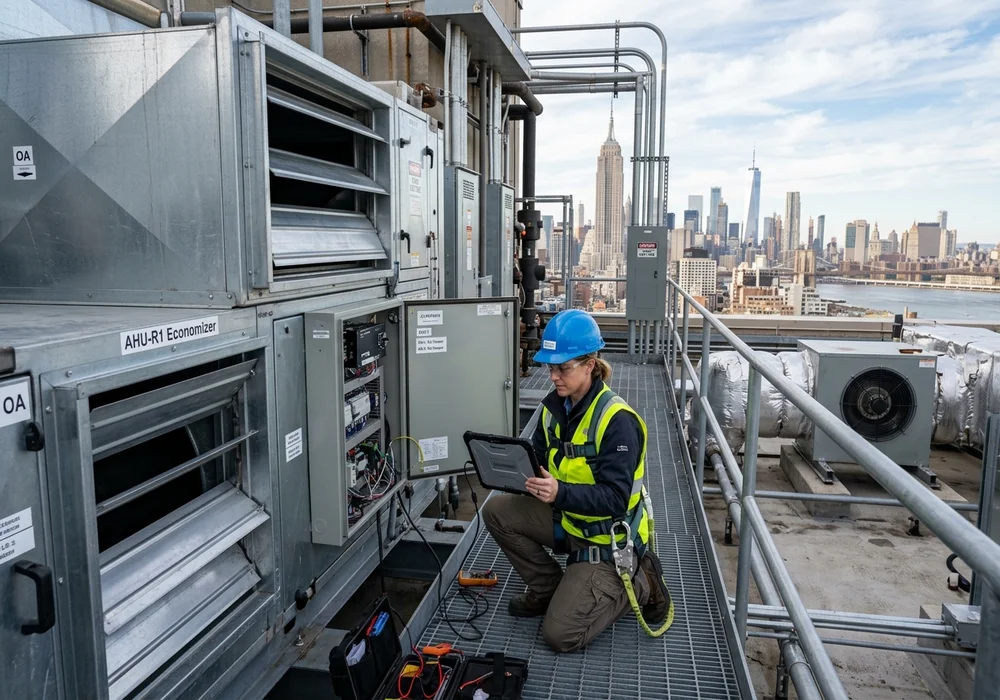
Step 3: Document Findings
The retro-commissioning process should produce a record of what was investigated and what deficiencies were identified.
A useful way to think about the documentation is:
| Observed Finding / Deficiency | Corrective Action (Measure) | Verification & Retest Method |
|---|---|---|
| Incorrect HVAC Schedule: AHU running 24/7 during unoccupied weekend hours. | Reprogram BMS occupancy schedule with holiday exceptions. | Review 7-day trend logs to confirm automatic shutdown. |
| Miscalibrated Sensor: Supply air temp sensor reading 6°F higher than actual. | Calibrate sensor with NIST-traceable digital probe. | Perform comparative spot check under active flow. |
| Improper Economizer Sequence: Outdoor air damper stuck open 100% in winter. | Replace damaged actuator motor and lubricate linkages. | Command 0%, 50%, 100% stroke test in BMS. |
| Unnecessary Pump Operation: Secondary heating pumps running during summer cooling. | Implement automated seasonal lockout controls. | Verify pump status when outdoor air exceeds 60°F. |
The purpose is to demonstrate that the measure was not simply recommended but was evaluated and, where applicable, corrected and tested.
Step 4: Record the Retro-Commissioning Measures
The identified measures are then captured in the required Retro-commissioning Data Collection Tool.
NYC's EER system specifically provides a Retro-commissioning Measures section for this information.
The report should therefore create a traceable connection between:
Building Requirement → Observed Condition → Measure → Correction / Verification Testing
This makes the submission more useful during a City review and gives the owner a record of building-system improvements.
Step 5: Distinguish Measures From Capital Improvements
Not every retro-commissioning finding requires a major equipment replacement.
Many measures involve operational or control adjustments rather than large construction projects.
Categorizing Building Recommendations
- Low-cost operational measure: Correct an HVAC start/stop schedule or adjust unoccupied thermostat setbacks.
- Control optimization measure: Reprogram multi-boiler lead/lag staging or enable static pressure reset.
- Maintenance measure: Calibrate drifted sensors, clean fouled heat exchanger plates, or replace failed steam traps.
- Capital improvement (LL87 Audit side): Replace an aging atmospheric boiler plant with modular condensing heat pumps.
The purpose of retro-commissioning is not to force every problem into a capital project. It is to identify and address operational deficiencies and improve the performance of existing base-building systems.
What Happens After a Measure Is Corrected?
Testing is an important part of the process.
A measure should be evaluated against the applicable operating requirements to determine whether the system is functioning as intended.
This is particularly important because changing one control sequence can sometimes create another operational problem.
Change Setpoint → Observe System Behavior → Test Under Operating Loads → Confirm Performance
The documentation should support the conclusion reached by the retro-commissioning agent.
What Goes Into the Final EER?
LL87's Energy Efficiency Report is not just a narrative report.
Current NYC guidance states that the EER includes professional certification forms and required energy-audit and retro-commissioning data collection tools. The City's filing guidance also identifies final audit and retro-commissioning reports as part of the broader EER submission package.
For the retro-commissioning component, the submission process includes:
Professional Certification → Data Collection Tool → Retro-Commissioning Report → DOB NOW EER Filing
The retro-commissioning report and supporting records should also be retained at the building as required by the LL87 compliance framework.
What Owners Should Keep on File
Even after the EER is submitted, owners should maintain organized records of the work.
Useful documentation includes:
- Final retro-commissioning report signed and sealed by the Registered Design Professional
- Current Facility Requirements documentation
- Written testing protocols and sensor verification logs
- Functional performance testing results and trend analysis data
- Master list of findings and deficiency log
- Proof of corrective actions (work orders, technician invoices, BMS screenshots)
- Completed Retro-commissioning Data Collection Tool Excel workbook
- Professional certification forms submitted through DOB NOW
- Mechanical, electrical, and control system drawings
NYC notes that audit and retro-commissioning reports can be requested by DOB for comprehensive review, and a site inspection may also be conducted to verify reported information.
Common Reporting Mistakes
1. Listing Problems Without Explaining the Action
A finding alone does not tell the complete story. The documentation must clearly detail the exact measure or corrective action that resolved the finding.
2. Skipping Verification Retests
Changing a control setting or replacing a part is not the end of retro-commissioning. Functional retesting is required to prove the system performs properly under load.
3. Treating the EER as an Administrative Checkbox
The EER represents substantial engineering field testing. Weak or fabricated underlying logs expose the building to DOB rejection and audit failure.
4. Discarding Documentation Post-Filing
NYC DOB enforces mandatory 10-year retention rules for all LL87 EER records. Discarding testing sheets leaves owners vulnerable during random DOB inspections.
LL87 Retro-Commissioning Reporting Checklist
Confirm reporting year: Verify your building's LL87 filing deadline based on the last digit of your NYC tax block number.
Establish CFR: Document the Current Facility Requirements with building operators and ownership.
Scope base systems: Inventory all base-building HVAC, domestic hot water, electrical, and conveyance equipment.
Develop testing protocols: Write comprehensive functional performance test sheets before starting site work.
Execute testing: Conduct on-site diagnostic testing, sensor calibrations, and sequence verifications.
Log deficiencies: Compile a deficiency tracking register with photographic and trend log evidence.
Implement corrections: Perform tuning, repairs, scheduling updates, and control reprograming.
Verify retests: Retest all repaired systems to confirm stable, efficient operation.
Complete Data Collection Tool: Populate all required tabs in the official NYC DOB Excel reporting tool.
Submit EER via DOB NOW: Obtain PE/RA seal and submit complete Energy Efficiency Report by December 31.
Retain permanent records: Archive the complete EER binder on site for mandatory compliance audits.
Conclusion
Reporting LL87 retro-commissioning measures is about more than listing efficiency ideas. The process creates a documented chain from the building's operating requirements through system testing, identified deficiencies, corrective measures, and verification.
NYC's required reporting tools specifically capture retro-commissioning measures as part of the Energy Efficiency Report submission.
For building owners, the best approach is to keep the documentation organized from the beginning. Establish the Current Facility Requirements, clearly document testing and findings, record corrective actions, and maintain the supporting reports. This makes the LL87 filing easier to complete and creates a useful record of how the building's systems were evaluated and improved.
Frequently Asked Questions
They are measures or corrective actions identified through the retro-commissioning process to improve the operation of existing base-building systems.
They are recorded in NYC's required Retro-commissioning Data Collection Tool, which forms part of the Energy Efficiency Report submission.
No. Many measures involve controls, schedules, setpoints, calibration, sequencing, or other operational improvements.
Yes. LL87's retro-commissioning framework requires sufficient analysis, corrections, and testing to demonstrate efficient operation of the applicable base-building systems.
NYC's compliance guidance requires the energy audit and retro-commissioning reports to be kept at the building until submission of the subsequent EER and notes that DOB may request them for review.