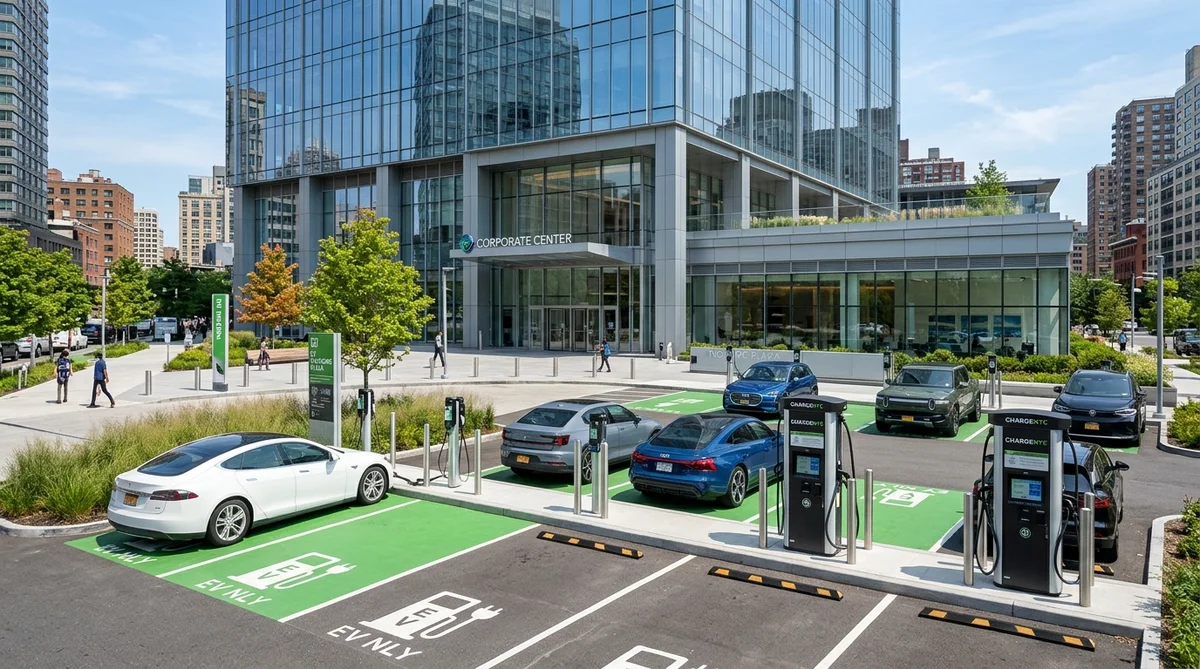
Can Private Property Owners Actually Get Federal EV Charging Funding?
A commercial property owner wants to install 20 EV charging ports in an office parking facility. Another landlord wants to add Level 2 chargers to a multifamily residential garage. Both projects require substantive capital expenditure: heavy electrical infrastructure, charging equipment, professional installation, utility coordination, and ongoing operations and software maintenance.
When searching for financial support, property owners discover that billions of dollars have been allocated to electric vehicle charging infrastructure through landmark federal programs such as the National Electric Vehicle Infrastructure (NEVI) Formula Program and the Charging and Fueling Infrastructure (CFI) Grant Program.
But there is a major practical complication: not every federal EV charging program allows private property owners to apply directly.
The Allocation Disconnect:
NEVI funding is distributed directly to state governments, which award projects competitively through state deployment plans and specialized solicitations. CFI grants generally go to eligible public agencies, which then partner with private developers and site hosts. Federal tax incentives operate under an entirely distinct statutory mechanism. A program may fund chargers placed on private land without the landowner ever receiving a direct federal check.
As of November 3, 2026, there are still compelling state-level funding opportunities for private commercial and multifamily EV charging investments, but several high-profile federal and utility incentive channels have closed or expired. Knowing the difference between these channels prevents costly planning missteps.
1. What Is the NEVI Program?
The National Electric Vehicle Infrastructure Formula Program was established under the Infrastructure Investment and Jobs Act (IIJA), signed in November 2021. The program originally allocated $5 billion in federal formula funding to state governments over five fiscal years (FY 2022 through FY 2026) to develop a reliable, interconnected nationwide network of fast-charging stations.
The initial statutory mandate focused strictly on designated Alternative Fuel Corridors (AFCs), primarily major interstates and critical highway routes. Under the Federal Highway Administration (FHWA) corridor deployment guidelines, NEVI fast-charging stations were planned at maximum intervals of approximately 50 miles, located within one travel mile of highway exits.
NEVI funding supports a wide spectrum of capital costs: eligible charging dispensers, electrical service upgrades, utility interconnection fees, civil site work, certified installation labor, and multi-year operations and maintenance. Federal participation generally covers up to 80% of eligible project costs, with the remaining 20% funded through private or non-federal capital.
The key takeaway for private landlords is that NEVI formula dollars flow straight to state departments of transportation (DOTs), not as an open over-the-counter rebate for private commercial parking structures. Private entities participate primarily by acting as site hosts, competitive contractors, or specialized charging network developers in state-approved projects.
2. Can a Private Business Apply for NEVI Funding?
Yes, but only within specific state-administered procurement frameworks. Private property owners participate across three common business arrangements:
- As a Site Host: The property owner leases or dedicates land in an accessible commercial parking lot to a selected charging operator (e.g., EVgo, Electrify America, Tesla) who designs, owns, and operates the publicly accessible DC fast-charging station.
- As a Project Applicant: Certain state transportation departments allow private businesses to submit competitive proposals directly during community-charging funding rounds.
- As a Development Partner: The property owner forms a joint venture or partnership with an EV service provider (EVSP) to co-develop charging infrastructure on the commercial property.
In all cases, private owners must comply with federal uptime minimums (typically 97% reliability), open payment standards, and mandatory public accessibility. A private garage reserved exclusively for tenant or residential parking does not meet NEVI corridor or community public-access mandates.
A Real Example: Pennsylvania's 2026 NEVI Community Funding
Pennsylvania exemplifies how private commercial businesses can access NEVI funds. PennDOT opened regional community-charging rounds during 2026, allocating approximately $100 million of its federal NEVI formula share. Any registered business entity not debarred from federal contracts is eligible to submit a proposal or partner with an operator.
| Pennsylvania Funding Round | Application Status | Important Milestone / Date |
|---|---|---|
| Southeastern Region | Closed | 71 project awards announced October 28, 2026 |
| Western Region | Open | Application deadline: November 20, 2026 |
| Central Region | Upcoming | Solicitation window opens December 7, 2026 |
| Eastern Region | Upcoming | Solicitation window opens December 7, 2026 |
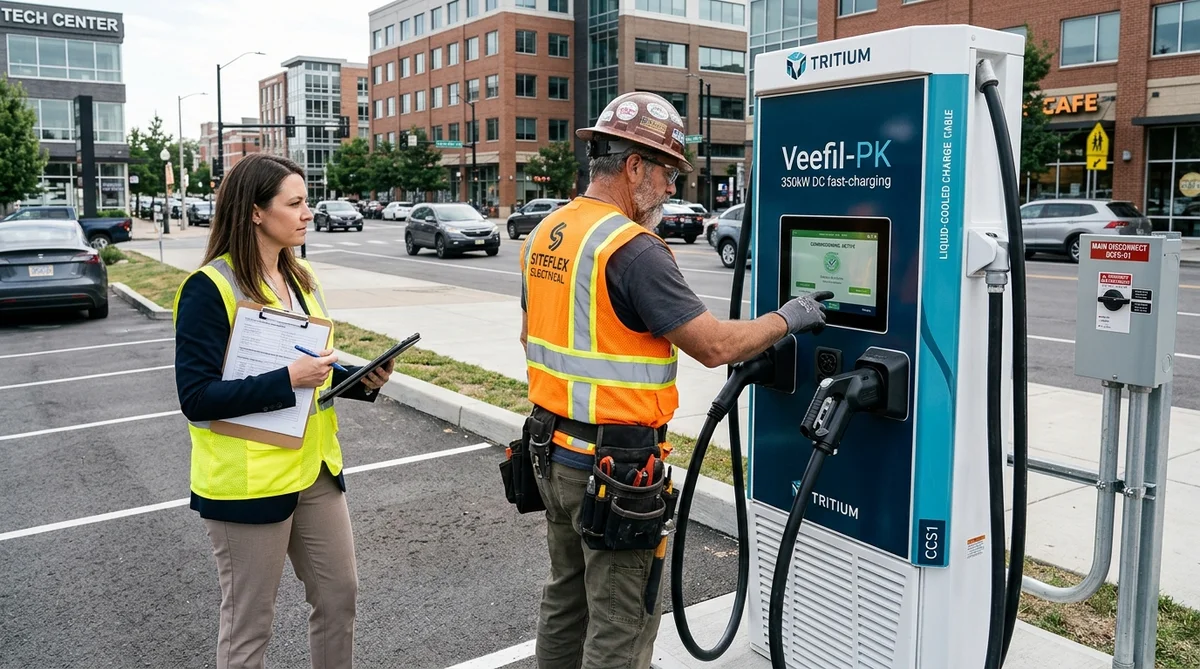 Licensed commercial electricians and facility managers inspecting high-power DC fast-charging dispensers and utility infrastructure.
3. What NEVI Funding Looks Like for New York Property Owners
New York State received approximately $175 million in NEVI formula funding over the five-year program window. The New York State Department of Transportation (NYSDOT) coordinates the overarching deployment plan, while the New York State Energy Research and Development Authority (NYSERDA) executes competitive solicitations.
In April 2026, NYSERDA announced a $45 million competitive solicitation—Program Opportunity Notice (PON) 6150—under the Alternative Fuel Corridor and Community NEVI DCFC Program. This opportunity was structured for qualified turnkey charging developers to install and operate four-port, 150kW+ DC fast-charging hubs.
As of November 3, 2026, proposals under PON 6150 (which closed June 23, 2026) are under award evaluation, following earlier upstate and downstate rounds awarded in spring 2026.
For private New York City building owners, this means NEVI is not an open grant program to add a cluster of Level 2 chargers inside a private multifamily or corporate garage. If a commercial owner possesses a publicly accessible, street-level retail lot near a designated arterial highway, the most viable path is partnering with an established EV network provider when NYSERDA issues its next solicitation.
4. What Is the CFI Grant Program?
The Charging and Fueling Infrastructure (CFI) Discretionary Grant Program is the second major federal funding initiative created by the IIJA, funded at $2.5 billion over five years. It operates through two distinct discretionary funding tracks:
| Grant Category | Primary Statutory Purpose | Typical Project Locations |
|---|---|---|
| Corridor Grants | Deploy charging along designated Alternative Fuel Corridors to build long-distance travel reliability. | Interstate rest areas, highway transit centers, commercial freight plazas, and arterial corridors. |
| Community Grants | Expand community charging access, especially in multifamily zones, downtowns, and disadvantaged areas. | Public parking lots, municipal garages, libraries, community centers, schools, and curbside spaces. |
Private entities cannot apply directly for CFI grants. Eligible lead applicants are limited to state and municipal governments, metropolitan planning organizations (MPOs), transit agencies, port authorities, and tribal entities. However, public applicants routinely issue RFPs to contract private charging operators and commercial property hosts to install and maintain the stations under an 80% federal cost-share agreement.
Is CFI Funding Currently Open?
According to the Congressional Research Service's review published on June 16, 2026, the FHWA had allocated approximately $1.8 billion across early rounds, with the latest recipient announcements completed in January 2025. No new Notice of Funding Opportunity (NOFO) was announced for the remaining $700 million FY 2026 allocation as of mid-2026 due to administrative review and policy shifts. Private property owners should not base immediate capital budgets on an anticipated near-term CFI round.
5. Federal EV Charging Tax Credit: What Happened to Section 30C?
For years, Section 30C of the Internal Revenue Code served as the primary federal tax incentive for private commercial businesses installing EV charging stations. Under the Inflation Reduction Act (IRA), business installations received a 6% base tax credit, increasing to 30% (up to $100,000 per charger unit) when meeting prevailing-wage and registered apprenticeship requirements in qualifying non-urban or low-income census tracts.
Under the One Big Beautiful Bill Act of 2025, Congress accelerated the phaseout of Section 30C: the credit does not apply to any charging property placed in service after June 30, 2026.
Critical Tax Rule for Current Projects:
A private landlord or business installing new EV charging equipment in November 2026 cannot claim the Section 30C federal tax credit. Signing a purchase contract or paying an equipment deposit before June 30, 2026, does not qualify; the IRS strictly defines "placed in service" as the date the equipment is fully installed, permitted, energized, and ready for actual charging operations.
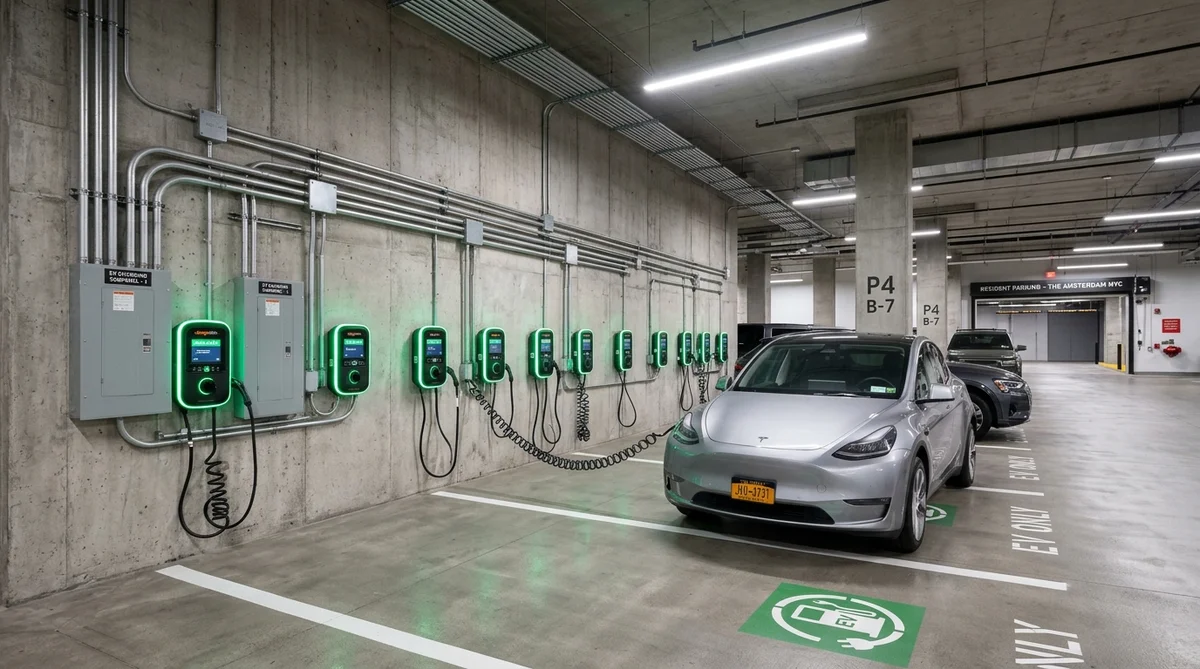 Multifamily residential garage installation featuring wall-mounted, networked Level 2 EV chargers eligible under NYSERDA Charge Ready NY 2.0.
6. What Private NYC Property Owners Can Use Instead
While federal tax credits have sunset and corridor grants are tightly restricted, private property owners in New York City have two immediate, highly actionable incentive programs: Charge Ready NY 2.0 and the New York State EV Charging Property Tax Credit.
Charge Ready NY 2.0 (NYSERDA PON 5367)
Unlike NEVI, NYSERDA's Charge Ready NY 2.0 is specifically designed for private commercial workplaces, multi-unit residential buildings, and hospitality properties installing networked Level 2 charging stations.
The program is currently active under PON 5367 with an application cutoff date of December 31, 2026, subject to remaining fund availability.
| Eligible Property Type | Base Cash Rebate Per Port |
|---|---|
| Commercial Workplace (20+ employees) | $3,000 per port |
| Multifamily Residential (10+ total units) | $3,000 per port |
| Hotel or Motel Lodging | $3,000 per port |
| Disadvantaged Community (DAC) Bonus | +$1,000 additional per port |
| Assigned Individual Space or Fleet Space | $1,000 per port |
Additional Tiered Bonus Incentives
Workplace and multifamily owners can capture substantial supplementary site bonuses by pairing charger installations with tenant/employee educational programs, ride-and-drive promotions, fleet electrification, or committing to free tenant charging for at least 12 months:
| Installation Category | Additional Bonus Incentive Per Site |
|---|---|
| Small Installation Tier | $4,000 bonus |
| Large Installation Tier | $10,000 bonus |
Core Eligibility & Operating Requirements
- Building Scale: Multifamily properties must have at least 10 dwelling units across the site, with each participating building housing at least 5 units. Workplaces must employ at least 20 individuals.
- Pre-Approval Window: Pre-installation applications reserve funds up to 180 days before installation completion. Post-installation filings are permitted within 90 days of energization.
- Hardware Requirements: Equipment must be selected from NYSERDA's approved network hardware list.
- Reporting: Owners must commit to operating the chargers and submitting operational data to NYSERDA for five years.
- Grant Stacking Prohibition: Charging equipment funded through NEVI or CFI grants is strictly ineligible for Charge Ready NY 2.0 rebates.
7. New York State EV Charging Tax Credit
Commercial building owners in New York can also leverage New York's Alternative Fuels and Electric Vehicle Recharging Property Credit. This is an official New York State corporate and personal income tax credit, not a discretionary grant.
For qualifying commercial installations, the credit equals the lesser of:
- 50% of eligible equipment and direct installation labor costs (net of any grant or rebate funding); or
- $5,000 per recharging installation.
The recharging property must be used at least 50% of the time in a trade or business conducted in New York State. The credit is nonrefundable, but unused amounts can be carried forward indefinitely. Under New York's 2025 tax-law legislation, this credit has been officially extended through tax year 2028.
How to Stack the State Tax Credit with Charge Ready NY 2.0
NYSERDA explicitly confirms that private property owners can combine Charge Ready NY 2.0 rebates with the New York State tax credit. The NYSERDA rebate must be deducted first before calculating the 50% state credit:
| Incentive Stacking Step | Financial Illustration (Per Port) |
|---|---|
| Gross Eligible Equipment & Installation Cost | $12,000 |
| Less: NYSERDA Charge Ready NY 2.0 Rebate | -$3,000 |
| Net Out-of-Pocket Expenditure | $9,000 |
| New York State Tax Credit (50% of net, max $5,000) | $4,500 |
| Net Final Cost to Commercial Property Owner | $4,500 (62.5% total savings) |
8. What About Utility EV Make-Ready Incentives?
Utility EV make-ready programs have historically funded up to 90%–100% of the expensive utility-side and customer-side electrical infrastructure (transformers, trenching, conduit, switchboards) needed to support charging hardware.
However, NYC building owners must account for a significant recent change: the Joint Utilities of New York closed the EV Make-Ready Program to new applications on April 21, 2026. Con Edison ceased accepting new Level 2 applications and paused DC fast-charging applications effective April 22, 2026.
9. Comparing Funding Options: What Should a Private Owner Pursue?
The matrix below summarizes the current operational status of all major EV charging funding channels available to private commercial real estate owners as of late 2026:
| Program Name | Direct Private Access? | Current Program Status (As of Nov. 3, 2026) |
|---|---|---|
| NEVI Formula Program | Via state procurements & host partnerships | Active via state DOT solicitations (e.g., PennDOT active; NY competitive rounds closed). |
| CFI Discretionary Grants | No (Public entities only; private partners) | Federal grant awards paused; awaiting future federal NOFO releases. |
| Federal Section 30C Tax Credit | Previously direct on IRS returns | Expired Terminated for property placed in service after June 30, 2026. |
| Charge Ready NY 2.0 (NYSERDA) | Yes, direct cash rebates | Active Open through Dec. 31, 2026 ($3,000–$4,000 per port + site bonuses). |
| New York State EV Tax Credit | Yes, direct tax credit | Active Reauthorized through tax year 2028 (50% of net cost up to $5,000/port). |
| NY Utility Make-Ready (ConEd) | Previously direct utility rebate | Closed Closed to new applications effective April 21–22, 2026. |
10. How to Prepare a Private Property for EV Charging Funding
Securing available rebates requires thorough engineering and administrative preparation before ordering equipment or breaking pavement:
Conclusion
Federal EV charging funding represents a historic investment in electrified transportation, but it was never structured as a universal direct rebate for private garages. NEVI and CFI dollars flow through state and municipal programs targeted toward public corridors. With federal Section 30C expired and utility make-ready programs closed to new applicants, private building owners cannot afford to design projects around outdated assumptions.
For New York commercial and multifamily property owners, the strategic winning formula in late 2026 is pairing NYSERDA Charge Ready NY 2.0 rebates with the New York State EV Charging Property Tax Credit. When structured correctly, these two combined incentives can offset 60% or more of total turnkey Level 2 installation costs.