Learn how battery storage works with solar, peak shaving benefits, and NYC ESS permitting.
BY NYC Energy Code Team
ON
22 August 2026
Net Metering Explained: How Solar Credits Work for NYC Buildings
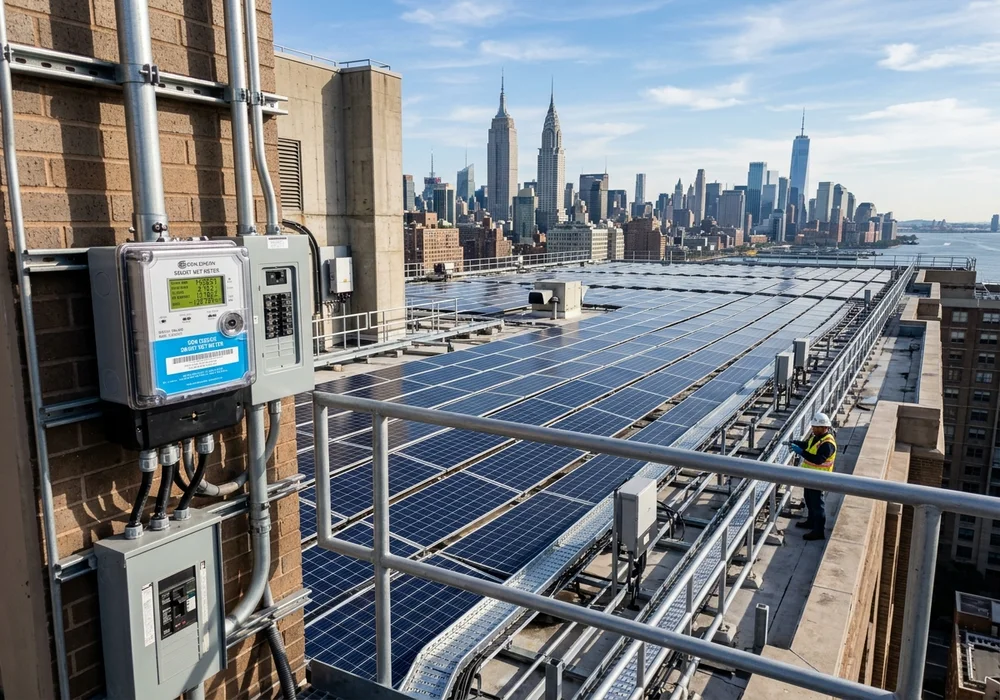
Installing solar panels on a New York City building raises an immediate operational question:
What happens when your rooftop panels produce more electricity than the building is consuming?
The answer revolves around net metering and utility compensation structures.
Net metering allows an eligible customer-sited solar array to export excess electricity back to Con Edison's grid. Instead of forfeiting that surplus energy, the property receives valuable financial credits applied directly to its monthly utility bill.
For NYC building owners, understanding how these credits are calculated is essential before finalizing system sizing, estimating revenue streams, and deciding whether traditional net metering or New York's Value Stack (VDER) provides superior financial returns.
Important Note: Not every commercial solar installation is compensated through traditional net metering. Under New York State PSC regulations, system capacity, electrical configuration, and utility tariffs dictate whether Net Energy Metering (NEM) or the Value Stack applies.
What Is Net Metering?
Net metering is a bi-directional billing mechanism that measures the difference between the electrical energy your building imports from the grid and the renewable electricity your solar panels export to the grid.
Solar Generates Electricity → Building Consumes What It Needs → Surplus Exports to Grid → Con Edison Credits Utility Bill
Con Edison utilizes bi-directional smart net meters that track electricity flow in both directions. When generation exceeds instantaneous on-site demand, the meter spins "backward" in accounting terms, generating monetary or kilowatt-hour credits that carry forward to offset future grid consumption.
A Practical Example of Solar Crediting
The Net Metering Calculation
Suppose your rooftop solar array generates 100 kWh between 12:00 PM and 2:00 PM on a bright afternoon.
During that same two-hour window, the building's lighting, HVAC, and plug loads draw 70 kWh.
100 kWh (Generated) − 70 kWh (Used On-Site) = 30 kWh Exported to Grid
The 30 kWh surplus is pushed onto Con Edison's distribution network, creating bill credits that automatically offset grid electricity consumed after sunset.
Why You Still Receive a Monthly Utility Bill
A common misconception among property owners is: "Once we install solar panels, our electric bill drops to zero."
In reality, grid-connected buildings remain active utility customers:
- Nighttime & Overcast Power: Solar systems produce zero energy at night and diminished output during heavy cloud cover, drawing power from the grid.
- Fixed Utility Service Charges: Basic customer connection fees, metering charges, and municipal surcharges apply regardless of solar production.
- Commercial Demand Charges: Peak demand spikes ($/kW) may still be incurred if coincident peak building demand occurs outside of peak solar generation hours.

On-Site Consumption vs. Grid Export: The Financial Hierarchy
From an economic standpoint, solar energy has two distinct destinations:
1. Immediate On-Site Consumption
Displaces full retail electric rates (supply + delivery + taxes). Every kWh consumed directly on-site saves the building the full commercial retail price (typically 22¢–28¢/kWh in NYC).
2. Grid Export Crediting
Surplus power exported to the grid is credited under Net Energy Metering or Value Stack tariffs, offsetting volumetric charges or accumulating monetary bill credits.
Net Metering vs. The Value Stack (VDER) in New York
New York State has transitioned distributed energy compensation to the Value of Distributed Energy Resources (VDER), commonly known as the Value Stack.
Under NYSERDA and NY Public Service Commission guidelines:
- Projects Under 750 kW AC (Host Load): Behind-the-meter solar systems under 750 kW AC that exclusively serve on-site building load have the flexibility to choose between Net Energy Metering (NEM) and the Value Stack.
- Projects Over 750 kW AC & Community Solar: Larger commercial arrays and off-site community solar projects are mandatory participants in the Value Stack tariff.
| Feature | Traditional Net Metering (NEM) | NY Value Stack (VDER) |
|---|---|---|
| Crediting Basis | Volumetric (kWh for kWh) or retail-rate equivalent | Monetary formula based on 5 stacked grid value components |
| Eligibility | Host-load projects under 750 kW AC | All commercial DERs, projects >750 kW, and Community Solar |
| Billing Reconciliation | Direct utility bill kWh offsets | Dollar credits applied against monthly electric utility charges |
| Complexity | Simple, predictable calculation | Granular, dynamic calculation based on timing and location |
How the Value Stack (VDER) Calculates Credit Value
Instead of treating every exported electron identically, the Value Stack calculates a precise monetary credit ($/kWh) based on five stacked value components:
Energy Value (LBMP): Day-ahead wholesale electricity market price in Zone J (NYC).
Capacity Value (ICAP): Value of solar power generated during peak summer grid demand hours.
Environmental Value (E-Value): Monetary compensation for avoided carbon emissions.
Demand Reduction Value (DRV): Value of relieving local distribution feeder strain during peak hours.
Locational System Relief (LSRV): Bonus credits for installations in grid-constrained NYC zones.
Multifamily Meter Configurations & Remote Crediting
In NYC multifamily buildings (co-ops, condos, and rental towers), utility meter topology dictates how solar benefits are allocated:
- Common-Area Master Meter: The simplest approach connects solar to the building's house meter, offsetting common lighting, elevators, hallway HVAC, and booster pumps.
- Remote Net Metering (RNM): Allows non-residential building owners with multiple Con Edison accounts to allocate excess solar credits from one rooftop host meter to other property accounts across the city.
- Community Distributed Generation (CDG): Allocates fractional monetary credits directly to individual tenant electric accounts without physical sub-wiring.
Common Net Metering Mistakes NYC Owners Make
Mistake 1: Sizing Systems Solely by Roof Area
Over-sizing a system beyond utility interconnection limits without analyzing interval load data can lead to reduced export compensation rates.
Mistake 2: Confusing Upfront Incentives with Ongoing Credits
NY-Sun rebates lower capital equipment costs; net metering governs 25-year operational utility bill credits. Both must be modeled together.
Mistake 3: Ignoring Future Electrification & EV Loads
Planning for future heat pump conversions or EV charging installations materially increases electricity demand, changing optimal solar sizing.
The Building Owner's Solar Credit Checklist
Annual kWh Generation: Modeled annual output using NYC solar irradiance data.
On-Site Consumption Ratio: Percentage of solar power consumed immediately vs. exported.
Tariff Selection: Financial comparison between Net Energy Metering (NEM) and Value Stack (VDER).
Utility Interconnection Class: Con Edison Coordinated Electric System Interconnection Review (CESIR).
Incentive Stacking: NY-Sun Megawatt Block + 30% Federal ITC + NYC Property Tax Abatement (PTA).
Final Takeaway
Net metering and the NY Value Stack ensure that no kilowatt-hour generated by your rooftop solar array goes to waste.
However, the true financial return of a solar installation is governed by the dynamic interplay of solar production + interval building demand + utility tariff compensation + state incentives.
Before purchasing equipment, commissioning a comprehensive Solar Feasibility Study ensures your system is right-sized for maximum economic yield and full regulatory compliance.
Frequently Asked Questions
Net metering allows eligible customer-sited solar PV systems to export surplus electricity to the Con Edison grid in exchange for monetary or volumetric kilowatt-hour credits on the customer's utility bill.
Yes. Eligible buildings receive utility bill credits or Value Stack tariff compensation when on-site solar generation exceeds the building's instantaneous electrical demand.
Yes. NYSERDA and NY PSC rules permit eligible host-load solar systems under 750 kW AC to choose between traditional Net Energy Metering (NEM) and the Value Stack.
The Value Stack (VDER) is New York's distributed energy compensation formula that calculates monetary compensation based on energy value, capacity, environmental value (E-Value), demand reduction (DRV), and locational relief (LSRV).
Excess power flows through the utility bi-directional meter onto Con Edison's grid, accumulating bill credits that offset grid power drawn at night or during future billing cycles.
No. Systems larger than 750 kW AC, standalone community solar arrays, or off-site remote projects are mandatory participants in the NY Value Stack compensation methodology.
Yes, through master metering, common-area host crediting, or Remote Net Metering / Community Distributed Generation (CDG) arrangements where credits are allocated across tenant accounts.
No. NY-Sun incentives and tax credits reduce upfront capital installation costs, whereas net metering and the Value Stack govern ongoing monthly revenue and billing credits for energy generated.
No. System sizing must balance available roof area against the facility's interval load profile, utility tariff rules, interconnection limits, and future electrification demands.
Not necessarily. Fixed basic service fees, customer charges, and certain demand charges may still apply even if solar credits offset 100% of volumetric energy consumption.