Learn what influences the cost of a commercial solar feasibility study in NYC and how it drives ROI.
BY NYC Energy Code Team
ON
19 August 2026
Battery Storage 101: Is It Worth Pairing with Your Solar Setup?
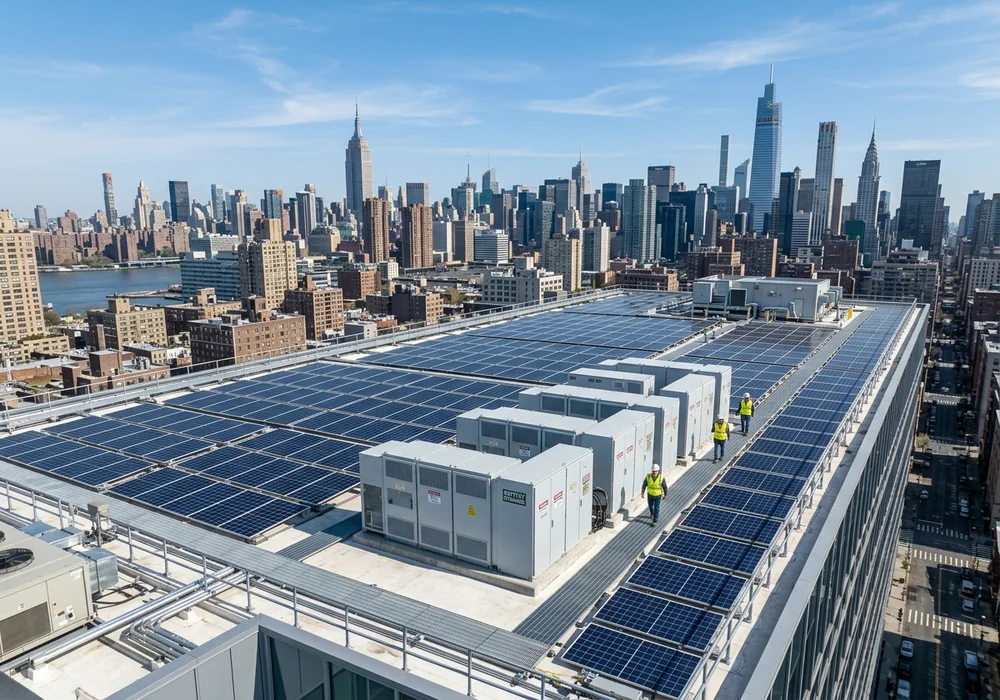
Solar panels are remarkably effective at one specific task: producing clean electricity when the sun is shining.
But what happens when the sun goes down or peak utility demand charges kick in?
That's where battery energy storage systems (BESS) come in.
Instead of exporting every surplus kilowatt-hour of solar electricity back to the grid at base export rates, an on-site battery can store that energy and make it available when it provides the highest financial value. For an NYC building owner, that can mean better utilization of rooftop solar, substantial utility bill savings through peak demand shaving, enhanced power resilience, and greater control over grid power draws.
But adding batteries isn't automatically an open-and-shut financial decision.
The right question is: "Will battery storage provide enough operational and financial value to justify its capital cost for this specific building?"
What Is Battery Energy Storage?
A battery energy storage system stores electrical energy chemically for dispatch at a later time. When integrated with a rooftop or canopy solar array, the power flow operates in a continuous smart cycle:
Solar Panels → Building Loads → Excess Electricity → Battery Storage → Discharged to Building Later
During sunny midday hours, solar production often exceeds instant building demand. Instead of pushing that excess to Con Edison's grid, the smart inverter directs it into the battery. Later, the battery discharges when:
- Solar production drops off in late afternoon and evening.
- Building electricity demand spikes to daily peaks.
- Utility time-of-use grid electricity rates are at their highest.
- The local grid experiences a blackout or voltage sag (providing backup power).
NYSERDA specifically identifies storing excess solar generation for use during higher-cost periods as one of the chief economic benefits of commercial energy storage in New York State.
Why Pair Solar With a Battery?
Solar and battery storage solve two distinct operational challenges:
- Solar generates clean kilowatt-hours.
- Battery storage moves that electricity through time to when it is most valuable.
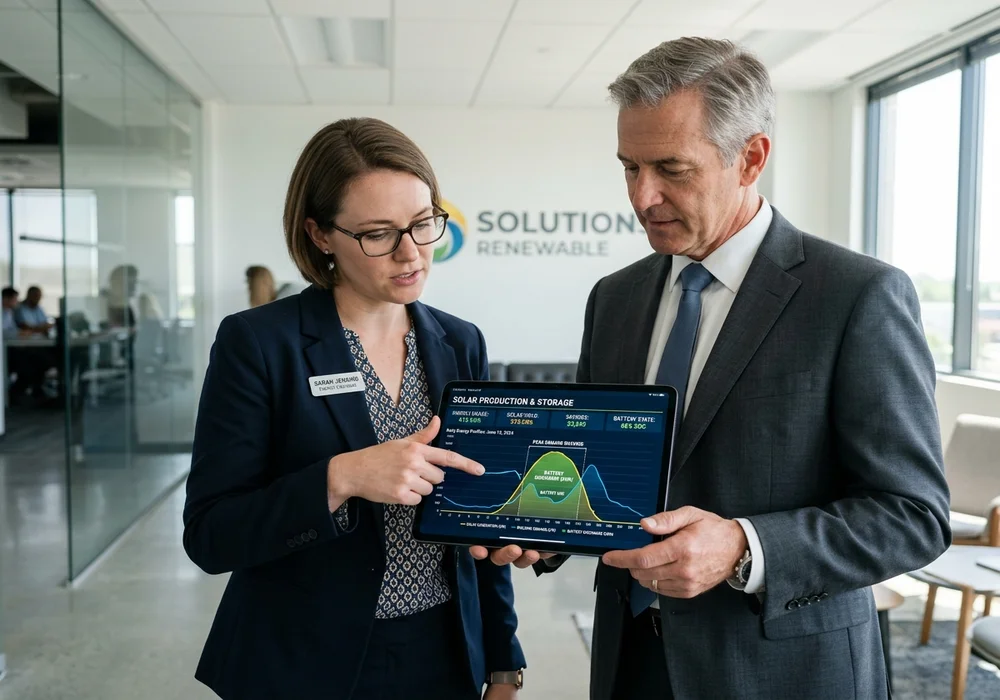
Consider a typical commercial office or residential building in NYC. Solar output peaks between 11:00 AM and 2:00 PM. However, maximum building consumption frequently occurs between 4:00 PM and 8:00 PM when tenants arrive home or cooling systems run at maximum capacity. Without storage, midday solar is exported at modest buyback rates while evening power is purchased at peak retail pricing. A battery shifts midday solar into peak evening hours, maximizing self-consumption.
Batteries and Commercial Peak Demand Shaving
For commercial property owners in NYC, monthly electric bills consist of two major charges: consumption (kWh) and demand ($/kW).
Demand charges are calculated based on the highest 15- or 30-minute power spike recorded during the billing cycle—often accounting for 30% to 50% of the entire utility bill.
An intelligent battery management system detects when building demand nears peak thresholds and instantly discharges stored power, flattening the spike. This process—known as peak shaving—can generate tens of thousands of dollars in annual utility bill savings without altering tenant operations.
What About Emergency Backup Power?
Resilience during severe weather events or localized grid disruptions is a primary motivator for NYC landlords and co-op/condo boards.
While a battery system rarely replaces an entire building's central heating and chillers indefinitely, it can be engineered with critical load subpanels to sustain essential operations:
- Emergency corridor and stairwell egress lighting
- Security, fire alarm, and access control systems
- Sump pumps and domestic water booster pumps
- Telecom, Wi-Fi, and emergency management communication hubs
- Selected residential plug circuits and refrigeration
Solar Alone vs. Solar Plus Battery at a Glance
| Feature | Solar Only | Solar + Battery Storage |
|---|---|---|
| Energy Generation | Produces electricity in real time | Produces and stores electricity on-site |
| Energy Timing | Must be used or exported immediately | Dispatched on demand at peak rate hours |
| Peak Demand Shaving | Intermittent and weather-dependent | Automated, reliable spike reduction |
| Outage Backup | Shuts down during grid outages (anti-islanding) | Provides islanded backup to critical subpanels |
| Upfront Capital Cost | Lower capital expenditure | Higher upfront cost (offset by NYSERDA/tax credits) |
| Installation & Permitting | Standard electrical & DOB filing | Requires FDNY approval, DOB ESS plan review |
When Is Battery Storage Worth It?
Battery storage delivers the strongest financial returns when a property exhibits specific physical and operational characteristics:
High Demand Charges
Facilities paying steep $/kW peak demand charges have the fastest payback through automated peak shaving.
Large Solar Capacity
Buildings with expansive roofs generating significant midday surplus energy can cycle batteries daily.
Heavy Evening Usage
Properties with active night operations or residential occupancy benefit from time-of-use rate arbitrage.
Mission-Critical Loads
Healthcare, data, life-safety, and residential facilities that cannot afford unscheduled downtime.
When Might a Battery Not Make Sense?
Battery storage is not a universal solution. It may be difficult to justify economically when:
- Overall electricity consumption and peak demand are relatively low.
- The building has minimal solar surplus to charge storage on-site.
- Utility rate tariffs do not impose heavy demand charges or time-of-use spreads.
- The building has severe structural or spatial constraints that inflate installation costs.
- Backup power is already reliably handled by existing emergency systems.
Don't Confuse kW (Power) With kWh (Energy Capacity)
A common point of confusion for property managers is the difference between battery power and battery capacity:
- kW (Kilowatts) = Power Output: Measures how fast the battery can deliver power at any given instant. A 100 kW battery can quickly discharge 100 kW to shave a heavy motor startup spike.
- kWh (Kilowatt-hours) = Energy Capacity: Measures total stored energy over time. A 200 kWh battery delivering 50 kW of power can sustain that load continuously for 4 hours (200 / 50 = 4).
NYC Safety, Permitting, and FDNY Compliance
In New York City, stationary energy storage systems (BESS) are subject to rigorous municipal safety codes.
NYC DOB & FDNY Regulatory Framework
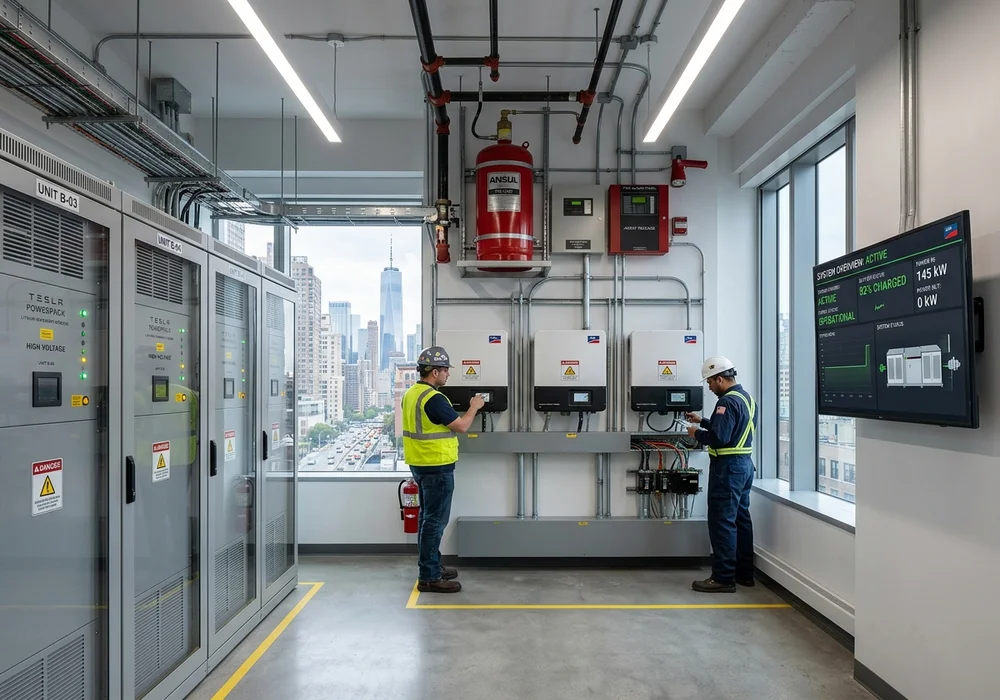
The NYC Department of Buildings classifies stationary battery storage under dedicated construction work types requiring full plan examination—Professional Certification (ProCert) is not permitted for ESS applications.
Projects require UL 9540 listing, UL 9540A large-scale fire testing documentation, FDNY Certificate of Approval, dedicated gas detection, automatic fire suppression, and third-party commissioning. Engineering and permitting must be budgeted upfront.
Incentives and Tax Credits in 2026
State and federal incentive programs significantly accelerate battery storage ROI:
- NYSERDA Energy Storage Incentives: NYSERDA's commercial and retail storage programs provide direct $/kWh incentives for qualifying systems paired with renewable generation, with higher incentive blocks for projects in Disadvantaged Communities and affordable housing.
- Federal Clean Energy Tax Credit (ITC): The federal Inflation Reduction Act provides an Investment Tax Credit starting at 30% base credit for commercial battery energy storage systems, with additional 10% bonus credits for domestic content and energy community locations.
- NYC Property Tax Abatement: Eligible solar and storage installations can qualify for property tax relief through NYC's PTA programs.
Battery Storage and Local Law 97
While a battery system does not generate renewable electrons by itself, pairing battery storage with solar PV allows buildings to optimize on-site clean energy use and reduce reliance on peak grid electricity.
Under Local Law 97, qualifying distributed energy resources (DERs) can contribute to compliance deductions, lowering annual emissions liabilities and avoiding steep fines of $268 per metric ton of CO₂e.
A 10-Step Solar + Battery Decision Roadmap
Before committing capital to battery storage, follow this structured engineering process:
1 Interval Load Data Analysis
Extract 15-minute utility interval data to map the building's 24-hour demand profile across all four seasons.
2 Solar Production Modeling
Model hourly solar PV generation to calculate exact midday surplus available for charging.
3 Demand Charge Exposure Check
Quantify monthly peak demand expenses ($/kW) to evaluate potential peak shaving savings.
4 Critical Load Identification
Specify exact life-safety, pumping, lighting, and elevator circuits required during grid outages.
5 Power (kW) and Capacity (kWh) Sizing
Right-size the inverter power rating and battery storage capacity for optimal cycle life.
6 FDNY & Spatial Feasibility
Confirm compliant outdoor rooftop or dedicated indoor room locations with required fire separation.
7 NYSERDA Incentive Application
Verify current retail and commercial storage incentive block availability and file pre-applications.
8 Life-Cycle Financial Modeling
Model 15-to-20 year cash flows factoring in degradation, tax credits, demand savings, and maintenance.
9 Con Edison Interconnection Review
Submit preliminary interconnection screening to confirm transformer and electrical service capacity.
10 Professional Engineering Filing
Engage a Registered Design Professional (PE) for formal DOB plan examination and FDNY sign-offs.
Final Takeaway
So, is battery storage worth pairing with your solar setup?
For buildings with significant peak demand charges, valuable critical loads, and strong midday solar surplus, battery storage transforms a standard solar installation into an intelligent, highly resilient energy management powerhouse.
Solar generates the energy—battery storage controls when you deploy it. A professional Solar Feasibility Study will analyze your interval load profile and determine the exact financial payback before you invest.
Frequently Asked Questions
Yes, particularly for commercial properties facing heavy utility demand charges ($/kW), buildings with evening consumption peaks, or facilities requiring critical backup power during grid disruptions.
Yes. An integrated battery captures surplus solar generation during peak sun hours and stores it on-site rather than exporting it at lower grid buyback rates, allowing you to discharge it when energy is most expensive.
Yes, when designed with islanding capabilities and dedicated critical load subpanels. The battery can sustain lighting, water pumps, elevators, and communications during blackouts.
No. A battery stores electricity with instant response, zero noise, zero on-site fuel combustion, and zero direct emissions. Unlike generators that require fossil fuel deliveries, batteries recharge automatically from solar.
Yes. NYSERDA offers commercial energy storage incentives on a $/kWh basis, and the federal IRA provides a 30%+ Investment Tax Credit (ITC) for commercial storage installations.
In most cases, yes. An AC-coupled or DC-coupled battery energy storage system can be integrated with existing commercial solar installations through NYSERDA's retail storage program.
No. Systems must use certified equipment, satisfy utility interconnection standards, meet prevailing wage or apprenticeship criteria (for full ITC), and be approved under NYSERDA program rules.
Yes. The NYC Department of Buildings requires full plan examination (ProCert is prohibited for ESS), along with FDNY Certificate of Approval, UL 9540/9540A testing, and third-party commissioning.
Perform a detailed interval load analysis and Solar Feasibility Study to determine your building's exact demand profile, solar output, and critical load requirements before selecting equipment.