Learn how Local Law 97 emissions limits change between 2024-2029 and 2030-2034...
BY NYC Energy Code Team
ON
18 August 2026
Carbon Trading for Buildings: Can You Buy Your Way Out of LL97 Fines?
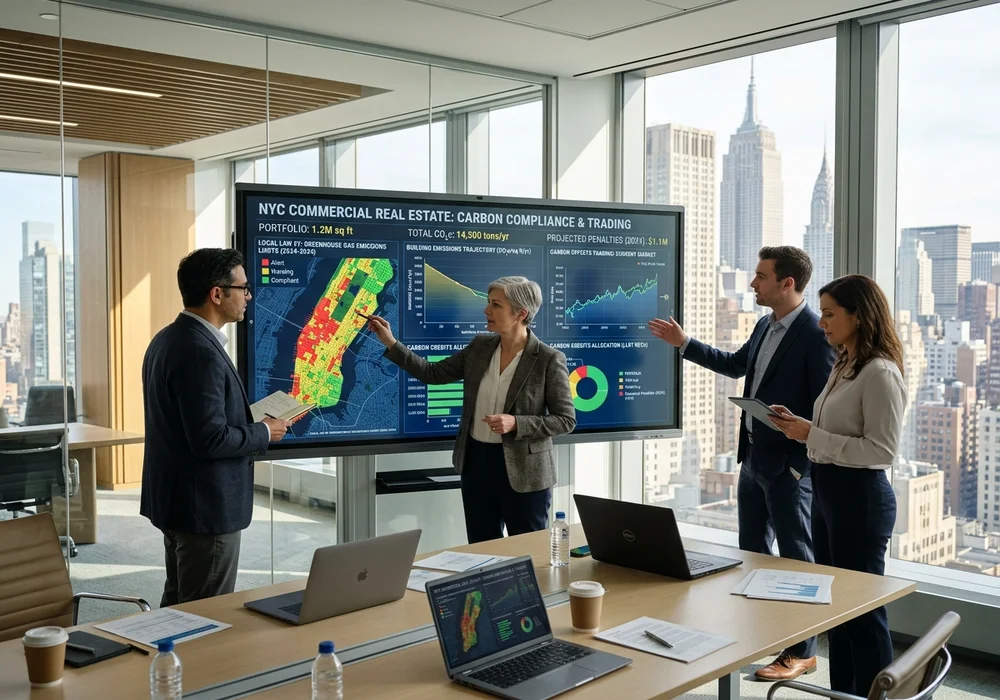
Local Law 97 has created a question that comes up more often as building owners review their annual greenhouse gas emissions:
"Can I just buy carbon credits and avoid the fine?"
The answer is not exactly.
LL97 does provide certain deductions and alternative methods that can reduce a building's compliance burden. But NYC's program is not a free-market carbon exchange where an owner can simply exceed the emissions limit and purchase unlimited credits to make the problem disappear.
There are specific rules around greenhouse gas offsets, Renewable Energy Credits (RECs), distributed energy resources, and beneficial electrification deductions. Crucially, several of these options are strictly capped.
For building owners, the distinction matters because buying an eligible compliance instrument can be useful in specific situations, but it is never a permanent substitute for planning the building's physical energy performance.
What Does "Carbon Trading" Mean Here?
In a traditional voluntary carbon market, an organization that emits more than its target may purchase credits representing verified emissions reductions from forestry or renewable projects anywhere in the world.
Local Law 97 establishes a much narrower, localized framework.
The NYC Department of Buildings (DOB) allows specific deductions and alternative compliance methods that can adjust how a building's annual emissions are calculated:
- Greenhouse gas offsets (via the Affordable Housing Reinvestment Fund)
- Renewable Energy Credits (RECs) tied to qualifying clean electricity
- Distributed energy resources (DERs) like on-site solar and battery storage
- Beneficial electrification deductions for clean heat pumps
- Certain alternative calculation methodologies for complex campuses
So while the phrase "carbon trading" can be useful shorthand, it must not be confused with unlimited permission to buy your way out of LL97 obligations.
The Most Important Option: LL97 Offsets
For certain covered buildings, eligible greenhouse gas offsets can reduce the total reported emissions amount used for annual compliance.
The 10% Statutory Cap
The offset deduction is strictly capped at 10% of the building's applicable annual emissions limit.
Under current 2026 program guidance, the only greenhouse gas offsets eligible for LL97 compliance are those purchased through the Affordable Housing Reinvestment Fund (AHRF) Offsets Program.
That means offsets are a limited bridge tool—not an open loophole.
How Much Do LL97 Offsets Cost?
The current AHRF program lists a fixed price of $268 per offset, with one offset representing one metric ton of CO₂ equivalent (tCO₂e).
Because the maximum offset purchase is capped at 10% of the building's applicable emissions limit, here is how the math works in practice:
Illustrative Example Calculation:
Assume a large commercial property has an applicable annual emissions limit of 10,000 metric tons of CO₂e.
- 10% Maximum Offset Cap: 10,000 tCO₂e × 10% = 1,000 metric tons
- Cost per Offset: $268 per tCO₂e
- Maximum Allowed Purchase: 1,000 tCO₂e × $268 = $268,000
Note: This hypothetical example demonstrates the statutory calculation. Actual applicable limits and eligibility must be verified by a registered design professional.
Why the 10% Cap Matters
This is the critical factor many owners misunderstand.
The Overage Trap
Imagine a building exceeds its limit by 25%. The owner cannot simply buy offsets for the entire 25% excess. Because the deduction is capped at 10% of the total limit, offsets can cover only a fraction of the overage. The remaining 15% excess emissions will still trigger substantial annual DOB civil penalties unless resolved through building operational improvements or equipment upgrades.
Where Does the Offset Money Go?
LL97's AHRF offset program is purposefully designed to direct capital toward deep energy improvements in New York City's qualifying affordable housing properties.
The NYC Department of Buildings channels offset revenue directly into decarbonization retrofits administered through the NYC Department of Housing Preservation and Development (HPD).
This structure ensures that compliance dollars remain inside New York City, funding real emissions reductions in underserved communities rather than purchasing distant, unverified credits.
What About Renewable Energy Credits (RECs)?
Renewable Energy Certificates (RECs) represent the environmental attributes of one megawatt-hour (MWh) of renewable electricity generation delivered to the grid.
Under Local Law 97, building owners may apply deductions for qualifying RECs to offset emissions from electricity consumption—subject to strict NYC rules:
- The renewable energy must be generated in, or directly delivered into, the NYC transmission territory (NYISO Zone J).
- RECs cannot be used to offset emissions from on-site fossil fuel combustion (natural gas or fuel oil boilers).
- RECs are not interchangeable with AHRF offsets.
NYC continues to regulate and review REC policies. For instance, proposed City Council legislation has explored capping REC deductions at 10% of a building's electricity emissions overage. Owners must distinguish between current active rules and future legislative proposals.
Distributed Energy Resources & Beneficial Electrification
Rather than purchasing external credits, owners can invest in on-site assets that qualify for direct compliance deductions under DOB rules:
Solar PV & Energy Storage
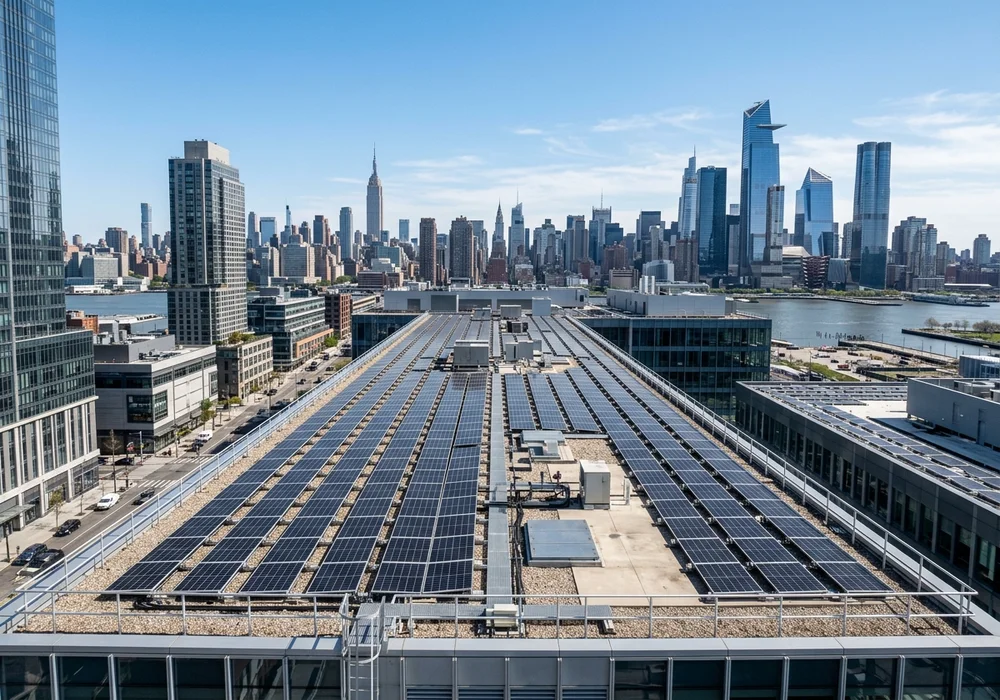
On-site solar arrays and battery energy storage systems (BESS) qualify for emissions deductions under DOB DER guidelines.
Beneficial Electrification
Transitioning heating and domestic hot water from fossil fuels to clean electric heat pumps qualifies for specialized deduction formulas.
So Can You Actually "Buy Your Way Out"?
The reality is clear: only to a limited extent, and never as a substitute for long-term capital planning.
Eligible offsets and deductions provide valuable flexibility if your property is within striking distance of its emissions target. But if the building has substantial fossil fuel consumption or poor energy efficiency, purchased deductions cannot bridge the gap on their own.
Penalty vs. Compliance: Why Paying the Fine Is Not a Strategy
Some owners wonder whether simply treating DOB penalties as an "annual cost of doing business" makes financial sense.
Key Penalty Facts for NYC Owners:
- Article 320 Buildings: Fined $268 per year for every metric ton of CO₂e emitted above the limit, plus monthly fines for late or missing annual filings ($0.50/sq ft/month).
- Article 321 Buildings: Subject to direct $10,000 penalties for non-compliance or failure to implement required prescriptive energy conservation measures.
- No Certificate of Compliance: Paying a fine does not grant compliance status—the open violation remains on Department of Buildings public records, impairing refinancing, sales, and leasing.
When Offsets vs. Building Upgrades Make Sense
Determining the right mix of operational measures and compliance deductions depends on your current emissions margin:
- When Offsets Make Sense: When a building is within 5% to 10% of its emissions limit, purchasing AHRF offsets can provide an immediate, predictable compliance buffer while capital projects are being designed.
- When Physical Upgrades Make Sense: When a building consistently exceeds limits by 15% or more, or when preparing for the tighter 2030 limits, physical upgrades (HVAC optimization, controls tuning, LED lighting, insulation, and heat pumps) are essential to eliminate recurring annual liabilities.
A Practical 7-Step LL97 Compliance Roadmap
For NYC property owners, a sensible and cost-effective compliance workflow follows these seven steps:
1 Calculate Actual Emissions
Aggregate 12 months of utility data (electric, gas, steam, fuel oil) to calculate your building's exact gross annual metric tons of CO₂e.
2 Determine the Applicable Limit
Verify your building's ENERGY STAR Portfolio Manager property type classifications and calculate your specific 2024–2029 and 2030–2034 caps.
3 Quantify the Compliance Gap
Calculate the exact tonnage overage and corresponding penalty risk ($268/tCO₂e) under current and future limits.
4 Identify Legitimate Deductions
Review eligibility for AHRF offsets (up to 10% cap), Zone J RECs, solar PV, energy storage, and beneficial electrification.
5 Evaluate Low-Cost Physical Improvements
Leverage Local Law 87 retro-commissioning, sensor calibrations, and boiler tuning to shave off low-hanging energy waste.
6 Compare Life-Cycle Economics
Compare upfront equipment costs, Con Edison incentives, operating utility savings, and avoided annual penalty exposure.
7 File Certified Compliance Reports
Submit the annual emissions report prepared and certified by a Registered Design Professional (PE or RA) by the DOB deadline.
The Biggest Mistake Property Owners Make:
"I'll deal with our emissions later and just buy credits if necessary." Waiting until the deadline leaves owners with capped deduction options, zero lead time for engineering, and unavoidable penalties.
Final Takeaway
So, can you buy your way out of LL97 fines? Not completely.
While the Affordable Housing Reinvestment Fund allows offsets at $268 per metric ton, the deduction is strictly capped at 10% of your building's emissions limit.
The winning strategy is to understand your building's emissions profile today, leverage allowable deductions where appropriate, and invest in the energy efficiency, controls, and electrification measures needed for long-term 2030 compliance.
Frequently Asked Questions
To a limited extent, eligible LL97 offsets can provide a deduction from emissions used for compliance. However, the current AHRF offset deduction is strictly capped at 10% of the building's applicable annual emissions limit.
They are qualifying greenhouse gas offsets recognized under NYC's LL97 compliance framework. Under current 2026 guidance, eligible LL97 offsets are purchased through the Affordable Housing Reinvestment Fund (AHRF) Offsets Program administered with HPD.
The current AHRF program lists the price at $268 per metric ton of CO₂e, subject to program eligibility rules and the 10% purchase ceiling.
No. The maximum allowable offset deduction is 10% of the building's applicable annual emissions limit. Any emissions exceeding that cap cannot be mitigated through offsets.
No. RECs and greenhouse gas offsets are distinct compliance mechanisms. RECs offset emissions from electricity consumption only and must originate from clean energy delivered into NYISO Zone J, while offsets mitigate overall building emissions under the AHRF fund.
Yes. NYC's LL97 framework recognizes qualifying distributed energy resources (DERs)—including on-site rooftop solar, off-site community solar, and battery energy storage—as valid emissions deductions.
No. Because offsets are capped at 10% and emissions limits become significantly more stringent in 2030, relying solely on offsets leaves the building exposed to massive future fines. Physical efficiency and decarbonization address the root cause.
For Article 320 buildings, annual civil penalties of $268/tCO₂e continue to recur every year. Paying the penalty leaves an open Department of Buildings violation on the property, which can complicate financing, property sales, and tenant leasing.