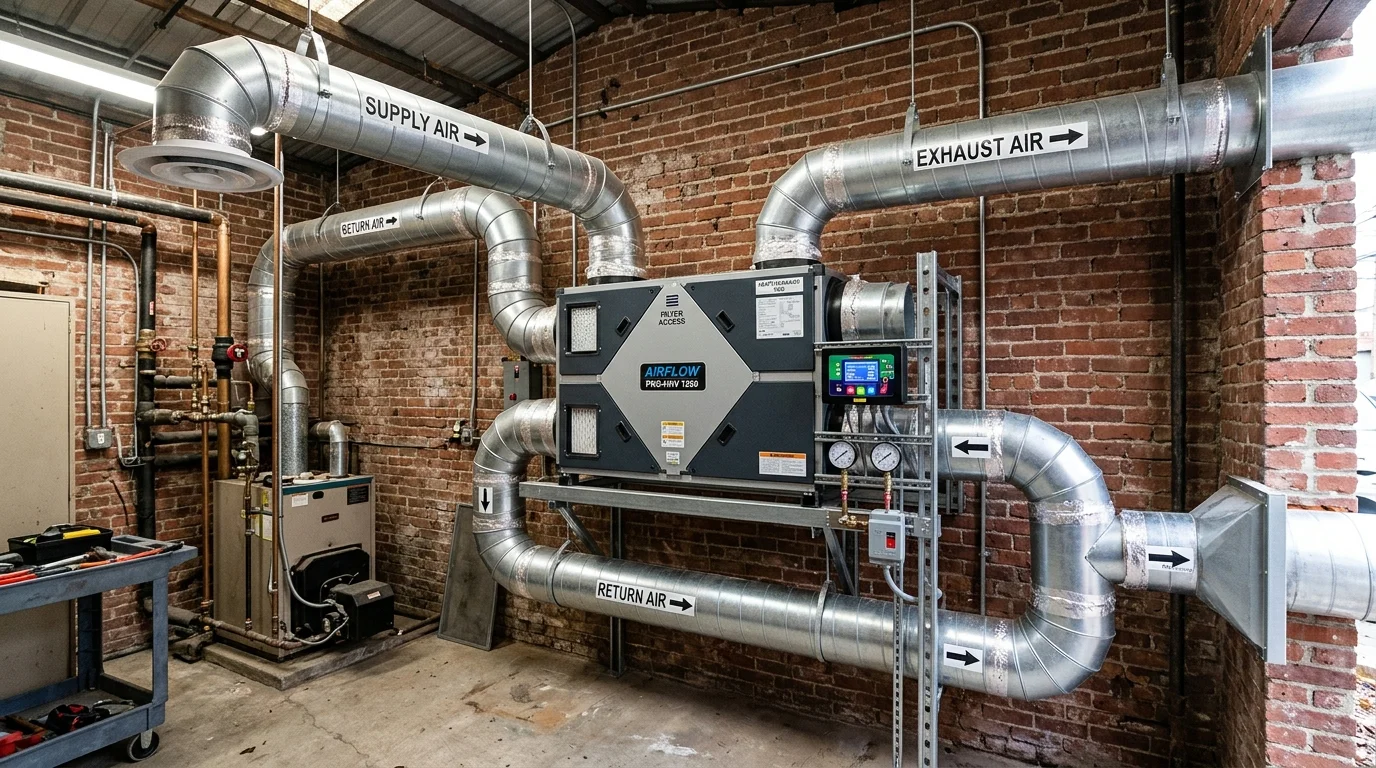
Why Older Buildings Need a Different Approach to Ventilation
Older buildings often have a ventilation problem that is difficult to solve with a single HVAC upgrade. Some rely on bathroom and kitchen exhaust fans, aging ductwork, operable windows, or systems that were never designed for today's expectations around energy efficiency and indoor air quality.
During winter, opening windows or exhausting warm indoor air can increase heating demand. In summer, bringing in hot outdoor air can add to the cooling load. Simply reducing ventilation is not a good solution either, because occupants still need adequate fresh air and effective removal of indoor pollutants.
Heat recovery ventilation (HRV) offers a way to introduce outdoor air while recovering some of the heat contained in the outgoing exhaust air. This can reduce the energy required to condition incoming air, particularly during cold weather.
For owners of older multifamily, residential, and commercial buildings in New York City, however, installing an HRV system requires more planning than selecting equipment. Available duct routes, limited mechanical space, the condition of existing ventilation systems, moisture control, and fire-safety requirements can determine whether the retrofit is practical.
The real question is not simply whether heat recovery works. It is whether the building can accommodate the system at a reasonable cost while improving ventilation performance.
What Is Heat Recovery Ventilation (HRV)?
An HRV is a mechanical ventilation system that supplies outdoor air and exhausts stale indoor air while transferring heat between the two airstreams through a heat exchanger.
During winter, warm exhaust air transfers some of its heat to the incoming cold outdoor air. The supply air enters the building warmer than it otherwise would, reducing the heating load associated with ventilation.
Depending on the system design and operating conditions, heat transfer can also work in the opposite direction during warmer weather, reducing the amount of outdoor heat entering with ventilation air.
An HRV does not eliminate the need for heating or cooling. It reduces part of the energy required to condition ventilation air.
It also does not replace every ventilation system in a building. Exhaust from areas such as commercial kitchens, clothes dryers, hazardous processes, and certain other applications has specific requirements and cannot simply be routed through a standard heat recovery unit.
The U.S. Department of Energy identifies heat and energy recovery ventilation as useful HVAC retrofit measures because they recover energy that would otherwise be exhausted from a building. [Source: DOE — HVAC Retrofit].
HRV vs ERV: Which Is Better for an Older Building?
Before planning an installation, distinguish an HRV from an energy recovery ventilator (ERV). They work on similar principles, but transfer different forms of energy.
| Feature | Heat Recovery Ventilator (HRV) | Energy Recovery Ventilator (ERV) |
|---|---|---|
| Heat transfer | Yes | Yes |
| Moisture transfer | Generally no | Yes, depending on the core and system |
| Winter operation | Recovers sensible heat from exhaust air | Recovers heat and can transfer moisture |
| Humidity management | Does not intentionally transfer moisture between airstreams | Can reduce the moisture load associated with incoming ventilation air |
| Retrofit considerations | Useful where sensible heat recovery is the priority | Worth evaluating where both temperature and moisture loads matter |
In a cold winter, an HRV can help recover heat from warm indoor air. An ERV may be preferable in circumstances where transferring moisture helps maintain more suitable indoor humidity or reduces the load associated with humid outdoor air.
New York City's climate includes cold winters and humid summers, so neither technology is automatically the right choice for every building. The decision should account for the building's existing humidity conditions, exhaust sources, ventilation strategy, and HVAC equipment.
NYCHA's design guidance discusses HRVs and ERVs as ventilation improvements for multifamily properties, including corridors, common areas, and deep energy retrofits. [Source: NYCHA — Energy Recovery and Heat Recovery Ventilation].
The Main Benefits of HRV Retrofits
1. Lower Heating Demand From Ventilation
In a building without heat recovery, warm indoor air is exhausted and outdoor air must be heated to the desired supply condition. The heating equipment must provide that energy.
An HRV transfers some heat from the outgoing air to the incoming air, reducing the amount of additional heating required.
The benefit is most relevant when the building needs significant outdoor ventilation during cold weather and has a suitable supply-and-exhaust arrangement.
However, the savings depend on the actual airflow, heat exchanger performance, operating hours, fan electricity, and heating system efficiency. A system operating at very low ventilation rates or in a building with limited heating demand may provide less financial benefit.
2. More Controlled Fresh-Air Delivery
A properly designed system can provide a more predictable supply of outdoor air than relying on incidental air leakage or opening windows.
For multifamily buildings, a well-coordinated ventilation upgrade can improve airflow consistency across apartments or common spaces. The actual indoor-air-quality result depends on system design, filtration, airflow balancing, commissioning, and maintenance.
An HRV should be viewed as one part of a ventilation strategy rather than a guarantee of improved indoor air quality. Adequate ventilation rates and pollutant control still need to be established for the intended occupancy.
3. Better Coordination With Energy Retrofits
An HRV can complement air sealing, insulation, window upgrades, and HVAC improvements.
For example, improving an older building's airtightness through commercial roof and wall insulation may reduce uncontrolled infiltration and heating losses. A planned ventilation system can then help deliver the required outdoor air through designated pathways while recovering energy from exhaust air.
The sequence matters. Adding heat recovery without understanding the existing airflow may fail to address the underlying problem. Similarly, sealing a building without reviewing its ventilation needs can produce poor results.
The U.S. Department of Energy recommends evaluating ventilation, controls, and other HVAC retrofit measures as part of an integrated strategy. [Source: DOE — HVAC Retrofit].
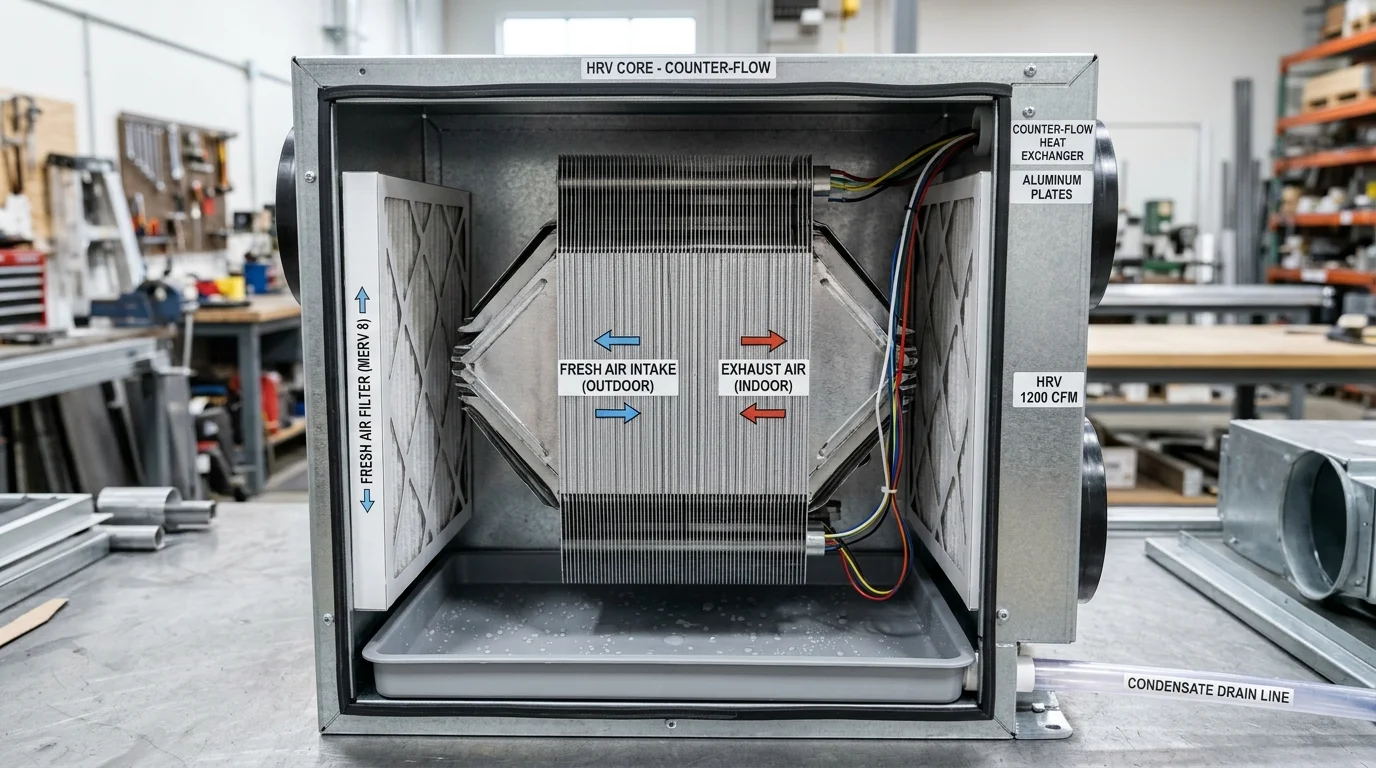 Internal view of a counter-flow HRV heat exchanger core showing separate fresh air intake and exhaust channels
The Challenges: Why HRV Installation Is Harder in Older Buildings
The technology itself is relatively straightforward. Retrofitting it into an occupied building is where the complexity often begins.
Limited Space for Ductwork
Many older apartment buildings were designed without dedicated routes for balanced supply and exhaust ventilation. Existing shafts may be crowded with plumbing, electrical services, and other building systems.
A centralized HRV may require new ductwork through corridors, ceilings, closets, or other spaces. A decentralized or room-by-room system can reduce the need for extensive duct networks, but it still requires suitable locations for outdoor-air intake and exhaust.
In historic buildings, exterior openings may also require careful design or approvals.
Disruption to Occupied Spaces
Installing new ductwork can involve opening ceilings, constructing chases, relocating services, and repairing interior finishes.
In multifamily buildings, the work may need to take place across numerous apartments, with access coordinated around residents' schedules. This can add labor and management costs beyond the price of the HRV equipment itself.
A project that looks affordable when priced as a piece of equipment may become much more expensive once access, duct routing, restoration, and tenant coordination are included.
Condensation, Drainage, and Frost Protection
Heat recovery systems operating in cold weather can produce condensate, and moisture in the heat exchanger may freeze under certain conditions.
The system therefore needs suitable frost protection, drainage arrangements, and access for maintenance. These requirements become especially important when equipment is installed in a basement, attic, rooftop enclosure, or other space with challenging conditions.
A design that ignores condensate disposal or freeze protection can lead to operating problems and reduce the system's overall performance.
Ventilation Balance and Existing Exhaust Systems
An HRV typically operates with supply and exhaust airstreams that need to be coordinated. If the existing ventilation system remains unchanged, the combined system may produce unexpected pressure conditions or uneven airflow.
The HVAC engineer should check the existing exhaust equipment, combustion appliances where present, required ventilation rates, and system control strategy as part of a comprehensive LL87 energy audit and RCx investigation. The final system needs to deliver the intended airflow without creating unsafe or unsuitable building pressure conditions.
The design must also distinguish ordinary ventilation exhaust from specialized exhaust streams. NYC Mechanical Code Section MC 514 restricts the use of energy recovery systems in specified applications, including hazardous exhaust, smoke control systems, commercial kitchen hood exhaust, and clothes-dryer exhaust, unless the applicable engineered-system conditions or exceptions are met. [Source: NYC Mechanical Code — Energy Recovery Ventilation Systems].
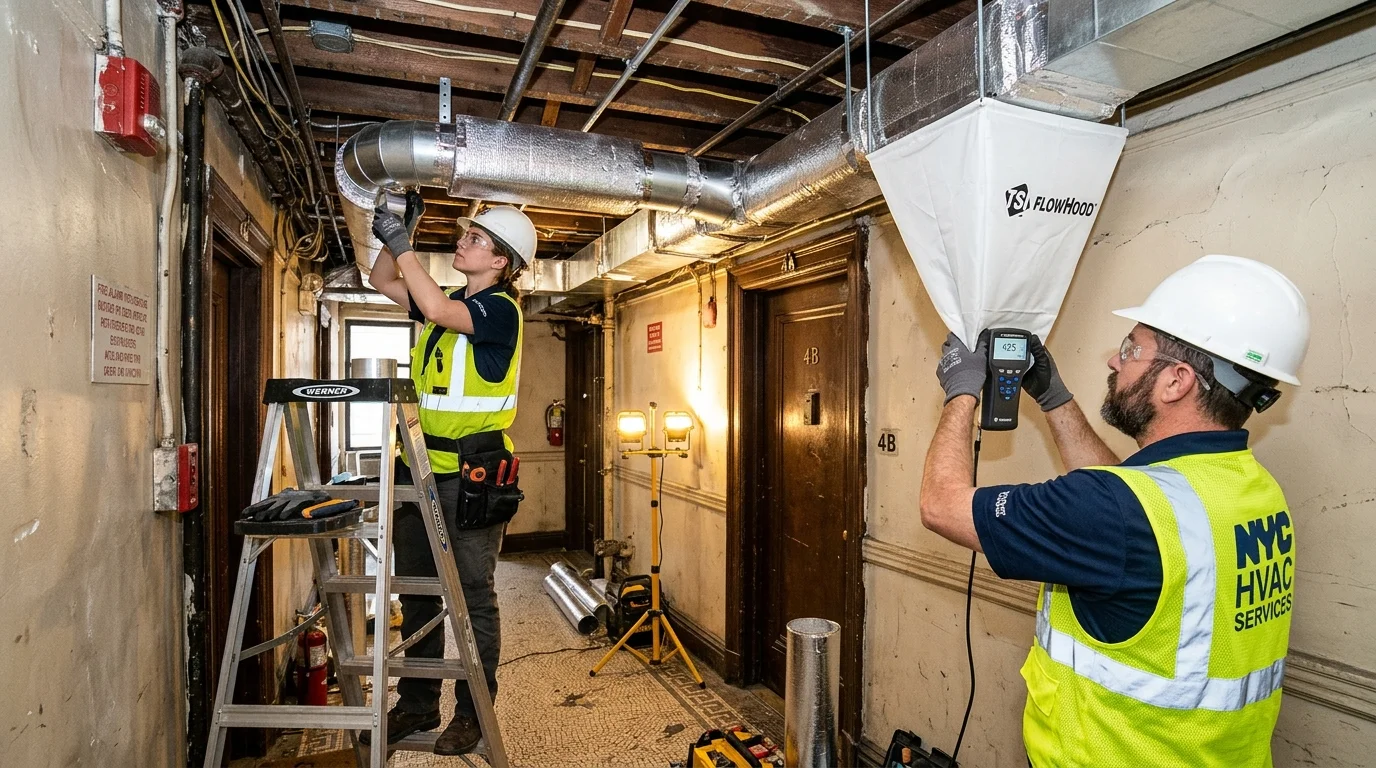 Technicians installing overhead insulated ventilation ducting and balancing airflow in an older NYC residential hallway
How Much Does Heat Recovery Ventilation Cost?
There is no single installation price for an older building. The main cost drivers are the system's airflow capacity, whether usable ductwork already exists, the distance between supply and exhaust points, access to occupied spaces, electrical work, controls, and the amount of finish repair required.
For a rough residential reference, a US market guide published in October 2026 estimates a typical whole-home HRV retrofit at approximately $2,000–$6,500 installed, with more complex projects potentially costing more than $8,000. These are broad homeowner estimates, not a quote for a NYC apartment building, commercial property, or centralized multifamily system. [Reference: 2026 HRV cost guide].
For commercial and multifamily buildings, project costs can be substantially different because airflow capacities, duct networks, firestopping, controls, access, and commissioning requirements vary widely. A unit price or residential square-foot estimate should not be extrapolated directly to a building-wide retrofit.
| Cost component | What affects the price |
|---|---|
| HRV or ERV equipment | Airflow capacity, recovery performance, controls, and equipment configuration |
| Ductwork and grilles | Number of spaces served, duct length, ceiling access, and routing constraints |
| Installation labor | Access to mechanical rooms, occupied units, rooftops, or concealed spaces |
| Electrical and controls | Power supply, system integration, sensors, and control sequences |
| Building repairs | Ceiling and wall openings, finish restoration, firestopping, and exterior work |
| Testing and commissioning | Airflow balancing, performance verification, and control adjustments |
| Ongoing maintenance | Filters, heat exchanger cleaning, fan servicing, and drainage inspection |
For NYC owners, the best early budget is based on a site survey and a defined scope. At a minimum, obtain pricing that distinguishes the equipment from ductwork, construction, controls, testing, and ongoing service.
How to Evaluate Whether an HRV Retrofit Is Worth It
The right question is not simply, "How much energy does an HRV recover?" It is, "How much does that recovered energy reduce the building's actual heating and cooling costs after operating expenses are included?"
A meaningful evaluation should estimate the ventilation airflow, annual operating hours, seasonal temperature and humidity conditions, heat exchanger performance, fan power, and the efficiency of the existing HVAC system.
For a simple illustration, suppose an HRV retrofit costs $30,000 and the engineering analysis estimates $6,000 in annual net operating savings after allowing for additional fan electricity and routine maintenance.
Under those assumptions, the simple payback is five years. This is an illustrative calculation, not a typical or guaranteed return for older buildings. A real assessment must account for installation complexity, actual ventilation loads, local energy rates, and whether the upgrade changes the building's operating strategy under NYC Local Law 97 emissions targets.
Energy savings are only one potential benefit. An upgrade may also provide more controlled outdoor-air delivery or help resolve ventilation problems. Those benefits can matter to building owners, but they should be evaluated separately rather than automatically converted into assumed financial savings.
Is Heat Recovery Ventilation Required in NYC?
The applicable requirement depends on the building type, code edition, and scope of work.
NYC's 2025 Energy Conservation Code includes a residential provision, Section R403.6.1, addressing heat or energy recovery ventilation in dwelling units, together with specified exceptions. The current code framework began enforcement on March 30, 2026, for applicable filings.
That does not mean every existing NYC building must immediately retrofit an HRV. Existing-building requirements and exceptions depend on the work being performed and the applicable provisions. Owners should have the project design professional determine whether a ventilation upgrade is required, permitted, or simply being considered as an energy-efficiency measure.
The Mechanical Code also governs ventilation-system design and addresses access for servicing energy recovery equipment. Ducted and non-ducted HRVs must meet the applicable listing requirements, and prohibited exhaust applications need to be respected.
Review the NYC Department of Buildings — 2025 Energy Conservation Code and the applicable NYC Mechanical Code provisions before finalizing the design.
A Practical Retrofit Checklist for Building Owners
Before committing to an HRV or ERV project, establish the existing ventilation arrangement and confirm what problem the upgrade needs to solve.
- Identify the existing supply and exhaust systems, including fans, shafts, and any available ductwork.
- Determine the required ventilation rates for the spaces being served.
- Review available mechanical drawings and locate viable equipment and duct routes.
- Assess moisture risks, condensate drainage, frost protection, and outdoor-air intake locations.
- Check which exhaust streams are appropriate for heat recovery and which are prohibited or require specially engineered equipment.
- Compare centralized and decentralized systems, including access and disruption costs.
- Estimate annual energy savings alongside fan electricity, maintenance, and commissioning costs.
- Confirm code applicability, required permits, and inspection or testing obligations.
This early review can reveal whether a centralized retrofit is practical or whether a smaller, phased, or decentralized solution deserves consideration.
Conclusion
Heat recovery ventilation can help older buildings reduce the energy penalty associated with supplying outdoor air. By transferring heat from exhaust air to incoming air, an HRV can reduce ventilation-related heating demand while supporting controlled air exchange.
The trade-off is installation complexity. Older buildings may lack suitable duct routes, accessible equipment locations, and the space needed for new ventilation systems. Moisture management, frost protection, pressure balancing, fire safety, and access for future maintenance all need attention.
For NYC property owners, the most practical approach is to evaluate the existing ventilation system before choosing the equipment. Confirm the required airflow, compare HRV and ERV options, estimate the full installed cost, and determine the applicable code requirements with a qualified mechanical design professional.
The best retrofit is one that improves ventilation and energy performance without creating a system that is too expensive or difficult to operate and maintain.