Explore how transitioning from fossil fuels to heat pumps impacts building electrical infrastructure, operating costs, and emissions compliance.
BY NYC Energy Code Team
ON
29 September 2026
The Role of Heat Pumps in NYC's Decarbonization Push
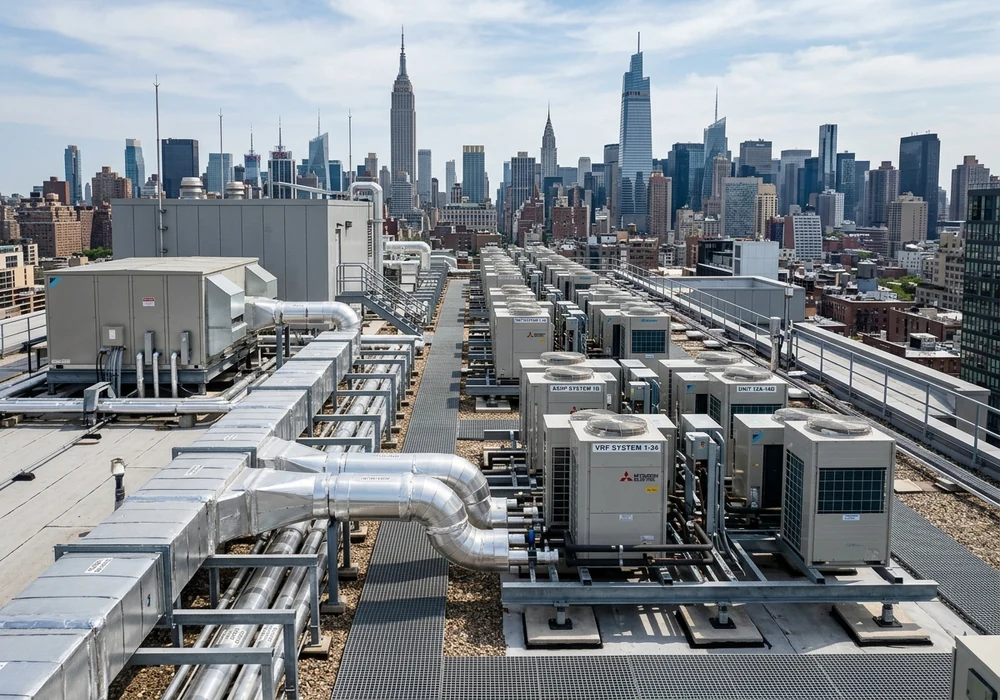
For decades, many NYC buildings have depended on boilers, furnaces, and other combustion-based systems for heating. That model is changing as New York moves toward lower-carbon buildings and greater electrification.
At the center of that transition is the heat pump.
Unlike a traditional heating system that creates heat by burning fuel, a heat pump transfers heat from one place to another. In heating mode, it can move heat from outdoor air or the ground into a building. Many systems can also reverse that process to provide cooling.
For NYC property owners, heat pumps are therefore becoming more than an HVAC technology. They are increasingly part of the conversation around building electrification, LL97 compliance, energy efficiency, and long-term capital planning.
NYC's own building-electrification policy and New York State's energy programs both identify heat pumps as an important pathway toward reducing fossil-fuel use in buildings.
Why Heat Pumps Matter to NYC
The reason heat pumps have attracted so much attention is straightforward: they can provide heating and cooling without onsite fossil-fuel combustion.
Consider a building using a natural-gas boiler.
Natural gas
→
combustion
→
heat
→
distribution through building
A heat-pump system takes a different approach:
Electricity
→
heat transfer
→
heating/cooling
→
building
That difference matters because replacing fossil-fuel combustion with efficient electric equipment can reduce direct onsite emissions and support the broader electrification of buildings.
NYSERDA describes building electrification and energy efficiency as central to New York's effort to reduce greenhouse-gas emissions and reach its climate goals. The agency specifically identifies heat pumps as a clean heating and cooling technology.
Heat Pumps and NYC's Decarbonization Regulations
Heat pumps do not exist in a regulatory vacuum.
Two NYC laws are particularly relevant to understanding the direction of building policy.
Local Law 97 establishes greenhouse-gas emissions limits for many larger existing buildings, with the first limits applying beginning in 2024 and stricter limits beginning in 2030. NYC's stated long-term goal is a 40% reduction in emissions from covered buildings by 2030 and net zero by 2050.
Local Law 154, meanwhile, addresses new construction. It prohibits onsite combustion of fuels emitting more than 25 kg CO₂/MMBtu in covered new buildings and phases the requirements according to application dates and building characteristics. The next major milestone is July 2, 2027, when the requirements expand to all occupancies covered by the law, including service hot water, subject to specified exceptions.
That distinction is important.
LL154 does not mean every existing NYC building must immediately replace its boiler with a heat pump.
For existing buildings, heat pumps may instead become part of an owner's strategy for reducing operational emissions, replacing aging equipment, or preparing for future electrification.
How a Heat Pump Actually Works
The technology is easier to understand than the name suggests.
A heat pump uses a refrigerant cycle to move thermal energy rather than generating heat directly through combustion.
In heating mode:
Outdoor environment
→
refrigerant cycle
→
indoor heat
In cooling mode, the direction is reversed:
Indoor heat
→
refrigerant cycle
→
outdoor environment
That means the same basic equipment can provide both heating and cooling, depending on the system design.
This is one reason NYSERDA describes heat pumps as a technology capable of providing both heating and cooling in appropriate applications.
The Main Types of Heat Pumps
For building projects, the technology is not one-size-fits-all.
Air-Source Heat Pumps
Air-source heat pumps transfer heat between the building and outdoor air.
They are often attractive for retrofits because they do not require drilling wells or installing underground heat-exchange fields.
Cold-climate versions are specifically designed to operate in colder conditions. NYSERDA's current heat-pump programs include cold-climate air-source systems for eligible projects.
Ground-Source Heat Pumps
Ground-source systems exchange heat with the ground rather than directly with outdoor air.
They can be highly efficient, but site conditions, drilling, land availability, and project complexity can make them more difficult to implement in dense urban properties.
Heat Pump Water Heaters
Heat pumps are not limited to space heating and cooling.
Heat pump water heaters (HPWHs) can use electricity to move heat into domestic hot water rather than producing heat through conventional combustion or electric resistance.
NYC's broader electrification strategy and New York State programs include heat-pump water heating as another electrification opportunity.
Why Existing Buildings Are More Complicated
Installing heat pumps in a new building is generally easier because the entire building can be designed around the equipment.
Existing NYC buildings are different.
An owner may be dealing with:
Old boilers
+
steam radiators
+
limited electrical capacity
+
tight mechanical spaces
+
existing tenants
That makes electrification more than an equipment swap.
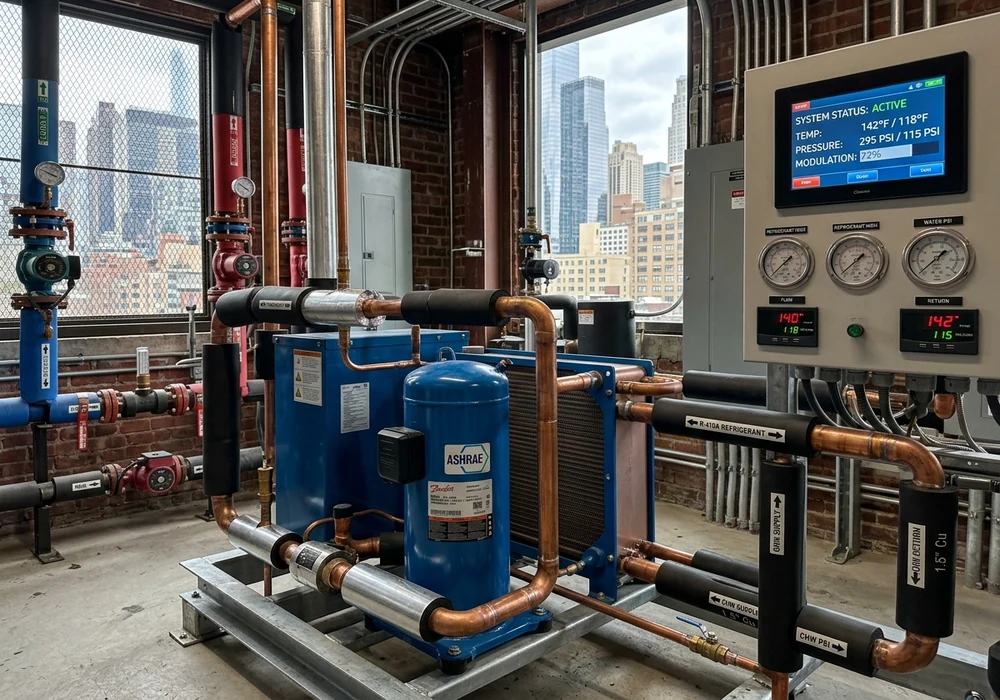
For example, replacing a central gas boiler with heat pumps may require evaluating the electrical service, distribution system, indoor equipment, outdoor equipment locations, controls, heat distribution, and potentially the building envelope.
This is why NYSERDA recommends considering heat pumps alongside broader HVAC studies and capital planning, particularly when heating equipment is approaching the end of its life.
The Electrical Capacity Question
One of the biggest issues in a heat-pump retrofit is often not the heat pump itself.
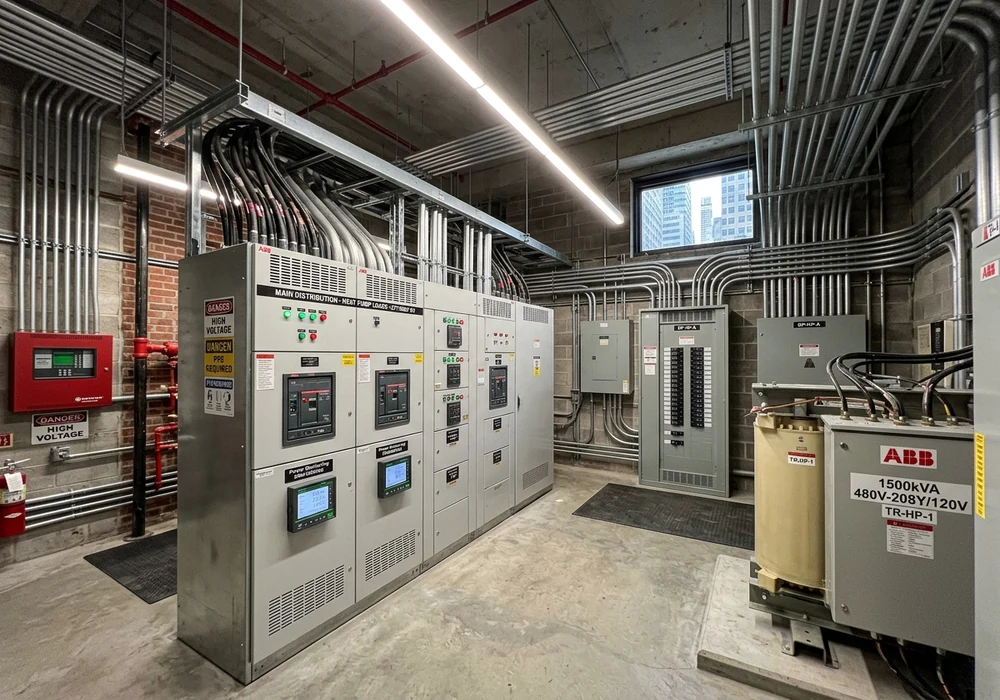
It is the electrical infrastructure behind it.
A building may currently have:
Gas boiler
→
relatively limited electrical heating load
After electrification:
Heat pumps
→
significantly greater electrical demand
The owner may therefore need to evaluate:
Utility service
→
switchgear
→
transformers
→
feeders
→
panels
→
HVAC equipment
This becomes even more important when the property is simultaneously planning EV charging, electric domestic hot water, induction cooking, or other electrification projects.
A building that appears to have enough electrical capacity for one project may not have enough capacity for all of them together.
Why the Building Envelope Matters
Heat pumps are not a substitute for good building-envelope performance.
Imagine an older building with:
Poor insulation
+
significant air leakage
+
inefficient windows
Installing a larger heat pump may provide the required heating capacity, but the building could still consume substantial energy because the envelope continues to lose heat.
Improving the envelope first—or alongside the HVAC project—can reduce the heating and cooling loads that the new system must meet.
The strategic relationship is:
Better envelope
→
lower load
→
smaller or more efficiently operated HVAC system
This is one reason building electrification is often more successful when combined with broader energy-efficiency work.
Heat Pumps and Existing Radiators
One of the common assumptions about electrification is that an entire existing heating-distribution system must automatically be discarded.
That is not always the case.
The appropriate solution depends on the existing system and the heat pump configuration.
A project may involve:
Option A
Heat pump + existing hydronic distribution
Option B
Heat pump + new hydronic system
Option C
Heat pump + ducted/ductless distribution
Option D
Heat pump + supplemental or hybrid system
The engineering challenge is to determine whether the building's existing distribution system can deliver the required heat under the operating temperatures produced by the proposed equipment.
That decision should be made through detailed engineering analysis rather than a generic rule.
Heat Pumps as Part of an LL97 Strategy
For an existing covered building, heat pumps can potentially reduce emissions by replacing or reducing fossil-fuel consumption.
NYC's LL97 rules specifically recognize beneficial electrification as one of the available deduction categories under the law, with defined eligibility and calculation requirements.
This is an important distinction.
A heat pump should not be installed simply because it is an electrification technology. The project needs to be evaluated against the building's actual energy use, emissions profile, electrical infrastructure, operating requirements, and the applicable LL97 methodology.
The Economics Are More Complicated Than “Electricity vs Gas”
A simple utility-rate comparison does not capture the entire financial case.
A heat-pump project may involve:
Equipment
+
electrical upgrades
+
engineering
+
controls
+
installation
but can potentially produce:
Lower fuel consumption
+
lower maintenance needs
+
emissions reductions
+
cooling capability
+
eligibility for incentives
NYSERDA currently offers commercial and multifamily support for clean heating and cooling technologies, while utility programs may also provide incentives. The amounts and eligibility vary by utility, building type, equipment capacity, and system configuration.
That means the economics should be modeled rather than estimated from a generic payback period.
Incentives Are Evolving
New York continues to expand programs supporting building electrification.
For example, NYSERDA's current New Efficient Homes New York: Heat Pump Incentive provides incentives for eligible new residential construction and multifamily projects under 50,000 square feet, including cold-climate air-source and ground-source heat pumps. Selected projects must meet program-specific electrification requirements.
The program illustrates an important trend: incentives are increasingly being tied not just to purchasing efficient equipment, but to achieving broader building-performance and electrification outcomes.
Commercial building owners should therefore check current utility and state programs before finalizing a project budget because program structures can change.
What a Heat-Pump Feasibility Study Should Ask
A serious feasibility study should move beyond:
“Can we install a heat pump?”
It should ask:
How much heating and cooling capacity is actually required?
What is the building's electrical capacity today?
What happens during peak winter conditions?
Can the existing distribution system be reused?
Does the envelope need improvement first?
What other electrification projects are planned?
How would the system affect LL97 emissions?
What will the project cost over its useful life?
That is a much more useful set of questions for a property owner.
A Practical Electrification Sequence
For an existing building considering heat pumps, the project can often be approached as:
Benchmark the building
→
understand existing systems
→
assess loads
→
evaluate envelope
→
check electrical capacity
→
model heat-pump options
→
evaluate incentives
→
design
→
install
→
commission
This sequence matters because electrification decisions made without understanding the building's existing loads can lead to oversized equipment, unnecessary infrastructure costs, or a system that does not operate as efficiently as expected.
Where Heat Pumps Work Particularly Well
Heat pumps can be particularly interesting when a property is already facing a major HVAC decision.
For example:
Aging boiler + planned replacement
is an excellent point to compare:
Like-for-like replacement
against:
High-efficiency or electrified alternatives
Similarly, a major renovation provides an opportunity to coordinate envelope improvements, electrical infrastructure, controls, and HVAC design.
NYSERDA specifically identifies renovation and end-of-life HVAC replacement as useful points for considering building electrification.
Common Mistakes
Treating Electrification as an Equipment Swap
The electrical service, distribution, envelope, controls, and heat distribution system all matter.
Ignoring Winter Design Conditions
A system that performs well during mild weather still needs to meet the building's heating requirements during design conditions.
Installing Heat Pumps in a Poorly Performing Envelope Without Analysis
High heating loads can make electrification more expensive and can affect equipment sizing.
Looking Only at the Purchase Price
Capital cost is only part of the financial picture. Energy, maintenance, incentives, infrastructure, and equipment life also matter.
Assuming LL154 Applies to Every Existing Building
LL154 primarily governs specified new-building applications and alterations filed as new buildings. It should not be interpreted as an immediate universal requirement for every existing building.
Conclusion
Heat pumps are becoming a central technology in NYC's building decarbonization strategy because they can replace or reduce fossil-fuel combustion while providing efficient heating and cooling.
Their importance is reinforced by the direction of NYC and New York State policy. LL154 is steadily expanding restrictions on onsite fossil-fuel combustion in covered new construction, while LL97 creates emissions-reduction obligations for many larger existing buildings.
But a heat pump is not automatically the right answer for every building.
For existing properties, the real question is whether the building can support electrification technically, financially, and operationally. Electrical capacity, envelope performance, heating distribution, controls, peak loads, equipment location, and long-term capital plans all need to be considered.
The strongest approach is to treat heat-pump adoption as part of a building-wide electrification strategy, not as an isolated equipment replacement.
FAQs
Heat pumps can provide heating and cooling using electricity rather than onsite fossil-fuel combustion. They are therefore an important technology for reducing direct fossil-fuel use as buildings move toward electrification.
No. LL154 establishes onsite fossil-fuel combustion limits primarily for specified new-building applications and certain alterations filed as new buildings. Its requirements are phased according to application dates and building characteristics.
Heat pumps can potentially reduce fossil-fuel consumption and associated emissions in existing buildings. NYC's LL97 framework also recognizes qualifying beneficial electrification as a potential deduction, subject to specific rules and eligibility requirements.
Yes, but the solution depends heavily on the building. Existing heating distribution, electrical capacity, envelope performance, mechanical-space constraints, and tenant conditions all need to be evaluated.
Cold-climate heat pumps are specifically designed to operate in colder conditions, but system selection, sizing, controls, and building loads must be evaluated for the site's winter conditions. NYSERDA currently supports cold-climate air-source heat pumps through applicable programs.
Not necessarily. The required electrical work depends on the existing service, the proposed system, building loads, and other planned electrification. A professional electrical-load assessment is needed before making that determination.
Yes. NYSERDA and utility programs currently provide support for eligible commercial and multifamily clean-heating and cooling projects, although incentive amounts and eligibility vary by program, utility, building type, and system configuration.
A major HVAC replacement, renovation, building-envelope project, or broader electrification project can be a logical time to evaluate heat pumps. NYSERDA specifically identifies HVAC end-of-life and renovation as opportunities to consider clean heating and cooling upgrades.