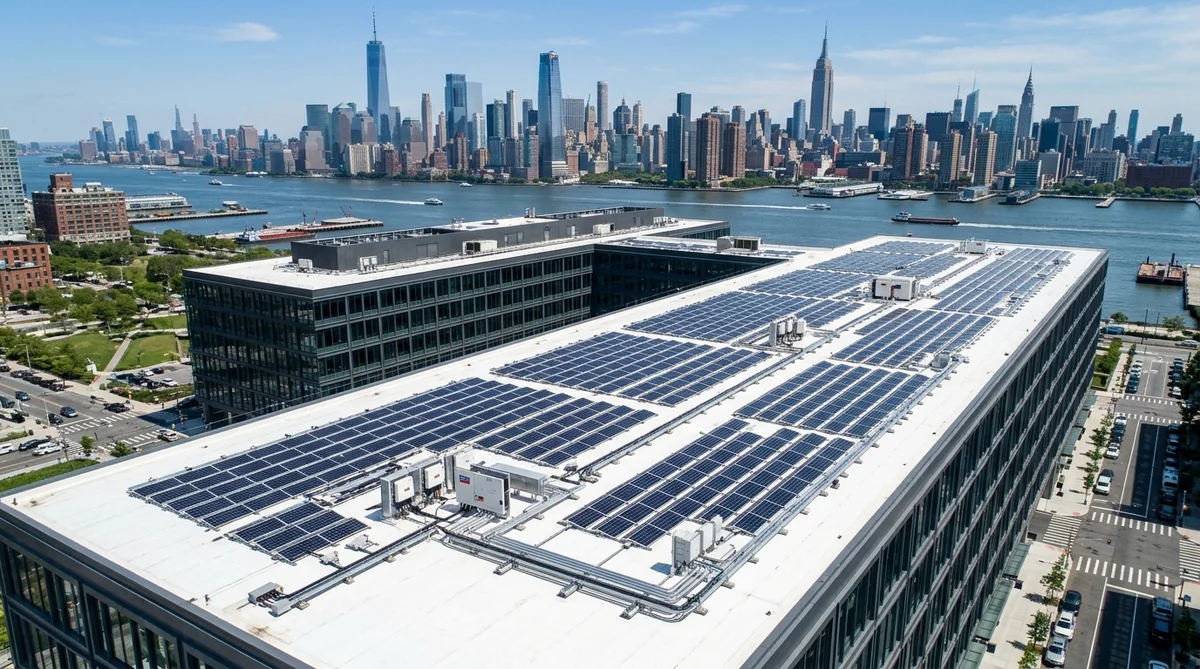
Is the Federal Solar Tax Credit Still Available for Commercial Buildings in 2026?
A commercial building owner planning a rooftop solar installation may have heard that the federal government previously offered a standard 30% solar investment tax credit. That incentive made solar projects financially attractive for offices, warehouses, hotels, multifamily properties, and other commercial buildings across New York.
However, the tax rules changed significantly in 2025.
The One Big Beautiful Bill Act (OBBBA), signed into law on July 4, 2025, accelerated the statutory termination of federal clean electricity tax credits for qualifying wind and solar projects. This legislation substantially altered the timeline under which commercial property owners can claim the federal solar investment credit.
The current commercial solar incentive is generally claimed under Section 48E of the Internal Revenue Code, known as the Clean Electricity Investment Credit.
Critical Statutory Status as of November 4, 2026:
- Solar projects that began construction after July 4, 2026, generally must be placed in service by December 31, 2027, to avoid accelerated termination.
- Projects that can establish construction began before July 5, 2026, may qualify for a longer completion period, provided they satisfy applicable IRS construction and continuity rules.
- Additional restrictions involving prohibited foreign entities (PFEs) and equipment sourcing also apply to relevant projects beginning construction after December 31, 2025.
This means the federal solar tax credit has not simply disappeared. However, commercial owners must now verify their project's construction-start date, equipment supply-chain eligibility, ownership structure, and projected completion date before assuming that a credit is available.
1. What Is Section 48E?
Section 48E is the technology-neutral Clean Electricity Investment Credit introduced by the Inflation Reduction Act to replace the legacy Section 48 solar investment tax credit framework for electricity-generation facilities placed in service after December 31, 2024.
Unlike former Section 48 rules that enumerated specific technologies, Section 48E is structured around qualifying facilities with an anticipated greenhouse gas emissions rate of zero. Solar photovoltaic (PV) systems inherently qualify because they generate clean electricity without direct combustion or operational greenhouse gas emissions.
For commercial building owners, this encompasses qualifying rooftop arrays, solar canopies over parking decks, and ground-mount installations used to power building electrical loads or export power under net metering.
Qualified Investment vs Total Renovation Costs
The tax credit is calculated strictly on the taxpayer's qualified investment in the solar facility, rather than automatically applying to every expenditure in a broader building capital improvement project. In a commercial solar project, qualified investment includes:
- Solar photovoltaic modules and mounting racking integral to the array.
- Inverters, optimizers, and balance-of-system electrical switchgear.
- Dedicated conduits, combiner boxes, and monitoring equipment.
- Qualified interconnection property directly required to connect the facility to the electric utility grid (subject to statutory limits for systems under 5 MW).
Important Roof Replacement Limitation:
An entire commercial roof tear-off and replacement, general electrical panel modernization, or structural reinforcements do not automatically qualify for the 30% solar credit simply because they occur alongside a solar installation. Taxpayers must carefully segregate eligible solar equipment basis from non-eligible building envelope costs.
2. How Much Is the Commercial Solar Tax Credit?
The statutory Section 48E credit has a base rate of 6% of qualified investment. It increases to a full 30% credit when the project satisfies registered prevailing-wage and apprenticeship standards, or qualifies under the statutory small-facility exception.
| Credit Category | Applicable Tax Credit Rate |
|---|---|
| Base investment credit rate | 6% of qualified investment |
| Increased credit with prevailing-wage and apprenticeship compliance | 30% of qualified investment |
| Increased credit for qualifying small facilities below 1 MW AC | 30% of qualified investment |
The small-facility exception applies to facilities with a maximum net output of less than 1 megawatt (MW) AC. For most commercial rooftop projects in NYC (typically ranging from 50 kW to 500 kW), the system qualifies for the 30% rate automatically without having to submit certified prevailing-wage payroll records to the IRS.
However, for large commercial rooftop arrays, solar farms, or community solar projects of 1 MW AC or greater, strict prevailing-wage compliance and registered-apprenticeship participation must be established from the initial day of construction to earn the 30% rate.
A Simple Commercial Solar Tax-Credit Calculation
Consider a commercial property owner installing a qualifying rooftop solar PV system with a qualified investment basis of $500,000. Assuming the installation qualifies for the increased 30% rate:
If the same project failed to qualify for the increased rate, the tax credit would drop to the base 6% rate ($30,000):
| Financial Parameter | Base Rate (6%) | Increased Rate (30%) |
|---|---|---|
| Qualified Solar Investment Basis | $500,000 | $500,000 |
| Applicable Section 48E Credit Rate | 6% | 30% |
| Potential Federal Tax Credit Value | $30,000 | $150,000 |
The credit directly reduces the taxpayer's dollar-for-dollar federal tax liability. It is not an upfront cash rebate from the contractor; it is claimed when filing annual federal income taxes.
3. The Biggest 2026 Change: New Solar Construction Deadlines
The most consequential update facing commercial solar developers is the accelerated termination timeline enacted under OBBBA. Under amended Section 48E rules, solar facilities are no longer eligible for the investment tax credit if placed in service after December 31, 2027, unless construction began on or before July 4, 2026.
| Project Construction Status | Statutory Deadline to Qualify for Credit |
|---|---|
| Construction began on or before July 4, 2026 (under qualifying IRS rules) | Eligible for credit even if placed in service after 2027, subject to continuous construction rules (through 2030). |
| Construction begins after July 4, 2026 | Must be placed in service by December 31, 2027 to claim the credit. |
| Construction begins after July 4, 2026, placed in service after Dec. 31, 2027 | Ineligible Terminated under OBBBA clean electricity provisions. |
 Building owners and solar engineers evaluating Section 48E tax credit models, NY-Sun incentives, and electrical interconnection filings.
What Qualifies as Beginning Construction?
Under IRS Notice 2025-42, the IRS recognizes two distinct methods to substantiate that construction began:
- The Physical Work Test: Performing physical work of a significant nature on-site or off-site under a binding written contract (e.g., driving array foundation posts, installing racking, assembling custom switchgear). Preliminary activities like planning, designing, securing permits, or clearing a site do not qualify.
- Five Percent Safe Harbor: Paying or incurring at least 5% of the total ultimate cost of the facility before the statutory cutoff. Under Notice 2025-42, this safe harbor is restricted to solar facilities with maximum net output not exceeding 1.5 MW AC.
Continuous Construction Safe Harbor
For projects that properly established a pre-July 5, 2026 construction start, the IRS continuity safe harbor allows up to four calendar years after the year construction began to place the system in service. A project starting in 2026 has until December 31, 2030, to complete construction without having to satisfy an annual facts-and-circumstances audit.
4. New 2026 Restriction: Solar Equipment Sourcing & Foreign-Entity Rules
Another major compliance hurdle for 2026 commercial solar projects is the Prohibited Foreign Entity (PFE) restriction. Under OBBBA, facilities beginning construction after December 31, 2025, forfeit tax credit eligibility if they incorporate material assistance from prohibited foreign entities.
In February 2026, the IRS published Notice 2026-15 providing interim rules for calculating the Material Assistance Cost Ratio (MACR). The MACR determines what percentage of direct manufactured product costs originate from compliant non-PFE sources.
Commercial building owners cannot evaluate tax credits based solely on project costs. Before executing solar contracts, owners must obtain supply-chain certifications from their developer covering:
- Silicon wafer, ingot, and solar cell manufacturing origin.
- Country-of-origin documentation for solar inverters and balance-of-system electronics.
- Supplier warranties certifying compliance with IRS Notice 2026-15.
- Itemized bills of materials supporting MACR threshold calculations.
5. Can Commercial Projects Receive Additional Bonus Credits?
Section 48E provides tiered "adders" that stack on top of the 30% credit for qualifying commercial properties:
- Domestic Content Bonus (+10%): Applies if 100% of structural steel/iron and required statutory percentages of manufactured products are mined, produced, or manufactured in the United States.
- Energy Community Bonus (+10%): Available if the facility is located in a designated brownfield site, a metropolitan statistical area with elevated fossil-fuel employment, or a coal-closure census tract.
- Low-Income Communities Bonus (+10% to +20%): Competitive annual allocation under Section 48E(h) for facilities under 5 MW AC:
| Eligible Low-Income Category | Potential Additional Tax Credit |
|---|---|
| Category 1: Facility located in an eligible low-income community | +10 percentage points (40% total) |
| Category 2: Facility located on qualifying Indian land | +10 percentage points (40% total) |
| Category 3: Qualified low-income residential building project | +20 percentage points (50% total) |
| Category 4: Qualified low-income economic benefit project | +20 percentage points (50% total) |
The low-income program has an annual capacity limitation of 1.8 GW AC across the nation. Being located in a designated census tract does not automatically confer the bonus; owners must submit a formal application to the Department of Energy and receive an allocation award.
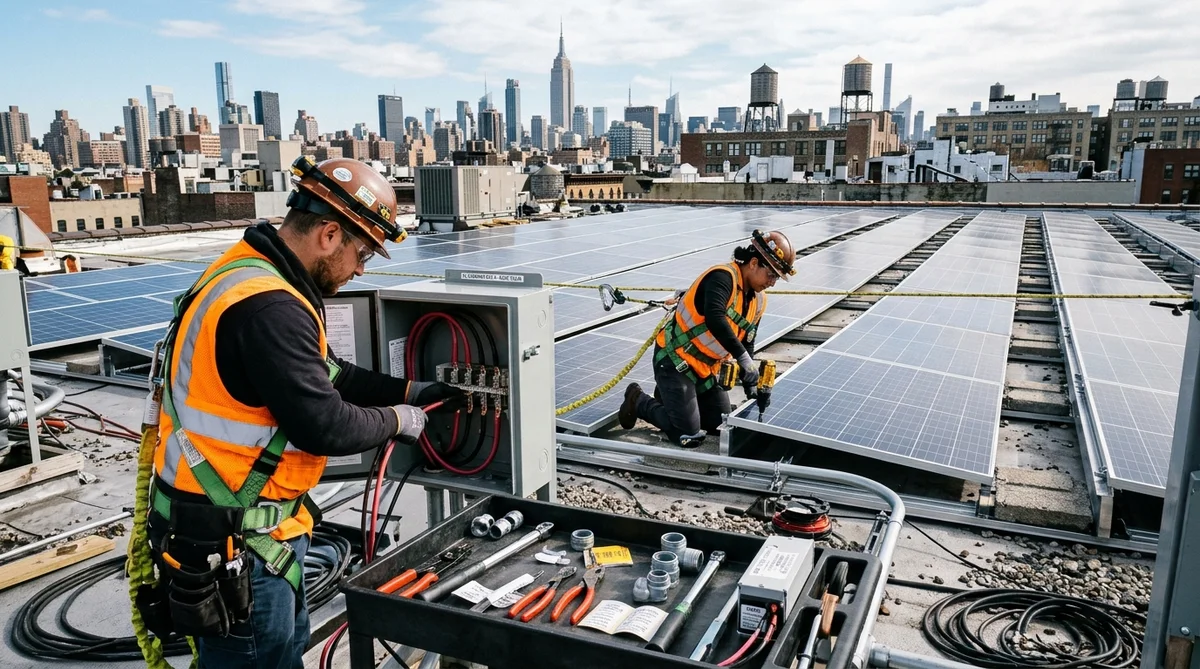 Certified commercial solar installation crew mounting ballasted rooftop solar modules and routing electrical conduits on an NYC commercial roof.
6. Who Actually Receives the Solar Tax Credit?
Owning the building does not automatically entitle the landlord to claim the solar credit. The entity that owns the solar equipment for federal tax purposes claims the credit:
| Financing / Ownership Structure | Who Claims the Federal Section 48E Credit? |
|---|---|
| Direct Capital Purchase (Cash or loan) | Building owner / commercial property entity. |
| Equipment Lease | Solar leasing entity or lessor (unless passed through under election rules). |
| Power Purchase Agreement (PPA) | Third-party solar developer/investor who owns and maintains the panels. |
| Tax-Exempt / Municipal Owner | Qualifying nonprofit or public entity via IRS Elective Pay. |
Under a Power Purchase Agreement (PPA), the building owner pays only for the electricity generated, usually at a discounted kWh rate. The developer monetizes the 30% federal tax credit and MACRS depreciation. Property owners must evaluate whether direct ownership or third-party financing yields the best net present value.
7. Can a Commercial Building Owner Sell or Transfer the Tax Credit?
The Inflation Reduction Act introduced groundbreaking liquidity mechanisms that remain active under Section 48E:
Credit Transferability (Section 6418)
Under Section 6418, taxable business entities can sell all or a portion of their Section 48E credit to an unrelated corporate taxpayer for cash. This is invaluable for real estate partnerships or building owners who lack sufficient tax liability to monetize a $150,000+ credit. Transactions occur on clean energy credit transfer markets, typically trading for $0.90 to $0.95 per dollar of credit value.
Elective Pay / Direct Pay (Section 6417)
Section 6417 allows tax-exempt entities (hospitals, universities, religious organizations, municipal agencies) to receive the cash value of the credit as a direct refund payment from the IRS. For-profit real estate corporations cannot use elective pay; they must use transferability under Section 6418.
8. Does Solar Tax Credit Eligibility Also Include Battery Storage?
Commercial property owners frequently install solar panels alongside battery energy storage systems (BESS) to shave peak demand charges and comply with NYC Local Law 97 carbon limits.
Section 48E separately recognizes qualifying energy storage technology (minimum 5 kWh capacity). Crucially, OBBBA's accelerated solar termination deadline of December 31, 2027, does not apply to standalone energy storage. However, for paired solar-plus-storage projects, tax accountants must carefully track the separate cost bases and supply-chain origins of the battery and solar equipment.
9. Can Solar Tax Credits Be Combined With Depreciation Benefits?
Yes. Commercial solar equipment qualifies for 5-year MACRS (Modified Accelerated Cost Recovery System) depreciation. Taxpayers must reduce the solar asset's depreciable basis by 50% of the tax credit determined:
| Cost Recovery Component | Illustrative Amount |
|---|---|
| Gross Qualified Solar Investment | $500,000 |
| Section 48E Federal Tax Credit (30%) | $150,000 |
| Mandatory 50% Basis Reduction | -$75,000 |
| Adjusted 5-Year MACRS Depreciable Basis | $425,000 |
This allows property owners to write off $425,000 over five years alongside the $150,000 tax credit. Projects are subject to a five-year credit recapture schedule if the system is decommissioned or disposed of prematurely.
10. New York and NYC Solar Incentives That Stack With the Federal Credit
NYC commercial property owners have access to two potent local incentives that stack directly with the federal credit:
NYSERDA NY-Sun Commercial Solar Incentives
Administered through NY-Sun, NYSERDA provides an upfront cash rebate paid directly to the approved solar contractor (typically $0.20 to $0.40 per watt DC for commercial systems in the Con Edison region), which is deducted directly from the customer's contract invoice.
NYC Solar Electric Generating System Tax Abatement
New York City provides a property tax abatement through the Department of Finance for solar PV installations placed in service between 2024 and 2035. The abatement provides a property tax reduction equal to 7.5% of eligible solar installation costs per year for four years (30% total), capped at the lower of real estate taxes or $62,500 annually.
11. Complete Financial Example: NYC Commercial Rooftop Solar
Here is how a $500,000 commercial rooftop solar installation in NYC stacks federal, state, and local incentives:
| Incentive Stacking Step | Financial Impact |
|---|---|
| Initial Gross Turnkey Solar Cost | $500,000 |
| Less: NY-Sun Commercial Rebate | -$30,000 |
| Net Out-of-Pocket Contract Cost | $470,000 |
| Federal Section 48E Tax Credit (30% of $470,000) | -$141,000 |
| NYC Property Tax Abatement (7.5% × 4 years = 30%) | -$141,000 |
| Net Project Cost Before Depreciation Deductions | $188,000 (62.4% cost reduction) |
| Adjusted 5-Year MACRS Depreciation Basis | $399,500 ($470,000 - $70,500) |
12. What Documents Should Building Owners Prepare?
To substantiate Section 48E claims and survive IRS compliance audits, owners must assemble a comprehensive project binder:
| Required Project Document | Compliance Purpose |
|---|---|
| Solar EPC / Turnkey Contract | Establishes equipment ownership, binding dates, and payment milestones. |
| Itemized Equipment Invoices | Substantiates qualified basis segregation from building roof repairs. |
| Manufacturer Sourcing Certifications | Verifies compliance with Notice 2026-15 Prohibited Foreign Entity rules. |
| Construction Logs & Photos | Proves Physical Work Test or 5% Safe Harbor before July 5, 2026. |
| DOB Electrical & Structural Permits | Confirms regulatory code compliance and structural roof load capacity. |
| Utility Interconnection Agreement & PTO | Establishes official "Placed in Service" operational date. |
| Prevailing Wage Payroll Records | Required for installations ≥ 1 MW AC to claim the 30% increased rate. |
| NYSERDA Incentive Approval Letter | Documents state grant deductions for federal basis calculations. |
Conclusion
The federal commercial solar tax credit remains a powerful financing tool in late 2026, but navigating Section 48E requires navigating strict statutory construction deadlines and supply-chain restrictions. For solar projects starting construction after July 4, 2026, systems must be fully placed in service before December 31, 2027.
For New York City building owners, coupling the 30% federal Section 48E credit with NY-Sun rebates, NYC's 4-year property tax abatement, and 5-year MACRS depreciation delivers unparalleled economics, offsetting more than 60% of total system costs while slashing building carbon emissions under Local Law 97.