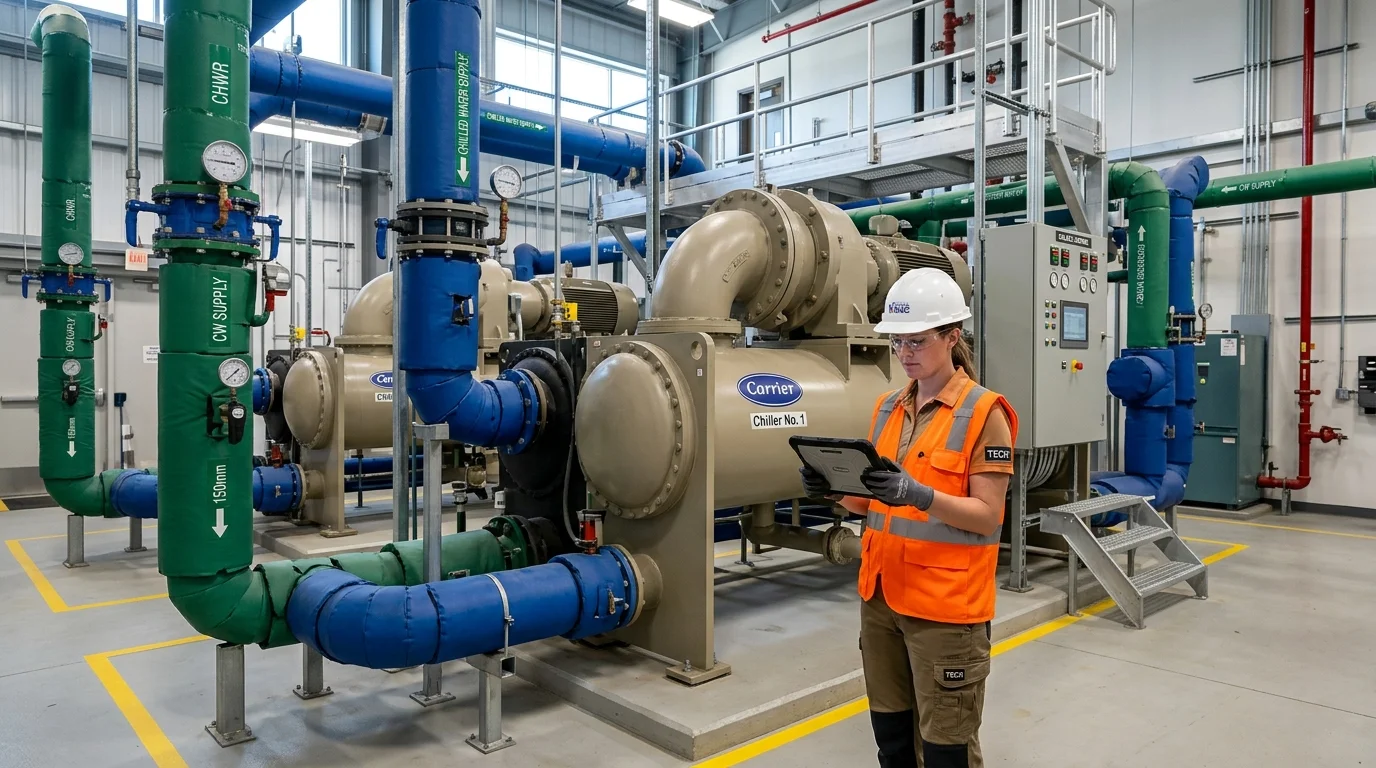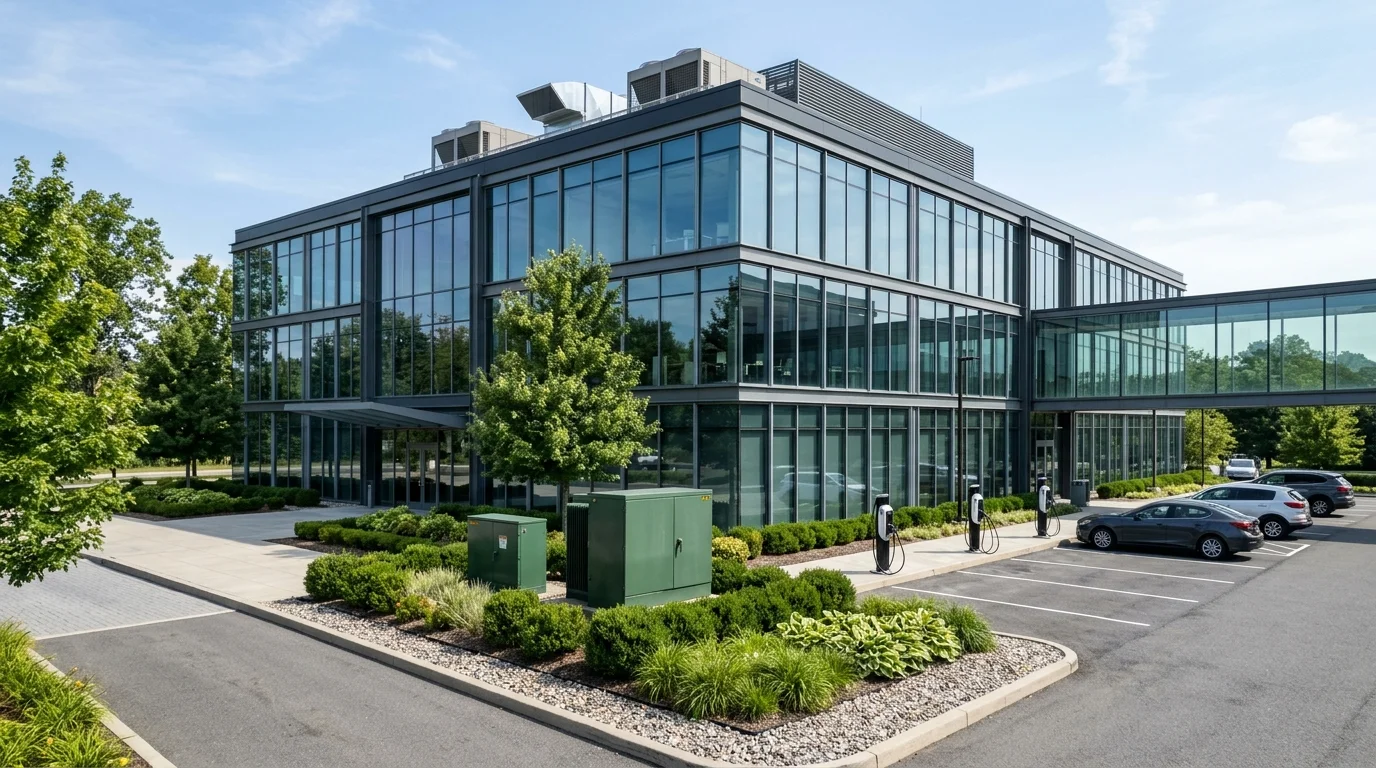
Planning to electrify an existing building? Learn how electrical panels, service capacity, meters, transformers, and utility coordination affect electrification projects. Understand the upgrade process, technical requirements, and steps to prepare your building for increased electrical demand.
Introduction: Why Electrical Service Upgrades Matter for Building Electrification
Building electrification is becoming an important part of commercial property modernization across the United States. Driven by urban decarbonization mandates like NYC Local Law 97, corporate ESG commitments, and volatile fossil-fuel prices, many property owners are replacing traditional gas and oil equipment with high-efficiency electric alternatives.
Common conversions include commercial heat pumps, centralized electric water heating, commercial induction cooking, and electric vehicle (EV) charging stations.
While these technologies support building decarbonization and eliminate on-site combustion, they introduce an urgent engineering challenge: Can your existing electrical infrastructure handle the added electrical demand?
Many legacy commercial buildings and multifamily properties were designed around modest electrical loads. Their original switchgear, distribution panels, service entrance conductors, meter banks, and utility connections were never sized to support multiple high-demand electric thermal systems operating simultaneously during peak heating or cooling periods.
This is where electrical service upgrades become essential. Depending on existing conditions and the electrification scope, projects may require:
- Main Service Switchgear & Distribution Expansion: Replacing legacy 200A–400A main service disconnects with modern 800A–2000A switchboards equipped with integrated ground-fault protection.
- Dedicated High-Amperage Branch Circuits: Installing dedicated 50A–125A commercial feeder circuits for heat pump outdoor inverter units, centralized chillers, and electric domestic hot water (DHW) skid systems.
- Service Entrance Conductor & Conduit Upsizing: Replacing undersized underground service laterals or overhead drops with high-capacity copper or aluminum parallel conductors.
- Current Transformer (CT) Cabinet & Metering Modernization: Upgrading utility revenue metering from direct-read meter sockets to rated CT enclosures compatible with modern commercial utility tariffs.
- Utility Substation & Vault Transformer Upgrades: Coordinating with Con Edison or local utilities for public grid network vault transformer expansions to handle added diversified electrification demand.
However, not every electrification retrofit demands a complete service replacement. Through dynamic load management, automated subpanel distribution, and variable-capacity equipment, building owners can frequently accommodate new electric loads while avoiding costly and time-consuming utility service expansions.
This guide explains each electrical component, details the upgrade sequence, and provides a clear engineering roadmap for property owners preparing for building electrification.
1. What Is an Electrical Service Upgrade?
An electrical service upgrade is a coordinated modification of a building's incoming electrical infrastructure that increases its capacity to receive, meter, distribute, and protect electrical power safely under expanded loads.
It encompasses everything from the utility grid connection and service conductors to the metering enclosure, main disconnecting switch, and downstream distribution switchboards.
The objective is ensuring the electrical system delivers reliable, continuous power without overloading conductors, tripping main breakers, or causing dangerous voltage drops during peak demand.
1.1 Why Do Buildings Need Electrical Upgrades for Electrification?
Conventional commercial properties traditionally split their thermal and power demands across two distinct energy networks:
- Natural gas or fuel oil boilers provided space heating and domestic hot water.
- Gas piping operated commercial kitchen appliances.
- Electricity operated lighting, ventilation fans, elevators, and tenant plug loads.
During electrification, fossil fuels are retired, shifting substantial thermal loads entirely onto the electrical grid:
- Heat Pump Heating: Replacing steam or hydronic gas boilers with air-to-water or VRF heat pumps introduces substantial compressor and auxiliary heating loads.
- Electric Domestic Hot Water (DHW): High-capacity heat pump water heaters require dedicated 208V or 480V three-phase circuits.
- Fleet & Tenant EV Charging: Installing Level 2 chargers (7.2 kW to 19.2 kW each) or DC fast chargers (50 kW to 350 kW) creates massive instantaneous electrical demand.
- All-Electric Kitchens: Commercial induction ranges and combi ovens introduce dense, continuous electrical loads.
Without an engineering assessment, adding these loads can exceed the thermal ratings of service conductors and main distribution busbars.
1.2 Does Every Electrification Project Require a Panel Upgrade?
No. Many existing commercial services possess spare ampacity that can be leveraged without upgrading the main service entrance.
For example, a building may have sufficient total amperage but lack physical breaker slots in its main distribution board. Installing an adjacent subpanel or utilizing tandem breakers can resolve the physical space constraint without touching the utility service.
Conversely, if total calculated demand exceeds available capacity, a full service upgrade or an approved load-management system becomes mandatory under the National Electrical Code (NEC).
2. Understanding the Main Electrical Components
Planning an electrical upgrade requires understanding the six core physical stages that deliver power from the municipal utility into commercial tenant spaces:
2.1 Electrical Service Panel & Switchgear
The main service panel (or commercial switchboard) receives high-voltage power from the utility, provides primary overcurrent protection via a main circuit breaker or fused disconnect, and divides current among feeder and branch circuits. Key evaluation factors include busbar ampere rating, interrupt capacity (AIC rating), enclosure NEMA rating, and physical expansion space.
2.2 Main Electrical Service Capacity
Service capacity defines the maximum continuous electrical demand the building's incoming electrical service can safely support without overheating conductors. While residential properties typically operate on 120/240V single-phase power (100A to 200A), commercial and multifamily properties utilize 120/208V or 277/480V three-phase services rated from 400A to 4,000A or higher.
2.3 Electrical Meter & CT Enclosures
Measures energy consumption (kWh) and peak power demand (kW) for billing. For commercial services exceeding 200A to 400A, utilities require Current Transformer (CT) metering cabinets, where sensor coils step down high currents to safe levels for digital metering.
2.4 Service Entrance Conductors & Raceways
Heavy-gauge copper or aluminum cables running overhead from utility poles or underground through concrete-encased duct banks into the main electrical room. Upsizing service capacity requires pulling larger conductor sets and frequently replacing conduit raceways.
2.5 Utility Distribution Transformer
Reduces utility distribution voltage (typically 4,160V to 13,800V) down to building utilization voltage (208V or 480V). Transformers may be pole-mounted, pad-mounted on the property exterior, or located inside dedicated subterranean transformer vaults. The utility owns this equipment and must approve any load increase.
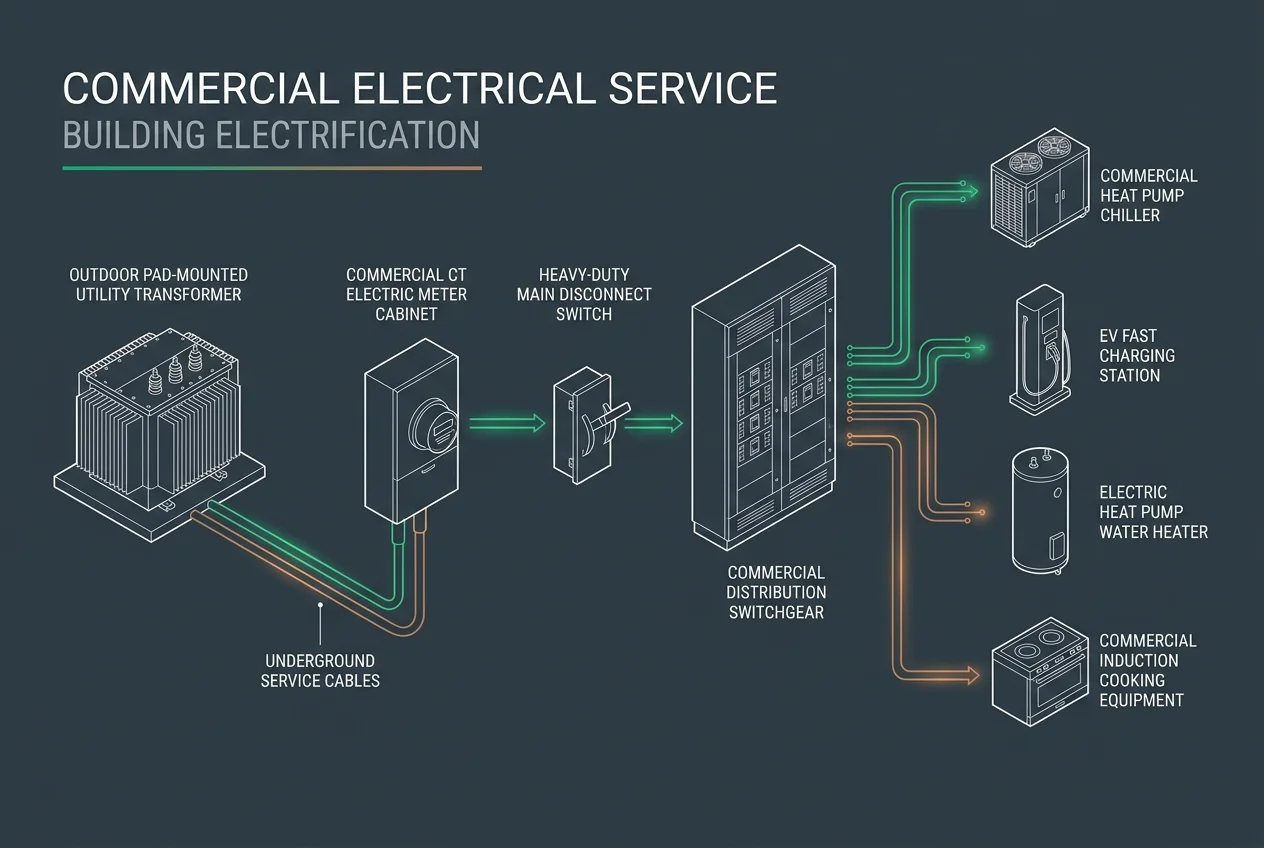 Technical overview of commercial electrical service infrastructure: from the utility distribution transformer and service entrance conductors to CT metering, main switchgear, and dedicated electrification branch circuits.
3. Panel Upgrade vs. Service Upgrade vs. Meter Upgrade
Property owners and facility managers frequently conflate these three terms. Distinguishing between them prevents unnecessary capital expenditures and clarifies utility boundaries:
| Upgrade Classification | Physical Equipment Replaced | Primary Trigger Condition | Utility Permitting Required? |
|---|---|---|---|
| Panel Upgrade | Distribution board, interior busbars, circuit breakers | Physical lack of breaker slots, obsolete equipment, or safety violations | Local electrical permit only (utility notification not always required) |
| Service Upgrade | Main disconnect, service entrance conductors, utility tie-in | Calculated building electrical demand exceeds incoming ampacity | Yes—requires formal utility engineering review, layout, and disconnect/reconnect |
| Meter Upgrade | Meter socket, CT enclosure, digital AMI metering unit | Transition from self-contained to CT metering, or new utility tariff | Yes—utility must furnish meter and inspect enclosure |
| Subpanel Installation | Secondary downstream distribution panel | Main panel is full, but overall service has surplus ampacity | Local electrical permit only |
| Transformer Upgrade | Pole-mounted or pad-mounted utility distribution transformer | Combined electrification demand exceeds utility substation/transformer rating | Yes—fully executed and managed by the electric utility |
3.1 When Is a Panel Upgrade Enough?
A panel-only replacement is appropriate when a formal load calculation demonstrates that existing service ampacity (e.g., 800A) is adequate, but the physical panel is obsolete (such as outdated fuse boxes or discontinued switchboards), corroded, or physically maxed out with zero space for new branch breakers.
3.2 When Is a Full Service Upgrade Necessary?
A complete service upgrade is mandatory when the sum of existing continuous loads and new electrification equipment exceeds 80% of the service rating under NEC Article 220 calculations. Upsizing incoming conductors and switchgear guarantees that total demand will not cause thermal degradation or nuisance main-breaker trips.
3.3 When Can a Subpanel Avoid a Main Service Replacement?
Installing an electrical subpanel downstream from existing switchgear provides an economical solution when service capacity exists but physical space is constrained. For example, feeding a 200A subpanel from an existing 1200A switchboard creates 30 to 42 new breaker spaces dedicated to heat pumps and EV chargers at a fraction of the cost of replacing the entire main board.
Upgrading an internal distribution panel increases circuit breaker capacity inside your electrical room, but it does NOT increase the total power entering the building. If your incoming service conductors or utility transformer are maxed out, you must execute a comprehensive service upgrade with your utility.
4. How to Calculate Electrical Capacity Before Electrification
Before ordering heat pumps or charging stations, building owners must commission an electrical load calculation from a licensed Professional Engineer (PE) or master electrician.
4.1 Identify Existing Connected Electrical Loads
The engineering team audits existing nameplate ratings across lighting, elevator motors, ventilation fans, pumps, refrigeration, and tenant plug loads. For commercial properties, reviewing 12 to 24 months of utility 15-minute interval demand data (from monthly electric bills) reveals actual historical peak kilowatt demand.
4.2 Calculate Additional Electrification Loads
Next, project engineers compile nameplate electrical data for every planned electrification component:
| Planned Electrification Asset | Typical Electrical Specification | Key Electrical Engineering Consideration |
|---|---|---|
| Commercial Air-Source Heat Pump | 208V or 480V, 3-Phase; Minimum Circuit Ampacity (MCA) | Evaluate compressor inrush current; verify Maximum Overcurrent Protection (MOCP) |
| Commercial Heat Pump Water Heater | 208V/240V or 480V, 30A to 100A dedicated circuit | Account for auxiliary electric backup resistance elements during low ambient temps |
| Level 2 Commercial EV Chargers | 208V/240V, 40A to 80A per dual-port charging pedestal | Treated as continuous loads (125% multiplier under NEC Article 625) |
| Commercial DC Fast Charger (DCFC) | 480V 3-Phase, 100A to 400A+ (50 kW to 350 kW) | Almost always triggers a dedicated utility service or transformer upgrade |
| Commercial All-Electric Kitchen Line | 208V 3-Phase, 150A to 300A total connected load | Apply NEC Article 220 demand factors for commercial kitchen equipment |
4.3 Perform the Code-Compliant Load Calculation
Under National Electrical Code (NEC) Article 220, demand calculations apply statutory diversity factors to connected loads. Furthermore, continuous loads (operating for three hours or more, such as EV chargers and commercial lighting) must be calculated at 125% of their rated capacity. If total calculated amperes exceed the service rating, an upgrade or smart load-management system is legally required.
5. Meter Upgrades: What Building Owners Need to Know
Electricity meters represent the legal point of demarcation between utility infrastructure and customer-owned premises wiring. Managing meter requirements is crucial to project schedules:
5.1 When Does a Meter Need to Be Upgraded?
A meter upgrade is required whenever service amperage exceeds 200A (requiring CT metering), when transitioning from single-phase to three-phase power, or when enrolling in specialized utility electrification rates that mandate digital interval recording meters.
5.2 Direct Self-Contained Metering vs. Current Transformer (CT) Metering
Self-contained meters carry 100% of the electrical current through the glass meter enclosure; they are standard for loads up to 200A. For commercial services between 400A and 4,000A, current transformers (CTs) are installed inside a metal CT cabinet. The CTs step down the current proportionally (e.g., 400:5 ratio), allowing a remote digital meter to record usage safely without routing massive service cables through the meter head.
5.3 Advanced Metering Infrastructure (AMI) Benefits
Modern utility smart meters provide real-time interval data feeds. For building operators, AMI data identifies peak demand windows, tracks electrification system efficiencies, and ensures compliance with annual benchmarking mandates like NYC Local Law 84.
6. Utility Coordination: The Most Critical Step Before Construction
The single greatest cause of electrification project delays is failing to engage the electric utility early in the design phase. A building owner cannot simply install a 1,200A panel and assume the street grid can supply it.
6.1 When Should You Contact the Utility?
Contact the local utility (such as Con Edison, National Grid, PSEG, or ComEd) during schematic design—at least six to nine months before planned construction. In dense urban areas, utility transformer lead times and street excavation permits can exceed 12 months.
6.2 What Documentation Does the Utility Require?
To initiate a service upgrade request, utilities require an engineering package prepared by a licensed PE:
- Completed utility service application and load letter.
- Existing and proposed peak connected load calculations (kW and kVA).
- Electrical one-line riser diagrams showing service equipment.
- Site utility plans indicating property lines, service points, and meter locations.
- Equipment manufacturer cut-sheets for heat pumps and EV chargers.
6.3 Who Pays for Utility Infrastructure Upgrades?
Under standard utility tariffs, the building owner pays for all customer-side equipment (conduits, CT cabinets, main disconnects, panels). For grid-side equipment (pole transformers, underground cable pulls, network protectors), costs depend on utility rate structures. Many utilities offer Make-Ready EV programs or clean heat rebates that offset up to 100% of utility-side electrical infrastructure costs.
Utility engineering reviews, network transformer vault replacements, and street excavation work routinely take 6 to 18 months in dense urban areas like NYC. Submitting your load letter and one-line diagram should occur well before purchasing mechanical equipment.
7. Step-by-Step Process for Electrical Service Upgrades
Navigating an electrical service upgrade requires disciplined execution across nine chronological milestones:
- Preliminary Engineering Load Assessment: Audit existing switchgear, historical peak demand, and physical space in the electrical room.
- Electrification Scope & Equipment Selection: Finalize heat pump, DHW, and EV charging engineering specifications.
- Utility Service Application Submission: File the load letter and electrical drawings with the electric utility project center.
- Utility Engineering Review & Service Layout: Receive the utility's formal Service Layout specification and cost determination.
- Municipal Permit Acquisition: Submit electrical construction drawings to the local building department (e.g., NYC DOB NOW: Build).
- Electrical Room Construction & Switchgear Installation: Licensed electrical contractors install conduits, CT cabinets, panels, and equipment disconnects.
- Municipal Electrical Rough & Final Inspection: City inspectors or certified third-party agencies sign off on code compliance.
- Utility Cut-In, Meter Installation & Service Energization: The utility disconnects old lines, ties in new service conductors, installs the meter, and energizes the service.
- System Commissioning & Integrated Load Testing: Commission heat pumps, EV chargers, and water heaters under full operational conditions.
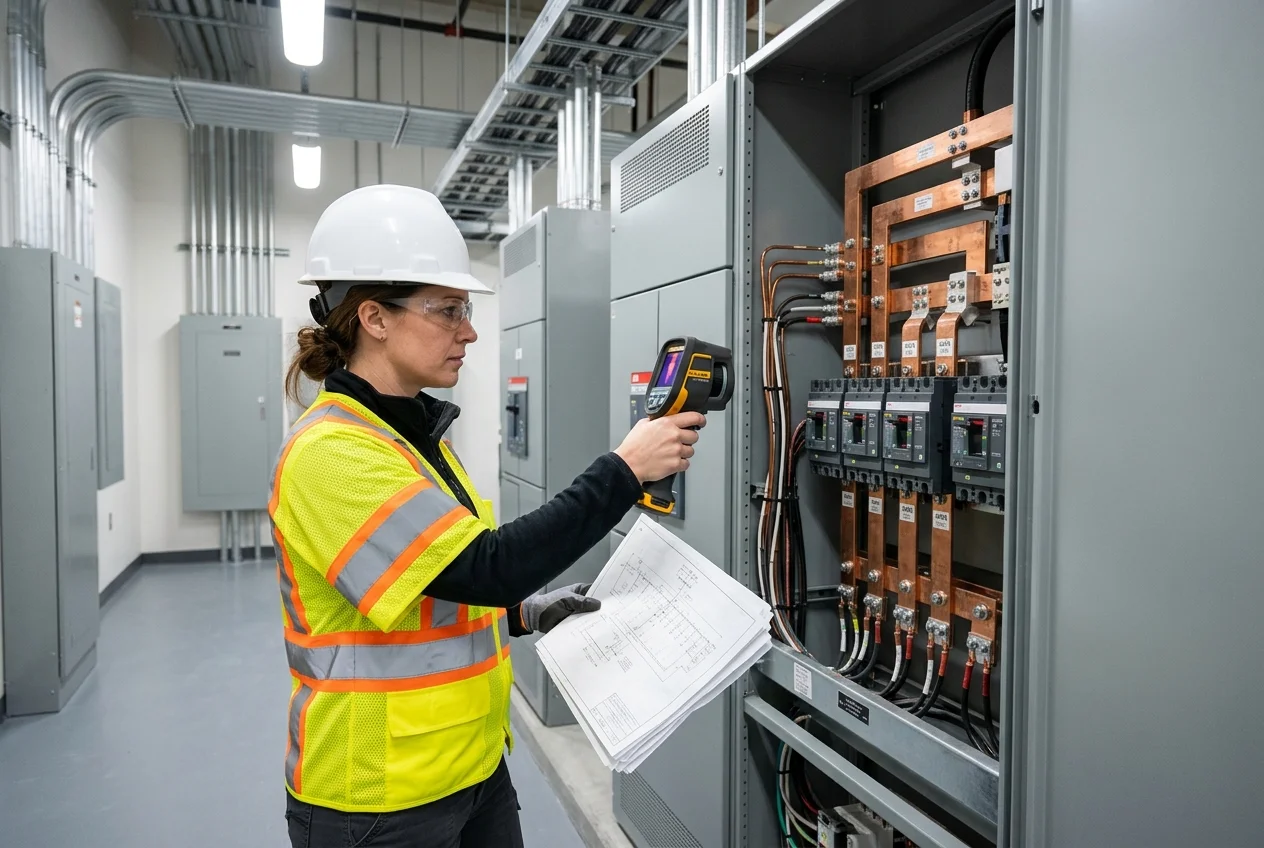 Licensed electrical engineers conduct comprehensive torque, thermal, and load-verification inspections on commercial distribution switchgear prior to utility service energization.
8. Can Load Management Avoid a Full Electrical Service Upgrade?
Yes. Emerging Automatic Load Management Systems (ALMS) enable commercial buildings to execute comprehensive electrification while avoiding millions of dollars in utility service and transformer upgrades.
8.1 Smart Commercial Electrical Panels
Smart panels dynamically track whole-building demand in real time. If building electrical demand approaches the service rating threshold, the smart panel throttles non-critical circuits (such as water heater elements or EV charging speeds) for short intervals, preventing main breaker overloads.
8.2 EV Charging Dynamic Load Sharing
Under NEC Article 625, EV charging infrastructure equipped with an approved Energy Management System (EMS) does not require service capacity equal to the total connected load. If four 40A chargers share an 80A feed, the system automatically dials back charging rates when multiple vehicles plug in, optimizing power delivery without exceeding capacity.
8.3 Thermal Energy Storage & Battery Integration
Pairing commercial heat pumps with thermal water storage or battery energy storage systems (BESS) allows buildings to "peak shave"—storing energy during low-demand night hours and discharging during peak periods, flattening the building's electrical load profile.
By implementing dynamic EV charging load sharing, domestic hot water pre-heating controls, and peak demand limiters, many building owners successfully electrify without triggering costly utility transformer vault expansions.
9. Electrical Upgrade Considerations for Different Building Types
Different property sectors present distinct electrical engineering challenges:
- Commercial Office Properties: Often possess substantial 480V 3-phase capacity but face challenges routing heavy feeder conduits through riser shafts to rooftop heat pump chillers.
- Multifamily Residential Buildings: Must balance central domestic hot water loads against tenant meter banks. Electrifying tenant cooking or in-unit heat pumps requires upgrading individual apartment subpanels (often limited to 60A in older buildings).
- Industrial & Warehouses: Ideal for fast EV fleet charging and large solar arrays, but high-capacity charging frequently requires dedicated medium-voltage transformers.
- Pre-War & Historic Properties: Characterized by cramped electrical closets, ungrounded conduits, and low service capacity (often 100A to 200A total for multi-story buildings), requiring comprehensive distribution overhauls.
10. Common Mistakes to Avoid During Electrical Service Upgrades
Avoiding these critical errors saves months of project delays and tens of thousands of dollars:
- Replacing Panels Without Verifying Utility Supply: Installing a 1,200A panel when the incoming street service is limited to 400A will cause main service failure during peak operation.
- Delayed Utility Engagement: Submitting utility applications after purchasing mechanical equipment frequently leads to months of downtime awaiting transformer upgrades.
- Sizing for Today, Ignoring Tomorrow: Upgrading a service for heat pumps today without factoring in future EV charging or electric DHW results in expensive secondary upgrades later.
- Overlooking Spatial Clearances: NEC Article 110 mandates strict working clearances around electrical equipment (typically 36 to 48 inches of unobstructed depth and 30 inches of width). Electrical rooms must be designed to code.
- Ignoring Utility Tariff & Demand Charge Impacts: Electrification shifts consumption from gas to electric. Operating equipment during peak demand windows can trigger massive utility demand charges unless paired with smart controls.
Building electrification is ultimately an electrical infrastructure challenge. Successful decarbonization requires seamless coordination between mechanical engineers, master electricians, and the electric utility. By auditing existing service capacity, evaluating smart load-management solutions, and engaging utilities early, commercial property owners can future-proof their assets while avoiding unnecessary capital expenditure.
Planning an Electrical Upgrade for Building Electrification?
Transitioning a commercial building toward electric heating, water heating, and EV charging requires careful planning of its electrical infrastructure. From distribution panels and metering equipment to service conductors and utility transformer capacity, every component should be evaluated before installation begins.