BY NYC Energy Code Team
ON
14 October 2026
Chiller Replacement Planning: Signs It Is Time and Typical Lifespan
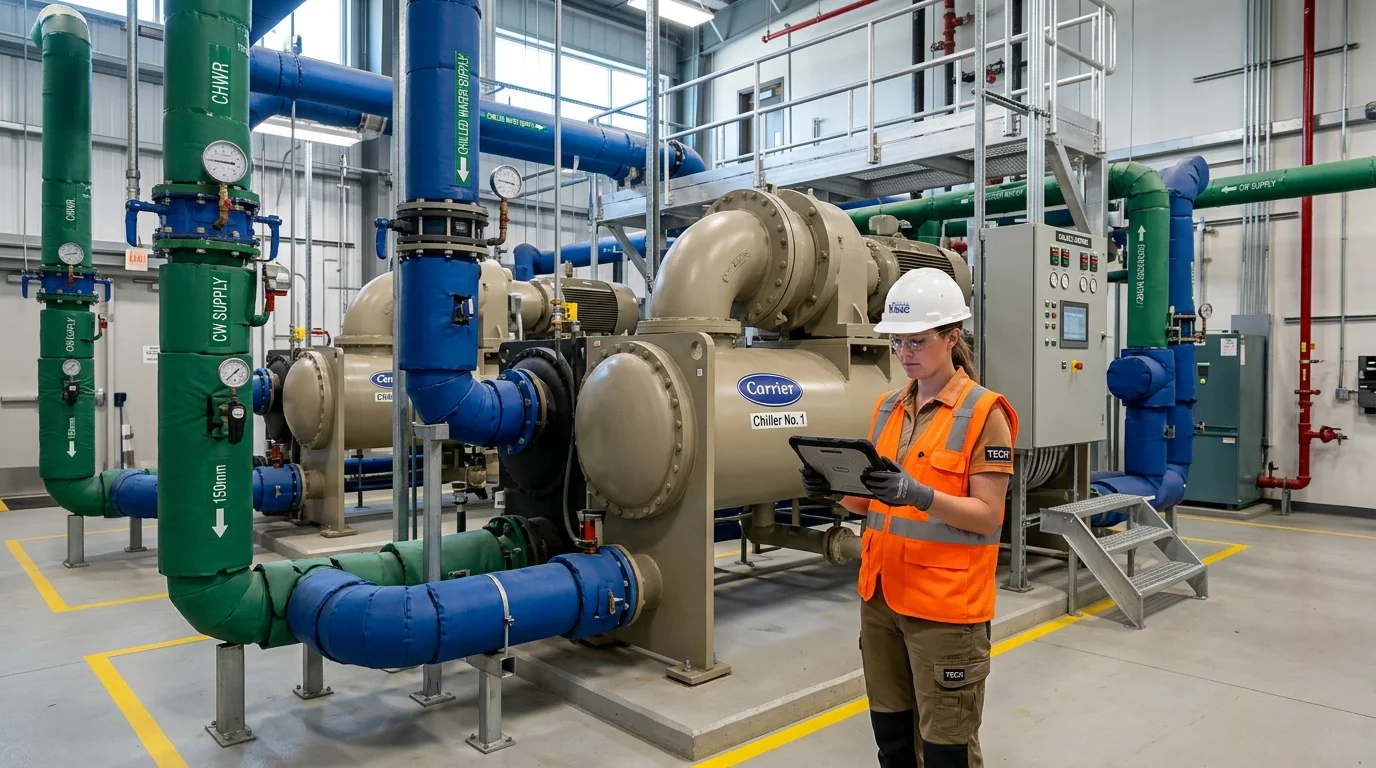
A commercial chiller rarely fails at a convenient time. In an office building, hotel, hospital, or multifamily property, a major cooling failure during peak summer demand can disrupt operations, affect tenant comfort, and require expensive emergency repairs.
The challenge for property owners is knowing when continued maintenance is sensible and when replacing the equipment would be the better long-term decision.
Age is a useful starting point, but it is not the only factor. A well-maintained chiller may continue operating beyond its typical service-life range, while a younger unit may become an expensive liability because of recurring failures, poor performance, or limited parts availability.
Effective chiller replacement planning combines equipment condition, energy performance, repair history, future cooling demand, and the cost of keeping the system operational. This approach gives building owners time to evaluate options before a breakdown turns a planned capital project into an emergency.
Proactive Capital Planning vs. Emergency Replacement
Planning a chiller replacement proactively avoids emergency rental chillers, premium overtime labor rates, and rushed equipment sizing. Evaluating lifecycle costs, kW/ton part-load curves, and refrigerant phaseouts allows owners to capture substantial energy savings under the 2025 NYC Energy Conservation Code.
How Long Does a Commercial Chiller Typically Last?
For preliminary capital planning, approximately 20–25 years is a reasonable planning range for many central commercial chillers. However, actual service life varies by equipment type, operating conditions, maintenance practices, and the replacement history of individual components.
ASHRAE's service-life research reports a median service life of 25 years for centrifugal chillers in its published dataset. Other chiller types have different reported results, and some categories have relatively small sample sizes. These figures are useful planning references, not guaranteed lifespans. Source: ASHRAE HVAC Service Life and Maintenance Cost Database.
A chiller's age should therefore be considered alongside its condition.
| Approximate Equipment Age | Practical Planning Approach |
|---|---|
| Under 10 years | Prioritize preventive maintenance, control optimization, and performance tracking unless serious defects exist |
| 10–15 years | Review energy performance, repair patterns, parts availability, and future building cooling needs |
| 15–20 years | Begin detailed replacement planning if performance is declining or major components are approaching the end of their useful life |
| 20–25 years | Evaluate repair versus replacement through lifecycle costs and establish a clear capital plan |
| More than 25 years | Assess condition carefully and plan for replacement where reliability, efficiency, or parts availability justify it |
These are planning guidelines, not mandatory replacement deadlines. A chiller older than 25 years may still be serviceable, while a 12-year-old unit could warrant replacement after a major failure. The decision should follow the evidence rather than the calendar alone.
Seven Signs It May Be Time to Replace Your Chiller
1
1. Energy Consumption Keeps Increasing
One of the strongest reasons to investigate an older chiller is a sustained deterioration in energy performance.
A chiller may consume more electricity to provide the same amount of cooling because of equipment wear, fouled heat-transfer surfaces, control problems, or other operating issues. Before assuming the chiller itself is inefficient, the building team should check whether cooling demand, operating schedules, weather, or the performance of associated equipment has changed.
A useful metric is chiller efficiency at a defined operating condition, commonly expressed as kilowatts per ton of cooling (kW/ton). Lower kW/ton generally indicates better efficiency when comparing equipment under equivalent conditions.
For example, if an older chiller consistently consumes more power at a comparable cooling load than its historical baseline, investigate the cause. If the deterioration persists after appropriate maintenance and controls adjustments, replacement may deserve serious consideration. ENERGY STAR recommends reviewing HVAC operating conditions, controls, schedules, pressures, temperatures, and energy use as part of an effective operations and maintenance program. Source: ENERGY STAR — Operations and Maintenance Best Practices.
2
2. Repairs Are Becoming More Frequent and Expensive
An isolated repair does not usually justify replacing an entire chiller. The bigger concern is a pattern of recurring failures and rising maintenance expenses.
Repeated compressor problems, oil-system issues, refrigerant leaks, unreliable controls, or failures involving major electrical components can signal that the equipment is becoming increasingly difficult to maintain economically.
Consider an older chiller that requires multiple service visits each cooling season. The owner is paying for parts and labor, while the building remains exposed to the possibility of another failure during hot weather.
At that point, compare the expected cost of continued repairs over the next several years with the lifecycle cost of replacement. Include planned maintenance, emergency risk, energy consumption, and the cost of operational disruption—not just the price of the next repair. A major repair can still be the better option when the rest of the chiller is in good condition. The decision depends on what the repair restores and how much useful service life is realistically expected afterward.
3
3. The Chiller Cannot Consistently Meet Cooling Demand
A chiller that runs for extended periods but struggles to maintain the required chilled-water temperature may have a capacity or performance problem.
This can appear as warm complaints from tenants, insufficient cooling during high outdoor temperatures, or difficulty maintaining indoor conditions when occupancy increases.
However, inadequate cooling does not automatically mean the chiller must be replaced. The underlying cause could be fouled heat exchangers, condenser-water problems, pump or flow issues, faulty sensors, incorrect control sequences, or a building load that has grown beyond the original design. The first step is to verify the actual cooling load and investigate the complete chilled-water plant. Replacement becomes more compelling when testing shows that the chiller is genuinely undersized, significantly degraded, or unable to meet demand economically.
4
4. Major Components Are Approaching the End of Their Useful Life
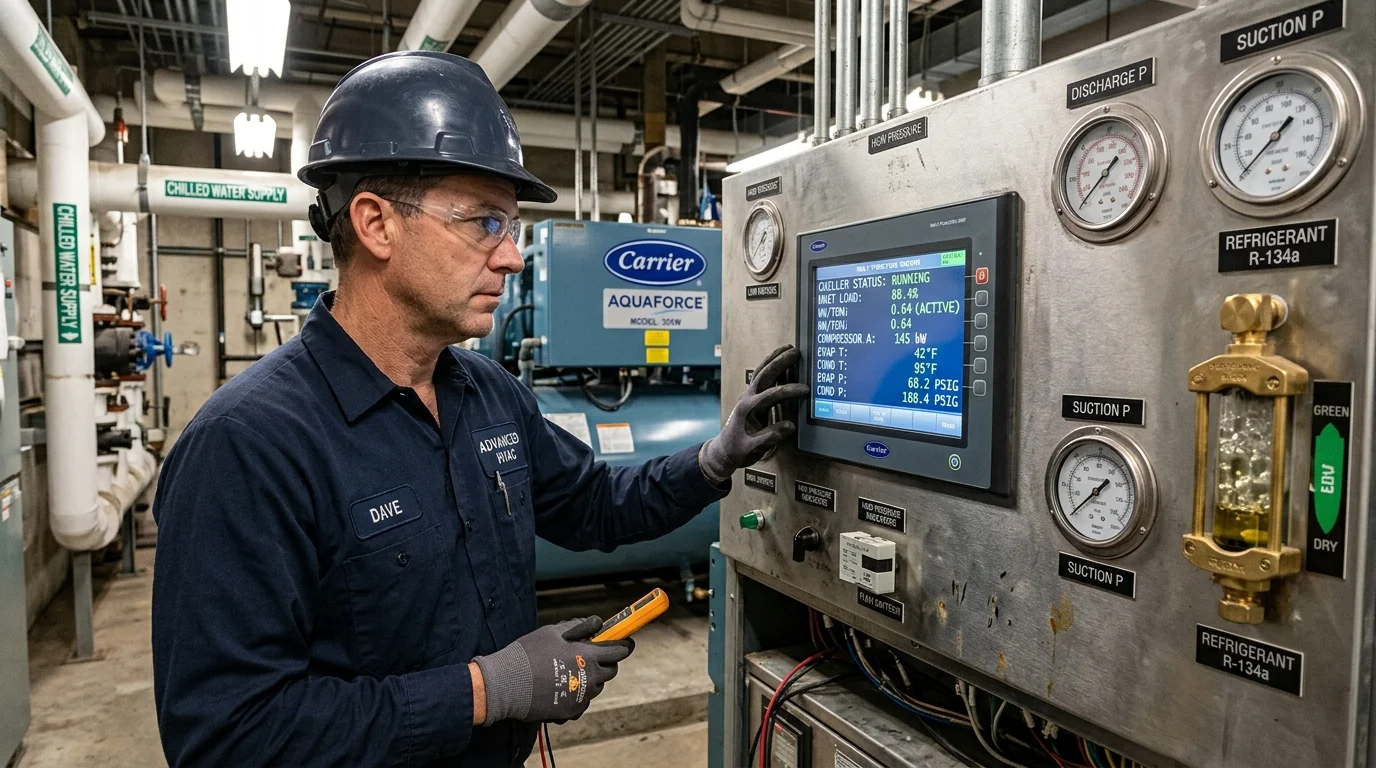
The condition of the compressor, motor, heat exchangers, electrical components, and control system can materially influence replacement decisions.
For example, an older unit may still operate but require a major compressor overhaul, extensive control replacement, or repairs that are unusually expensive because of equipment-specific requirements.
The question is whether the proposed repair restores reliable performance at a reasonable cost. If multiple major components are deteriorating at the same time, replacing one component may simply postpone another expensive intervention. A condition assessment by a qualified chiller service provider or mechanical engineer can help separate routine component maintenance from evidence of broader equipment deterioration.
5
5. Refrigerant and Replacement-Part Support Is Becoming Difficult
Older chillers can become harder to maintain when compatible parts, specialist expertise, or suitable refrigerant options become less accessible.
Refrigerant requirements are particularly important because equipment conversions and replacements must account for system compatibility, manufacturer instructions, safety requirements, and applicable regulations.
A refrigerant-related issue alone does not prove that a chiller needs to be replaced. The owner should first establish which refrigerant the equipment uses, whether it can continue to be serviced, and what compliant repair or retrofit options are available. If maintaining the existing unit increasingly depends on difficult-to-source components or costly modifications, replacement planning becomes more urgent.
6
6. The Chiller Has Repeatedly Failed During Peak Demand
Reliability matters as much as energy efficiency. An unexpected outage during summer can create emergency contractor costs, tenant complaints, disruptions to business operations, and possible damage to temperature-sensitive activities or equipment.
If the same chiller repeatedly trips, shuts down, or requires emergency intervention, review its failure history rather than treating every incident as an isolated event.
A building with redundant cooling capacity may be able to tolerate a planned replacement more easily. A single-chiller building without adequate backup may need a detailed transition plan, including temporary cooling or a carefully scheduled installation. When the consequences of another failure are high, it may be financially sensible to replace equipment before it reaches complete failure.
7
7. The Building's Cooling Needs Have Changed
Sometimes a chiller is replaced not because it is beyond repair, but because the building itself has changed.
Tenant improvements, longer operating hours, new server rooms, equipment additions, or changes in occupancy can increase cooling demand. Energy-efficiency retrofits or changes in building use can also reduce the load, leaving the existing chiller oversized.
A properly planned replacement starts with updated cooling-load calculations. Selecting a new chiller based solely on the existing nameplate capacity may lead to another mismatch. The objective is to select equipment that meets peak demand while operating efficiently under the building's actual range of cooling loads.
Repair, Retrofit, or Replace: How to Decide
Not every aging chiller should be replaced immediately. Three options should generally be evaluated.
| Option | Most Appropriate When | Main Consideration |
|---|---|---|
| Continue maintenance | Performance is stable and repairs remain manageable | Preserve useful service life while monitoring condition |
| Retrofit or overhaul | The main problems are identifiable and the core equipment remains viable | Compare retrofit cost, performance improvement, remaining life, and compatibility |
| Replace the chiller | Reliability is declining, major repairs are expensive, or performance no longer meets the building's needs | Evaluate capital cost, operating savings, downtime, and lifecycle value |
A replacement should be assessed through total cost of ownership rather than purchase price alone.
That analysis can include equipment and installation costs, electrical modifications, crane or rigging arrangements, piping changes, controls integration, maintenance, projected energy use, and expected service life.
For a property manager, a simple comparison of the next repair invoice against the new chiller's purchase price will rarely tell the whole story.
How Energy Efficiency Changes the Replacement Decision
New chillers can offer efficiency improvements, but the actual savings depend on the existing equipment, selected replacement, operating conditions, and cooling-load profile.
A useful analysis compares performance at several expected operating conditions—not just at the rated full-load point. Many commercial chillers spend substantial time operating at partial load, so part-load efficiency and control strategy can materially influence annual energy consumption.
For an illustrative calculation, suppose an existing chiller plant uses 500,000 kWh annually for chiller operation. A proposed replacement is projected to reduce that consumption by 15%.
Annual energy savings = 500,000 × 0.15 = 75,000 kWh
At an assumed electricity price of $0.20 per kWh:
75,000 × $0.20 = $15,000 annually
This hypothetical project would save an estimated 75,000 kWh and $15,000 per year in chiller electricity costs.
The assumptions are illustrative, not a prediction for a particular property. A credible estimate should account for actual load profiles, equipment efficiency, pump and cooling-tower interactions, utility tariffs, and any change in operating strategy.
Where savings are important to the investment decision, the engineering team should compare equipment alternatives using a consistent annual operating profile and document the assumptions behind the calculations.
Planning a Chiller Replacement Without Disrupting Building Operations
Once replacement becomes a realistic option, the best time to organize the project is before the equipment fails.
- Start with a condition and performance review: Compile maintenance records, fault logs, energy data, operating temperatures, and information about major components. Identify which problems are confirmed and which still require investigation.
- Confirm the required capacity: Reassess the building's cooling loads, seasonal demands, occupancy patterns, and any planned upgrades. The new equipment should be sized for the present and expected future requirements rather than copied blindly from the existing unit.
- Review the whole cooling plant: Chillers operate alongside pumps, cooling towers, heat exchangers, sensors, valves, and building automation systems. Upgrading the chiller without addressing a poorly performing supporting system may limit the benefits of the investment.
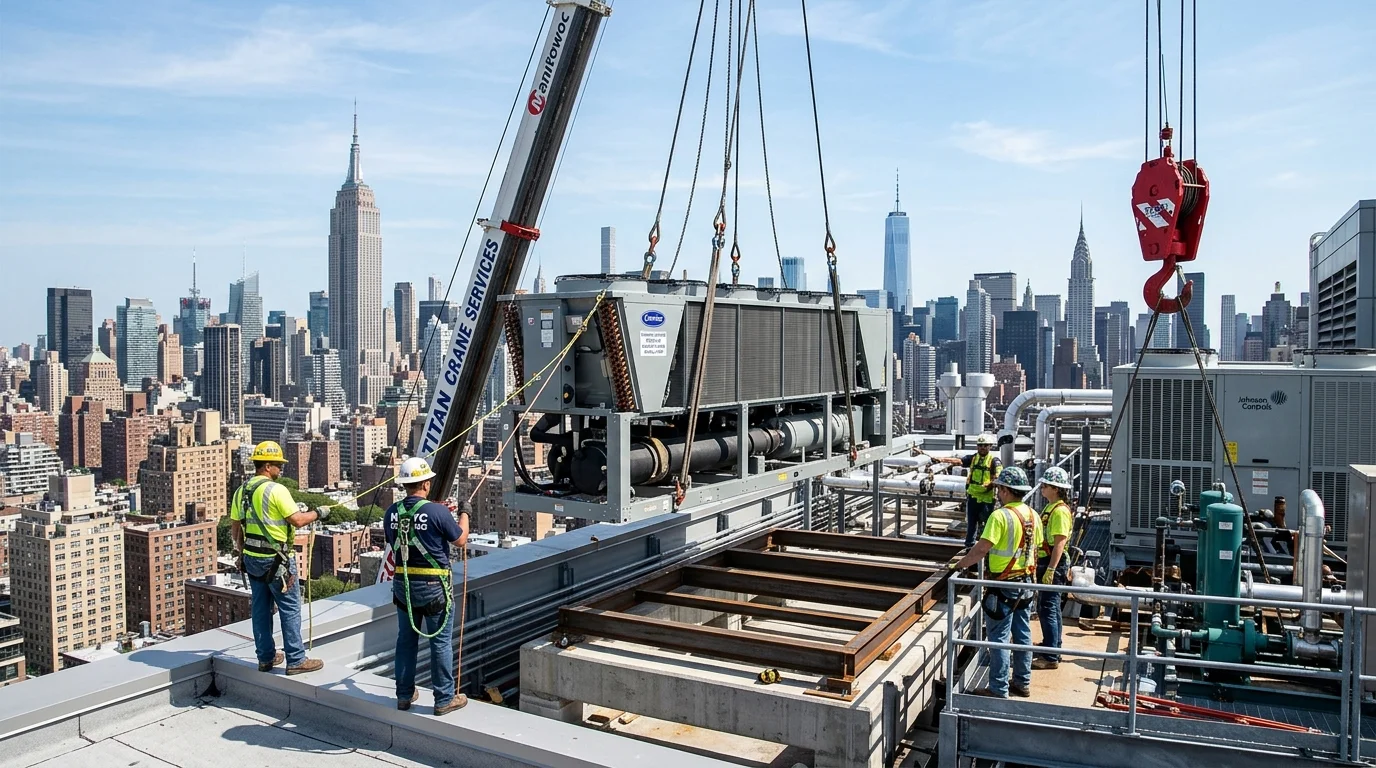
- Plan installation and procurement: Confirm equipment dimensions, access routes, rigging requirements, electrical supply, piping connections, controls integration, commissioning, and temporary cooling needs where necessary. Equipment removal can be a significant part of the project in older buildings with restricted mechanical-room access.
- Verify operation after installation: Commissioning should confirm that the system delivers the required cooling and that its controls, safeties, water flows, and operating sequences work as designed. Establish a performance baseline so the team can monitor actual energy use after the replacement.
What NYC Building Owners Should Consider
For projects in New York City, replacement planning should include a review of the applicable energy-code and mechanical requirements.
As of October 2026, enforcement of the 2025 NYC Energy Conservation Code and 2025 NYC ASHRAE 90.1 began March 30, 2026. The applicable requirements depend on the project scope, filing circumstances, selected compliance pathway, and relevant exceptions. Owners should not assume that every chiller replacement triggers identical requirements or that a like-for-like replacement is automatically exempt.
The 2025 NYC ASHRAE 90.1 includes requirements addressing HVAC alterations, equipment efficiency, submittals, and verification. Some exceptions apply in defined circumstances, including certain like-for-like replacements that would otherwise require extensive revisions to other systems or building elements.
Review the project with the responsible design professional and confirm the correct code pathway before finalizing the equipment specification. Source: NYC Department of Buildings — 2025 Energy Conservation Code.
The project team should also verify any applicable construction, mechanical, electrical, and refrigerant-related requirements. Addressing these issues during design is usually easier than resolving them after equipment delivery.
Conclusion
Commercial chillers do not have one universal replacement age. A planning horizon of roughly 20–25 years is useful for many central systems, but the actual decision should be based on condition, efficiency, repair history, available parts, cooling requirements, and the cost of continued operation.
Increasing energy use, recurring repairs, poor cooling performance, and major component deterioration are reasons to investigate—not automatic proof that a chiller must be replaced.
For building owners, the most effective strategy is to assess the equipment before a major failure, compare repair and replacement options on a lifecycle basis, confirm the correct cooling capacity, and coordinate the installation with the rest of the HVAC plant.
A planned replacement gives the property team greater control over budget, equipment selection, contractor scheduling, and operational disruption. Most importantly, it allows the new chiller to be selected for the building's actual needs rather than under emergency conditions.
Frequently Asked Questions
A planning range of 20–25 years is common for many central commercial chillers. ASHRAE's published dataset reports a median service life of 25 years for centrifugal chillers, although other equipment types and operating conditions vary.
Not necessarily. Twenty years is a useful point to conduct a detailed condition and lifecycle review, but a well-maintained unit may remain viable longer. Replacement depends on reliability, efficiency, repair costs, parts availability, and cooling demand.
Persistent performance deterioration, frequent failures, expensive major repairs, reduced cooling capacity, and increasingly difficult parts or refrigerant support are important warning signs. Each should be investigated to determine whether maintenance, retrofitting, or replacement is the best response.
Repair may be cheaper in the short term, particularly when the fault is isolated. Replacement may provide better long-term value when several major components are deteriorating or the existing equipment consumes substantially more energy. A lifecycle-cost comparison is more informative than the next repair cost alone.
Compare measured or reasonably estimated annual energy consumption for the existing system with projected consumption for the proposed equipment. Use the building's actual operating conditions and electricity tariff, and consider the associated pumps, cooling towers, and controls.
Winter or another low-cooling-demand period may simplify scheduling in some buildings, but the best installation window depends on the property's cooling requirements, redundancy, contractor availability, equipment lead times, and temporary cooling options. Planning early is more important than following a universal season.
Not necessarily. Requirements depend on the scope of work, applicable code pathway, and relevant exceptions. NYC building owners should have the responsible design professional confirm the requirements for the specific replacement project before procurement and filing.
Gather the chiller's model and age, maintenance and repair history, energy-use records, cooling-load information, fault logs, and details about connected pumps, towers, and controls. This information helps the engineering team evaluate whether to retain, retrofit, or replace the equipment.
You may also like