BY NYC Energy Code Team
ON
9 October 2026
Common Reasons a DOB Violation Gets Dismissed

Receiving a New York City Department of Buildings (DOB) violation can create problems beyond the initial inspection. An unresolved violation may complicate a property sale, refinancing, or the approval of a new or amended Certificate of Occupancy. Depending on the violation, financial penalties and additional enforcement action may also follow.
However, not every violation issued by DOB is necessarily valid. A violation may be dismissed when the evidence does not establish the alleged offense, the documented facts contradict the charge, or a significant procedural issue undermines the case.
The key is understanding what the notice alleges, which agency issued it, and what evidence can support a challenge. A strong dismissal request is built on verifiable facts—not simply the belief that the violation is unfair.
Core Principle of DOB Violation Challenges
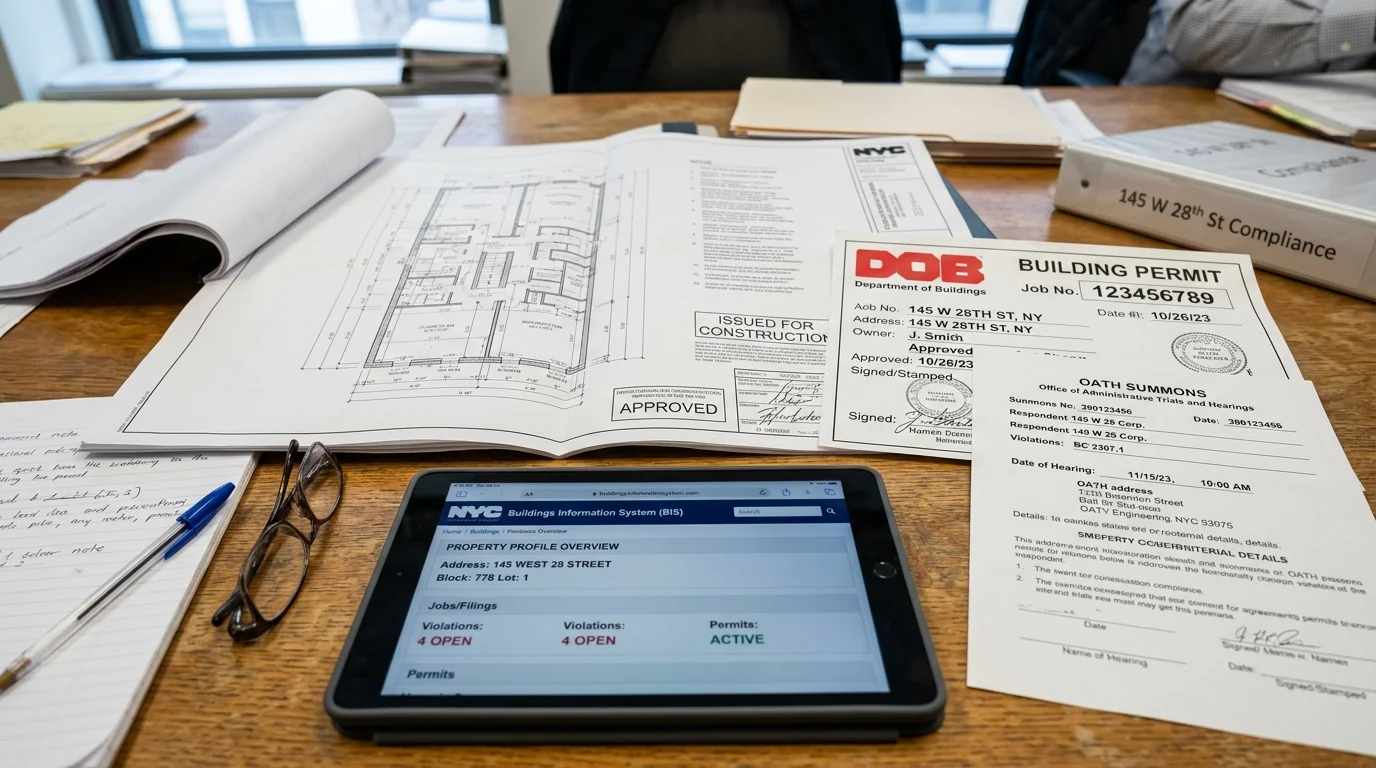
A successful challenge before the NYC Department of Buildings or the Office of Administrative Trials and Hearings (OATH) requires concrete documentary evidence. Factual alignment between your approved permits, physical site conditions, and the exact language in the administrative summons forms the foundation of every valid dismissal defense.
1. The Alleged Violation Did Not Occur
One possible reason for dismissal is that the cited condition did not exist as described or that the facts do not establish a violation of the applicable requirement.
For example, an inspector might allege that construction work was performed without the required permit. However, the owner may have an applicable permit that was valid for the work and property in question. Similarly, an alleged obstruction or unsafe condition might not have been present when the inspection occurred.
The important distinction is between claiming that a violation never existed and demonstrating that claim with reliable evidence.
Useful supporting records may include approved plans, permits, inspection reports, dated photographs, sign-off records, and other documents that directly relate to the condition described in the notice.
At an OATH hearing, the issuing agency generally must establish the factual allegations by a preponderance of the evidence, while a respondent must prove an affirmative defense when one is raised. The specific legal requirements depend on the charge and applicable rules. NYC OATH evidence rules.
2. The Evidence Does Not Support the Charge
A violation can also be challenged when the available evidence does not adequately support the allegation.
Consider a construction-site violation that describes a particular condition but provides unclear photographs or limited information about where the condition was observed. If the evidence presented at the hearing does not establish the alleged facts, the respondent may have grounds to contest the charge.
This does not mean that an owner can obtain a dismissal merely by questioning an inspector's observations. An OATH summons that has been properly sworn to or affirmed may itself serve as prima facie evidence of the facts stated in it. The strength of the defense therefore depends on the entire record, including the summons, inspection report, photographs, testimony, and any credible contrary evidence.
A useful approach is to compare each allegation with the documents that support it. If the charge refers to a specific location, date, installation, or piece of equipment, the response should address that exact detail rather than offer a general denial.
3. The Wrong Person or Property Was Identified
Incorrect identification can provide grounds to challenge a violation when the mistake is material to the case.
For example, the notice may identify the wrong respondent, reference an incorrect property, or attribute responsibility to someone who can demonstrate that the relevant allegation does not apply to them. Ownership records and property documentation may help clarify the issue.
A change in ownership, however, does not automatically invalidate a violation associated with a building. Nor does the fact that a property manager, contractor, or previous owner was involved necessarily remove the current owner's obligations.
The relevant question is whether the respondent named in the summons is properly connected to the alleged violation and whether the evidence supports that connection. Respondents who believe they have been incorrectly identified should raise the issue through the appropriate process and provide supporting records. OATH guidance on responsibility for summonses.
4. A Significant Error Appears in the Summons or Notice
The accuracy and adequacy of a summons matter because the respondent needs to understand what conduct is being alleged and prepare a meaningful defense.
Potential issues include a materially incorrect description of the alleged condition, a citation that does not match the alleged conduct, or missing or inaccurate information that prevents the respondent from adequately understanding the charge.
However, not every typographical mistake or technical error results in dismissal. The significance of an error depends on the applicable rules, the circumstances of the case, and whether the problem affects the fairness or validity of the proceeding.
The best response is to identify the exact defect, explain why it matters, and connect it to the applicable legal requirement. A vague claim that the paperwork is incorrect is usually much less persuasive than a documented, specific objection.
5. The Required Notice Was Not Properly Served
Service and notification issues can be relevant when challenging an administrative summons. For example, a respondent may have evidence that the notice was not delivered in the manner required by the applicable rules.
The legal significance depends on the type of case and the service requirements that apply. Simply saying that a notice was never seen or personally received does not establish that service was legally defective.
An owner or respondent who raises this issue should review the available service records and identify the specific requirement that may not have been satisfied. The issue should be raised through the appropriate hearing or challenge procedure, rather than ignored.
Procedural challenges are especially fact-dependent, so legal advice may be appropriate when service, notice, or jurisdiction is disputed.
6. Permits, Approved Plans, or Inspection Records Contradict the Allegation
DOB violations frequently involve construction, building systems, alterations, and work that may require permits or other approvals. Records from DOB or licensed design professionals can help establish what work was authorized and whether the cited condition complied with the relevant requirements.
Suppose a violation alleges that an alteration was performed without authorization. The owner discovers that a permit existed for the relevant scope of work and that the approved plans covered the installation in question. Those records may help contest the allegation, depending on the permit's validity, dates, scope, and other facts.
On the other hand, producing a permit for unrelated work is unlikely to resolve the issue. The supporting documentation must correspond to the actual condition and applicable requirement.
Before submitting a challenge, organize the documents by date and relevance. Include the permit number, approved plans, applicable inspection results, and any other record that directly addresses the allegation.

7. The Agency Cannot Establish an Essential Element of the Violation
Sometimes the disagreement is not about whether a physical condition existed, but whether that condition meets the legal definition of the cited violation.
For example, an inspector may observe an installation but the dispute may concern whether it falls under the specific code provision cited, whether the cited provision applies to the property, or whether an element required by the charge has been established.
These cases require more than general technical disagreement. The respondent should identify the precise code provision, explain how it applies to the facts, and provide credible documentation or qualified professional analysis where appropriate.
At an OATH hearing, the hearing officer evaluates the evidence and applicable requirements before issuing a decision. A dismissal may follow when the respondent successfully contests the violation, but the outcome depends on the individual case. DOB guidance on OATH hearings and outcomes.
8. The Violation Was Corrected or Compliance Was Established
Correction is important, but it is essential to understand the difference between correcting a condition and obtaining a dismissal.
Imagine a building owner receives a violation concerning unpermitted work. The owner subsequently obtains the required approvals where available, completes the necessary corrective work, and gathers photographs and inspection records. This documentation may help establish compliance and support the process for resolving the violation.
However, fixing the condition does not automatically mean the original charge will be dismissed. Depending on the violation, the owner may still need to submit an acceptable Certificate of Correction, pay applicable penalties, or follow a separate DOB procedure.
For OATH summonses, the outcome may involve a dismissal after a successful hearing, an approved correction filing, a reduced penalty, or another permitted resolution. These outcomes are not interchangeable.
DOB explains that an ordinary DOB violation generally requires correction and proof to be provided to the issuing unit. A dismissed DOB violation is identified differently in the Buildings Information System (BIS), with an asterisk next to the violation number. DOB's guide to resolving a summons or violation.
What Evidence Can Strengthen a DOB Violation Challenge?
The strongest evidence is the material that directly answers the allegation. Before filing, match the documents to the specific violation rather than submitting a large collection of unrelated records.
| Type of Evidence | What It May Help Establish |
|---|---|
| Approved permits and plans | The work was authorized or the cited scope was covered |
| Dated photographs or video | The physical condition at a relevant time |
| Inspection reports and sign-offs | The results of inspections or documented compliance |
| Ownership and property records | The correct property or responsible party |
| Contractor records and receipts | The nature, timing, or completion of corrective work |
| Professional reports | Technical facts relevant to a disputed building or code condition |
| Summons and service records | The exact allegation and potential procedural issues |
These documents do not guarantee a dismissal. Their value depends on how directly they address the legal and factual issues in the case.
How to Pursue a Dismissal or Resolution
Start by identifying which type of enforcement notice you received. NYC DOB distinguishes a DOB violation from an OATH summons. The appropriate route depends on that distinction.
1
OATH Summons Hearing
For an OATH summons, the respondent may contest the charge at a hearing and submit relevant evidence. Failing to attend a scheduled hearing can result in a default finding and increased penalties, so the hearing date should be treated seriously.
2
DOB Violation Dismissal Request Form
For a DOB-issued violation that is not an OATH summons, the usual route is to contact the issuing unit and follow its instructions. DOB also provides a Violation Dismissal Request form for requesting dismissal of eligible active DOB or Unsafe Building violations. The request must be completed correctly and accompanied by supporting documentation; the department may reject an incomplete submission.
3
Certificate of Correction & Compliance Filings
For a violation that has been corrected, the owner should determine whether a Certificate of Correction, evidence of compliance, penalty payment, or another unit-specific step is required. DOB's official violation-resolution guidance explains the general process.
Common Mistakes That Weaken a Dismissal Request
A weak challenge often focuses on frustration rather than evidence. The following mistakes can make the process more difficult:
- Assuming a violation disappears once the physical condition is corrected. Resolving the condition on-site does not automatically close the administrative summons or remove open violation flags.
- Submitting photographs without dates, location details, or an explanation of their relevance. Unlabeled or undated imagery lacks probative value during formal enforcement reviews.
- Relying on a permit that does not cover the cited work. Producing permits for plumbing or electrical work when the citation targets unpermitted structural modifications will not suffice.
- Treating every paperwork error as grounds for dismissal. Minor typographical variances that do not impair notice or substantive fairness are regularly amended rather than dismissed.
- Missing a hearing or filing deadline while attempting to resolve the issue informally. Administrative default penalties are substantial and significantly harder to overturn once entered.
- Confusing dismissal with a reduced penalty or an approved Certificate of Correction. A dismissal vacates the charge entirely; a Certificate of Correction certifies compliance but acknowledges the underlying issuance.
The better strategy is to establish what the agency alleged, what evidence supports that allegation, and what specific facts or legal grounds justify a challenge.
Conclusion
A DOB violation may be dismissed when the charge cannot be established, the evidence supports a defense, a material identification or procedural problem undermines the case, or the respondent successfully challenges the allegation under the applicable rules. But dismissal is never automatic, and correcting a building condition is not the same as clearing the record.
For NYC property owners, the most effective starting point is to review the exact notice, assemble relevant documentation, confirm the correct administrative process, and meet all applicable deadlines. Where the issue involves serious safety concerns, substantial penalties, disputed service, or complex code interpretations, consulting a qualified NYC building professional or attorney can help clarify the available options.
Frequently Asked Questions
Yes. Eligible DOB violations may be considered for dismissal through the appropriate DOB process, and OATH summonses may be dismissed following a successful hearing. The available procedure depends on the type of notice and the grounds for the challenge.
No. Correction and dismissal are different outcomes. Depending on the case, the owner may need to file an acceptable Certificate of Correction, provide proof to the issuing unit, pay applicable penalties, or pursue a hearing.
A material error may support a challenge if it affects the allegation or its validity. Minor clerical errors do not automatically lead to dismissal.
The respondent should review the notice and gather records that demonstrate the identification problem. Ownership or responsibility disputes must be raised through the applicable process, and a change in property ownership alone does not automatically invalidate a violation.
Yes, when they are relevant and reliable. Dated photographs may help establish the condition of a property at a particular time, but they are generally more useful when supported by permits, inspection records, or other documentation.
Check the NYC Buildings Information System (BIS) or the relevant DOB portal. DOB indicates that dismissed violations may appear with an asterisk next to the violation number. Confirm the current status rather than assuming that a submitted request has been approved.
DOB provides a Violation Dismissal Request form for eligible active DOB and Unsafe Building violations. The request must be submitted to the appropriate issuing unit with the required supporting documents. OATH summonses follow a different process when a hearing is involved.
A lawyer is not required for every OATH hearing. However, legal assistance may be valuable when a case involves significant financial exposure, complex code provisions, disputed service, repeat violations, or a potential impact on a property transaction.
You may also like