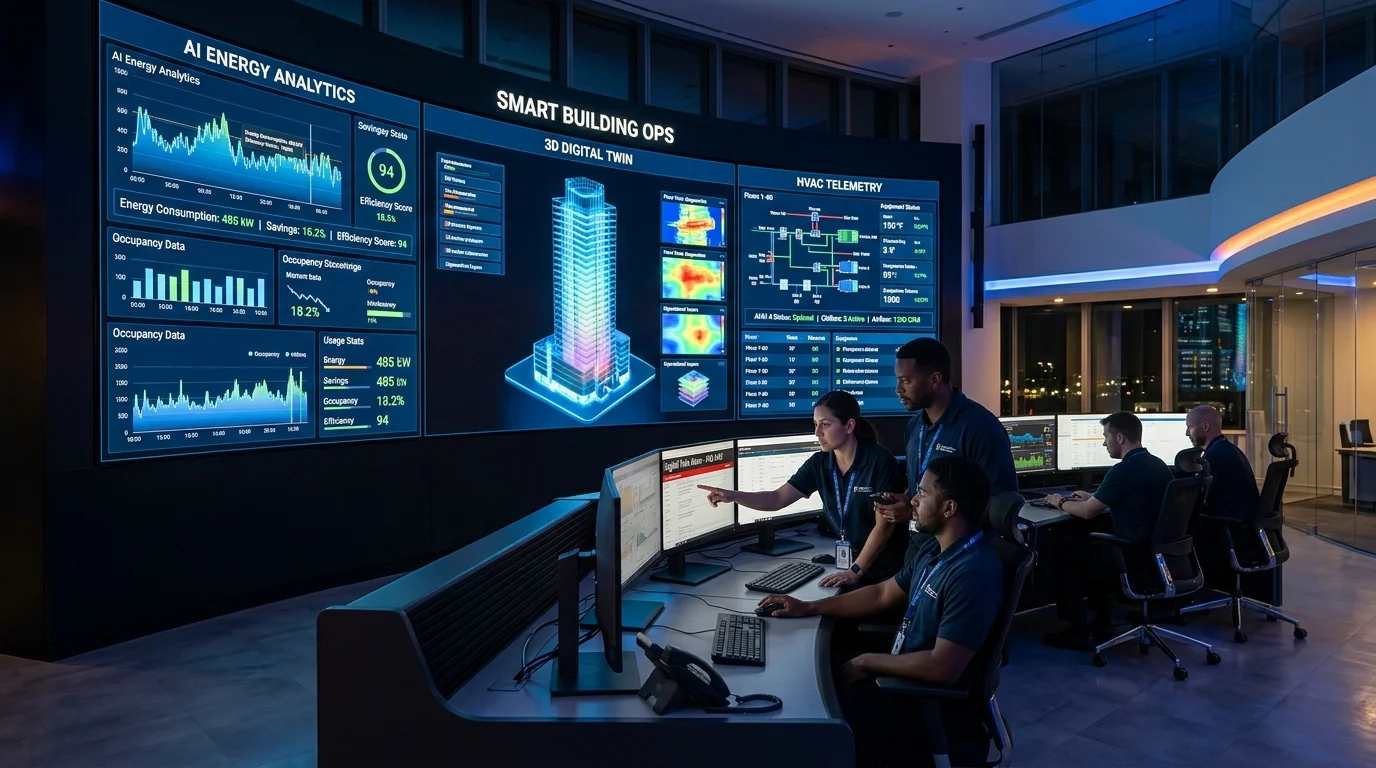
AI in Buildings: Real Operational Improvement or Just Another Dashboard?
A commercial building owner receives a proposal for an AI-powered building management platform. The vendor promises lower energy bills, fewer equipment failures, automated maintenance, improved tenant comfort, and smarter decision-making.
The presentation looks impressive. There are real-time dashboards, predictive alerts, energy forecasts, and a digital model of the building.
But one question matters more than the features: What specific building problem will this technology solve, and how will the owner verify the results?
Artificial intelligence can help building operators identify inefficient HVAC operation, detect equipment faults, forecast energy demand, and make better use of existing building automation data. These applications can create measurable value when they lead to corrective action.
However, adding AI to a building does not automatically improve performance. If temperature sensors are inaccurate, equipment records are incomplete, or nobody responds to system alerts, even sophisticated software may produce little practical benefit.
The difference between useful technology and marketing hype comes down to evidence. A successful implementation should identify a real operational problem, demonstrate measurable improvement, and fit the building's existing systems and maintenance processes.
What Does AI Actually Do in Building Operations?
AI in building operations refers to software that uses data analysis, machine learning, pattern recognition, or other computational methods to support decisions about building systems.
It can work with information from a Building Management System (BMS), utility meters, HVAC controllers, temperature sensors, occupancy systems, maintenance records, and other sources.
Traditional automation typically follows predefined instructions. For example, an HVAC controller may start a cooling system at 7 a.m. and stop it at 7 p.m.
AI-based analytics can examine operating data to determine whether that schedule makes sense, identify unusual patterns, or recommend changes based on occupancy, weather, and historical performance. Some advanced systems can adjust controls automatically when the integration, permissions, and safety constraints allow it.
The distinction is important: a system that follows fixed rules is not necessarily using AI, and a system that uses AI does not necessarily control the building automatically.
In many properties, the most valuable application is not replacing the existing BMS. It is helping operators make better use of the data that the BMS already collects.
The National Institute of Standards and Technology (NIST) is actively researching AI-enabled building systems that can optimize operations, identify faults, and support more reliable coordination between equipment and controls. [Source: NIST — AI for Building Systems Innovation].
Four Areas Where AI Can Deliver Real Value
1. HVAC Fault Detection and Diagnostics
HVAC systems rarely operate perfectly all the time. Sensors drift, valves stick, filters become clogged, control sequences are configured incorrectly, and equipment continues running when it is not needed.
AI-assisted fault detection and diagnostics (FDD) can analyze equipment data to identify patterns that may indicate a problem.
Consider an office building where a cooling valve remains open even when the system should not require cooling. An operator may not notice the issue during a routine inspection because the building still feels comfortable.
An analytics platform could flag an unusual combination of valve position, supply-air temperature, and cooling demand. A technician can then investigate whether the valve is malfunctioning or the control sequence is incorrect.
This is a meaningful use of AI because it directs maintenance staff toward a specific, testable problem.
The important qualification is that an alert identifies a potential fault, not necessarily a confirmed failure. Equipment conditions, sensor quality, and system configuration need to be considered before repairs are authorized.
Berkeley Lab's fault-detection resource reports that FDD technology can identify operational faults associated with energy waste and help isolate their causes. Actual savings depend on the building and whether identified problems are corrected. [Source: Berkeley Lab — Fault Detection and Diagnostics].
2. Energy Optimization and HVAC Scheduling
AI can help identify when HVAC systems consume energy unnecessarily.
A building may cool vacant offices, operate ventilation outside expected hours, heat spaces earlier than necessary, or run multiple systems in conflicting modes.
An AI-enabled platform can analyze weather forecasts, historical loads, occupancy information, and HVAC performance to recommend or implement more appropriate operating schedules.
For example, suppose an office building normally starts cooling every floor at 6 a.m., even though occupancy is concentrated on a smaller portion of the property early in the day. A properly integrated control strategy might start equipment in phases or adjust schedules according to the expected demand.
This does not mean the system should simply turn equipment off whenever occupancy appears low. Minimum ventilation, humidity control, equipment limitations, and occupant requirements must remain protected.
The practical benefit is more intelligent operation within defined limits—not unrestricted automation.
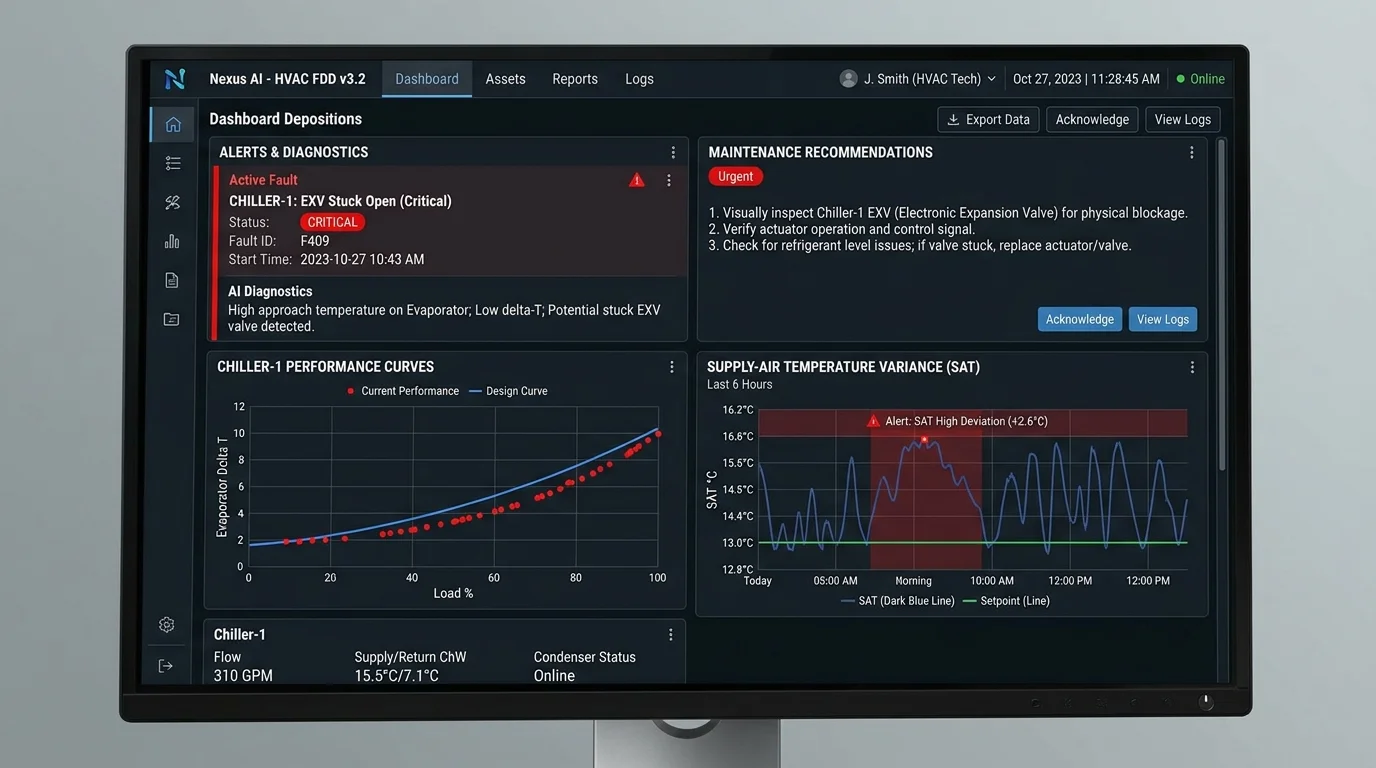 AI-assisted fault detection and diagnostics (FDD) dashboard flagging an anomalous stuck cooling valve and tracking supply-air temperature variance
3. Predictive Maintenance
Traditional maintenance often follows a calendar or responds after a breakdown. AI-assisted predictive maintenance looks for changes in equipment behavior that may indicate developing problems.
For example, unusual vibration, rising motor temperature, increasing runtime, or changes in operating pressures could prompt an earlier inspection.
The system may help a facility team prioritize a chiller, pump, fan, or air-handling unit that is showing abnormal behavior rather than treating every piece of equipment as equally urgent.
But predictive maintenance has a limitation: a prediction is only useful when it is sufficiently reliable and leads to an appropriate intervention.
A vendor that claims it can predict every equipment failure should be asked which components the system covers, what data it uses, how predictions are validated, and how often false alarms occur.
Equipment that has no suitable sensors or historical operating data may not support sophisticated predictive maintenance without additional instrumentation.
4. Energy and Demand Forecasting
AI can help estimate future energy consumption by analyzing historical utility data, weather conditions, operating schedules, and other relevant variables.
These forecasts can help building managers spot unusual demand, prepare for peak periods, and evaluate whether equipment operation matches expected conditions.
For properties with demand-based electricity tariffs, forecasting may help operators schedule flexible loads where practical. In buildings with batteries, EV charging, or other controllable electrical equipment, a suitable platform may also support coordinated energy management.
However, an energy forecast is not a guarantee. Unexpected occupancy changes, abnormal weather, equipment failures, and inaccurate meter data can undermine its accuracy.
Forecasting is most valuable when it supports a concrete decision, such as investigating an unexpected load increase or adjusting a permitted operating schedule.
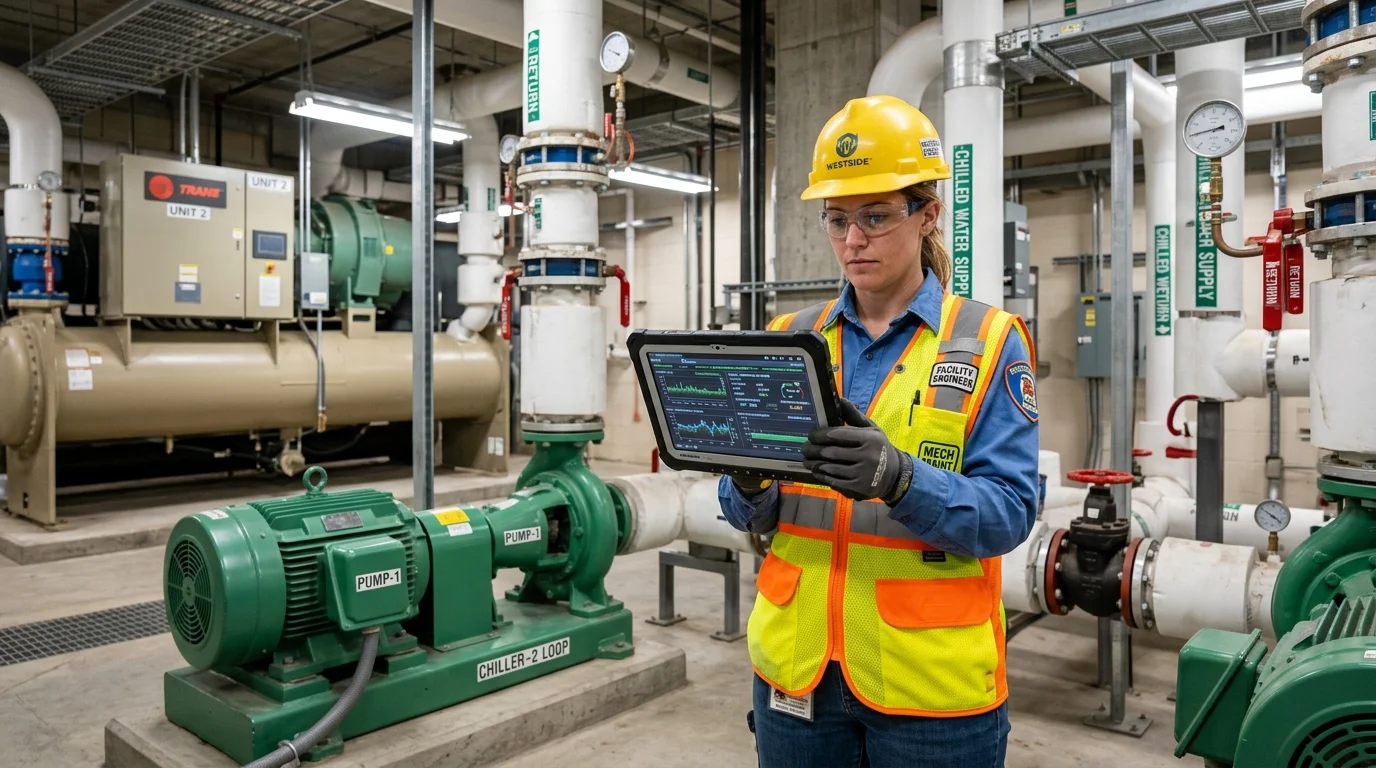 Building operations engineer reviewing real-time equipment telemetry and predictive vibration metrics on a tablet in a central mechanical plant
Where AI Building Technology Can Become Marketing Hype
Not every product marketed as AI-powered provides the same level of intelligence or operational value.
| Marketing claim | What to verify | Warning sign |
|---|---|---|
| “AI reduces energy use by 30%” | How savings were measured, against which baseline, and under what conditions | A guaranteed percentage without building-specific evidence |
| “Predicts equipment failure before it happens” | Which failures it detects, warning lead time, false-alarm rate, and validation method | Claims of universal prediction across all equipment |
| “Fully autonomous building” | Which decisions it can make and what safety constraints remain | No clear human override or fallback procedure |
| “Digital twin of your building” | Whether the model reflects actual equipment, operating data, and current conditions | A static 3D model presented as an operational simulation |
| “Works with every BMS” | Supported controllers, protocols, data points, and integration costs | Compatibility described without a technical assessment |
| “Instant energy savings” | Installation effort, commissioning, operating changes, and measurement period | No baseline, measurement plan, or post-installation verification |
These concerns do not mean that AI building tools are ineffective. They mean that marketing language is not a substitute for a defined technical capability and a measurable result.
A platform that displays hundreds of sensor readings may look sophisticated while doing little to change how the building operates. Conversely, a relatively simple analytics tool that detects one recurring HVAC fault could save money by helping the maintenance team fix it.
The right evaluation is based on the problem solved, not the number of AI features advertised.
A Realistic Example: A NYC Office Building Tests AI HVAC Analytics
Consider a hypothetical 100,000-square-foot office building with an existing BMS, several air-handling units, and a central cooling plant.
The property manager notices that electricity consumption remains high after normal business hours. The building team suspects the HVAC system is running longer than necessary but does not know which equipment or schedule is responsible.
The owner commissions an AI-assisted analytics pilot using existing BMS data.
During the pilot, the platform identifies recurring periods when selected equipment continues operating after scheduled occupancy. The facilities team reviews the alerts, confirms which operating periods are unnecessary, and adjusts the approved control schedules.
The owner then compares energy use before and after the changes, accounting for weather, occupancy, operating hours, and any other significant changes.
The value of the pilot is not that the building has acquired AI software. It is that the software helped identify a specific operational issue, the facilities team corrected it, and the result can be measured.
The analysis could also reveal that some alerts were caused by inaccurate sensors or legitimate operating requirements. Those findings are useful because they help distinguish genuine waste from normal equipment behavior.
This example illustrates a sensible deployment strategy: begin with an operational problem, test whether the software can identify it, and measure the outcome before expanding the system.
How Much Energy Can AI Actually Save?
There is no universal energy-savings percentage that applies to every building using AI.
A systematic review published in Energy Informatics in November 2025 examined 126 studies of AI applications in building energy optimization. It found promising results across different approaches, but also substantial variation between studies and limited real-world deployment relative to the overall research literature.
That distinction matters. Results from simulations, laboratories, and selected pilot buildings do not necessarily translate directly to an older office tower, a multifamily property, or a building with limited automation infrastructure. [Source: Energy Informatics — Systematic Review and Meta-Analysis].
The actual savings depend on the building's starting condition. A property with persistent scheduling errors or poorly functioning equipment may have significant opportunities. A building with well-maintained equipment, calibrated sensors, and optimized controls may have less room for improvement.
To evaluate the financial return, use a transparent calculation:
Suppose an AI analytics pilot costs $20,000 to install and operate during the first year, and the verified annual net savings after operating costs are estimated at $8,000.
This is an illustrative example, not a market benchmark or a promise of performance. A valid assessment would account for recurring software fees, controls integration, staff time, maintenance, and any changes in utility prices. Where possible, owners should measure actual energy savings using a documented baseline and a method that accounts for weather, occupancy, and operating changes under NYC Local Law 97 carbon limits.
AI Does Not Replace Building Engineers or Facility Managers
AI is particularly useful for processing data at a scale that would be difficult for a person to review manually. It can flag unusual conditions, summarize trends, and help prioritize investigation.
However, facility teams remain responsible for understanding the physical building, authorizing maintenance, protecting occupants, and ensuring that equipment operates safely.
A model may flag a pump as inefficient because its operating pattern differs from historical data. A mechanical engineer may discover that the pump is operating under a legitimate temporary condition or that a sensor is giving an incorrect reading.
Similarly, automatically changing an HVAC setpoint may affect humidity, comfort, ventilation, or equipment performance if the control limits are poorly configured.
A safe deployment defines what AI may recommend, what actions it may execute, and which decisions require human approval. Critical safety functions should not depend solely on an unverified AI prediction.
Cybersecurity: The Risk Building Owners Should Not Ignore
AI tools often connect to building automation systems, cloud platforms, remote monitoring services, and third-party applications. These connections can provide operational value, but they can also introduce cybersecurity exposure.
Building automation systems are operational technology: they interact with physical equipment and building conditions. Unauthorized access, poorly managed accounts, insecure remote connections, or vulnerable integrations can therefore affect more than data confidentiality.
NIST's guidance on building systems emphasizes the importance of cybersecurity for HVAC, lighting, access systems, and other connected building services. In August 2026, NIST also published guidance highlighting the need to address risks to building automation and control systems. [Source: NIST — Cybersecurity for Building Systems].
Before connecting an AI platform to a BMS, building owners should understand what data leaves the building, which controls the platform can access, how vendor access is managed, and what happens if network communication fails.
A sensible deployment uses appropriate access controls, network segmentation, audit logs, secure remote access, and a documented fallback plan. The system should not receive unrestricted control privileges simply because the vendor describes it as intelligent.
How to Evaluate an AI Vendor Before Signing a Contract
A useful vendor assessment begins with a specific operational objective. For example, the owner might want to reduce after-hours HVAC operation, identify recurring chiller faults, or investigate unexplained electricity peaks.
The vendor should then explain how its platform will use the building's actual data to address that objective.
Ask for a clear explanation of the required equipment, sensors, communication protocols, integration effort, and data history. Establish which findings will be delivered, how the building team should respond, and what will count as a successful result.
The contract should also clarify software and service fees, data ownership, system access, cybersecurity responsibilities, support commitments, and how the owner can export or retain operational data if the service ends.
Most importantly, agree on how performance will be measured before installation begins. A baseline established after the software is installed is much less useful when the goal is to prove that the technology produced savings.
A Practical 90-Day AI Pilot for Building Operations
Instead of deploying AI across every building system immediately, owners can begin with one well-defined use case.
- Days 1–30: Establish the baseline. Select the target system, review BMS data quality, identify relevant energy and operating metrics, and document current performance.
- Days 31–60: Run the analytics. Allow the platform to identify patterns and potential faults. Have facility staff verify a sample of alerts and record which ones are actionable, incorrect, or caused by legitimate operating conditions.
- Days 61–90: Make controlled changes and evaluate results. Implement approved adjustments, monitor comfort and operating conditions, and compare performance against the baseline while accounting for significant changes in weather, occupancy, and schedules.
At the end of the pilot, the owner should be able to answer three questions: Did the platform identify problems that were previously missed? Did the team take action on those findings? Can the results be measured clearly enough to justify the ongoing cost?
If the pilot cannot answer those questions, expanding the platform may add complexity without delivering sufficient operational value.
What NYC Building Owners Should Prioritize
For NYC commercial and multifamily buildings, AI is best evaluated as part of an existing operational and energy-management strategy rather than as a standalone sustainability feature.
Owners should first examine the quality of their utility data, BMS integration, maintenance records, and equipment controls. These fundamentals determine whether the AI platform has reliable information to work with.
Where the objective is energy performance or emissions reduction, compare the potential operational improvements with the building's existing energy-management priorities, capital plan, and applicable compliance requirements. AI analytics may help find waste, but the technology does not automatically satisfy NYC benchmarking, energy-code, or emissions-reporting obligations under LL87 energy audits.
For older properties without extensive building automation, a basic controls upgrade or targeted sensor installation may be a more sensible first investment than purchasing an elaborate AI platform.
The best starting point is the building's most expensive or persistent operational problem—not the vendor's most impressive demonstration.
Conclusion
AI can make building operations more efficient when it helps people identify faults, optimize HVAC schedules, forecast energy demand, and prioritize maintenance. Its value is greatest when the system works with reliable building data and leads to corrective action that can be verified.
The marketing risk comes from treating AI itself as the outcome. A dashboard does not save energy, a prediction does not prove equipment failure, and a digital twin does not guarantee better performance.
For building owners, the practical approach is to choose one measurable problem, establish a baseline, test the technology, protect the building's control systems, and measure the result before expanding deployment.
The best AI investment is not the one with the most advanced features. It is the one that reliably improves a real building outcome at a cost the owner can justify.