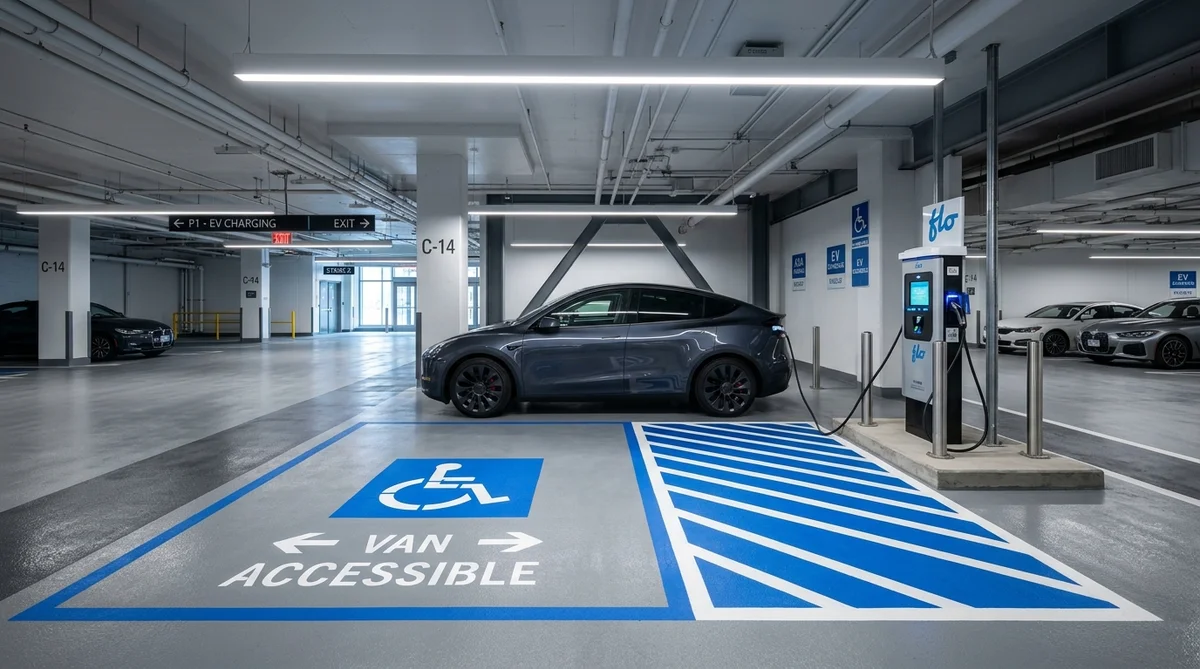
Introduction: Installing EV Chargers Is Not Enough
Parking garages across New York City are rapidly adding electric vehicle charging infrastructure as demand for EV ownership accelerates. But installing charging equipment involves far more than securing electrical service, running conduit, and selecting appropriate charging speeds.
The charging station must also be fully accessible to people with disabilities.
A driver using a wheelchair or mobility device may need substantial extra room to exit a vehicle, maneuver around the perimeter, reach the charging pedestal, unholster the heavy connector, and interact with touchscreens or payment terminals. A charger installed behind concrete crash bollards or across an obstructed pedestrian walkway may function electrically, but remain completely unusable for that driver.
For NYC commercial property owners, parking garage operators, residential co-op and condo boards, and facility managers, accessibility is simultaneously a critical design discipline and an enforceable statutory mandate under the NYC Construction Codes.
While the federal Americans with Disabilities Act (ADA) establishes broad non-discrimination obligations, NYC Building Code Section 1106.8 establishes explicit, quantifiable technical requirements specifically governing EV charging stations.
Under the NYC rule, at least 5% of common-use EV charging stations must be accessible, with a statutory minimum of at least one accessible station for each distinct charging type provided. Furthermore, these accessible charging spaces must be provided in addition to the garage's standard quota of required accessible parking stalls.
Critical Legal Distinction:
An accessible parking space is not legally equivalent to an accessible EV charging space. Under NYC Building Code Section 1106.8.1, accessible charging spaces cannot be subtracted from your existing parking quota. Converting an ordinary ADA parking stall into an EV charger stall without adding a replacement accessible stall triggers DOB violations and accessibility liability.
1. Which Accessibility Laws Apply to EV Charging Stations?
There is no single accessibility rule that governs every parking facility in isolation. Building owners and design teams must evaluate how federal, state, and municipal regulations intersect.
The Americans with Disabilities Act (ADA)
The federal ADA applies across multiple classifications of commercial and civic properties:
- Title II: Governs state and municipal government facilities, public transit authorities, and municipal parking structures.
- Title III: Governs places of public accommodation and commercial facilities operated by private entities, including commercial parking garages, retail garages, office building visitor garages, and mixed-use parking lots open to the public.
The 2010 ADA Standards establish baseline requirements for parking stall widths, accessible pathways, clear floor spaces, and operable controls. However, the 2010 federal standards do not establish a stand-alone numerical percentage specifically for EV charging stalls.
To bridge this gap, the U.S. Access Board issued technical guidance outlining how existing ADA provisions apply to electric vehicle supply equipment (EVSE). While this guidance is an invaluable engineering benchmark, the Access Board expressly notes that its advisory publications do not constitute independent, legally binding federal regulations.
NYC Building Code Section 1106.8
For parking facilities in the five boroughs, NYC Building Code Section 1106.8 serves as the enforceable, controlling standard. It dictates:
- The minimum ratio of accessible EV charging stations (5% minimum).
- Mandatory van-accessible dimensional standards per ICC A117.1.
- Direct connection to continuous, barrier-free accessible pathways.
- Cable routing rules to prevent tripping hazards.
- Max reach ranges and single-handed operable control forces.
These local provisions give NYC property owners concrete legal specifications rather than ambiguous federal guidelines.
New York State Building Code
New York State enforces accessibility rules for EVSE under the State Uniform Code for jurisdictions outside NYC. However, New York City maintains its own independent construction codes through Title 28 of the NYC Administrative Code. A parking garage in Manhattan, Brooklyn, Queens, the Bronx, or Staten Island must be engineered to the NYC Building Code.
2. How Many Accessible EV Charging Stations Are Required in NYC?
NYC Building Code Section 1106.8.1 governs the minimum quantity of accessible stations. The formula states:
Where EV charging stations are provided for common use, at least 5% of the total EV charging stations per facility must be accessible, but not fewer than one for each type of EV charging station.
Example: A Commercial Garage With 20 EV Charging Ports
Consider an NYC midtown parking facility installing:
- 12 Level 2 charging ports (typically 208/240V AC, 7.2 kW to 19.2 kW).
- 8 Direct-Current Fast Charging ports (DCFC, 50 kW to 150 kW+).
- Total capacity: 20 simultaneous vehicle charging positions.
Calculating 5% of 20 yields 1.0. However, because the garage provides two distinct charging types (Level 2 and DCFC), the code mandates at least one accessible station for each type.
| Charging Station Type | Total Ports Provided | 5% Base Calculation | Minimum Accessible Ports Required |
|---|---|---|---|
| Level 2 AC (Commercial) | 12 | 0.60 (rounds to 1) | 1 |
| DC Fast Charging (DCFC) | 8 | 0.40 (rounds to 1) | 1 |
| Combined Facility Total | 20 Ports | 1.0 Port | 2 Accessible Positions |
Sample Sizing Matrix Across Garage Capacities
| Total Charging Ports | Equipment Configuration | Minimum Accessible Stations Required |
|---|---|---|
| 1 to 20 | Single charging type (e.g., Level 2 only) | 1 accessible station |
| 1 to 20 | Dual charging types (Level 2 + DCFC) | 2 accessible stations (1 per type) |
| 21 to 40 | Single charging type | 2 accessible stations (5% of 40 = 2) |
| 21 to 40 | Dual charging types | 2 accessible stations (minimum 1 per type) |
| 41 to 60 | Dual charging types | 3 accessible stations (5% of 60 = 3) |
| 61 to 100 | Dual charging types | 5 accessible stations (5% of 100 = 5) |
Do Accessible EV Charging Spaces Count Toward Parking Requirements?
No. NYC Building Code Section 1106.8.1 explicitly dictates that accessible EV charging stations are provided in addition to the garage's legally required accessible parking spaces.
If an existing garage is mandated to maintain 4 accessible parking stalls under general zoning and building code quotas, and now decides to install 20 EV chargers, it cannot simply place chargers at 2 of its existing accessible stalls and call it a day. Doing so would effectively reduce the available general accessible parking supply to 2 stalls, creating a non-compliant condition.
3. What Dimensions Must an Accessible EV Charging Space Have?
NYC Building Code Section 1106.8.2 mandates that each accessible EV charging space must comply with the provisions for a van-accessible parking space under Sections 502.2 through 502.5 of ICC A117.1-2009 (Accessible and Usable Buildings and Facilities).
| Design Element | ICC A117.1 Standard Requirement | NYC Code Specification |
|---|---|---|
| Standard Van-Accessible Space Width | 132 inches (11 feet) minimum | Mandatory base standard |
| Associated Access Aisle Width | 60 inches (5 feet) minimum | Full length of vehicle stall |
| Alternative Universal Configuration | 96 inches (8 feet) space + 96 inches aisle | Permitted alternative under ICC A117.1 |
| Maximum Surface Slope | 1:48 maximum (2.08% grade) | Pavement and access aisle must be level |
| Access Aisle Marking | Contrasting diagonal hatched striping | Must clearly discourage parking overlap |
| Pedestrian Route Connection | Direct connection to accessible route | Must not be blocked by curbs, posts, or cables |
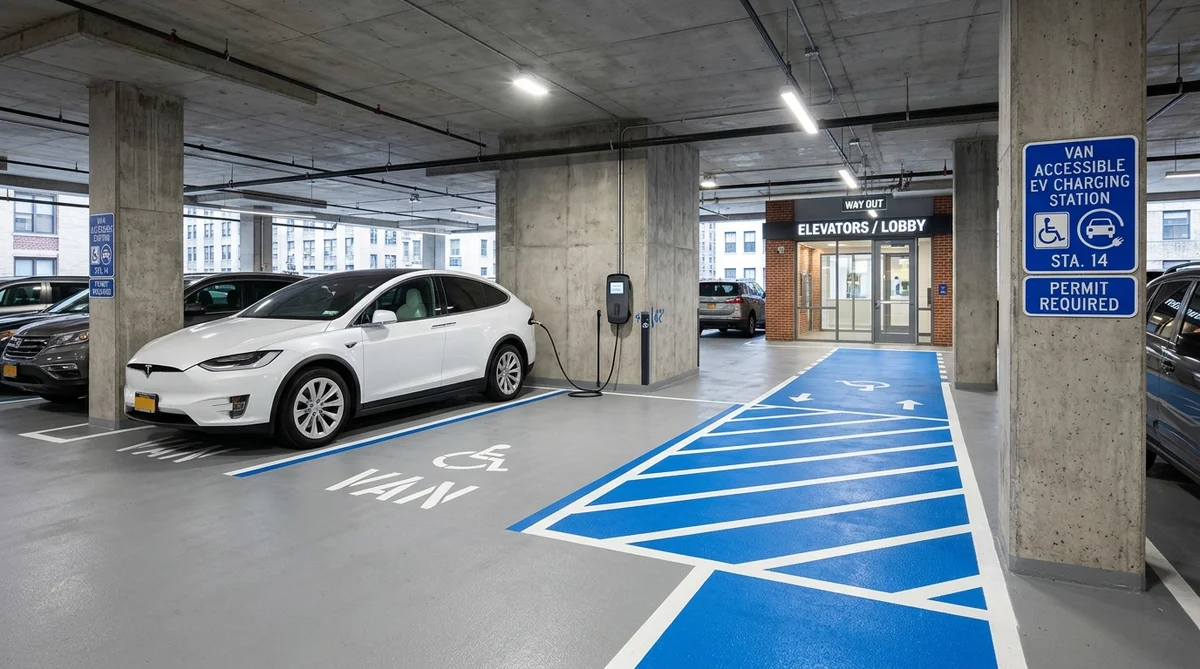 Van-accessible EV parking bays must provide at least 132 inches of stall width with an adjacent 60-inch access aisle, connecting seamlessly to an accessible garage entrance without barrier curbs.
Why U.S. Access Board Recommendations Exceed Minimum Parking Standards
While standard accessible parking assumes a driver merely exits the vehicle and proceeds onto the walkway, EV charging requires active circumnavigation around the vehicle perimeter.
Electric vehicle charging ports are not standardized in a single uniform location across automotive manufacturers:
- Tesla / NACS vehicles: Rear driver-side corner.
- Ford / GM / Rivian: Front driver-side or rear passenger-side.
- Nissan / Porsche / Audi: Front bumper center or front quarter panels.
Because vehicles may pull in head-first or back in, the Access Board strongly recommends a generous 11-foot stall width, 20-foot stall length, and a 5-foot or 8-foot shared access aisle. This provides adequate clear ground space (30 inches by 48 inches) for a wheelchair user to access charging ports regardless of vehicle orientation.
4. Accessible Routes Inside Parking Garages
An accessible stall is worthless if the driver cannot travel safely from their car to the charger pedestal and from the charger to the building elevators. Under NYC Building Code Section 1106.8.3, the accessible charging stall must be linked by a continuous, unobstructed accessible route.
The accessible route must connect the charging space directly to the accessible pedestrian entrance of the building or elevator bank. The path must maintain a minimum clear width of 36 inches, zero abrupt vertical changes greater than 1/4 inch, and compliant cross-slopes.
Vertical Clearance: The 98-Inch Rule
Wheelchair-accessible conversion vans equipped with mechanical side-loading lifts or raised roofs require substantial overhead headroom. The 2010 ADA Standards and NYC accessibility rules require at least 98 inches of vertical clearance along:
- The vehicular garage entrance and interior drive aisles leading to the stall.
- The van-accessible EV charging parking stall itself.
- The adjacent access aisle.
In pre-war or older NYC parking garages where overhead structural concrete beams, sprinkler mains, or low-hanging HVAC ductwork dip below 8 feet 2 inches (98 inches), placing accessible EV stalls requires careful structural clearance verification.
5. EV Charger Controls Must Be Accessible
NYC Building Code Section 1106.8.5 mandates that EV charging pedestals, user interfaces, and operable controls comply with ICC A117.1 Sections 309.2 and 309.3. A charger cannot require physical dexterity, excessive grip strength, or extreme reach heights that exclude drivers with physical disabilities.
| Charger Component | Accessibility Requirement | Engineering Design Target |
|---|---|---|
| Touchscreens & Displays | Reachable within unobstructed forward or side reach | Display centerline placed between 40 and 48 inches above finished floor |
| Card Readers / RFID / QR | Usable without tight grasping or pinching | Tap-to-pay sensor positioned at or below 44 inches |
| Connector Holster | Operable with one hand; under 5 lbs release force | Holster handle height between 36 and 48 inches maximum |
| Emergency Stop Button | Readily accessible; single-handed operation | High-contrast red mushroom button within clear reach |
| Start / Stop Buttons | Tactile feedback; does not require wrist twisting | Push-button activation force ≤ 5 lbf |
6. Charging Cables, Bollards, and Other Common Accessibility Problems
One of the most frequent DOB inspection failures and accessibility lawsuits stems not from the charger electronics, but from surrounding site barriers such as bollards and charging cords.
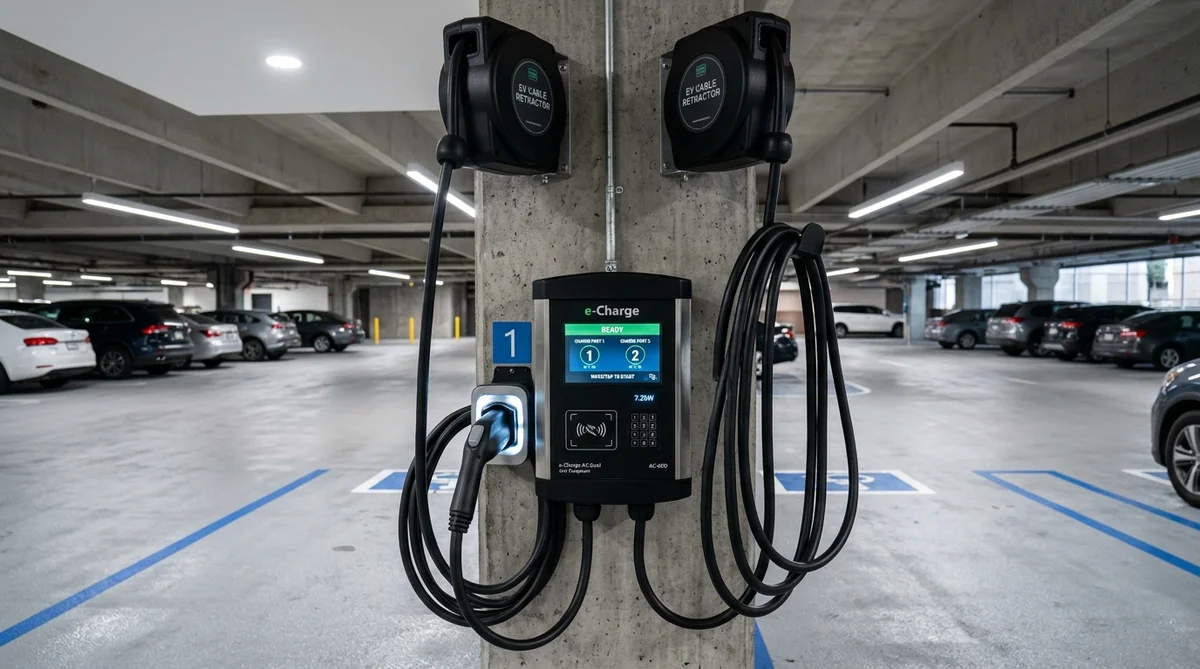 Column-mounted commercial EV chargers with compliant control reach heights (under 48 inches) and overhead retractor cable management systems prevent heavy cords from obstructing access aisles.
Common Design Traps to Avoid
1. Loose Cables Snaked Across the Access Aisle: High-powered Level 2 and DC fast charging cables are thick, heavily insulated, and stiff. When left unmanaged, they drape across the access aisle, creating severe barrier obstacles for wheelchair wheels and tripping hazards for visually impaired pedestrians. NYC Building Code Section 1106.8.4 expressly prohibits cables from obstructing accessible paths.
2. Protective Bollards Blocking Access: Garage operators frequently install steel crash bollards to protect costly EV chargers from bumper collisions. However, placing a bollard directly in front of the charger face prevents a wheelchair user from making a compliant 30" × 48" forward or parallel approach. Bollards must be positioned to safeguard the pedestal without pinching the clear maneuvering zone.
3. Mounting Chargers on High Curbs or Housekeeping Pads: Installing a charging pedestal atop a 6-inch or 8-inch raised concrete island effectively raises all buttons, screens, and holsters by that same height, pushing operable parts past the 48-inch legal reach ceiling.
7. Do EV Charging Displays and Payment Systems Need to Be Accessible?
Physical spatial access must be matched by functional cognitive and sensory accessibility. When public or commercial parking garages install smart networked EVSE, drivers must interact with digital screens, mobile apps, payment gateways, and RFID readers.
- Screen Glare and Contrast: Underground garages often have high-glare LED fixtures. Screens must maintain adequate contrast and legible text sizes (minimum 3/16-inch cap height for close viewing) readable from both a sitting and standing position.
- Audible and Visual Feedback: Transaction prompts, charging status, and error notifications should provide redundant sensory cues (e.g., both an audible beep and visual LED color change upon plug confirmation).
- Alternative Payment Gateways: Facilities should not rely exclusively on smartphone app downloads or proprietary subscription memberships. Having an accessible contactless payment reader (NFC / credit card tap) or automated toll-tag billing provides seamless independent access.
8. Does the ADA Require Every EV Charger to Be Accessible?
No. Neither federal ADA regulations nor NYC Construction Codes require 100% of EV chargers in a facility to be fully van-accessible. Doing so would consume vast amounts of garage square footage with 5-foot and 8-foot access aisles.
Instead, NYC establishes a calibrated statutory proportion: at least 5% of common-use stations, with at least one accessible station per charging type. For a standard 40-port installation, providing 2 accessible positions satisfies the numerical quota.
Status of Federal Rulemaking
In September 2024, the U.S. Access Board issued a Notice of Proposed Rulemaking (NPRM) seeking to codify nationwide EVSE accessibility standards into the ADA Guidelines. However, in late 2025, this rulemaking was moved to inactive status in the federal Unified Agenda. Consequently, as of late 2026, NYC Building Code Section 1106.8 represents the binding governing authority in New York City.
9. What Happens When an Existing Parking Garage Adds EV Chargers?
Retrofitting electric vehicle chargers into an existing parking facility presents severe physical constraints that new construction does not face:
- Structural Column Grids: Pre-war concrete columns spaced 16 to 18 feet apart often make inserting an 11-foot van stall and a 5-foot aisle impossible without losing multiple revenue-generating parking spaces.
- Steep Ramp Gradients: Many subterranean NYC garages connect levels via 15% ramps, exceeding accessible walkway maximum slopes (1:12 or 8.33%).
- Ceiling Height Obstructions: Low-hanging plumbing stacks, pneumatic ducts, and structural drop-beams frequently violate the 98-inch vertical clearance threshold.
NYC Building Code Section 1106.8.3 contains a narrowly defined exception: In existing facilities where an accessible route does not currently exist, an accessible charging station is not required to be located along an accessible route.
However, this exception is strictly limited to the route itself—it does not exempt the facility from providing the 5% quota, compliant stall dimensions, access aisles, or accessible charger control reach heights.
10. NYC EV-Ready Requirements Are Separate From Accessibility Requirements
Owners frequently confuse two distinct regulatory tracks: EV readiness mandates (how many chargers or conduits must exist) versus accessibility mandates (how those chargers are built for people with disabilities).
| Regulatory Framework | Primary Objective | Key Milestone Mandates |
|---|---|---|
| NYC Local Law 55 of 2024 | Fleet electrification in existing DCWP garages (≥10 spaces) | By Jan 1, 2035: At least 20% of spaces equipped with Level 2 chargers; at least 40% EV-capable. |
| NYC Building Code Section 406.4.10 | EV infrastructure in new construction and major alterations | Requires 20% EV-installed and remaining spaces EV-capable or EV-ready. |
| NYC Building Code Section 1106.8 | Civil rights and physical accessibility for disabled drivers | Requires 5% of common-use EV chargers to be fully accessible with van-width stalls and compliant controls. |
Compliance with Local Law 55 does not automatically ensure accessibility. When planning for 2035 compliance, engineering teams must layer the 5% accessibility quota across their expanded charging layout.
11. Practical Accessibility Checklist for NYC Parking Garage Owners
Before submitting Department of Buildings (DOB) electrical and construction filings, facility managers and design professionals should verify each checklist item:
| # | Inspection Category | Design & Verification Action |
|---|---|---|
| 1 | Quota Verification | Confirm at least 5% of total ports are accessible; ensure at least 1 accessible stall per charging type (L2 and DCFC). |
| 2 | Independent Supply | Verify accessible EV stalls do NOT reduce or replace standard required ADA parking spaces. |
| 3 | Stall Dimensions | Layout 132" vehicle stall width with 60" access aisle (or 96" space + 96" aisle). |
| 4 | Slope Tolerances | Laser-level stall and access aisle to verify slope does not exceed 1:48 (2.08%) in all directions. |
| 5 | Vertical Clearance | Confirm a minimum of 98" overhead clearance from the garage entry gate to the accessible stall. |
| 6 | Operable Parts Height | Measure card readers, plugs, and touchscreens: ensure all operable parts sit between 15" and 48" above finished grade. |
| 7 | Single-Hand Operation | Confirm the charging connector unholsters with one hand using ≤ 5 pounds of force, without twisting wrists. |
| 8 | Cable Management | Install spring-loaded overhead cable retractor arms to keep cords off the ground and out of pedestrian pathways. |
| 9 | Bollard Placement | Position protective bollards outside the 30" × 48" clear ground space approach zone. |
| 10 | Continuous Route | Confirm a barrier-free, 36"-wide accessible route directly connects the charging bay to the elevator lobby. |
| 11 | Signage Compliance | Post reflective International Symbol of Accessibility (ISA) signs mounted at least 60" above the floor to avoid vehicle obstruction. |
| 12 | DOB Plan Review | Ensure registered design professionals (PE or RA) explicitly dimension accessibility features on filed architectural sheets. |
Conclusion: Accessible EV Charging Must Be Designed Into the Garage
EV charging accessibility is not an afterthought that can be remedied with a coat of blue paint or a lower wall bracket. A driver with a physical disability needs to be able to pull into a garage, park comfortably, deploy a wheelchair ramp or lift, reach the charging pedestal, unlatch the connector, and pay for the session without meeting impossible physical barriers.
In New York City, Building Code Section 1106.8 establishes clear obligations: at least 5% of common-use EV charging stations must be accessible, with at least one station for each charging type provided, preserved completely independent of ordinary accessible parking quotas.
By coordinating electrical infrastructure planning, structural garage layout, and accessibility engineering from the very beginning, building owners can avoid costly DOB stop-work orders, retrofit rebuilds, and civil rights litigation while delivering clean, inclusive charging infrastructure for all New Yorkers.