BY NYC Energy Code Team
ON
15 October 2026
Smart Thermostats vs Full BMS: Which Fits a Small Commercial Building?
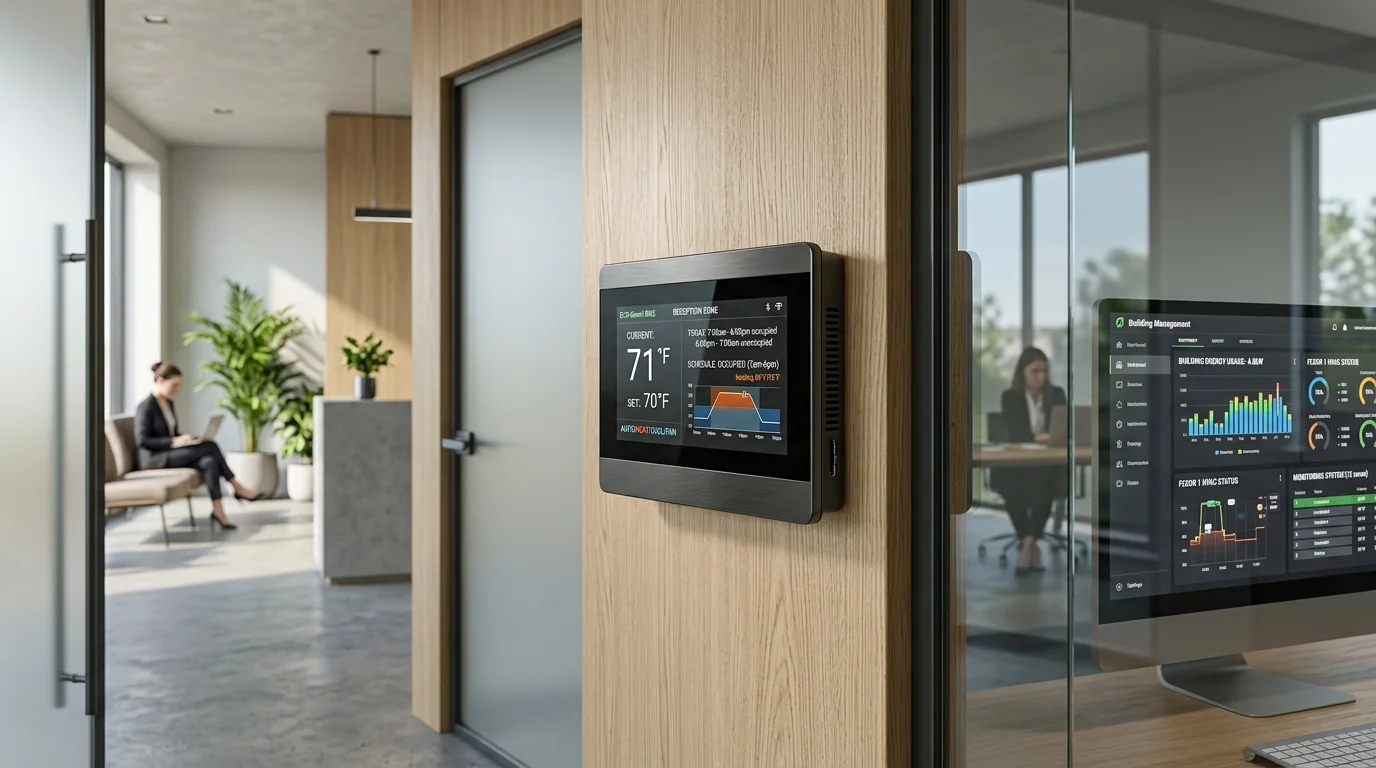
A small office, retail unit, medical practice, or neighborhood commercial building may not need the same building automation system as a large corporate tower. Yet its HVAC equipment can still waste energy when heating or cooling runs after closing, temperature settings are inconsistent, or systems operate without considering occupancy.
Two common solutions are smart thermostats and a Building Management System (BMS). Both can improve control over building operations, but they serve different purposes.
A smart thermostat typically manages the heating and cooling equipment connected to an individual thermostat or zone. A BMS provides a broader platform for monitoring and coordinating building systems, potentially including HVAC, lighting, energy meters, alarms, and other equipment.
For a small building with a few independent HVAC units, smart thermostats may provide the better return on investment. For a property with multiple systems, complex schedules, or a need for centralized monitoring, a BMS may offer greater long-term value.
The right choice depends less on square footage alone and more on the complexity of the equipment, how the building is used, and how much oversight the owner needs.
Architecture and Oversight: The Real Decision Drivers
Rather than selecting controls solely based on building square footage, evaluate the number of independent rooftop units, ventilation dampers, centralized alarm requirements, and demand-responsive control provisions under the 2025 NYC Energy Conservation Code.
What Is a Smart Thermostat in a Commercial Building?
A smart thermostat is a connected temperature-control device that allows users to adjust settings, establish schedules, and manage heating and cooling remotely. Depending on the model and HVAC equipment, it may also provide runtime information, occupancy-based control, temperature alerts, or integration with other devices.
For a small commercial property, the main advantage is straightforward: heating and cooling can follow the building's operating schedule instead of running at the same settings throughout the day.
Consider a 5,000-square-foot office that operates from 8 a.m. to 6 p.m. If the HVAC system continues maintaining occupied-hour temperatures overnight and on weekends, a compatible smart thermostat can apply an appropriate setback schedule.
It may also let the property manager adjust settings without visiting the building, which is useful when operating hours change or a tenant reports a comfort problem.
However, smart thermostats do not automatically improve every HVAC system. Compatibility matters. Some packaged rooftop units, communicating systems, heat pumps, and multi-stage equipment require specific control interfaces or professional configuration.
A smart thermostat also does not necessarily provide visibility into the performance of the entire building. It may show the operation of a particular HVAC unit without revealing whether another unit is running unnecessarily or whether a ventilation system has a fault.
For background on thermostat scheduling, remote control, and energy-use feedback, see the ENERGY STAR smart thermostat guidance.
What Is a Full Building Management System?
A Building Management System, also called a Building Automation System (BAS), connects compatible building equipment to a common control and monitoring platform.
Rather than concentrating on room temperature alone, a BMS can coordinate equipment operation, schedules, setpoints, alarms, and performance data across multiple systems.
Depending on its scope, a commercial BMS may manage:
- HVAC units, pumps, boilers, chillers, and ventilation equipment.
- Multiple temperature zones and shared operating schedules.
- Lighting controls and occupancy-related functions.
- Energy meters, runtime data, and demand information.
- Equipment alarms, fault notifications, and maintenance monitoring.
Not every BMS includes every function. A small-building installation might cover only HVAC equipment, while a more comprehensive system could integrate several building services.
The difference becomes important when equipment interacts. For example, a thermostat may control one rooftop unit, but a BMS could coordinate several units according to schedules and defined operating sequences, provided the equipment and controls support that integration.
The U.S. Department of Energy describes building controls as systems that can monitor and regulate HVAC, lighting, and other building equipment through coordinated control logic. Advanced controls can also support fault detection and energy optimization. Source: DOE — About Building Controls.
Smart Thermostats vs BMS: The Main Differences
| Feature | Smart Thermostats | Full BMS |
|---|---|---|
| Primary purpose | Control heating and cooling at individual zones or units | Monitor and coordinate multiple building systems |
| Best fit | Simple HVAC arrangements | More complex equipment or operating requirements |
| Scheduling | Schedules heating and cooling for compatible equipment | Coordinates schedules across connected equipment and systems |
| Remote access | Commonly available through an app or web interface | Commonly available through a central interface or remote platform |
| Equipment visibility | Usually focused on connected thermostats and HVAC equipment | Can provide centralized status and alarms across integrated systems |
| Energy analysis | May provide temperature, runtime, or usage insights | May offer broader equipment, zone, and energy data depending on integration |
| Integration | Limited to compatible devices and platforms | Can integrate multiple systems using supported controls and communication protocols |
| Upfront complexity | Generally lower | Usually higher because of controls, integration, configuration, and commissioning |
| Ongoing management | Relatively simple for a few devices | Can require specialist support, software management, and control-system maintenance |
A key distinction is that a BMS is not simply a more expensive smart thermostat. It is a different level of building control.
A BMS also does not guarantee better performance just because it has more features. If its control sequences are poorly configured or operators do not use the available data, a simpler system that is properly scheduled and maintained may deliver better results.
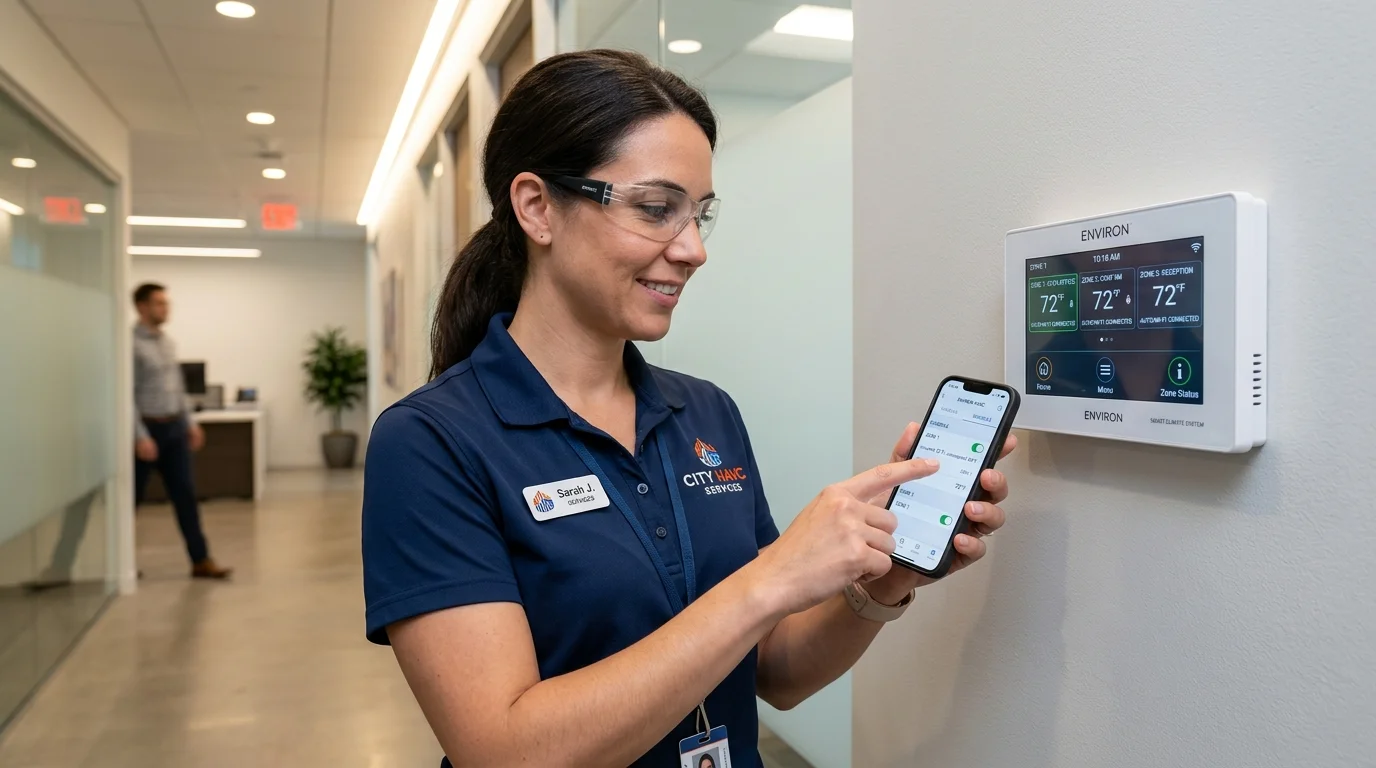
A Practical Example: A Small NYC Office Building
Imagine a two-story office property measuring approximately 8,000 square feet. It has three packaged rooftop HVAC units, each serving a defined area of the building.
The property operates during regular business hours, with limited weekend use. The owner wants to reduce unnecessary HVAC runtime, respond to temperature complaints, and avoid adding unnecessary operating costs.
Option 1
Install Smart Thermostats
The owner installs compatible smart thermostats for the three HVAC zones and configures operating schedules.
The thermostats can lower heating setpoints or raise cooling setpoints during unoccupied periods, subject to equipment capabilities, occupant needs, and applicable requirements. The property manager can also review temperature settings remotely.
For this building, the arrangement may address the most obvious problem: HVAC operation outside business hours. It also avoids the additional integration work associated with a full BMS. The limitation is that the manager may still need to access separate controls to investigate other equipment or coordinate systems that are not connected to the thermostats.
Option 2
Install a BMS
The owner installs a small-building automation system capable of communicating with the three rooftop units and monitoring other selected equipment.
The platform coordinates schedules and setpoints, reports equipment alarms, and centralizes available operating information. If compatible sensors and meters are added, it may also help identify unusual runtime or energy patterns.
This approach becomes more valuable if the building has additional systems that need coordination, such as a dedicated ventilation system, shared boilers, lighting controls, or multiple tenant schedules. However, for a building with only three straightforward rooftop units, a full BMS might introduce more cost and complexity than the owner actually needs.
Which Option Fits This Example?
Smart thermostats are the logical starting point when the main objective is to automate three simple HVAC zones and reduce unoccupied-hour operation.
A BMS becomes more attractive when the owner needs central alarms, broader equipment monitoring, more advanced control sequences, or integration with additional building systems.
The conclusion could change if the rooftop units use proprietary controls, the building experiences recurring comfort problems, or a future renovation will add more equipment. The decision should be based on the actual HVAC architecture rather than the building's floor area alone.
When Smart Thermostats Are the Better Investment
Smart thermostats are often the practical choice when a property has straightforward HVAC equipment and a limited need for central oversight.
They are particularly well suited to buildings where the main operational issues are predictable: heating and cooling outside occupied hours, inconsistent temperature settings, or the inconvenience of making adjustments locally.
A small café with a few HVAC zones, a standalone office, or a compact retail unit may benefit from automated schedules without needing a centralized building platform.
The financial case is strongest when the controls address a specific, observable problem. Before investing, review HVAC operating hours, thermostat schedules, occupant complaints, and equipment runtime. This helps determine whether unnecessary operation is actually occurring.
Smart thermostats may also be a useful first phase of a broader controls strategy. Owners should select compatible equipment and check whether the system can support future integration if the building's needs expand.
When a Full BMS Makes More Sense
A BMS is worth evaluating when the building's operational complexity has outgrown what individual thermostats can manage conveniently.
Suppose a small commercial property includes several rooftop units, a central boiler, exhaust ventilation, common-area lighting, and different tenant operating schedules. A centralized platform may reduce the need to inspect several disconnected controls and can help staff identify conflicting schedules or equipment faults.
It can also provide a more structured way to trend temperatures, review runtime, and identify recurring operational problems. More advanced systems may support fault detection and diagnostic functions, although those capabilities depend on the installed hardware and software.
Central monitoring becomes especially valuable when no one is on-site continuously. An equipment alarm may alert the property manager to investigate a failure before it causes a prolonged comfort complaint or operational disruption.
There are trade-offs. The owner must account for integration costs, compatible controllers and sensors, programming, commissioning, software or service fees, and staff training. Proprietary systems may also create additional costs when changing vendors or expanding the platform.
A BMS delivers value when the building actually uses its data and automation to improve operation—not simply when the platform has been installed.
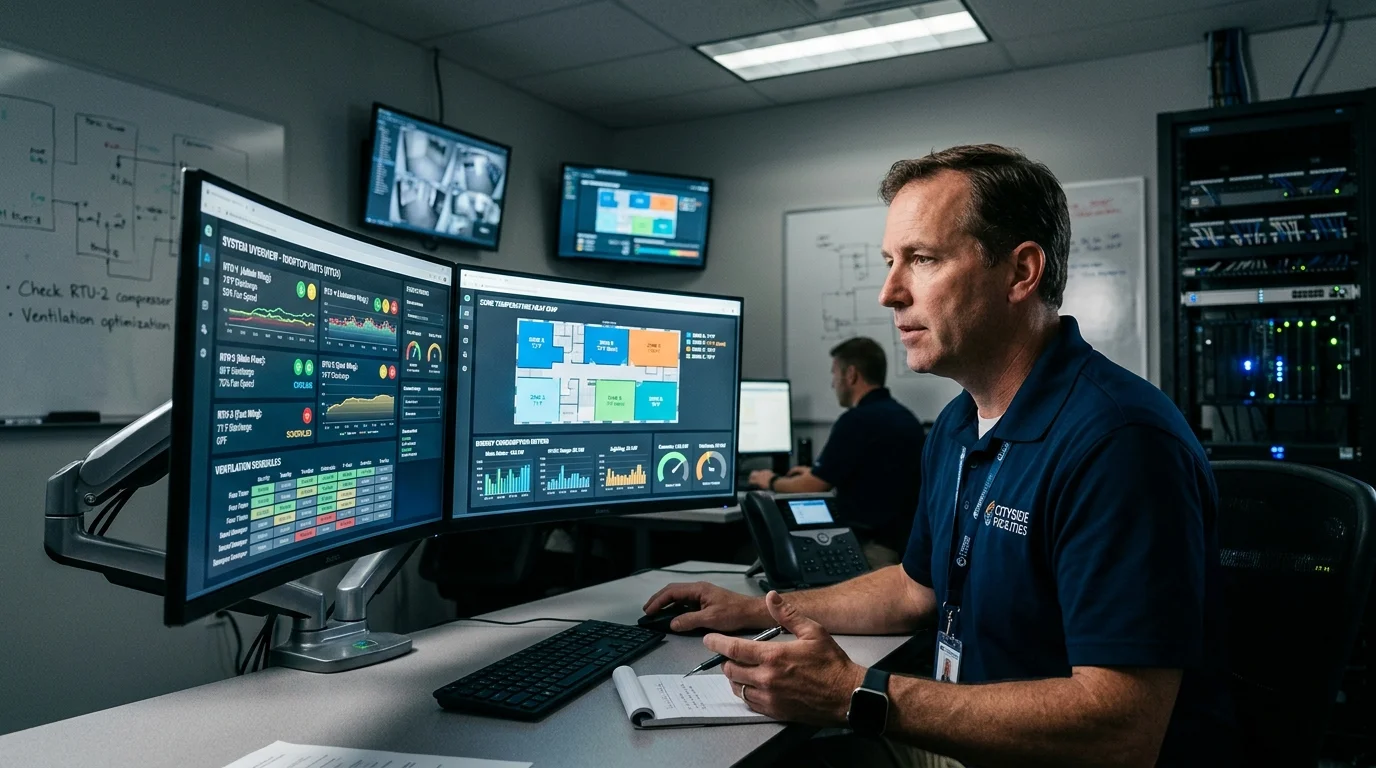
What About Energy Savings and Return on Investment?
Neither a smart thermostat nor a BMS has a guaranteed savings percentage. Results depend on the original controls, building schedules, HVAC condition, weather, occupant behavior, and how well the new system is configured.
For example, a building that already turns off its HVAC equipment at the correct time may gain relatively little from adding another scheduling device. A property that routinely cools empty spaces overnight could have a more promising opportunity.
A useful way to compare investments is to estimate the value of the specific operating problems each system can correct.
| Cost or Benefit | Smart Thermostat Project | BMS Project |
|---|---|---|
| Hardware and installation | Primarily compatible thermostats and any required interfaces | Controllers, sensors, communication infrastructure, software, and integration |
| Setup and commissioning | Equipment configuration and schedule verification | More extensive programming and system-level testing where integration is involved |
| Potential operational benefit | Reduced unnecessary heating and cooling runtime | Coordinated operation, broader visibility, alarms, and more advanced control |
| Ongoing costs | Connectivity, support, or device replacement where applicable | Software, specialist service, network support, and system maintenance where applicable |
| Main risk | Limited compatibility or capability for the connected equipment | Paying for functionality the building does not need or use |
For an initial estimate, owners can use:
Simple Payback = Installed Project Cost / Estimated Annual Net Savings
Suppose a compatible thermostat project costs $1,800 installed and is expected to produce $600 in annual net savings. Its simple payback would be:
$1,800 / $600 = 3 years
These numbers are illustrative only. The $600 must be supported by a reasonable estimate based on actual HVAC operation and energy costs; it is not a guaranteed saving from installing smart thermostats.
For a BMS, the same calculation can be used, but the savings estimate should include only benefits the system can realistically deliver. If the project also improves maintenance response or reduces equipment downtime, those benefits can be considered separately, provided the assumptions are explicit.
The Department of Energy notes that advanced building controls can produce significant energy savings in commercial buildings, but outcomes vary by building type and control strategy. Its research should not be interpreted as a guaranteed savings rate for either of these specific solutions. Source: DOE — Building Controls.
What NYC Building Owners Should Check Before Choosing
New York City's energy-code requirements are relevant when installing or altering HVAC controls. The applicable provisions depend on the type and scope of the work, the equipment, the code pathway, and any relevant exceptions.
As of October 2026, enforcement of the 2025 NYC Energy Conservation Code and 2025 NYC ASHRAE 90.1 began March 30, 2026. The code includes demand-responsive control provisions for applicable electric heating and cooling systems. These provisions address a system's ability to respond to demand signals by adjusting temperature setpoints while maintaining required operating conditions.
A smart thermostat is not automatically compliant simply because it connects to Wi-Fi. Where these requirements apply, the design team must verify the required communication and performance capabilities for the specific equipment. A BMS using direct digital controls may also need to demonstrate the required demand-response functionality.
See the NYC Department of Buildings' 2025 Energy Conservation Code resources and the applicable commercial provisions, including Section C403.4.6. Confirm the requirements for the individual project before purchasing or installing controls.
Owners should also verify compatibility with the installed HVAC equipment, control wiring, sensors, and manufacturer requirements. For a BMS project, confirm that the proposed system can communicate with the intended equipment and that future maintenance or replacement will not depend on unsupported interfaces.
A Simple Decision Framework
Before choosing a solution, answer three questions.
1
What Needs to Be Controlled?
If the problem is primarily temperature scheduling for a few independent HVAC units, smart thermostats may be enough. If the building needs coordinated control across several types of equipment, a BMS deserves closer review.
2
What Information Does the Property Manager Need?
If remote setpoint changes and basic alerts are sufficient, a simpler solution may be appropriate. If the owner needs centralized alarms, equipment trends, energy monitoring, and system-wide visibility, a BMS may provide greater value.
3
Will Someone Act on the Information?
The value of advanced controls depends on maintenance staff or service contractors reviewing alerts, investigating abnormal operation, and correcting the underlying problems.
A building should not purchase a complex automation system without a plan for using it. Conversely, a building with recurring system-wide problems should not be limited to individual thermostats simply because they have a lower initial cost.
Conclusion
Smart thermostats and full BMS platforms solve related but different problems. Smart thermostats are usually the simpler way to improve temperature scheduling and remote HVAC control in a small commercial property. A BMS provides broader oversight and coordination when the building contains multiple systems or requires more advanced monitoring.
For a small office or retail building with a few independent HVAC units, begin by identifying the operating problems and checking whether compatible smart thermostats can solve them. Evaluate a BMS when central monitoring, coordinated equipment operation, or system-level diagnostics would provide clear additional value.
The best investment is not necessarily the technology with the longest feature list. It is the system that fits the building's equipment, satisfies applicable requirements, and gives the property team practical ways to improve comfort, reliability, and energy performance.
Frequently Asked Questions
Yes, when the thermostat is compatible with the installed HVAC equipment and suitable for the building's operating needs. They can automate schedules, enable remote adjustments, and provide temperature or runtime information.
A smart thermostat generally controls a particular HVAC unit or zone. A BMS can monitor and coordinate multiple connected systems through a central platform, depending on its scope and integration capabilities.
Not necessarily. A building with a few independent HVAC units and straightforward schedules may be adequately served by smart thermostats. A BMS becomes more useful when there are multiple interacting systems, centralized monitoring needs, or recurring operational problems.
Neither solution automatically saves more. Savings depend on the existing controls, operating schedules, equipment condition, control strategy, and how the system is maintained. Advanced controls may provide additional opportunities when several systems can be coordinated effectively.
They can replace some functions of a basic HVAC control setup, but they do not generally provide every capability of a full BMS. A BMS may offer system-wide alarms, integrated controls, equipment trend data, and centralized monitoring that individual thermostats cannot provide.
Some can, but compatibility depends on the rooftop unit's control interface, heating and cooling stages, wiring, and manufacturer requirements. Confirm compatibility before ordering; some equipment requires a dedicated controller or a more specialized thermostat.
They can involve higher upfront and ongoing costs than a simple thermostat project because the installation may require controllers, sensors, communication infrastructure, programming, integration, and commissioning. The total cost depends on the number of systems and the scope of automation.
There is no single rule requiring every small commercial building to choose one of these two systems. Applicable energy-code provisions may require specific HVAC control and demand-response capabilities depending on the equipment and project. The owner should verify the relevant requirements with the project design professional.
You may also like