Learn how IoT sensors track occupancy, optimize HVAC, and deliver real-time energy savings.
BY NYC Energy Code Team
ON
26 August 2026
Building Management Systems (BMS) Explained for Non-Technical Owners
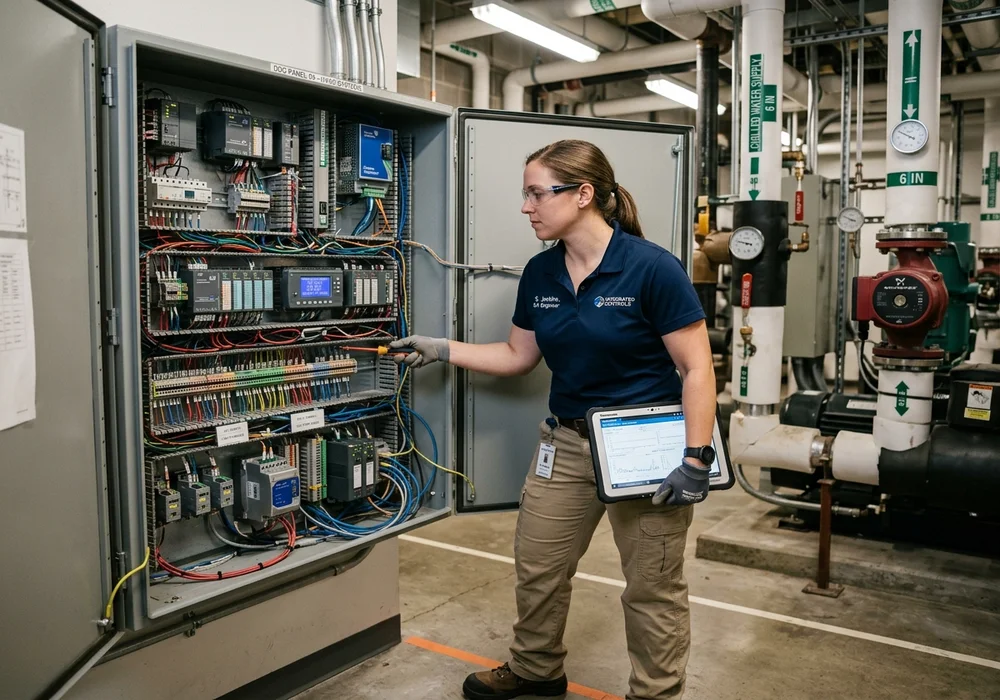
If you've ever stepped inside a commercial mechanical room and encountered walls of Direct Digital Control (DDC) panels, motorized valves, conduits, pressure gauges, and wires, you may have wondered how anyone keeps track of it all.
That is precisely where a Building Management System (BMS) comes in.
You do not need an engineering degree to grasp the core concept: Think of a BMS as the brain and central nervous system of your building.
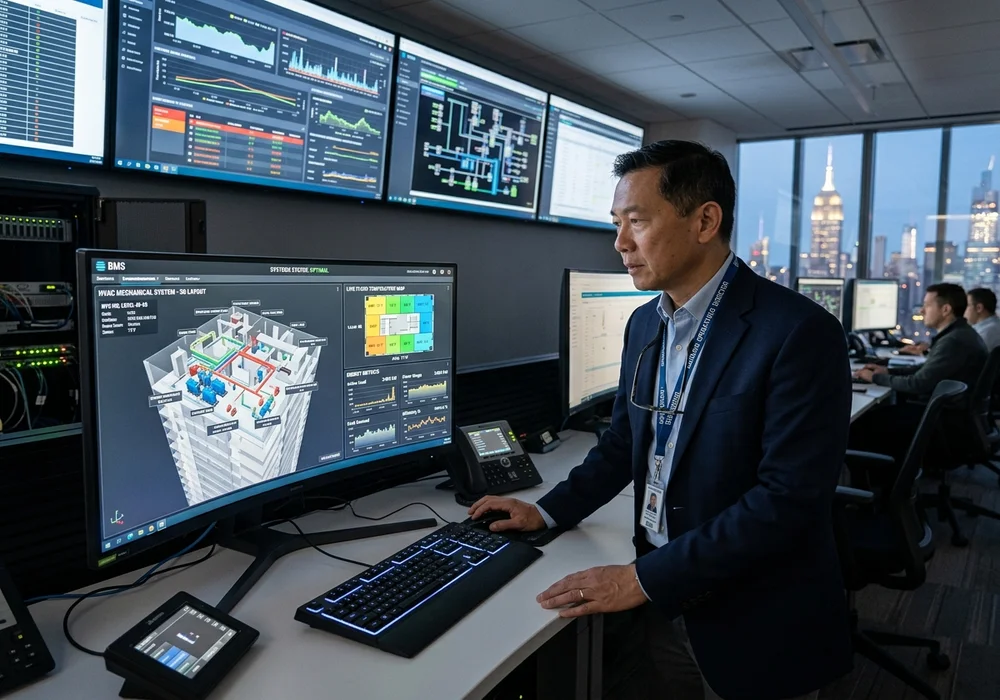
Rather than sending a building engineer to manually check every rooftop unit, boiler burner, air damper, circulation pump, and thermostat schedule, the BMS continuously gathers sensor data, displays operating conditions on a single computer screen, and automatically adjusts equipment based on pre-programmed energy rules.
Why BMS Matters in New York City
With NYC electric and steam rates among the highest in the country, and strict carbon emissions caps under Local Law 97, a well-tuned BMS is one of the most cost-effective tools to eliminate mechanical waste and prevent expensive regulatory fines.
What Does a Building Management System Actually Control?
A modern BMS connects major energy-consuming base-building mechanical and electrical equipment into an integrated network:
- Heating Systems: Steam boilers, hydronic hot water boilers, heat exchangers, and mixing valves.
- Cooling Plants: Water-cooled chillers, air-cooled chillers, cooling towers, and condenser water pumps.
- Air Handling & Ventilation: Central Air Handling Units (AHUs), Variable Air Volume (VAV) terminal boxes, supply/return fans, and make-up air units.
- Water Distribution: Variable frequency drive (VFD) circulation pumps and domestic hot water (DHW) heaters.
- Indoor Environment: Zone temperature, humidity, indoor air quality (CO2 levels), and static air pressure.
- Lighting & Power: Scheduled corridor/lobby lighting, exterior facade lighting, and submetered electrical panels.
- Automated Alarms: Low freeze-stat alerts, water leak detection, filter pressure drop alerts, and pump failure notifications.
BMS vs. BAS vs. Controls: Are They the Same?
In real estate discussions, you will hear several terms used almost interchangeably:
- BMS: Building Management System
- BAS: Building Automation System
- BEMS: Building Energy Management System
- DDC: Direct Digital Controls
While specific vendors may apply nuanced marketing definitions, they all describe the same core technology: a computerized network connecting building equipment so operators can automate and manage property operations intelligently.
How Does a BMS Work? The Three Architecture Layers
1. Field Sensors & Actuators
Sensors collect real-world physical data (temperature, pressure, CFM airflow, CO2). Actuators physically open valves and position air dampers.
2. Direct Digital Controllers (DDC)
Microprocessors installed in mechanical panels execute pre-programmed algorithms (e.g., PID loops) and command equipment without human intervention.
3. Central Software Interface
A web-based graphical dashboard where property managers and operators monitor floor plans, adjust setpoints, review trend logs, and receive alarm alerts.
How Smart BMS Controls Slash Energy Utility Bills
A BMS does not magically make a motor or burner more efficient. Energy savings come from preventing equipment from running when it isn't needed.
Dynamic Occupancy Scheduling: Automatically sets back heating/cooling when tenants leave for evenings and weekends, avoiding hundreds of hours of unneeded runtime.
Outdoor Air Temperature Resets: Automatically lowers supply water temperatures on mild winter days and raises chilled water loops on cooler summer mornings.
Optimal Equipment Sequencing: Stages multiple boilers or chillers to run at their peak efficiency curve (typically 60%–80% load) rather than short-cycling single large units.
Peak Demand Limiting: Staggers motor startups and pre-cools thermal mass to avoid expensive Con Edison electric peak demand ratchet charges.
Proactive Maintenance: What Is Fault Detection and Diagnostics (FDD)?
Traditional maintenance is reactive: you wait until an office gets boiling hot or freezing cold and a tenant submits a work order.
Advanced BMS systems incorporate Fault Detection and Diagnostics (FDD) software. FDD continuously analyzes trend data to catch mechanical degradation before equipment suffers catastrophic failure:

Real-World FDD Catch: The Simultaneous Heating & Cooling Trap
A stuck heating valve on an AHU will cause the cooling coil to blast 100% chilled water to compensate. Both systems fight each other. The tenants feel comfortable, but the building wastes $2,000 a month. FDD flags this anomaly immediately by comparing valve command signals against supply air temperature sensors.
BMS and NYC Energy Compliance: LL84, LL87, and LL97
A BMS plays a pivotal role across NYC's major building compliance laws:
- Local Law 84 Benchmarking: Provides automated submeter data streams directly to ENERGY STAR Portfolio Manager.
- Local Law 87 Energy Audits & Retro-Commissioning: Supplies the historic trend logs, temperature calibrations, and sequence verification data required for the 10-year Energy Efficiency Report (EER).
- Local Law 97 Carbon Limits: By trimming 10% to 25% of annual boiler gas and chiller electricity consumption, a BMS directly reduces metric tons of CO2e to avoid annual fines of $268/tCO2e.
Important Caution for Owners
Never assume that simply purchasing a BMS satisfies NYC compliance. A BMS is a management instrument. Actual compliance requires verified energy reductions, proper operational maintenance, and official DOB filings stamped by a licensed Professional Engineer.
10 Questions Owners Should Ask Before Hiring a BMS Vendor
Open Protocol: Is the system built on open standard BACnet/IP protocols, or will we be locked into proprietary vendor hardware?
Data Ownership: Does the building owner retain 100% ownership and unrestricted API export rights to all sensor and energy data?
Independent Servicing: Can any certified third-party controls contractor service and re-program this system in the future?
Commissioning Scope: Does the bid include thorough point-to-point seasonal commissioning and functional performance testing?
Final Takeaway
A Building Management System is a tool, not a standalone strategy.
The best BMS is not the system with the flashiest 3D graphics—it is the one that gives your operators actionable visibility, automates seasonal schedules, catches mechanical defects early, and delivers measurable energy savings.
Start by identifying your building's greatest operational headaches, determine which mechanical points actually need control, and ensure your system is properly commissioned from day one.
Frequently Asked Questions
A Building Management System, or BMS, is a centralized technology platform used to monitor and control building systems such as HVAC, lighting, ventilation, pumps, and other equipment.
It can. A properly configured BMS can reduce unnecessary equipment operation through scheduling, temperature control, equipment sequencing, and other strategies.
The terms BMS and BAS are often used interchangeably in the building-controls industry, although specific technical definitions can vary between vendors and systems.
It can support energy management and provide useful operational data, but installing a BMS does not automatically satisfy NYC energy laws or filing requirements.
No. The financial and operational value depends on building size, equipment complexity, energy usage, and the sophistication of existing controls.
Depending on the installation, a BMS can control HVAC equipment, fans, pumps, lighting, temperature setpoints, schedules, ventilation, and other connected systems.
Frequent equipment problems, poor temperature control, outdated software, limited visibility, manual operation, and rising energy costs can all justify evaluating the existing controls system.
No. A BMS provides information and automation, but technicians and building operators are still needed to diagnose problems, maintain equipment, and make operational decisions.
Yes. Commissioning helps verify that sensors, equipment, schedules, alarms, and control sequences work as intended.
Look at interoperability, reliability, data access, controls capability, vendor support, scalability, commissioning, and the total cost of ownership—not just the software interface.