Learn step-by-step strategies for planning, budgeting, and delivering successful building energy retrofits.
BY NYC Energy Code Team
ON
04 September 2026
How to Sequence Multiple Local Law Compliance Projects Efficiently
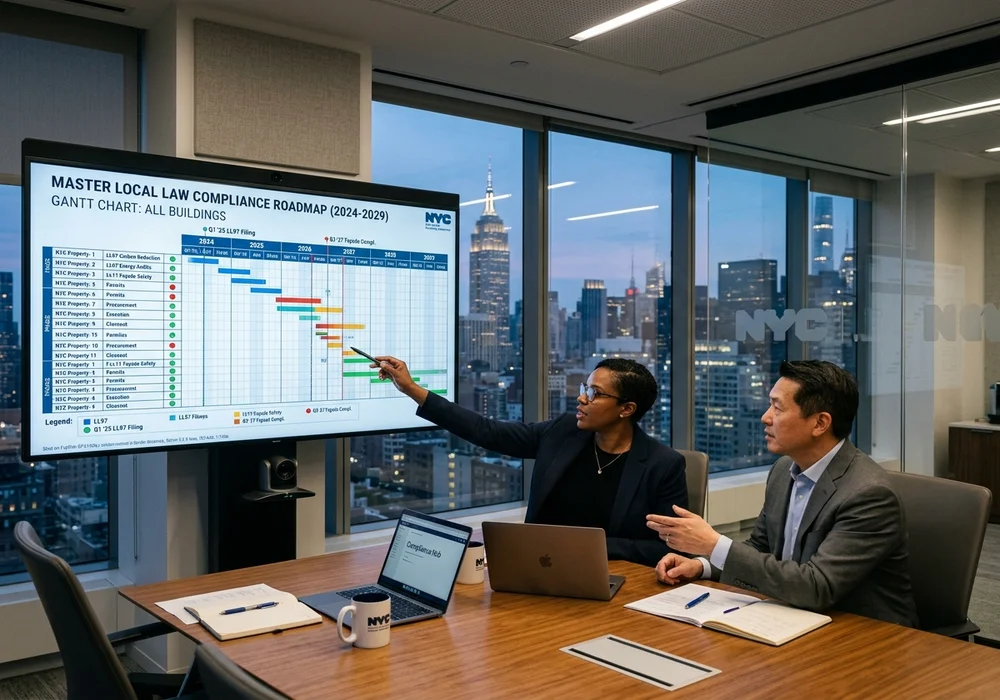
New York City building owners rarely have the luxury of managing just one compliance deadline at a time. A typical mid-to-large residential or commercial property faces an overlapping web of statutory mandates: LL84 annual utility benchmarking, LL87 decennial energy audits & retro-commissioning, LL95 building energy grades, LL97 carbon emission caps, LL152 periodic gas piping inspections, FISP (Local Law 11) facade safety reports, and LL88 lighting/submetering upgrades.
Treating each Local Law as an isolated, reactive task results in staggering financial waste: paying for redundant engineering site walk-throughs, erecting costly sidewalk sheds multiple times, replacing equipment prematurely, and exposing ownership to steep Department of Buildings (DOB) penalties.
The Strategic Sequencing Approach
A synchronized compliance roadmap sequences projects based on statutory deadlines, technical engineering dependencies, physical building conditions, and carbon ROI. By spending capital intentionally, each diagnostic project directly informs and optimizes subsequent physical upgrades.
Step 1: Build a Comprehensive Multi-Year Compliance Matrix
The foundational step in project management is mapping every regulatory mandate against a shared multi-year timeline:
| Local Law | Compliance Focus | Statutory Frequency / Timing | Planning Priority |
|---|---|---|---|
| LL84 | Whole-Building Energy & Water Benchmarking | Annual (Filing Deadline: May 1) | High (Information Engine) |
| LL87 | ASHRAE Level II Audit + Retro-Commissioning (RCx) | Every 10 Years (Based on Tax Block Number) | High (Diagnostic Roadmap) |
| LL95 | Building Energy Letter Grade (A through F) | Annual (Generated by LL84 Benchmarking) | Medium (Public Asset Value) |
| LL97 | Greenhouse Gas Carbon Emission Caps ($t\text{CO}_2\text{e}$) | Annual Reporting + 2024 / 2030 Tiered Caps | Critical (High Fine Exposure) |
| LL152 | Exposed Gas Piping Safety Inspections | Every 4 Years (Community District Schedule) | High (Life Safety & Gas Shutoff Risk) |
| FISP (LL11) | Exterior Wall / Facade Condition Assessment | Every 5 Years (FISP Cycle Sub-Cycles) | High (Sidewalk Shed & Mobilization) |
Step 2: Separate Administrative Filings from Capital Upgrades
Not every compliance mandate requires physical construction. Managing projects efficiently requires sorting requirements into distinct operational categories:
- Administrative Reporting (LL84 / LL95): Utility bill aggregation, meter onboarding in ENERGY STAR Portfolio Manager, and annual compliance submissions.
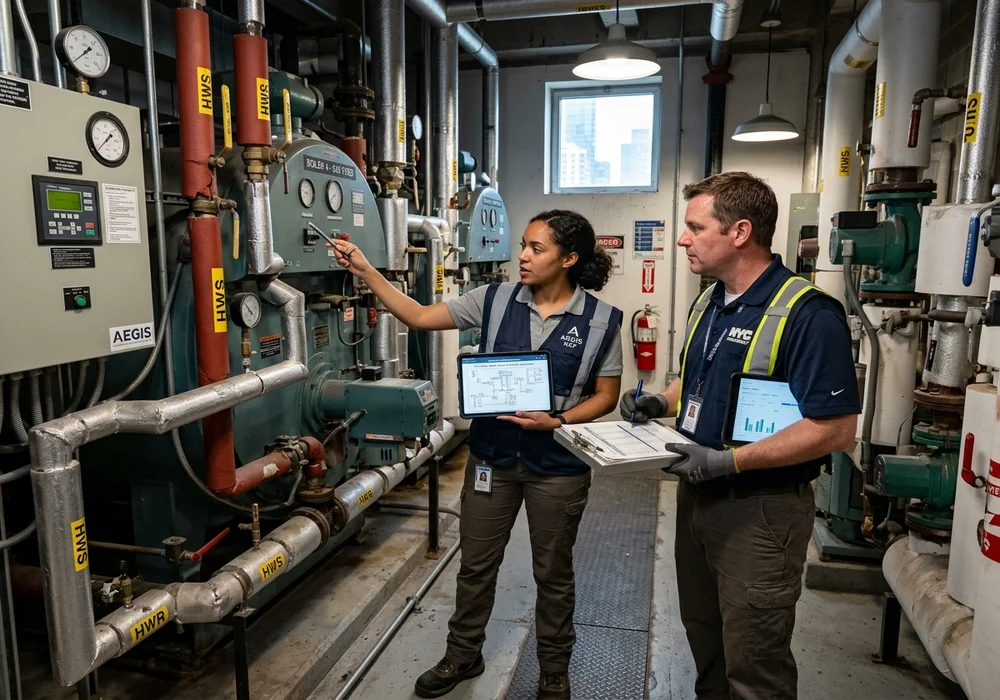
- Diagnostic Assessments (LL87 / Energy Modeling): Comprehensive engineering audits that uncover hidden system faults, measure Energy Use Intensity (EUI), and rank Energy Conservation Measures (ECMs).
- Life-Safety Inspections (LL152 / FISP): Visual and non-destructive testing identifying immediate structural or gas distribution hazards.
- Physical Capital Construction (LL97 / LL88): Boiler replacements, heat pump conversions, building envelope overhauls, submeter installations, and BMS controls.
Step 3: Start with Information-Generating Projects First
The single most expensive mistake an owner can make is purchasing new mechanical equipment before conducting diagnostic audits.
The Information Rule: Always perform LL84 benchmarking and your LL87 ASHRAE Level II Energy Audit before finalizing capital upgrade budgets. An energy audit reveals actual heating and cooling loads, allowing engineers to right-size future heat pumps or VRF systems rather than over-sizing equipment based on obsolete pre-war boiler assumptions.
Step 4: Map Critical Technical Engineering Dependencies
Building systems do not operate in silos. Capital investments must follow a rigorous engineering dependency chain:
The Ideal Engineering Sequence
1. Envelope & Air Sealing → 2. Building Automation (BMS) → 3. Electrical Capacity Upgrade → 4. Electrified HVAC (Heat Pumps)
Tightening the building envelope and optimizing controls lowers overall peak thermal demand. This shrinks the required heat pump capacity, reducing both equipment capital cost and the extent of electrical switchgear upgrades needed from Con Edison.
Step 5: Bundle Work to Eliminate Mobilization Costs
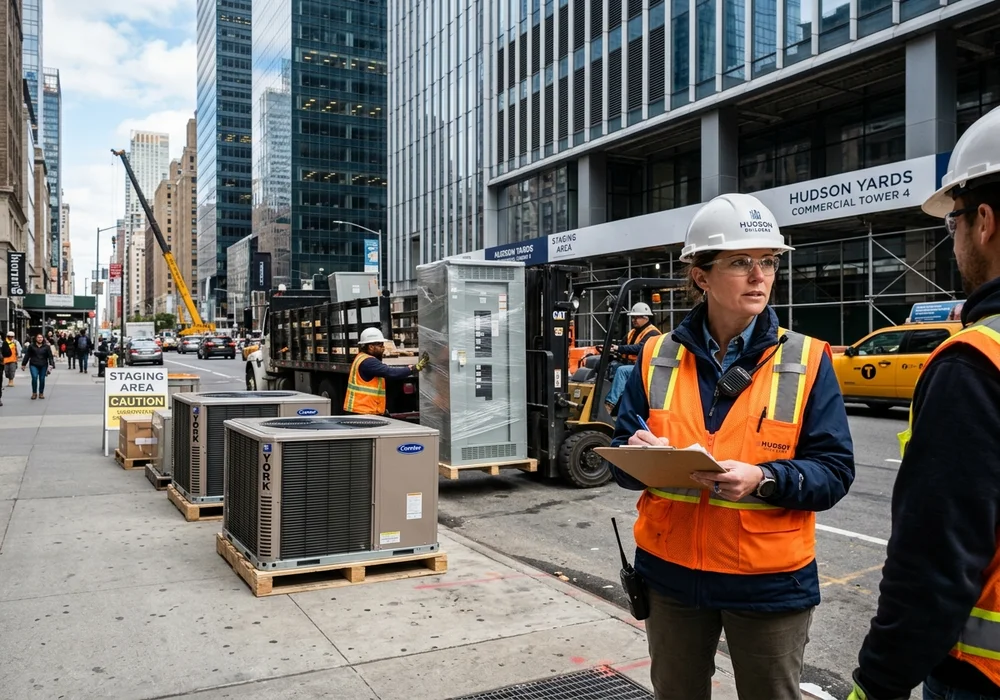
Construction mobilization and sidewalk sheds represent massive overhead expenses. Look for logical bundling synergies:
- FISP Scaffolding + Window/Envelope Retrofits: When sidewalk sheds and pipe scaffolding are erected for mandatory FISP Cycle 10 facade repairs, simultaneously execute window perimeter caulking, lintel thermal break installations, and masonry wall insulation.
- LL152 Gas Piping + Boiler Electrification: If an LL152 inspection reveals aging gas piping that requires thousands in repairs, evaluate abandoning gas branches entirely in favor of an accelerated domestic hot water (HPWH) heat pump conversion.
- LL88 Submetering + Smart BMS Controls: Install tenant submetering and digital smart thermostats simultaneously during electrical riser upgrades.
The 6-Phase Master Compliance Roadmap
Phase 1
Baseline Diagnostics (Months 1–6): Finalize annual LL84 benchmarking, conduct LL87 ASHRAE Level II audit & retro-commissioning, and review past FISP/LL152 filings.
Phase 2
Opportunity & Carbon Modeling (Months 6–9): Run 3D energy modeling to simulate LL97 carbon emission trajectories across 2024–2030 penalty thresholds.
Phase 3
Capital Scoping & Incentive Capture (Months 9–12): Package capital retrofits (envelope, MEP, lighting) and apply for NYSERDA Clean Heat and Con Edison rebates.
Phase 4
Engineering, LPC & DOB Permitting (Months 12–18): Develop detailed MEP construction drawings, file DOB Nowak permits, and secure LPC approvals if landmarked.
Phase 5
Staged Construction Execution (Months 18–30): Sequence envelope weatherization first, followed by electrical switchgear expansion and phased heat pump installation.
Phase 6
Commissioning & Closeout (Months 30–36): Perform functional performance testing, update Energy Star Portfolio Manager, and file final compliance certs.
4 Costly Sequencing Mistakes to Avoid
- Waiting Until the Filing Deadline: Scrambling 60 days before an LL87 or LL97 deadline limits engineering choices, spikes contractor pricing, and risks immediate DOB violation penalties.
- Replacing Boilers in Isolation: Replacing an oil boiler with another gas boiler in 2026 locks the building into fossil-fuel carbon fines through the 2030 Local Law 97 milestone.
- Ignoring Equipment Lead Times: Custom commercial VRF condensers, electrical switchgear panels, and heavy-duty dunnage steel often have 20- to 36-week manufacturing lead times.
- Uncoordinated Tenant Disruptions: Entering residential apartments three separate times for gas testing, radiator valve repairs, and submetering creates severe tenant friction.
Owner's Compliance Sequencing Checklist
Master Regulatory Matrix: Document all applicable Local Laws (LL84, LL87, LL95, LL97, LL152, FISP, LL88) with exact statutory due dates.
Historical Data Review: Compile past 3 years of Portfolio Manager EUI data and inspection violation logs.
Information First: Execute energy audits and structural reviews before finalizing capital scopes.
Dependency Mapping: Sequence building envelope tightening before mechanical heating/cooling sizing.
Bundling Opportunities: Combine facade scaffolding mobilizations with window and lintel weatherization.
Utility & Incentive Alignment: File NYSERDA Clean Heat and Con Edison applications before procuring equipment.
Long-Lead Procurement: Order electrical gear and heat pump chillers 6–9 months ahead of construction.
Conclusion
Managing NYC Local Law compliance is not an exercise in checking off isolated boxes—it is a comprehensive capital asset optimization program.
By building a multi-year master roadmap, executing diagnostic assessments first, respecting engineering dependencies, and bundling construction mobilizations, building owners can slash capital expenditures, eliminate DOB penalty risks, and transform mandatory compliance into long-term building equity.
Partner with a dedicated energy and engineering project management team to develop a seamless, multi-year Local Law sequencing roadmap tailored to your building's unique infrastructure.
Frequently Asked Questions
Not necessarily. Related inspections, engineering studies, and capital retrofits can be coordinated into combined project packages, eliminating duplicate site mobilizations while fully satisfying each legal mandate.
Information-gathering assessments (LL84 benchmarking and LL87 ASHRAE audits) should precede capital decisions. Physical projects with immediate statutory deadlines or major life-safety risks should receive top implementation priority.
Yes. An ASHRAE Level II energy audit identifies baseline HVAC, lighting, and building envelope efficiencies, providing the empirical engineering data needed to model Local Law 97 carbon emissions reduction strategies.
Building owners should establish a rolling 3- to 5-year compliance roadmap. This provides adequate lead time for engineering design, utility grid interconnection approvals, DOB permitting, equipment procurement, and capital reserve budgeting.
Yes. Bundling scaffolding (FISP + envelope window retrofits), staging combined MEP engineering assessments, and avoiding oversized heating equipment through prior envelope insulation can save 15% to 30% in overall capital expenditures.